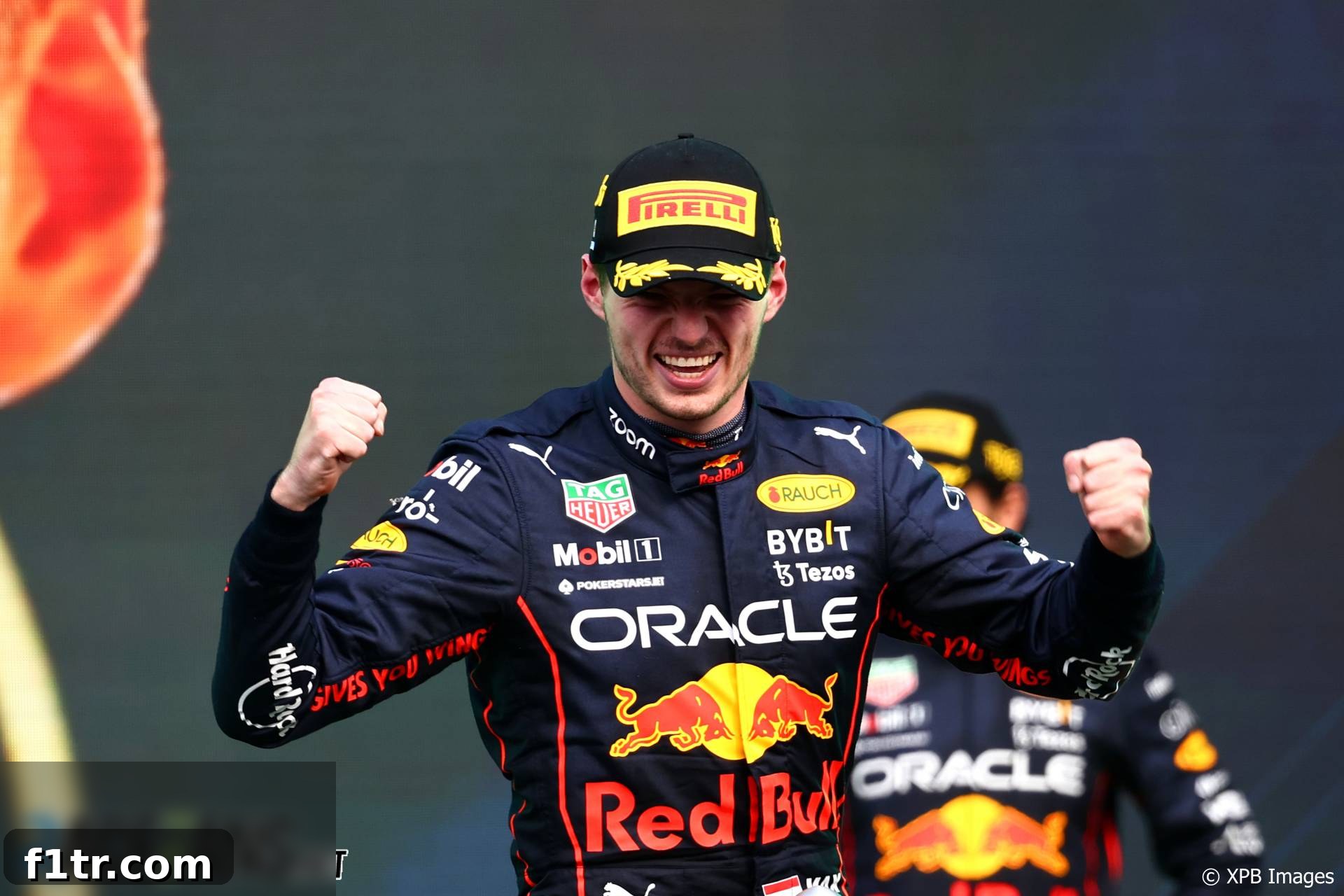
The Autódromo Hermanos Rodríguez in Mexico City bore witness to a historic triumph as Max Verstappen, starting from a commanding pole position, secured a remarkable victory at the Mexican Grand Prix. This dominant performance not only added another win to his illustrious season but also shattered the existing record for the most victories in a single Formula 1 season, elevating the Dutch driver to an unprecedented 14 wins. His strategic masterclass involved a prolonged second stint on medium tyres, ultimately proving too much for his closest rival, Lewis Hamilton, who finished a distant second.
Mercedes-AMG Petronas F1 Team had gambled on a more aggressive hard tyre strategy in their attempt to reel in the reigning world champion. However, Verstappen displayed exceptional tyre management, expertly preserving his medium compound tyres after his solitary pit stop, maintaining blistering pace until the chequered flag. He crossed the finish line a commanding 15 seconds ahead of Hamilton, underscoring the Red Bull Racing team’s strategic brilliance and the driver’s unparalleled skill. Meanwhile, local hero Sergio Perez delighted his passionate home crowd by securing a well-deserved third-place finish, marking another memorable podium celebration in front of his adoring fans.
The Dramatic Start: Battle for Supremacy
The atmosphere at the Autódromo Hermanos Rodríguez was electric as the cars lined up on the grid. Max Verstappen, in his Red Bull, occupied pole position, fitted with the softer compound tyres. Directly behind him, the two Mercedes of George Russell and Lewis Hamilton started on the more durable medium tyres, hinting at differing strategic approaches from the outset. As the five red lights extinguished, Verstappen executed a decent start, successfully fending off initial challenges and maintaining his lead into the crucial Turn One.
The opening sequence of corners proved to be a hotbed of action. George Russell, capitalising on the slipstream from Verstappen’s Red Bull, pulled out to the left on the approach to Turn One, attempting to challenge for the lead. However, Verstappen held his ground with characteristic tenacity, denying Russell the advantage. This brief but intense battle inadvertently created an opportunity for Lewis Hamilton, who shrewdly took advantage of the situation to slip past his teammate into Turn Three, snatching second place. The drama didn’t end there, as Sergio Perez, eager to make progress in front of his home crowd, executed a decisive move on Russell into Turn Four, relegating the young Briton to fourth position.
Tyre Strategy Unfolds: Soft vs. Medium vs. Hard
In the initial laps, Max Verstappen established a comfortable lead, showcasing the superior grip of his soft tyres. Lewis Hamilton, carefully managing his medium tyres, maintained a consistent gap of approximately 1.5 seconds to the leader, biding his time and observing Verstappen’s pace. The early phases of the race were a delicate balance of pushing hard and preserving tyres, with teams constantly monitoring degradation rates.
As the race progressed past the 20-lap mark, Verstappen began to report noticeable degradation from his soft tyres over team radio, a clear signal that a pit stop would soon be necessary. However, it was his teammate, Sergio Perez, who was the first of the leading contenders to make a move. At the end of lap 23, Perez dove into the pits for his first stop, switching to medium compound tyres. Unfortunately for the Mexican driver, a slight delay during the left-rear tyre change cost him valuable seconds, a moment that could prove critical in the tight battle for podium places. He rejoined the track in sixth position.
With Verstappen’s tyre degradation becoming more apparent, Hamilton began to close the gap to the leader. Recognising the opportune moment, Verstappen pitted at the end of lap 25, opting for a fresh set of medium tyres. He rejoined the race track approximately 20 seconds behind the two Mercedes cars, who were yet to make their first stops. This handed track position to Mercedes, albeit temporarily.
Mercedes, meanwhile, was executing a different strategy. Lewis Hamilton extended his first stint on the medium tyres before eventually pitting at the end of lap 29. Crucially, Mercedes fitted his car with hard compound tyres, indicating their intention to go the distance with a single stop and try to exploit the tyre durability in the latter stages of the race. Hamilton rejoined in third place, 5.7 seconds behind Verstappen, setting the stage for an intriguing strategic showdown.
Russell’s Extended Stint and Mid-Race Incidents
With Hamilton having pitted, George Russell inherited the lead of the Mexican Grand Prix. Russell, keen to maximise his track position and potentially benefit from his medium tyres, enquired with his team about extending his first stint even further. Mercedes granted his request, allowing him to stay out until the end of lap 34. This extended run ultimately saw him also switch to hard compound tyres, a decision that handed the race lead back to Max Verstappen, who was by now well into his second stint on mediums and demonstrating formidable pace.
As the race entered its middle phase, the strategic battle intensified. Sergio Perez, now on faster medium tyres compared to Hamilton’s hard compounds, began to significantly close the gap to the Mercedes driver. He managed to reduce the deficit to within two seconds, putting immense pressure on Hamilton for second place. However, despite his best efforts and the clear tyre advantage, Perez could not quite get close enough to launch a direct overtaking attempt on the seven-time world champion.
The race was not without its moments of significant drama further down the field. A collision unfolded at Turn Six involving Daniel Ricciardo of McLaren and Yuki Tsunoda of AlphaTauri, as the two drivers fiercely contested 11th place. The incident occurred when Ricciardo’s front left wheel made contact with Tsunoda’s rear right, causing the AlphaTauri to briefly lift into the air in a dramatic fashion. Tsunoda’s car sustained considerable damage in the impact, forcing him to retire from the race and head into the pits. Following a swift investigation by the stewards, Daniel Ricciardo was deemed primarily responsible for the collision and subsequently handed a ten-second time penalty, adding another layer of complexity to his race.
Verstappen’s Unassailable Pace and Record-Breaking Win
Out in front, Max Verstappen was executing a masterclass in tyre management. Despite being on the theoretically less durable medium tyres for an exceptionally long stint, he maintained a remarkably consistent and competitive lap time. Mercedes, who had hoped their hard tyre strategy would allow Hamilton to catch and challenge Verstappen in the closing stages, saw their hopes gradually diminish as the Red Bull driver showed no signs of a drop-off in pace. His ability to maintain such high performance on a worn set of medium tyres was a testament to his unique driving style and Red Bull’s setup.
In the closing laps of the Grand Prix, another incident momentarily spiced up the proceedings. Fernando Alonso, running strongly, was forced to pull off at Turn One, reporting a power unit failure. This unfortunate retirement for the two-time world champion triggered a brief Virtual Safety Car (VSC) period. However, the VSC intervention was short-lived, lasting less than a lap, and none of the leading contenders opted to pit under its cover. Consequently, the positions at the front remained unchanged when the race swiftly resumed to green flag conditions.
With the VSC period behind him, Max Verstappen smoothly ticked off the remaining laps, extending his lead and heading towards an inevitable victory. He crossed the chequered flag triumphant, securing his historic 14th win of the season, a new benchmark in Formula 1 history. Lewis Hamilton finished a commendable second, albeit 15 seconds behind the dominant Dutchman, while Sergio Perez held on to complete the podium in third place, much to the delight of the home crowd.
Post-Race Analysis and Championship Implications
George Russell, after a somewhat challenging race that saw him lose positions at the start, managed to secure fourth place. In a strategic move on the penultimate lap, Russell pitted once more, this time specifically chasing the fastest lap of the race. He successfully achieved his objective, demonstrating the raw pace of the Mercedes W13 and adding a valuable bonus point to his tally. He finished ahead of the two Ferraris, with Carlos Sainz Jnr and Charles Leclerc taking fifth and sixth positions respectively, a result that further solidified Mercedes’ lead over Ferrari in the constructors’ championship.
Daniel Ricciardo, despite the ten-second time penalty for his collision with Yuki Tsunoda, managed to salvage a respectable seventh place. He had pushed hard in the latter stages of the race, creating a gap of more than ten seconds over Esteban Ocon behind him. This crucial effort meant that even after the penalty was applied, he retained his position, showcasing his resilience. Rounding out the top ten were Lando Norris in the other McLaren, securing valuable points, and Valtteri Bottas in the Alfa Romeo, who continued his consistent points-scoring form. The 2022 Mexican Grand Prix will be remembered not just for the thrilling on-track battles but for Max Verstappen’s indelible mark on the Formula 1 record books, reaffirming his status as one of the sport’s all-time greats.
2022 Mexican Grand Prix Reaction
- Check back shortly for more in-depth race analysis and driver reactions from the Mexican Grand Prix, covering every angle of this historic event and its impact on the remainder of the season.