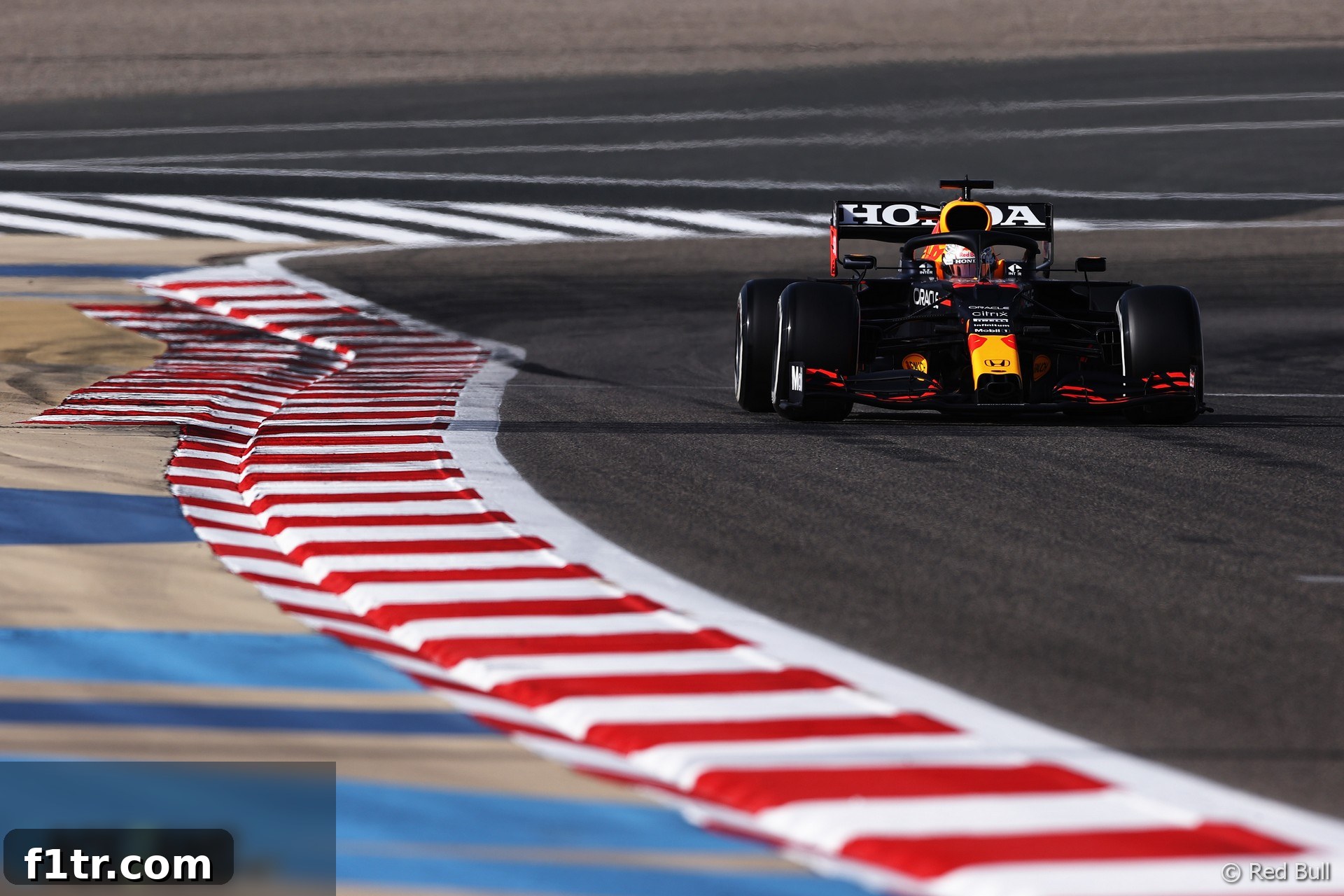
Red Bull Racing’s formidable driver, Max Verstappen, continued his commanding start to the Formula 1 season by securing a dominant hat-trick of fastest times across all three practice sessions at the Bahrain Grand Prix. His performance in the final Free Practice 3 (FP3) session was nothing short of exceptional, sending a clear message to his rivals and firmly establishing Red Bull as the team to beat heading into the crucial qualifying round.
The conditions at the Bahrain International Circuit in Sakhir were typically challenging, with track temperatures soaring to nearly 50 degrees Celsius under the intense afternoon sun. These scorching temperatures and the prevailing crosswinds often make the circuit a stern test for both drivers and engineers, influencing tyre degradation and car balance. Understandably, many teams initially hesitated to send their cars out early in the session, opting to wait for the track to rubber in and conditions to potentially stabilize slightly. Mercedes-AMG F1’s Valtteri Bottas was one of the first brave souls to venture out for a flying lap, aiming to gauge the circuit’s grip levels and the car’s handling in the challenging environment.
However, Bottas’s early efforts were marred by immediate difficulties. He notably struggled with the unpredictable crosswinds at Turn One, forcing him wide and prompting him to skate through the run-off area. His woes continued at Turn Four, where he regrettably repeated errors from Friday’s sessions, repeatedly violating the stringent track limits at the exit of the corner. These infractions resulted in his initial lap time being swiftly deleted, underscoring the unforgiving nature of the Sakhir track and the watchful eyes of race control.
With Bottas’s time nullified, Ferrari’s new recruit, Carlos Sainz Jnr, momentarily held the top spot early in the session. Demonstrating strong pace on the hard compound tyres, Sainz showcased Ferrari’s improved form and his rapid adaptation to his new team. Reigning world champion Lewis Hamilton then emerged from the Mercedes garage, opting for the softer compound tyres. As expected, his pace immediately surpassed Sainz’s benchmark, signaling Mercedes’ intent. However, Red Bull quickly responded by sending both their drivers out on the more durable hard tyres. To the surprise of many, Max Verstappen, even on the less grippy compound, managed to better Hamilton’s time by a few tenths of a second, highlighting the inherent speed of the new Red Bull RB16B and Verstappen’s exceptional talent.
Verstappen’s new teammate, Sergio Perez, also displayed a competitive rhythm on the hard tyre, indicating a promising start to his Red Bull tenure. Despite his solid performance, Perez was still outshone not only by Verstappen on the other side of the garage but also by AlphaTauri’s Pierre Gasly. Gasly utilized the softer tyres to brilliant effect, temporarily rocketing to the top of the timesheets and showcasing the significant progress made by Honda and its junior team during the off-season. This early inter-team comparison set an intriguing precedent for the qualifying battle to come.
As the session progressed, teams continued to fine-tune their setups and evaluate different tyre strategies. Carlos Sainz once again caught the eye with a remarkable lap time when he switched to the medium compound tyres, reaffirming Ferrari’s potential for a strong midfield challenge. Meanwhile, Alpine’s drivers, Esteban Ocon and Fernando Alonso, focused extensively on shorter runs using the same medium compound. This strategy often indicates a team’s focus on understanding qualifying pace and optimizing for the initial stages of a race rather than long-run degradation simulation.
The competitive stakes were significantly raised when Mercedes-AMG F1 decided to commit both their cars to a full qualifying simulation. Armed with fresh soft tyres, Hamilton and Bottas pushed their W12s to the absolute limit. Their coordinated effort yielded impressive results, as they became the first drivers of the day to breach the 1 minute 31 second barrier, briefly occupying the top two positions. This demonstration of pace from Mercedes was a strong statement, momentarily suggesting they had the edge for pole position. The pit lane buzzed with anticipation, wondering if anyone could match the Silver Arrows’ pace.
With just seven minutes remaining on the clock, the answer arrived in emphatic fashion. Max Verstappen, having patiently worked through his programme, finally switched to the soft compound tyres. What followed was a truly exceptional display of driving. Verstappen unleashed a superb lap, demonstrating extraordinary car control and aggression. He carved a massive 0.739 seconds off Hamilton’s previously leading time, setting an ominous 1 minute 30.577 seconds. This blistering lap was not only significantly faster than his main rival but also a staggering 1.331 seconds quicker than his new teammate Sergio Perez, who finished fifth. Verstappen’s performance was a clear signal of intent, highlighting Red Bull’s raw speed and his individual mastery of the Sakhir circuit.
Among the Mercedes drivers, Pierre Gasly once again impressed on the soft tyre, clocking a 1 minute 31.583 seconds. This stellar effort placed him third fastest, slotting in perfectly between Hamilton and Bottas. Gasly’s consistent strong showing throughout practice sessions further underscored the significant off-season progress made by Honda and AlphaTauri, positioning them as serious contenders for “best of the rest” and potentially challenging the front-runners on certain weekends. Carlos Sainz held onto sixth place, his lap set on the medium compound tyres proving remarkably competitive against those on softs, showcasing both his skill and Ferrari’s improved package.
Rounding out the top ten were a mix of familiar names and promising talents, all having utilized the soft compound tyres for their fastest runs. Alfa Romeo’s veteran Kimi Raikkonen secured seventh, followed by Alpine’s Esteban Ocon in eighth. Aston Martin’s Lance Stroll finished ninth, and McLaren’s Australian ace, Daniel Ricciardo, completed the top ten. Ferrari’s other driver, Charles Leclerc, finished just outside the top ten in eleventh after an unsettling moment at Turn Two where he ran wide but thankfully avoided any contact or damage to his car.
For some teams, the session proved more challenging. Aston Martin experienced a difficult FP3, with four-time world champion Sebastian Vettel noticeably off the pace. Adding to their woes, pieces were observed flying off his car during a run, suggesting potential underlying issues that would require immediate attention before qualifying. At the very back of the pack, Williams’ Nicholas Latifi struggled to extract performance, propping up the order despite setting most of his laps on fresh rubber. He finished behind both Haas drivers, with Nikita Mazepin having an eventful session, spinning off in the quick corners through the middle of the lap earlier on, highlighting the steep learning curve for the rookie drivers.
As the sun began to dip below the horizon, casting long shadows across the desert circuit, the final free practice session concluded with Max Verstappen firmly in control. His ability to deliver such a commanding performance, especially in the crucial FP3 session before qualifying, undoubtedly positions Red Bull Racing as the team to beat for the first pole position of the 2021 Formula 1 season. The competitive landscape promises an enthralling qualifying battle, with Mercedes keen to respond and the midfield teams eager to capitalize on any opportunity.
2021 Bahrain Grand Prix Third Practice Result
| Pos. | No. | Driver | Car | Best lap | Gap | Laps |
|---|---|---|---|---|---|---|
| 1 | 33 | Max Verstappen | Red Bull-Honda | 1’30.577 | 11 | |
| 2 | 44 | Lewis Hamilton | Mercedes | 1’31.316 | 0.739 | 14 |
| 3 | 10 | Pierre Gasly | AlphaTauri-Honda | 1’31.583 | 1.006 | 13 |
| 4 | 77 | Valtteri Bottas | Mercedes | 1’31.855 | 1.278 | 16 |
| 5 | 11 | Sergio Perez | Red Bull-Honda | 1’31.908 | 1.331 | 11 |
| 6 | 55 | Carlos Sainz Jnr | Ferrari | 1’32.108 | 1.531 | 16 |
| 7 | 7 | Kimi Raikkonen | Alfa Romeo-Ferrari | 1’32.224 | 1.647 | 15 |
| 8 | 31 | Esteban Ocon | Alpine-Renault | 1’32.423 | 1.846 | 11 |
| 9 | 18 | Lance Stroll | Aston Martin-Mercedes | 1’32.431 | 1.854 | 13 |
| 10 | 3 | Daniel Ricciardo | McLaren-Mercedes | 1’32.477 | 1.900 | 12 |
| 11 | 16 | Charles Leclerc | Ferrari | 1’32.482 | 1.905 | 17 |
| 12 | 99 | Antonio Giovinazzi | Alfa Romeo-Ferrari | 1’32.500 | 1.923 | 11 |
| 13 | 22 | Yuki Tsunoda | AlphaTauri-Honda | 1’32.709 | 2.132 | 15 |
| 14 | 5 | Sebastian Vettel | Aston Martin-Mercedes | 1’32.755 | 2.178 | 15 |
| 15 | 14 | Fernando Alonso | Alpine-Renault | 1’32.820 | 2.243 | 15 |
| 16 | 4 | Lando Norris | McLaren-Mercedes | 1’32.860 | 2.283 | 10 |
| 17 | 63 | George Russell | Williams-Mercedes | 1’33.323 | 2.746 | 14 |
| 18 | 47 | Mick Schumacher | Haas-Ferrari | 1’33.422 | 2.845 | 14 |
| 19 | 9 | Nikita Mazepin | Haas-Ferrari | 1’33.622 | 3.045 | 14 |
| 20 | 6 | Nicholas Latifi | Williams-Mercedes | 1’33.959 | 3.382 | 16 |
Third practice visual gaps
Max Verstappen – 1’30.577
+0.739 Lewis Hamilton – 1’31.316
+1.006 Pierre Gasly – 1’31.583
+1.278 Valtteri Bottas – 1’31.855
+1.331 Sergio Perez – 1’31.908
+1.531 Carlos Sainz Jnr – 1’32.108
+1.647 Kimi Raikkonen – 1’32.224
+1.846 Esteban Ocon – 1’32.423
+1.854 Lance Stroll – 1’32.431
+1.900 Daniel Ricciardo – 1’32.477
+1.905 Charles Leclerc – 1’32.482
+1.923 Antonio Giovinazzi – 1’32.500
+2.132 Yuki Tsunoda – 1’32.709
+2.178 Sebastian Vettel – 1’32.755
+2.243 Fernando Alonso – 1’32.820
+2.283 Lando Norris – 1’32.860
+2.746 George Russell – 1’33.323
+2.845 Mick Schumacher – 1’33.422
+3.045 Nikita Mazepin – 1’33.622
+3.382 Nicholas Latifi – 1’33.959
Drivers more than ten seconds off the pace omitted.
| Pos | Driver | Car | FP1 | FP2 | FP3 | Fri/Sat diff | Total laps |
|---|---|---|---|---|---|---|---|
| 1 | Max Verstappen | Red Bull-Honda | 1’31.394 | 1’30.847 | 1’30.577 | -0.27 | 46 |
| 2 | Lando Norris | McLaren-Mercedes | 1’31.897 | 1’30.942 | 1’32.860 | +1.918 | 55 |
| 3 | Lewis Hamilton | Mercedes | 1’31.921 | 1’31.082 | 1’31.316 | +0.234 | 53 |
| 4 | Carlos Sainz Jnr | Ferrari | 1’32.366 | 1’31.127 | 1’32.108 | +0.981 | 57 |
| 5 | Valtteri Bottas | Mercedes | 1’31.692 | 1’31.218 | 1’31.855 | +0.637 | 56 |
| 6 | Daniel Ricciardo | McLaren-Mercedes | 1’32.434 | 1’31.230 | 1’32.477 | +1.247 | 54 |
| 7 | Yuki Tsunoda | AlphaTauri-Honda | 1’33.329 | 1’31.294 | 1’32.709 | +1.415 | 59 |
| 8 | Lance Stroll | Aston Martin-Mercedes | 1’33.233 | 1’31.393 | 1’32.431 | +1.038 | 57 |
| 9 | Pierre Gasly | AlphaTauri-Honda | 1’32.195 | 1’31.483 | 1’31.583 | +0.1 | 63 |
| 10 | Sergio Perez | Red Bull-Honda | 1’32.071 | 1’31.503 | 1’31.908 | +0.405 | 49 |
| 11 | Esteban Ocon | Alpine-Renault | 1’33.528 | 1’31.601 | 1’32.423 | +0.822 | 55 |
| 12 | Charles Leclerc | Ferrari | 1’31.993 | 1’31.612 | 1’32.482 | +0.87 | 57 |
| 13 | Antonio Giovinazzi | Alfa Romeo-Ferrari | 1’32.786 | 1’31.740 | 1’32.500 | +0.76 | 54 |
| 14 | Sebastian Vettel | Aston Martin-Mercedes | 1’33.157 | 1’31.769 | 1’32.755 | +0.986 | 62 |
| 15 | Fernando Alonso | Alpine-Renault | 1’33.872 | 1’31.770 | 1’32.820 | +1.05 | 57 |
| 16 | Kimi Raikkonen | Alfa Romeo-Ferrari | 1’33.134 | 1’31.862 | 1’32.224 | +0.362 | 48 |
| 17 | George Russell | Williams-Mercedes | 1’34.127 | 1’32.331 | 1’33.323 | +0.992 | 64 |
| 18 | Mick Schumacher | Haas-Ferrari | 1’34.501 | 1’33.297 | 1’33.422 | +0.125 | 54 |
| 19 | Nicholas Latifi | Williams-Mercedes | 1’34.340 | 1’33.400 | 1’33.959 | +0.559 | 66 |
| 20 | Nikita Mazepin | Haas-Ferrari | 1’34.975 | 1’33.449 | 1’33.622 | +0.173 | 49 |
2021 Bahrain Grand Prix
- Why one driver says there’s no easy solution to F1’s ‘messy’ track limits problem
- Verstappen: Lost win in Bahrain “is not going to matter” if we have fastest car
- The classic rivalry for ‘best of the rest’ and six more Imola talking points
- Ocon: We need to extract the maximum from the car to score points
- Vettel feeling “not at home in the car yet” after tough weekend
Browse all 2021 Bahrain Grand Prix articles