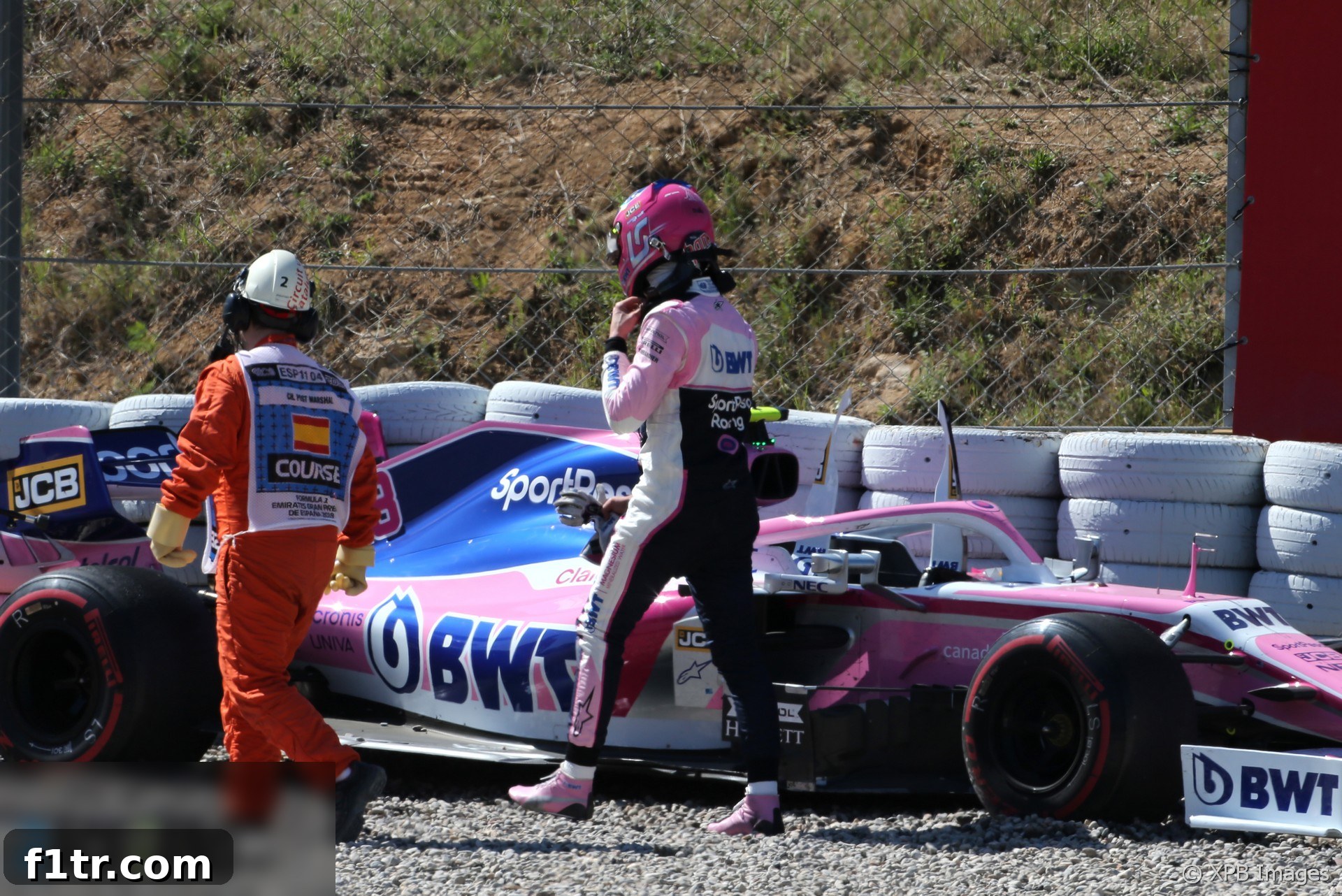
The exhilarating world of Formula 1 often delivers moments of intense wheel-to-wheel action, sometimes culminating in unavoidable collisions. Such was the case during the 2019 Formula 1 season, specifically at the Spanish Grand Prix, where a contentious incident unfolded between then Racing Point driver Lance Stroll and McLaren rookie Lando Norris. The clash, which occurred early in the race at Turn Two, ultimately ended both their races prematurely, sparking a debate over responsibility and racing etiquette. Stroll vehemently maintained there was no possible way for him to avert the collision, a sentiment not shared by his rival, Norris, who pointed to a lack of space left by the Canadian driver.
The Controversial Collision at Turn Two
The incident that brought an abrupt end to two promising drives unfolded on the Circuit de Barcelona-Catalunya. As the race was getting into its rhythm, Lando Norris, displaying the aggressive yet calculated driving style that would quickly become his trademark, attempted to overtake Lance Stroll. The McLaren driver made a move down the inside of the Racing Point car as they approached the sweeping left-hander of Turn Two. What followed was a brief but decisive moment of contact that sent both cars spiraling out of contention.
Lance Stroll’s Perspective: A Lack of Space
From Lance Stroll’s vantage point, the collision was an unfortunate consequence of the inherent limitations of racing lines and track space. Explaining his side of the story immediately after the incident, Stroll conveyed a clear sense of being boxed in and having no viable alternative. “I braked on the inside while he was on the outside,” Stroll recounted, detailing his approach to the corner. “And then I had to turn in to make the left-hand corner.”
Stroll emphasized the critical lack of available tarmac for both competitors to navigate the turn cleanly. “Unfortunately, there is not enough space for two cars, and there was not much I could do,” he stated, highlighting the tight confines of the racing line he felt compelled to take. The Racing Point driver described the impact from his perspective, feeling a sudden jolt that sealed his fate. “I felt contact on my rear and I was sent into the gravel,” he concluded, portraying the incident as an unavoidable outcome given the circumstances.
His defense centered on the fundamental geometry of the corner and the racing line. When two cars attempt to occupy the same piece of track, especially through a tight apex, contact becomes almost inevitable. Stroll suggested that his primary focus was on making the corner correctly from his position, and Norris’s presence alongside him simply overstretched the capacity of the track.
Lando Norris’s Account: An Unyielding Overtake
Lando Norris, however, offered a distinctly different narrative, directly accusing his rival of failing to afford him the necessary room to complete his maneuver safely. The young British driver’s frustration was palpable as he articulated his side of the story, emphasizing his presence and Stroll’s presumed awareness of it. “I was on the outside in Turn One; he knew I was there, he defended into Turn One,” Norris began, setting the scene for the subsequent turn.
Norris’s argument hinged on the continuity of his position and Stroll’s turning radius. “After that – I don’t know if he saw me after going into Turn Two, but I was still on the inside of Turn Two, and he just turned in, didn’t leave me enough space basically,” he explained. The McLaren driver felt that Stroll encroached on his line, making a fair contest impossible. “He kind of pushed the front of my car, and he put himself out of the race and me out of the race as well.”
For Norris, a rookie in his fifth Grand Prix start, the incident was particularly galling. “I’m a bit annoyed that I didn’t get to finish my fifth Grand Prix,” he admitted, reflecting the disappointment of a young driver eager to gain experience and prove his mettle. Despite the frustration, Norris maintained a pragmatic outlook regarding the championship implications. “But in the end of the day, we weren’t in the points, so it didn’t cost us as much as what it could have done.” This statement underscored McLaren’s position in the midfield at the time, battling for every point, yet also suggesting that while a DNF was frustrating, it didn’t represent a huge loss in terms of championship points for his specific position in that race.
The Stewards’ Verdict: A Racing Incident
Following the conclusion of the race, the incident was, as is customary in Formula 1, thoroughly investigated by the race stewards. Both drivers were summoned to present their respective accounts and evidence. After careful deliberation, weighing the telemetry, video footage, and driver testimonies, the stewards reached their official conclusion: the collision was deemed a racing incident.
The term “racing incident” in Formula 1 carries significant weight. It implies that neither driver was solely or predominantly to blame for the contact. Instead, it suggests a scenario where both drivers contributed in some way, or where the circumstances of close-quarters racing made the collision an unavoidable byproduct of aggressive competition. This ruling often reflects the stewards’ understanding that F1 is a contact sport, albeit with strict rules, and not every touch warrants a penalty.
For Stroll and Norris, this verdict meant no further action or penalties were imposed. While it didn’t change the outcome of their respective races, it provided official closure on the matter, signaling that from the perspective of the sport’s governing body, both drivers were simply pushing the limits in a competitive environment. The decision highlights the challenging nature of making snap judgments in high-speed, dynamic situations where fractions of a second and inches of track space can determine the difference between a clean overtake and a race-ending crash.
The Broader Context of the 2019 F1 Season
The 2019 Formula 1 season was a period of significant transition and fierce midfield battles. McLaren, with Lando Norris making his debut alongside Carlos Sainz, was on an upward trajectory, showing promising signs of recovery after several challenging years. Norris himself was quickly establishing a reputation as a fast, exciting, and articulate young talent. Every race, every lap, and every battle was crucial for him to gather experience and demonstrate his potential.
Racing Point, on the other hand, was navigating its first full season under new ownership, having emerged from the administration of Force India. Lance Stroll, in his first year with the team, was aiming to solidify his position and contribute to the team’s development. Both teams were locked in intense competition, fighting for every possible point in a crowded midfield. Incidents like the one between Stroll and Norris, while not involving championship contenders at the very front, were nonetheless critical in these midfield skirmishes, potentially costing valuable constructors’ points and momentum.
The Spanish Grand Prix incident served as a stark reminder of the fine margins in Formula 1 and the high stakes involved in every overtake attempt. While the immediate cost for McLaren and Racing Point was a double retirement, the lessons learned from such incidents are invaluable for drivers and teams alike, shaping their approach to future wheel-to-wheel battles. It highlighted the competitive spirit that defines the sport, where drivers constantly push boundaries, sometimes with unintended consequences.
Beyond the Incident: Learning and Progress
In the aftermath of any racing incident, particularly one where no blame is officially assigned, both drivers and teams take away valuable lessons. For Lando Norris, it was an early taste of the unforgiving nature of F1 racing, where aggressive maneuvers, even if justified from one’s perspective, can lead to costly outcomes. For Lance Stroll, it reinforced the need for precision and defensive driving in a highly competitive field. Both drivers continued to grow and evolve throughout the 2019 season and beyond, eventually becoming more established figures in the F1 paddock.
The 2019 season continued to deliver thrilling moments and intense rivalries, with many drivers pushing the limits. The collision between Stroll and Norris, while a disappointing end to their Spanish Grand Prix, was ultimately categorized as a typical racing incident – a testament to the relentless pursuit of speed and position that defines Formula 1. It underscored the fact that even the most skilled drivers, operating at the pinnacle of motorsport, can find themselves in situations where the track simply runs out of space, leading to unavoidable contact.
Such events are a part of Formula 1’s rich tapestry, contributing to the drama and excitement that captivate millions of fans worldwide. They also serve as crucial learning experiences for every driver on the grid, shaping their understanding of risk, reward, and the delicate balance required for successful wheel-to-wheel combat.
More from the 2019 F1 Season:
- Crying in the Melbourne car park at 2019 grand prix was my career low – Ocon
- McLaren Racing reports reduced £71 million loss in 2019
- Kvyat: Hockenheim podium last year was “my biggest achievement” so far
- How the FIA’s new encrypted fuel flow meter targets Ferrari’s suspected ‘aliasing’ trick
- “He smashed my office door”: 23 must-see moments from ‘Drive to Survive’ season two
Browse all 2019 F1 season articles