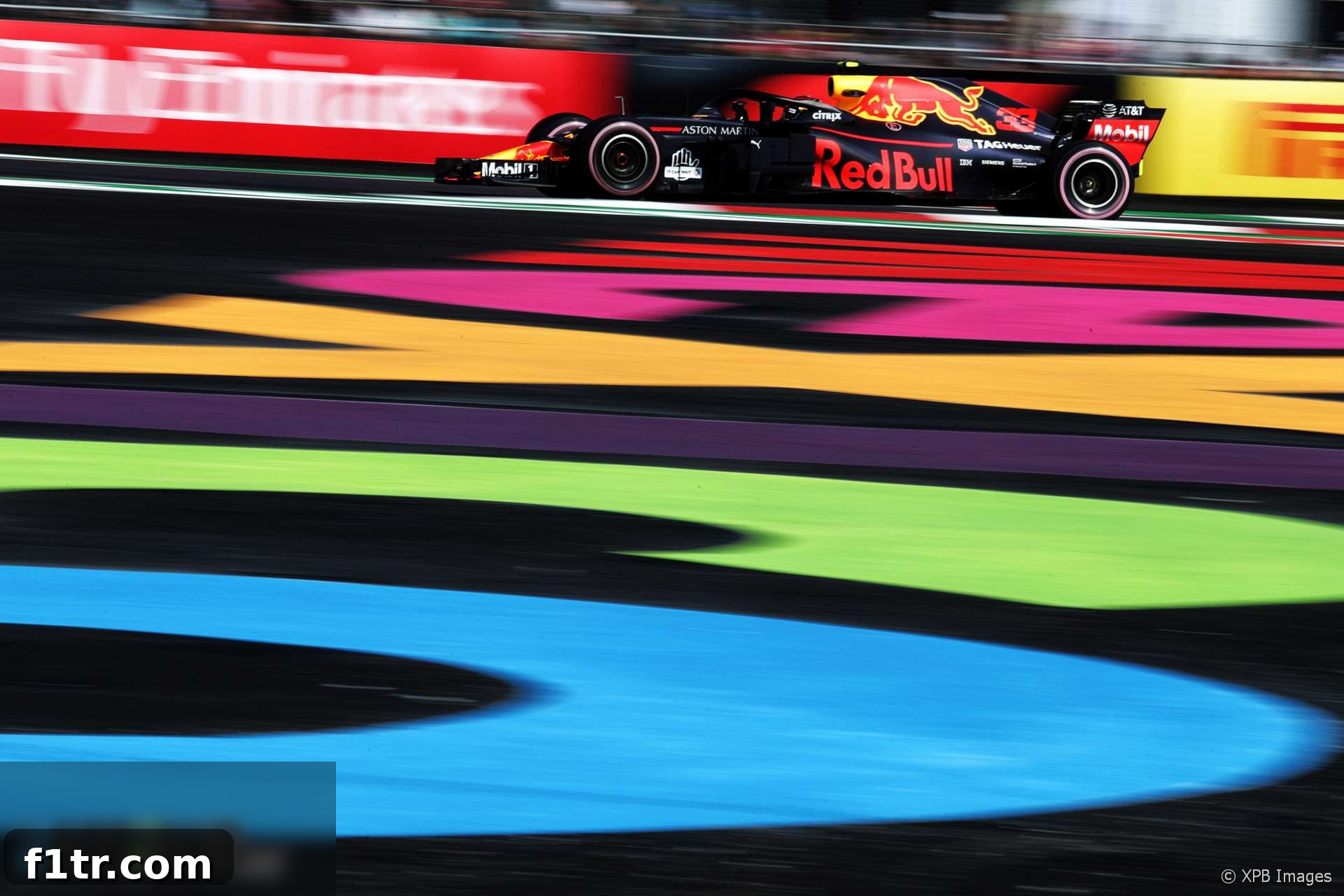
The high-altitude thrill of the Mexican Grand Prix weekend kicked off with an undeniable show of strength from Red Bull Racing, as Max Verstappen immediately asserted his dominance in the practice sessions. From the very first laps, the young Dutchman demonstrated an exceptional synergy with his RB14 chassis, setting a blistering pace that left much of the field trailing.
Even his seasoned teammate, Daniel Ricciardo, found himself battling to match Verstappen’s rhythm. For a significant portion of the running, Ricciardo lagged by around half a second, a testament to Verstappen’s formidable control. However, as the teams transitioned into qualifying simulations during the second practice session, Ricciardo managed to narrow the gap, closing Verstappen’s margin to a mere tenth of a second, hinting at Red Bull’s immense potential for the weekend.
Advert | Become a Supporter & go ad-free
Red Bull’s Altitude Advantage: Seizing the Final Opportunity
Red Bull had openly declared the Autódromo Hermanos Rodríguez as their “last, best chance” for a Formula 1 victory in the 2018 season. Their performance in practice sessions strongly suggested they were on track to deliver on that promise. The unique conditions presented by the Mexico City circuit, particularly its extreme altitude, play directly into Red Bull’s strengths, creating a level playing field where their aerodynamic efficiency often shines.
The Thin Air: A Game-Changer for Engine Power and Downforce
The primary factor dictating performance in Mexico is the thin air, a direct consequence of the circuit’s lofty elevation. At over 2,200 meters (7,200 feet) above sea level, the air density is significantly lower than at most other tracks. This has a profound impact on every aspect of a Formula 1 car’s operation.
Firstly, the lack of dense air severely saps power from the engines. Turbocharged power units, like those used in modern F1, are engineered to compensate, but the overall loss of horsepower is unavoidable. Naturally, engines with the greatest inherent power outputs, such as those from Mercedes and Ferrari, tend to have more to lose in absolute terms. While their power advantage is diminished, teams like Red Bull, whose chassis often excels in maximizing mechanical grip and aerodynamic efficiency at lower speed corners, find the performance gap to the engine powerhouses significantly reduced.
Secondly, the thin air drastically affects aerodynamic performance. Wings, which rely on air pressure to generate downforce, become less effective. To counteract this, teams typically configure their cars for maximum downforce, despite the Autódromo Hermanos Rodríguez featuring several long straights. This presents a unique challenge: balancing the need for grip in the circuit’s numerous slow corners with the desire for straight-line speed. Red Bull’s design philosophy, often characterized by a high-rake concept that generates significant downforce from the car’s underbody, inherently benefits in these conditions, allowing them to run higher downforce levels more effectively than some rivals, further playing to another Red Bull strength.
Autódromo Hermanos Rodríguez: A Track Tailored for the RB14
Beyond the atmospheric conditions, the very layout of the Autódromo Hermanos Rodríguez, as reworked by Hermann Tilke, appears to suit the RB14 chassis rather nicely. The modern iteration of the Mexico City track has often been criticized for its “toothless” reworking, with an abundance of slow-speed corners substituting for the sweeping, high-speed sections of the old course. These tight, technical sections demand excellent change of direction and strong traction, areas where the RB14 typically excels.
Ricciardo himself admitted this peculiar advantage: “Normally this kind of corners, they’re not very fun to drive, but they’re where our car works quite well.” This candid observation underscores Red Bull’s inherent chassis strengths in handling slow-speed transitions and optimizing grip through twisty sections, providing them with a crucial edge over rivals who might prefer more flowing, high-speed circuits.
The Pirelli Puzzle: Tyres Under Pressure and Strategic Implications
The weekend commenced with the track in a notoriously poor state, a common occurrence given its limited usage throughout the year. Mexico City’s infamous pollution tends to settle on the tarmac, reducing grip. However, as rubber was laid down, the track surface improved rapidly, forcing teams to constantly adapt their setups and driving styles. Amidst these evolving conditions, Pirelli’s aggressive tire choice for the event struggled to cope.
Ferrari and Mercedes, in particular, found it challenging to make their tires last for more than a lap during fast runs, experiencing severe “graining.” Graining occurs when the tire surface tears away in small chunks, leading to a significant loss of grip and increased degradation. This phenomenon explains why teams like Renault were, at times, surprisingly competitive in the initial practice sessions, benefiting from better tire management.
Pirelli’s sporting director, Mario Isola, provided insight into the teams’ collective challenge: “All the teams are working to try to reduce graining because graining is also generating some degradation on the tyres.” This inherent struggle with tire wear is poised to have a predictable and significant effect on race strategy.
Advert | Become a RaceFans supporter andgo ad-free
Qualifying Dilemma and Race Strategy
Isola further elaborated on the strategic outlook for qualifying: “In qualifying if the weather stays like this it is possible that the top teams will try to pass Q2 with the ultra-soft because it’s a more conservative approach and for the race it should be the right one.” This highlights a crucial strategic dilemma: whether to prioritize outright qualifying pace on the faster, but less durable, hyper-softs, or play it safe by clearing Q2 on the ultra-softs to start the race with a more resilient compound.
Assuming Mercedes and Ferrari regain their usual performance on Saturday, qualifying could again see the top midfield teams penalized for reaching Q3 by being forced to start on the fragile hyper-soft tires. Alternatively, given the hyper-softs’ limited operating window and high degradation, teams might collectively prioritize a strategic advantage over a front-row starting position, potentially leading to varied tire choices up and down the grid.
The unpredictable weather also adds another layer of complexity. As Isola pointed out, Friday’s forecast for rain turned into sunshine, leaving Saturday’s conditions uncertain. He noted, “maybe Saturday night there is rain, if it happens we have Sunday a green track as it was this morning.” A “green track” – one that has been washed clean by rain – would mean even more severe graining and reduced initial grip, further complicating tire management.
However, not everyone viewed this possibility with concern. Ricciardo, ever the optimist, commented, “It’s nice actually. Normally it’s easy one-stop, the races we’ve been doing, maybe actually we have a two-stop this weekend.” A two-stop strategy would introduce more variables, more pit stop action, and potentially more opportunities for teams to gain or lose positions through clever tactical calls.
Battling the Heat: Cooling Conundrums for Top Teams
Treating the tires well is made all the more difficult by the consistently high track temperatures in Mexico City. This, again, is a direct function of the thin air, which causes heat to dissipate much more slowly. With less air flowing over and around components, heat builds up rapidly and lingers longer, affecting everything from tires to engine internals.
This same phenomenon is at work on the cars’ mechanical and power unit components. Mercedes, in particular, admitted on Friday that they were grappling with significant problems cooling their power unit. Lewis Hamilton, the championship leader, was notably heard complaining over team radio about engine-related issues during practice, underscoring the severity of the challenge. Overheating can lead to power loss, reduced reliability, and forced adjustments to engine modes, all of which compromise performance.
It might have come as an added relief to Mercedes that their controversial special ventilated rear wheel hub design was officially cleared by the stewards before the race weekend even began. Despite the clearance, and the potential benefits it offers in managing tire and brake temperatures, catching the flying Verstappen and the exceptionally well-suited Red Bull team may prove to be an insurmountable task for the Silver Arrows in Mexico City.
Quotes: Dieter Rencken
Advert | Become a RaceFans supporter andgo ad-free
Longest stint comparison – second practice
This chart shows all the drivers’ lap times (in seconds) during their longest unbroken stint. Very slow laps omitted. Scroll to zoom, drag to pan, right-click to reset:
Complete practice times
| Pos | Driver | Car | FP1 | FP2 | Total laps |
|---|---|---|---|---|---|
| 1 | Max Verstappen | Red Bull-TAG Heuer | 1’16.656 | 1’16.720 | 40 |
| 2 | Daniel Ricciardo | Red Bull-TAG Heuer | 1’17.139 | 1’16.873 | 51 |
| 3 | Carlos Sainz Jnr | Renault | 1’17.926 | 1’17.953 | 55 |
| 4 | Sebastian Vettel | Ferrari | 1’18.746 | 1’17.954 | 59 |
| 5 | Nico Hulkenberg | Renault | 1’18.028 | 1’18.046 | 57 |
| 6 | Brendon Hartley | Toro Rosso-Honda | 1’19.024 | 1’18.061 | 64 |
| 7 | Lewis Hamilton | Mercedes | 1’18.075 | 1’18.100 | 63 |
| 8 | Kimi Raikkonen | Ferrari | 1’18.936 | 1’18.133 | 64 |
| 9 | Valtteri Bottas | Mercedes | 1’18.322 | 1’18.140 | 67 |
| 10 | Sergio Perez | Force India-Mercedes | 1’19.124 | 1’18.167 | 53 |
| 11 | Esteban Ocon | Force India-Mercedes | 1’18.485 | 24 | |
| 12 | Romain Grosjean | Haas-Ferrari | 1’19.276 | 1’18.733 | 65 |
| 13 | Charles Leclerc | Sauber-Ferrari | 1’19.024 | 39 | |
| 14 | Pierre Gasly | Toro Rosso-Honda | 1’19.047 | 38 | |
| 15 | Nicholas Latifi | Force India-Mercedes | 1’19.078 | 23 | |
| 16 | Stoffel Vandoorne | McLaren-Renault | 1’19.716 | 1’19.096 | 59 |
| 17 | Antonio Giovinazzi | Sauber-Ferrari | 1’19.134 | 25 | |
| 18 | Lance Stroll | Williams-Mercedes | 1’20.142 | 1’19.219 | 51 |
| 19 | Marcus Ericsson | Sauber-Ferrari | 1’19.312 | 1’19.322 | 69 |
| 20 | Sergey Sirotkin | Williams-Mercedes | 1’19.899 | 1’19.335 | 67 |
| 21 | Fernando Alonso | McLaren-Renault | 1’19.543 | 31 | |
| 22 | Lando Norris | McLaren-Renault | 1’19.646 | 23 | |
| 23 | Kevin Magnussen | Haas-Ferrari | 1’19.853 | 1’19.670 | 63 |
2018 F1 season
- F1 feared “death knell” for Drive to Survive after Ferrari and Mercedes snub
- McLaren staff told us we were “totally crazy” to take Honda engines in 2018 – Tost
- ‘It doesn’t matter if we start last’: How Red Bull’s junior team aided Honda’s leap forward
- Honda’s jet division helped F1 engineers solve power unit problem
- McLaren Racing losses rise after Honda split
Browse all 2018 F1 season articles