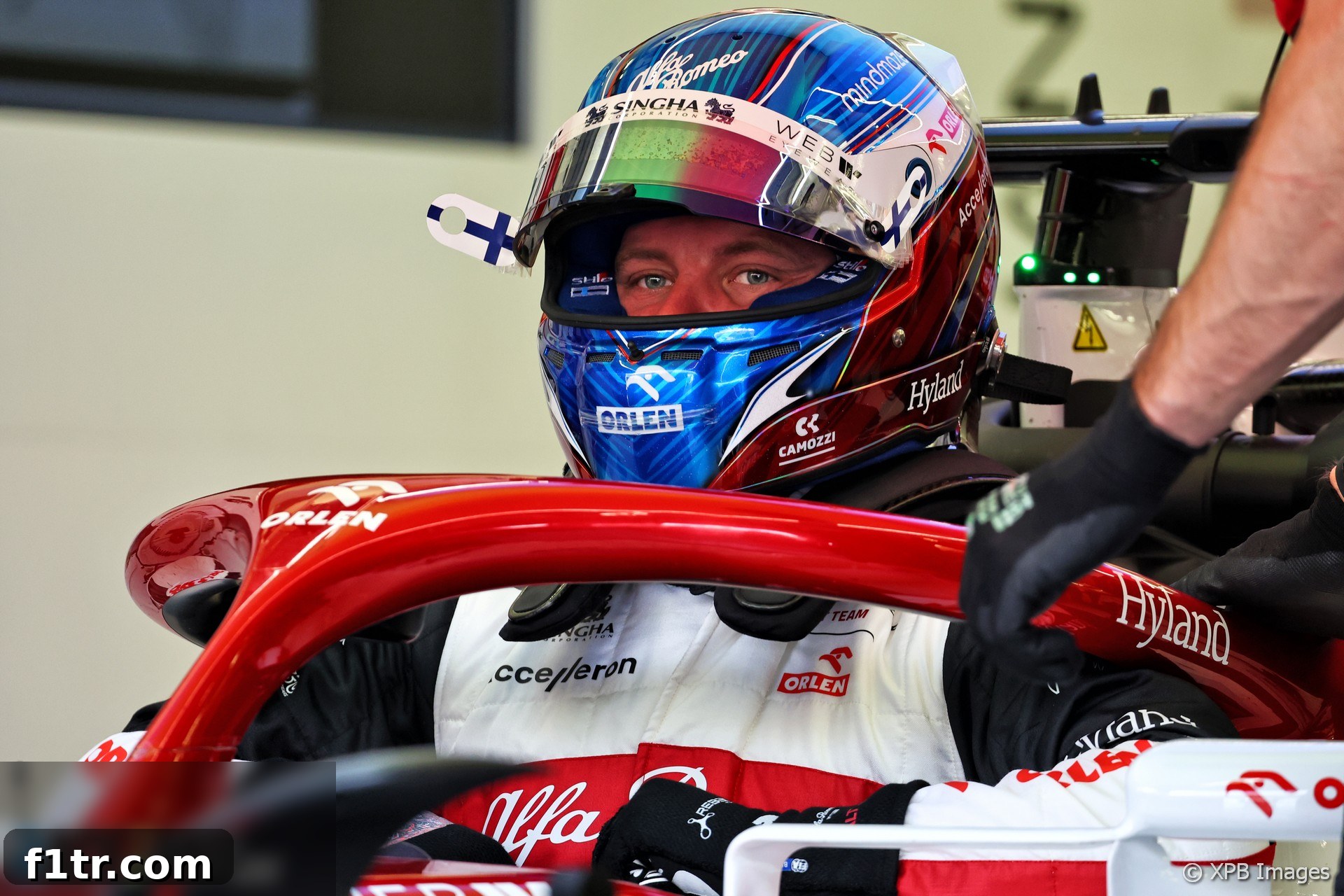
Valtteri Bottas Highlights Alfa Romeo’s C42 Progress Amidst Lingering Reliability Concerns for 2022 F1 Season
As the curtains closed on the final pre-season testing in Bahrain, Valtteri Bottas offered a nuanced perspective on Alfa Romeo’s preparations for the highly anticipated 2022 Formula 1 season. While encouraged by the noticeable performance improvements of their new C42 car, the experienced Finn voiced significant apprehension regarding the team’s ability to complete full race distances without issue, a critical factor as the season opener looms.
The team’s journey through pre-season testing presented a stark contrast between its two phases. The initial shakedown at Circuit de Catalunya in Barcelona two weeks prior saw Alfa Romeo covering the fewest laps of any team, raising eyebrows and fuelling concerns about their readiness. However, the subsequent three-day session in Bahrain proved far more productive, allowing the team to rack up more mileage and gather crucial data.
Despite the improved run-time in Bahrain, Bottas remains vigilant about the underlying reliability issues that plagued their early testing. “I’ll be more confident once we speak with the team next week and when I hear that all the issues we understand 100% and we make sure that they don’t happen again,” Bottas stated in response to a direct question from RaceFans, emphasizing the need for comprehensive solutions. “Because at the moment, now my biggest concern is doing a race distance.”
This candid assessment underscores the severity of the challenge. F1 cars are complex machines designed to operate at the absolute limit, and any intermittent fault, however minor, can quickly derail a race weekend. The new technical regulations for 2022, which introduced radical aerodynamic changes and ground-effect principles, have added another layer of complexity, often leading to unforeseen reliability headaches for all teams as they push the boundaries of design and engineering.
Navigating a Series of Setbacks and Finding Solutions
Bottas elaborated on the nature of the problems encountered. “We’ve had multiple different kind of issues during this test, but we’ve been able to fix them and we just hope there’s no new issues coming up.” This indicates a range of diverse problems rather than a single systemic flaw, which, while challenging, also suggests the team’s capacity to diagnose and implement fixes. The hope, of course, is that these “fixed” issues will remain resolved and no new, unforeseen problems emerge during the high-pressure environment of a Grand Prix weekend.
The reliability question casts a shadow over what is otherwise a positive outlook on the C42’s inherent performance. “Otherwise, in terms of performance, my feeling for now is that the team has made a clear step from last year. And that’s nice to see. You know testing, we can’t say in detail, but it’s not far off where we should be,” Bottas affirmed. This sentiment suggests that the raw pace and handling characteristics of the new car are a significant upgrade from its predecessor, a crucial foundation for any team aspiring to climb the midfield pecking order.
Towards the conclusion of the final day of testing in Bahrain, Bottas posted the fifth-fastest time, a strong indicator of the car’s potential when everything is working harmoniously. More importantly, he reported a growing familiarity and comfort level with the C42. “When it works, it’s not bad,” he remarked, a testament to the progress made. “I was really starting to like the car. Both high fuel and a little bit lower fuel it felt pretty decent. We got a clear direction on the set-up that we still need to go to extract more performance.”
Unlocking Performance: The Nuances of Car Setup and New Tyres
Identifying a “clear direction” for setup is invaluable in F1 testing. It means the engineers and drivers are converging on an understanding of how to best optimize the car’s balance and characteristics for maximum speed and consistency. This involves fine-tuning everything from suspension stiffness and ride height to aerodynamic configurations, each adjustment playing a critical role in extracting milliseconds from lap times. For Alfa Romeo, a team that has historically struggled for consistent pace, this clarity represents a significant step forward.
However, the new generation of F1 cars, coupled with the introduction of 18-inch Pirelli tyres, brings its own set of handling challenges. Bottas highlighted one such characteristic: “Still, it’s not easy in general to turn the car quickly and early enough in the corners. I think it’s also a characteristic of the new tyres, they are quite weak on the combined braking [and steering], the front tyres especially.”
This observation is crucial. “Combined braking and steering” refers to the delicate act of applying brakes while simultaneously turning the steering wheel into a corner. It’s a fundamental technique for F1 drivers, allowing them to carry speed into the apex. If the front tyres are “weak” in this scenario, it means they lose grip or lock up more easily when both forces are applied, making the car less responsive and potentially inducing understeer. Adapting to this new tyre characteristic will be key for all drivers and teams in the early part of the season, requiring adjustments to driving style and car setup to optimize corner entry.
Despite these specific handling quirks and the overarching reliability concerns, Bottas concluded his thoughts on a positive note regarding the day’s learning. “It was a good day for learning and the main thing is we just need to fix all the issues we’ve been having now.” The emphasis remains firmly on problem-solving, a race against time to ensure the C42 is robust enough to endure the rigours of a full Grand Prix.
Advert | Become a RaceFans supporter andgo ad-free
The Road Ahead: Valtteri Bottas’s Impact and Alfa Romeo’s 2022 Ambitions
Valtteri Bottas’s move to Alfa Romeo from Mercedes marks a pivotal moment for both the driver and the team. Having spent five successful years at a championship-winning outfit, Bottas brings invaluable experience in car development, race strategy, and a deep understanding of what it takes to operate at the pinnacle of motorsport. His detailed feedback and analytical approach are precisely what Alfa Romeo needs to accelerate their progress in the new era of Formula 1.
His immediate focus, as highlighted by his comments, will be to instill a culture of relentless problem-solving and reliability. In a sport where every point counts, especially in the fiercely competitive midfield, a car that consistently finishes races, even if not always at the very front, can make a significant difference to a team’s championship standing and financial rewards. The technical staff at Hinwil will be working tirelessly in the days leading up to the Bahrain Grand Prix to address every identified fault, ensuring the C42 is as bulletproof as possible.
For the 2022 F1 season, Alfa Romeo’s ambition will likely be to establish themselves as regular points scorers and challenge for positions consistently within the top ten. With Bottas leading the charge and rookie Guanyu Zhou learning alongside him, the team has a blend of experience and fresh talent. If they can indeed resolve their reliability woes, the performance gains Bottas has noted could translate into a much-improved season for the Swiss-based squad. The first race in Bahrain will provide the ultimate test of their pre-season efforts, revealing whether their cautious optimism can transform into tangible results on track.
More on the 2022 F1 season
- Mercedes told me “you’re wrong” about 2022 car’s problems – Hamilton
- FIA confirms all 10 F1 teams complied with 2022 cost cap
- Steiner “not ashamed” of panning “slow” Schumacher in Drive to Survive
- Albon believes year out of F1 improved him as a driver
- Hamilton sees diversity gains in F1 years on from his ‘traumatising’ experience of racism
Browse all 2022 F1 season articles