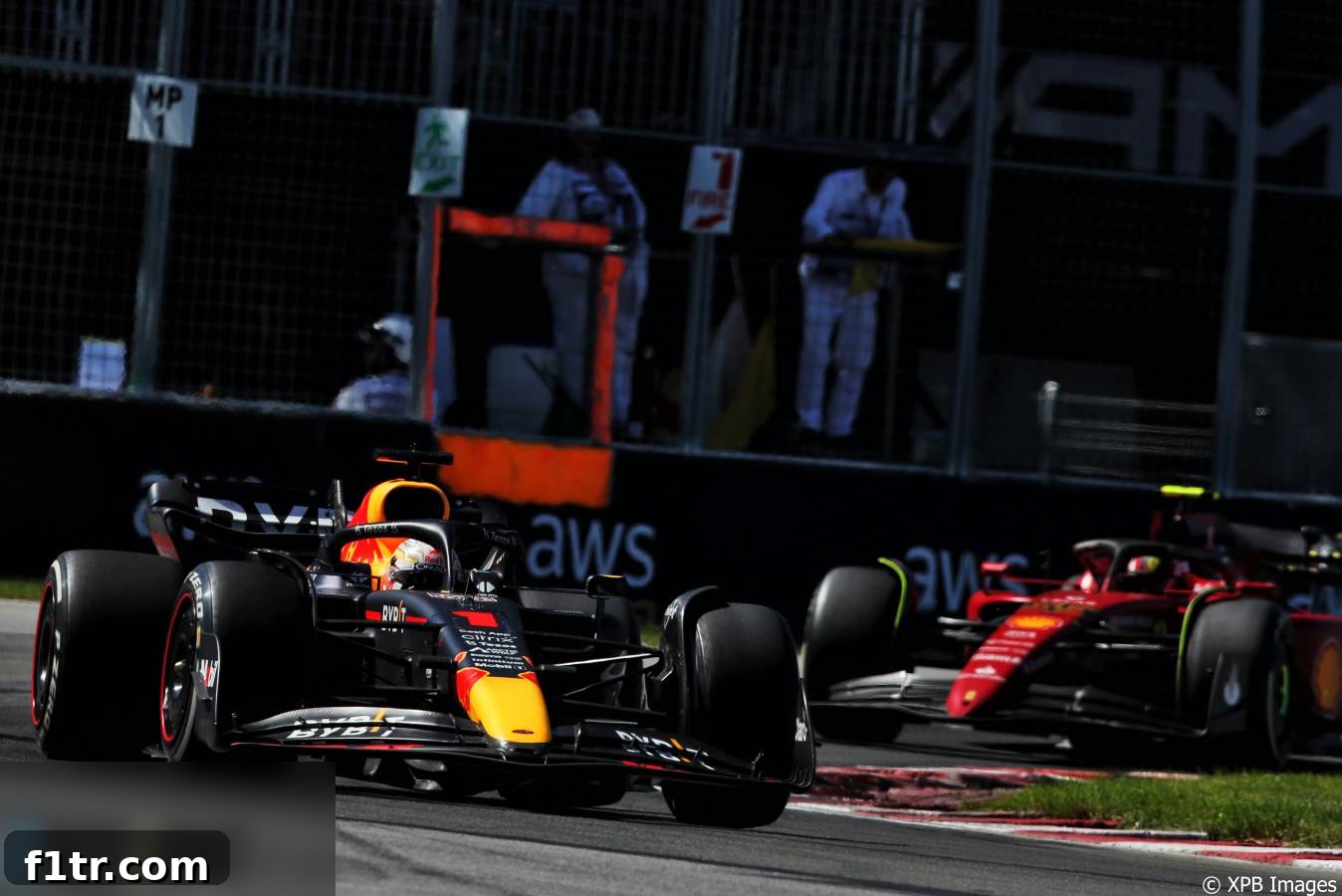
The exhilarating atmosphere of the 2022 Canadian Grand Prix bore witness to a high-stakes strategic battle, culminating in a dramatic victory for Max Verstappen. While the reigning world champion ultimately triumphed, his path to victory was far from straightforward, marked by an unexpected late-race twist that tested his composure and strategic prowess. Verstappen openly admitted his initial dissatisfaction when the Safety Car was deployed in the closing stages of the race, a decision he feared would leave him acutely vulnerable to the relentless pursuit of Carlos Sainz Jnr and his potent Ferrari.
Advert | Support Us & Enjoy Ad-Free Content
The race had been unfolding with a delicate balance of pace and strategy between the two front-runners. Verstappen, piloting his Red Bull machine, had relinquished the lead earlier to execute a crucial second pit stop, opting for fresher tires in a bid to maintain his advantage to the chequered flag. This strategic gamble was designed to give him a significant tire life and performance advantage over Sainz, allowing him to close the gap and dictate the pace in the final stint. However, the sudden appearance of the Safety Car, triggered by Yuki Tsunoda’s crash with just 21 laps remaining, instantly threatened to nullify this meticulously planned strategy. The intervention provided Sainz with a golden opportunity to pit for his own set of fresh tires without losing significant track position, effectively resetting the playing field and placing him directly behind Verstappen for the restart.
Reflecting on the pivotal moment, Verstappen articulated his thoughts on the team’s initial strategy. “We did our strategy and I think for us it worked,” he commented. “At that second stop, of course, I had the fresher tyres, I was closing in on Carlos, but I was not sure if I actually would fully close that gap to the end of the race.” This statement underscored the inherent uncertainty of racing, where even well-executed strategies can be subject to unforeseen circumstances. While he was confident in his fresh rubber, the closing rate on Sainz before the Safety Car was a variable, leaving room for doubt about whether he would have definitively caught and passed the Ferrari driver on track without external intervention.
The inherent pace advantage of the Ferrari in certain phases of the Formula 1 Canadian Grand Prix was a significant concern for Verstappen. He acknowledged that Sainz had demonstrated slightly quicker pace in the opening stages of the race, a factor that amplified his apprehension once the Safety Car was deployed. The prospect of defending against a driver with a perceived pace edge, now armed with equally fresh tires and the benefit of DRS on the long straights of the Circuit Gilles Villeneuve, was a daunting one. The strategic parity enforced by the Safety Car transformed what could have been a comfortable final stint for Verstappen into an intense defensive masterclass.
Verstappen’s frustration was palpable when he learned of the Safety Car. “The Safety Car came out and I was not very happy with that because then I knew, of course, that he would have fresh tyres behind me. And already with a little bit more pace compared to me, and it’s difficult to defend.” This candid admission highlighted the strategic conundrum that Formula 1 teams and drivers constantly face. A Safety Car can be a blessing or a curse, depending on one’s track position and tire strategy. For Verstappen, it erased his hard-earned advantage and thrust him into a direct head-to-head sprint to the finish, a scenario he clearly wished to avoid given Sainz’s demonstrated performance.
Once the race restarted, the tension was electric. Sainz, invigorated by his fresh tires and the unexpected opportunity, launched an immediate and relentless assault on Verstappen’s lead. Lap after lap, he applied immense pressure, frequently activating his Drag Reduction System (DRS) down the long back straight and into the final chicane, attempting to find a way past the Red Bull. The duel was a breathtaking display of raw speed, precision driving, and unwavering determination from both competitors. Verstappen, however, rose to the occasion, exhibiting the calm and masterful defensive driving that has become his hallmark. He strategically placed his car, managed his energy deployment, and executed flawless corner exits to deny Sainz any clear overtaking opportunities. It was a testament to his race craft that, despite the sustained pressure, he did not make a single significant error, ultimately fending off the Ferrari challenge to claim a hard-fought victory.
The final 15 or 16 laps were described by Verstappen as an ultimate test of endurance and skill. “The last 15 or 16 laps we were flat-out, pushing to the limit,” he recounted. “I knew, of course, that I couldn’t make a mistake.” This period represented pure, unadulterated Grand Prix racing, where every millisecond counted and every maneuver was scrutinized. For drivers of their caliber, these are the moments they live for. Verstappen expressed his profound satisfaction with this type of racing, contrasting it with races where tire preservation often dictates strategy. “But it was good racing. It’s always more enjoyable to be able to really push in a Formula 1 car instead of just saving your tyres.” This sentiment resonated with motorsport enthusiasts, who often crave the sight of drivers pushing their machines to the absolute limit without the constraints of extensive tire management.
Despite his hard-won victory, Verstappen offered a refreshingly honest assessment of the weekend’s performance, admitting the race had been “a bit more difficult than I expected.” He candidly added, “I expected to have a little bit more pace, but we seemed to lack a little bit compared to Carlos.” This acknowledgement speaks volumes about the continuous evolution of Formula 1 and the tight margins that separate the top teams. Even on a winning weekend, the pursuit of marginal gains and improved performance remains paramount. It highlights Red Bull’s commitment to continuous development and their recognition that competition from Ferrari is intense and fluctuating.
The Canadian Grand Prix played a crucial role in shaping the 2022 championship standings. With his closest championship rivals facing significant setbacks – Sergio Perez suffering a race-ending retirement and Charles Leclerc battling from the back of the grid to secure a commendable fifth place – Verstappen significantly extended his lead. He now commanded a healthy 46-point advantage at the top of the standings, a substantial buffer that provided some comfort but certainly not complacency. This substantial lead was a testament to his consistent performance and the team’s reliability, contrasting sharply with the misfortunes encountered by his main competitors.
However, despite the burgeoning points gap, Verstappen maintained a mature and grounded perspective on the championship battle. He remained acutely aware that the nature of Formula 1 allows for rapid shifts in fortune. “It’s still a very long way,” he cautioned. “I know the gap is quite big but I also know that it can switch around very quickly.” This level-headed approach is critical in a sport where technical issues, strategic missteps, or racing incidents can dramatically alter the championship landscape in a single weekend. He vividly recalled his own early-season deficit: “I mean, race three I was 46 behind. So we just need to stay calm, we need to focus, we need to improve, because today we’re not the quickest.” This self-awareness and focus on ongoing development, even after a victory, underscored his championship mentality.
Verstappen’s reflections further emphasized the fluctuating nature of performance between the leading teams throughout an F1 season. “It swings a bit, like last weekend it looked good in the race, now it didn’t look as good but we still managed to win and that I think is also a quality and we just have to work together with the whole team to try and just find little improvements in the car.” This statement highlights the dynamic competitive environment of modern Formula 1, where upgrades, circuit characteristics, and even weather conditions can shift the balance of power. The ability to win even when the car is not definitively the fastest is a hallmark of a true champion and a strong team. It speaks to the collective effort of Red Bull Racing to extract maximum performance and seize opportunities, turning challenging weekends into victories.
Advert | Become a RaceFans supporter andgo ad-free
Further Reading: Insights from the 2022 Canadian Grand Prix
Explore more perspectives and analyses from a thrilling weekend of Formula 1 action in Montreal:
- Alfa Romeo’s Optimistic Outlook for Zhou Guanyu’s F1 Future
- Esteban Ocon’s High Hopes for Alpine’s Silverstone Upgrade Package
- Lewis Hamilton’s Satisfying Podium Finish in Canada After Challenging Run
- Verstappen’s Call for Red Bull to Unlock More Pace Post-Canada Victory
- Ferrari’s Confidence in Carlos Sainz as a Future Race Winner
Dive deeper into all the analyses and reports from the 2022 Canadian Grand Prix.