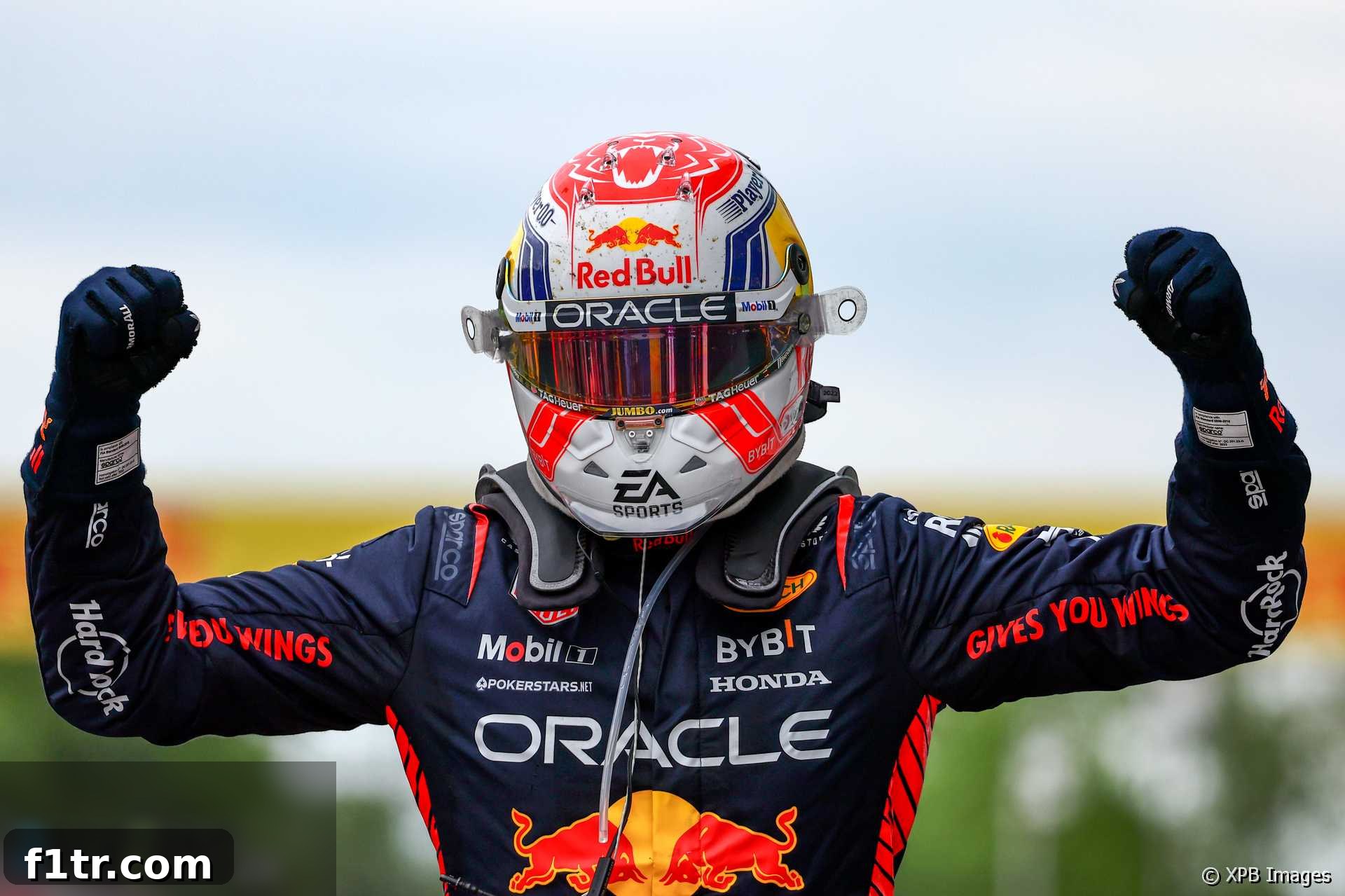
The 2023 Canadian Grand Prix marked a momentous occasion for both Max Verstappen and the Red Bull Racing team, as their dominant victory in Montreal yielded significant statistical milestones. While Verstappen celebrated a personal landmark and the team secured its centenary win, the weekend wasn’t without its challenges, particularly for Verstappen’s teammate and championship rival, Sergio Perez.
Max Verstappen’s Historic Ascent: Equalling Legends and Setting New Benchmarks
Max Verstappen’s triumph at the Circuit Gilles Villeneuve was his 41st career victory in Formula 1, an achievement that places him alongside the legendary three-time world champion, Ayrton Senna. This formidable comparison dates back to before Verstappen’s F1 debut, when Red Bull’s motorsport advisor Helmut Marko famously likened the young Dutchman to Senna. Now, a decade later, Verstappen has not only lived up to that lofty comparison but stands shoulder-to-shoulder with one of the sport’s icons, with only four drivers in F1 history having more wins than this illustrious pair.
While Verstappen reached this remarkable tally in 171 races, Senna achieved it slightly quicker in 158. However, what truly underscores Verstappen’s current dominance is the sheer pace of his recent success: an astounding 21 of his 41 victories – more than half – have come since the start of the 2022 season. This incredible surge highlights a period of unparalleled performance, firmly establishing him as the benchmark in modern Formula 1.
Beyond his race wins, Verstappen’s Canadian Grand Prix performance also saw him secure his 25th pole position, surpassing the legendary Niki Lauda. This achievement places him in elite company for qualifying prowess, further cementing his reputation as a formidable force on Saturdays as well as Sundays. Furthermore, his 48th front-row start puts him level with two other titans of the sport, Jim Clark and Juan Manuel Fangio, a testament to his consistent speed and ability to extract maximum performance from his machinery.
A Consistent Points Scorer: Outlasting Rivals and Chasing Records
The 25 points garnered from his Canadian GP victory propelled Verstappen’s career total past 2,200 points. While this is an impressive figure, it’s worth noting that the all-time record holder, Lewis Hamilton, boasts more than twice that amount, with over 4,500 career points. This significant disparity is largely due to the evolution of F1’s scoring system over the years. During Hamilton’s early career, race wins typically awarded 10 points, whereas the current system awards 25 points for a victory. Factoring in this change, Verstappen’s points accumulation is an astonishing indicator of his sustained performance at the pinnacle of the sport.
Verstappen’s consistency extends beyond just winning. The Canadian Grand Prix marked his 27th consecutive race finishing in the points, drawing him level with ‘The Iceman’ Kimi Raikkonen for second place on the all-time list of consecutive points finishes. This remarkable streak underscores his unwavering reliability and ability to consistently deliver results, race after race. Moreover, this was Verstappen’s ninth consecutive podium appearance, showcasing an unparalleled level of consistent front-running performance that few drivers in history have been able to maintain.
Red Bull’s Centenary Triumph: A Legacy Forged in Speed
Advert | Become a RaceFans supporter andgo ad-free
Beyond Verstappen’s individual heroics, the Canadian Grand Prix delivered a monumental team milestone: Red Bull Racing’s 100th Formula 1 victory. This achievement makes Red Bull only the fifth constructor in F1 history to reach the century mark, placing them in an exclusive club alongside Ferrari, McLaren, Williams, and Mercedes. What makes Red Bull’s accomplishment particularly impressive is the speed at which they’ve reached this landmark.
Red Bull achieved their 100th win in their 355th race, making them the third-quickest team to a century of victories. Mercedes holds the record, having taken just 207 races to reach 100 wins, followed by Williams in 316 races. McLaren achieved the feat in 381 races, and F1’s most decorated team, Ferrari, took 459 races to rack up their first hundred victories. However, directly comparing race counts can be misleading due to the changing F1 calendar. Older teams competed in an era with significantly fewer races per season.
A Fairer Comparison: Wins by Seasons Entered
To provide a more representative measure of a team’s efficiency in reaching 100 wins, it’s often more insightful to consider the number of seasons entered. By this metric, Mercedes again leads the pack, taking just under 12 seasons as an F1 constructor to accumulate 100 victories. Red Bull’s journey to 100 wins spans just under 18-and-a-half seasons, a testament to their sustained excellence over nearly two decades. Williams achieved the feat in 20-and-a-half seasons, while McLaren took just over 26 seasons. Ferrari, with its long and storied history, celebrated its 100th win in its 41st year of competing in F1, highlighting the different eras and competitive landscapes teams have navigated.
Red Bull’s rapid ascent to the top tier of Formula 1 has seen them quickly accumulate victories. While it took them 74 races to secure their inaugural F1 win, the subsequent victories came thick and fast. They racked up ten wins in just 23 additional races, and another 26 races after that brought them to a quarter-century of victories. Their 50th victory arrived in their 177th start, demonstrating a consistent growth in competitive prowess. This trajectory underscores how Red Bull, initially an underdog, transformed into a dominant force in the sport.
Looking at the contributions of individual drivers to Red Bull’s 100 wins offers further insight into their history of success. Max Verstappen, with his 41 victories, accounts for 41% of the team’s total wins. Four-time world champion Sebastian Vettel is close behind, having contributed 38 wins (38%). The remainder of the team’s victories came from Mark Webber (nine wins), Daniel Ricciardo (seven wins), and Sergio Perez (five wins). This diverse list of winners showcases Red Bull’s ability to attract and develop top talent over the years.
Perez’s Struggles and the Widening Championship Gap
Advert | Become a RaceFans supporter andgo ad-free
While Verstappen and Red Bull celebrated their milestones, the Canadian Grand Prix proved to be a challenging weekend for Sergio Perez, who remains Verstappen’s closest, albeit distant, title rival. Despite securing the fastest lap for the 11th time in his F1 career, a minor positive, Perez’s qualifying performance once again proved to be his Achilles’ heel.
Alarmingly, at four of the eight rounds held so far this year, Perez has failed to reach Q3, the final stage of qualifying. This inconsistency on Saturdays significantly compromises his race Sundays, often forcing him to battle through the field from a disadvantageous position. The impact on his championship standing is stark: having scored only six fewer points than Verstappen across the first four rounds, Perez has since been outscored by a significant 66 points. This widening gap underscores the challenge he faces in mounting a serious title challenge against his teammate’s relentless performance.
Verstappen’s sheer dominance is further illustrated by his incredible run of leading laps. Since he overtook Perez for victory at the Miami Grand Prix with ten laps to go, Verstappen has been at the front of the field for an astonishing 224 consecutive laps, encompassing three full races. While this is an exceptional display of control, it still falls short of Alberto Ascari’s all-time record of 304 consecutive laps led, achieved way back in 1952. Nevertheless, Verstappen’s ability to lead from start to finish in 10 F1 Grand Prix throughout his career underscores his complete command when at the front.
Other Notable Achievements and Comebacks in Canada
Fernando Alonso continued his remarkable resurgence, securing second place behind Verstappen in Canada. This podium finish marked the 104th of his illustrious career, moving him past Kimi Raikkonen into fifth place on the all-time list of most podiums. Alonso’s consistent performance with Aston Martin has been one of the standout stories of the season, showcasing his enduring talent and passion for the sport.
Further down the order, Haas driver Nico Hulkenberg quietly made history, moving past Gerhard Berger into 20th place on the all-time list of laps raced in the world championship. Having now completed 9,807 laps in his extensive career, Hulkenberg continues to demonstrate his longevity and dedication to Formula 1.
The Canadian Grand Prix also brought a much-needed morale boost for Williams, with Alex Albon delivering an impressive seventh-place finish. This was Albon’s best result since the 2020 Abu Dhabi Grand Prix, when he was racing for Red Bull, highlighting his continued development and the team’s progress. Adding to Williams’ positive weekend, Albon topped the second stage of qualifying (Q2) in Canada, marking the first time Williams had topped a segment of qualifying in seven years. The last instance was by Felipe Massa in Q1 at the 2016 Belgian Grand Prix, signaling a potential upward trend for the iconic British team.
Circuit Gilles Villeneuve: A Timeless Venue
Looking ahead, Formula 1 is set to return to Montreal next year for the 43rd time to race at the iconic Circuit Gilles Villeneuve. This makes it one of the most frequently visited circuits in F1 history, with only four other tracks having hosted more races, all of which are storied European venues. The circuit’s enduring popularity and reputation for exciting racing ensure its place as a cornerstone of the Formula 1 calendar.
The 2023 Canadian Grand Prix truly delivered a blend of historic milestones and intriguing subplots. From Verstappen’s relentless pursuit of records and Red Bull’s centenary celebration to Perez’s struggles and the glimmers of hope for teams like Williams, the race offered plenty for fans and statisticians alike. Did you spot any other fascinating statistics or facts from the Canadian Grand Prix? Share them in the comments below!
Advert | Become a RaceFans supporter andgo ad-free
2023 Canadian Grand Prix Insights
- Norris ‘even more’ sure Canada penalty was wrong after review request fails
- McLaren seeking more than just downforce gains from major upgrade
- Winning more races won’t necessarily lead to F1 seat – Palou
- Red Bull’s testing restriction will “massively affect” 2024 car development
- Schumacher’s set-up input gives Mercedes a “super advantage” – Wolff
Browse all 2023 Canadian Grand Prix articles