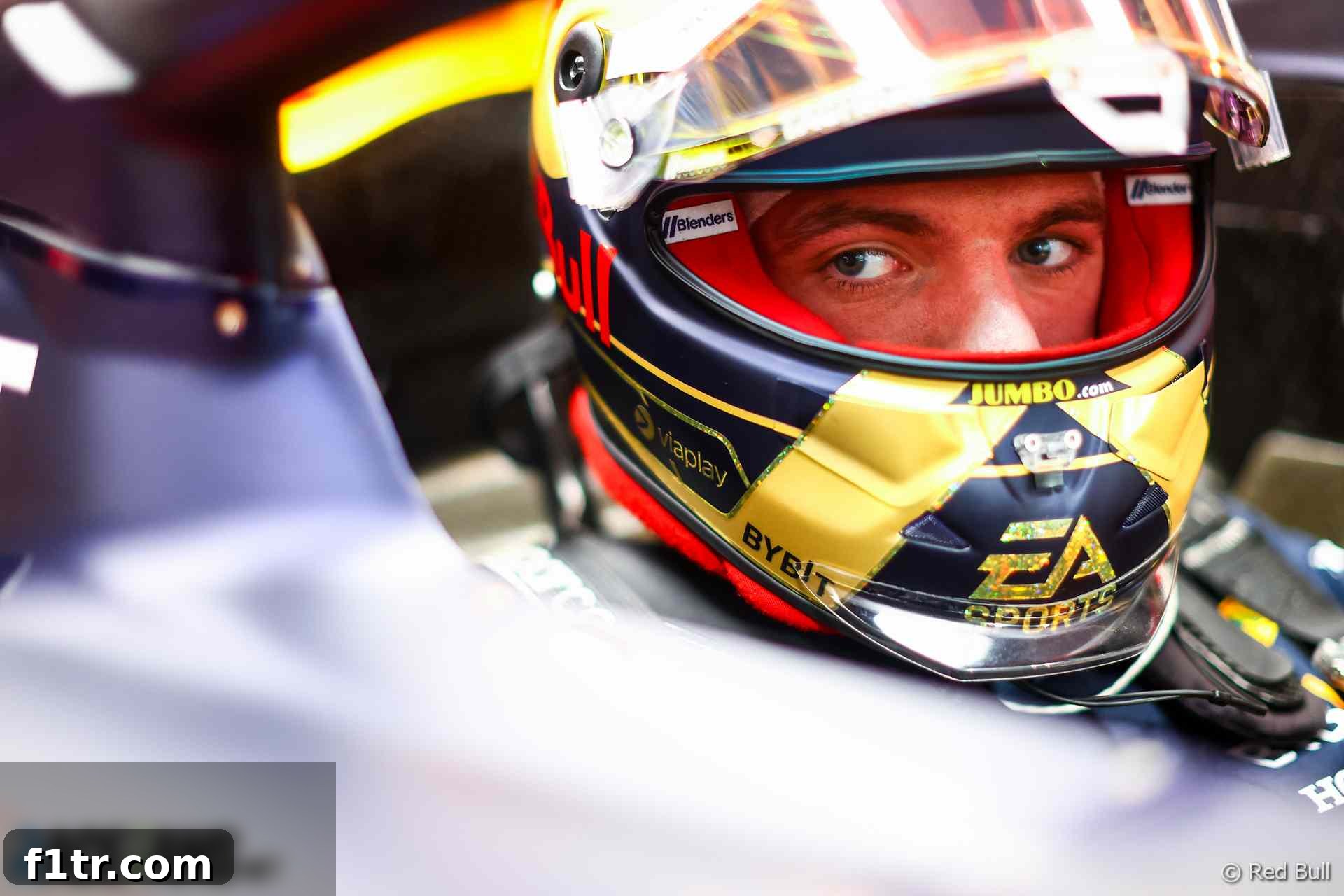
Max Verstappen, the reigning Formula 1 world champion, openly voiced his displeasure regarding the conduct of rival drivers during a congested pit lane exit sequence at the Yas Marina Circuit. The Red Bull ace found himself having to aggressively navigate past a queue of competitors during a crucial practice session, an incident that underscored the intense pressure for track time at the season-ending Abu Dhabi Grand Prix weekend.
Advert | Become a Supporter & go ad-free
Verstappen’s Friday schedule was already compromised, adding an extra layer of frustration to the pit lane skirmish. He had been sidelined for the first practice session (FP1), as Red Bull strategically handed his RB19 over to test driver Jake Dennis, fulfilling F1’s mandatory young driver testing requirements. Compounding the lost time, the subsequent second practice session (FP2) was significantly disrupted by a pair of unrelated crashes involving Carlos Sainz Jnr and Nico Hulkenberg. These incidents necessitated red flags, further reducing the precious window for teams and drivers to gather crucial data and fine-tune their cars. Consequently, every lap on track became invaluable, making any perceived obstruction even more irritating for a driver known for his relentless pursuit of perfection.
It was in this context of limited running that the pit lane incident unfolded. As Verstappen prepared to rejoin the track, he encountered the two Mercedes drivers slowing considerably ahead of him. The pit exit at Yas Marina is notoriously tight and winding, a challenging section that demands precision. Despite the confined space, Verstappen, driven by the urgency to maximize his available track time, saw an opportunity to squeeze past his slower rivals. His decisive move, however, was met with what he perceived as a lack of cooperation, igniting a heated radio exchange and subsequent public criticism.
The Dutch driver didn’t mince words, directly accusing his competitors of not driving quickly enough and failing to leave adequate room for him to pass. He articulated a common frustration among drivers when exiting the pits: the desire to maintain momentum and clear space, especially when time is of the essence. Verstappen’s irritation stemmed from the fact that while he sought to proceed efficiently, the drivers ahead remained in the middle of the pit exit, seemingly oblivious or indifferent to his approaching speed. This perceived lack of awareness escalated into a confrontation as he attempted to overtake.
“They have to move,” Verstappen stated emphatically, reflecting a sentiment shared by many top-tier racers. He elaborated on the incident, highlighting the deliberate nature of his rivals’ actions. “They’re all driving slow and I want to go out because we are all limited on time but they just keep on driving in the middle. Then when I tried to pass they tried to squeeze me in the wall. So yeah, a bit silly.” This candid assessment not only underscored his immediate annoyance but also hinted at a deeper frustration with what he viewed as unprofessional or unsportsmanlike conduct during a critical practice session. The implication of being “squeezed in the wall” suggested a potentially dangerous maneuver in a high-speed environment, even if confined to the pit lane exit.
Such incidents, though seemingly minor, can significantly impact a driver’s mindset and ability to prepare. For Verstappen, who had only managed a mere 17 laps during Friday’s practice sessions, every single circuit rotation was paramount for understanding the car’s behavior and optimizing its setup. His limited track time was reflected in his eventual position at the end of FP2, where he finished nearly two-tenths of a second slower than the pace-setter, Charles Leclerc of Ferrari. This deficit, while not insurmountable, served as a stark reminder of the work that lay ahead, particularly given the challenges he faced with his car’s handling.
Beyond the pit lane drama, Verstappen’s primary concern revolved around the balance of his Red Bull RB19. During the session, he reported to his team that the car was “bouncing like a kangaroo” in the final sector of the Yas Marina Circuit. This vivid description painted a clear picture of an unstable and unpredictable car, particularly in the high-speed and technical section towards the end of the lap. Such severe bouncing, often referred to as porpoising or bottoming out, can significantly compromise aerodynamic performance, driver confidence, and ultimately, lap times. It makes it incredibly difficult for a driver to attack corners with precision, apply consistent throttle, or trust the car’s grip limits.
Elaborating on his struggles after practice, Verstappen candidly admitted, “The balance was very off. A lot of understeer, a lot of jumping so definitely a few things to figure out for tomorrow.” Understeer, where the front wheels lose grip before the rear, forces a driver to reduce speed and turn the wheel more, costing precious time and making the car feel sluggish and unresponsive. The “jumping” further exacerbated the lack of stability, suggesting the suspension wasn’t effectively managing the track’s bumps or aerodynamic loads. These combined issues painted a picture of a car that was far from its optimal operating window, a rare occurrence for the dominant RB19 machine that had carried Verstappen to a record-breaking season.
“I didn’t expect it to be so far off so that’s also a bit of a question mark for us,” he added, highlighting his surprise at the extent of the handling woes. Despite these significant challenges, Verstappen remained pragmatically optimistic, acknowledging his P3 position: “I mean, we’re still P3, it’s not too bad, but balance-wise I think it can be a lot better. So we’ll try to have a look what happened there.” This statement underscored the Red Bull team’s relentless pursuit of perfection, even when a dominant championship has already been secured. The engineers and strategists would undoubtedly work late into the night, poring over telemetry data to diagnose and rectify the balance issues ahead of Saturday’s crucial third practice session (FP3) and qualifying. Resolving these setup complexities will be paramount for Verstappen to regain his usual commanding pace and challenge for pole position at the season finale.
Advert | Become a RaceFans supporter andgo ad-free
2023 Abu Dhabi Grand Prix
- Mercedes’ team photo shows we still have a long way to go on diversity – Hamilton
- Why luck was a factor in Perez’s penalty for “joke” comment
- Bottas and Zhou see encouraging signs from overhauled 2024 car
- Only Verstappen got the best from his car every weekend, rival team bosses admit
- How Sainz suffered the worst season finale for a driver since Schumacher in 1997
Browse all 2023 Abu Dhabi Grand Prix articles