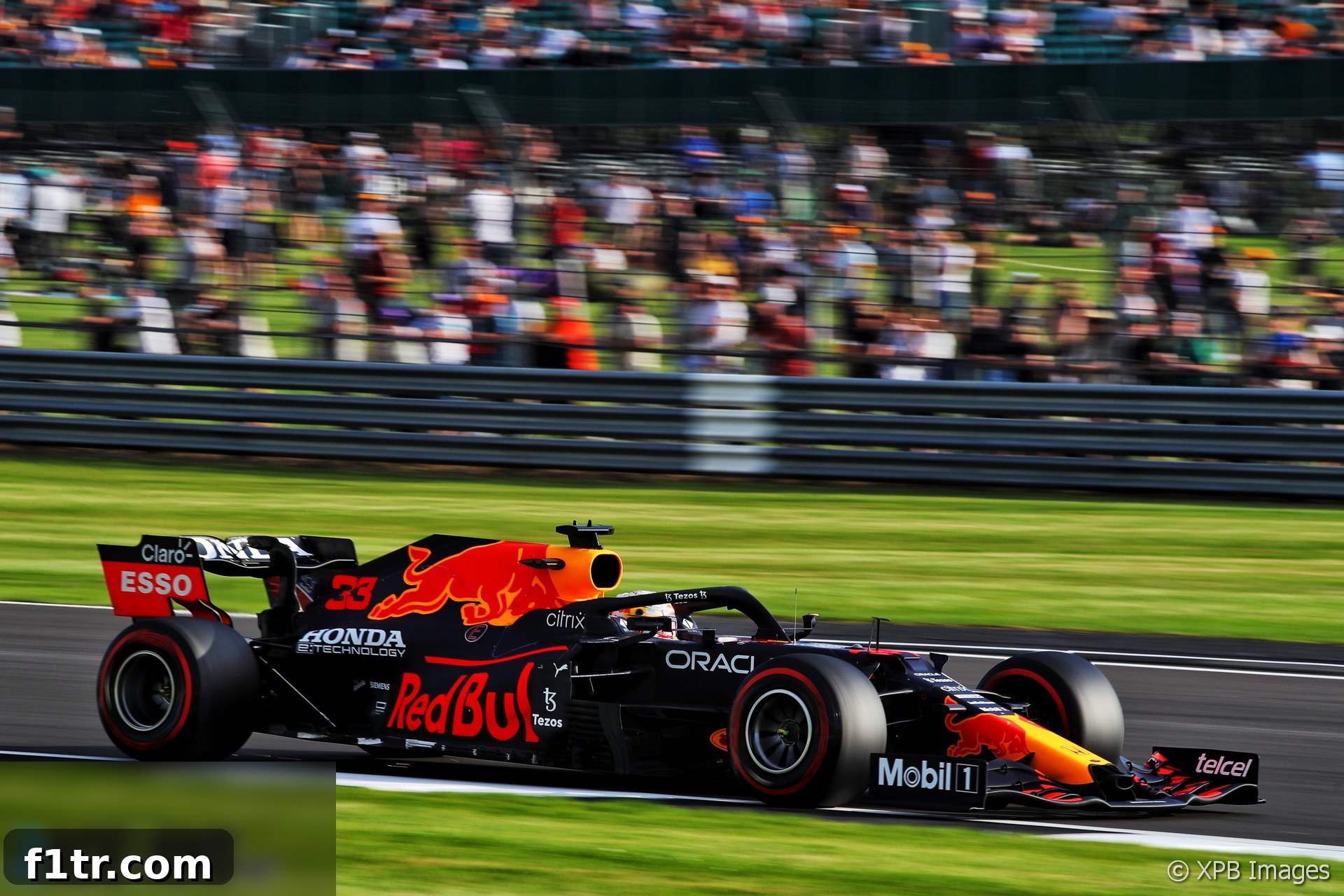
In a surprising twist at the 2021 British Grand Prix, Red Bull Racing’s star driver, Max Verstappen, experienced an unexpected and perplexing loss of pace between the lone practice session and the crucial qualifying showdown. Despite his dominant display in practice, where he comfortably outpaced his fiercest rival, Lewis Hamilton, by a significant margin, Verstappen found himself unable to replicate that formidable performance when it truly counted. This stark discrepancy between sessions left many observers puzzled, and Verstappen himself was quick to clarify that this downturn in speed was not attributable to any major alterations made to his formidable machine. The incident served as a potent reminder of Formula 1’s inherent unpredictability, particularly under the then-new sprint qualifying format, and injected an additional layer of intrigue into an already enthralling championship battle.
Advert | Become a Supporter & go ad-free
The prelude to qualifying had painted a picture of undeniable Red Bull superiority. Verstappen had commandingly topped the solitary practice session at the iconic Silverstone circuit, a session that crucially represented the sole opportunity for teams to fine-tune their cars before they entered stringent parc ferme conditions. His benchmark lap time had been a staggering eight-tenths of a second faster than Lewis Hamilton’s Mercedes, sending a clear message of intent and setting soaring expectations for the Dutchman to secure pole position. This substantial advantage had instilled a palpable sense of confidence within the Red Bull garage, seemingly well-justified by the car’s apparent handling prowess and Verstappen’s renowned skill behind the wheel on the challenging British tarmac.
However, the narrative shifted dramatically as the qualifying session commenced. As competitors pushed their machines to the absolute limit for their flying laps, it became increasingly evident that the Mercedes W12, expertly guided by local hero Lewis Hamilton, had unlocked an extra dimension of performance. Hamilton, driving with precision and determination, meticulously extracted every ounce of speed from his car, ultimately snatching pole position for Saturday’s inaugural sprint qualifying race by an agonizingly slender margin – less than a tenth of a second. For Verstappen, who had been heard relaying complaints of persistent understeer over his team radio, this sudden reversal of fortunes was bewildering. The abrupt disappearance of his earlier practice advantage was a puzzle he was determined to solve, articulating his confusion: “We just need to look at ourselves because I think the car itself was actually handling quite well, but with just a lot of understeer.” This candid admission underscored the frustration of a driver who felt his car possessed fundamental strength, yet was undermined by a singular, pervasive handling characteristic.
The Enigma of Understeer: A Driver’s Frustration
Understeer, a challenging phenomenon in motorsport, occurs when the front tires lose grip before the rear tires, causing the car to resist turning into a corner and instead push wide of the intended racing line. For a driver of Max Verstappen’s caliber, celebrated for his aggressive yet exquisitely precise driving style, significant understeer can be profoundly detrimental. It effectively robs him of the crucial ability to ‘attack’ corners with his characteristic verve, compelling him to adopt a more cautious approach and costing valuable milliseconds on a competitive circuit like Silverstone. Verstappen eloquently described this predicament, explaining, “I couldn’t really attack any corners. [I was] just waiting for the front to grip up.” This ‘waiting game’, in stark contrast to a decisive and early turn-in, prevents a driver from carrying optimal speed through the apex and accelerating efficiently onto the subsequent straight, thereby significantly hindering overall lap time. The immediate challenge for Red Bull was not merely to identify the presence of understeer, but to meticulously understand its underlying cause, especially given its unexpected manifestation after such a commanding practice performance.
Parc Ferme Regulations and Setup Constraints
The introduction of sprint qualifying in the 2021 season heralded unique regulatory complexities, particularly concerning the stringent parc ferme conditions. Under these rules, which were rigorously enforced from the outset of qualifying on Friday afternoon, teams faced severe limitations regarding the setup changes they could implement on their cars. This implied that once qualifying commenced, any substantial adjustments were strictly prohibited, effectively freezing the car’s configuration. While Red Bull did manage to execute some minor setup adjustments to Verstappen’s car between the practice session and qualifying, he resolutely dismissed the notion that these tweaks were responsible for his sudden dip in pace. “It was a bit of a weird feeling to be honest, to drive, because I don’t think it was set up or front wing related,” Verstappen confidently asserted. This statement suggested that the root cause of the issue was more intricate than a straightforward setup error, potentially hinting at factors such as evolving track conditions, nuanced tire behavior, or even a subtle shift in aerodynamic balance that became more pronounced under the intense pressures of a qualifying run. The inability to make significant modifications under parc ferme conditions further compounded Red Bull’s challenge, compelling them to seek solutions within extremely tight operational boundaries ahead of the sprint race.
Sprint Qualifying: Redefining Pole Position in Formula 1
The 2021 British Grand Prix marked a watershed moment in the annals of Formula 1 history, hosting the inaugural sprint qualifying race. This innovative format fundamentally restructured the traditional Grand Prix weekend, introducing a 100km sprint race on Saturday designed to determine the starting grid for Sunday’s main event. Crucially, the driver who emerged victorious from the sprint race would be officially credited with pole position for the Grand Prix, adding an unprecedented layer of strategic complexity and consequence to Friday’s qualifying session. Thus, while Lewis Hamilton celebrated his P1 finish in Friday qualifying, it was technically a “pole position” for the sprint race, not the revered Grand Prix itself. Verstappen candidly acknowledged this unique aspect, admitting that the new format felt distinctly strange when compared to a conventional race weekend. “You do qualifying, you go flat out and [then] actually, it doesn’t really mean anything in terms of a pole position feeling,” he mused. This sentiment encapsulated a psychological shift for the drivers, where the immediate gratification of setting the fastest lap on Friday was tempered by the understanding that the ultimate accolade, the official Grand Prix pole, remained contingent on Saturday’s performance. It effectively transformed Friday qualifying into a tactical battle for optimal track position in the sprint, rather than a definitive declaration of outright pace for Sunday’s main event.
Verstappen’s Resilience and Unwavering Race Day Confidence
Despite the qualifying setback, Max Verstappen maintained a characteristic blend of pragmatism and unyielding confidence. He swiftly acknowledged the immediate challenge but immediately recalibrated his focus towards the opportunities that lay ahead. “It is what it is. I mean, we are still quite close. So it’s all right,” he calmly remarked, deftly downplaying the significance of the marginal gap to Hamilton. His inherent optimism was firmly rooted in his conviction that Red Bull possessed a “strong race car,” an indispensable asset for both the upcoming sprint race and the marquee Grand Prix. The team’s immediate priority shifted to a thorough analysis of the data, aiming to understand and mitigate the understeer issues without breaching the stringent parc ferme regulations. Verstappen’s resolute statement, “We’ll see tomorrow. I think we have a strong race car, we just need to fix a bit the issues we had in qualifying. I’m quite confident still that we can have a strong race,” resonated deeply with his renowned fighting spirit. He fully comprehended that while Friday’s qualifying served as a crucial preamble, the real contests for championship points and strategic advantage would fiercely unfold on both Saturday and Sunday. The sprint race, in particular, presented a dual opportunity: not only to recover any lost ground but also to gain invaluable insights into the car’s long-run performance and tire degradation, knowledge that would be critical for the main event.
Broader Championship Implications and the Hamilton Rivalry
The intense, season-long rivalry between Max Verstappen and Lewis Hamilton unequivocally defined the 2021 Formula 1 season, with every single qualifying session and race carrying profound championship implications. Verstappen’s slight stumble in Friday qualifying at Silverstone, though not a catastrophic blow, represented a significant symbolic victory for Hamilton at his cherished home race. It provided a crucial psychological boost for Mercedes and served as a poignant reminder to Red Bull that their often-dominant advantage, while formidable, was never an absolute guarantee. The innovative sprint qualifying format further amplified these high stakes; a commanding performance in the sprint could provide invaluable momentum heading into Sunday, whereas a subpar showing could create a formidable uphill battle for the main race. The cumulative outcome of this pivotal weekend, commencing with Verstappen’s unexpected qualifying challenge, was destined to become a defining chapter in their enthralling championship duel, meticulously setting the stage for future confrontations and high-octane racing. The extraordinary resilience demonstrated by both teams and drivers under such immense, relentless pressure stood as a testament to the pinnacle of motorsport, where every minute detail, from precise car setup to an unwavering driver mindset, played an absolutely critical role in the relentless pursuit of ultimate victory.
Advert | Become a RaceFans supporter andgo ad-free
2021 British Grand Prix: Related Articles and Analysis
- Verstappen reveals “vision problems” since 2021 Silverstone crash with Hamilton
- Who was to blame for Verstappen and Hamilton’s collision at Silverstone?
- Hamilton penalty “harsh” for move within FIA’s overtaking guidance – Allison
- Why Hamilton “wasn’t seen as wholly to blame” for the Verstappen crash
- Sainz convinced he had pace to challenge for podium without British GP setbacks
Browse all 2021 British Grand Prix articles