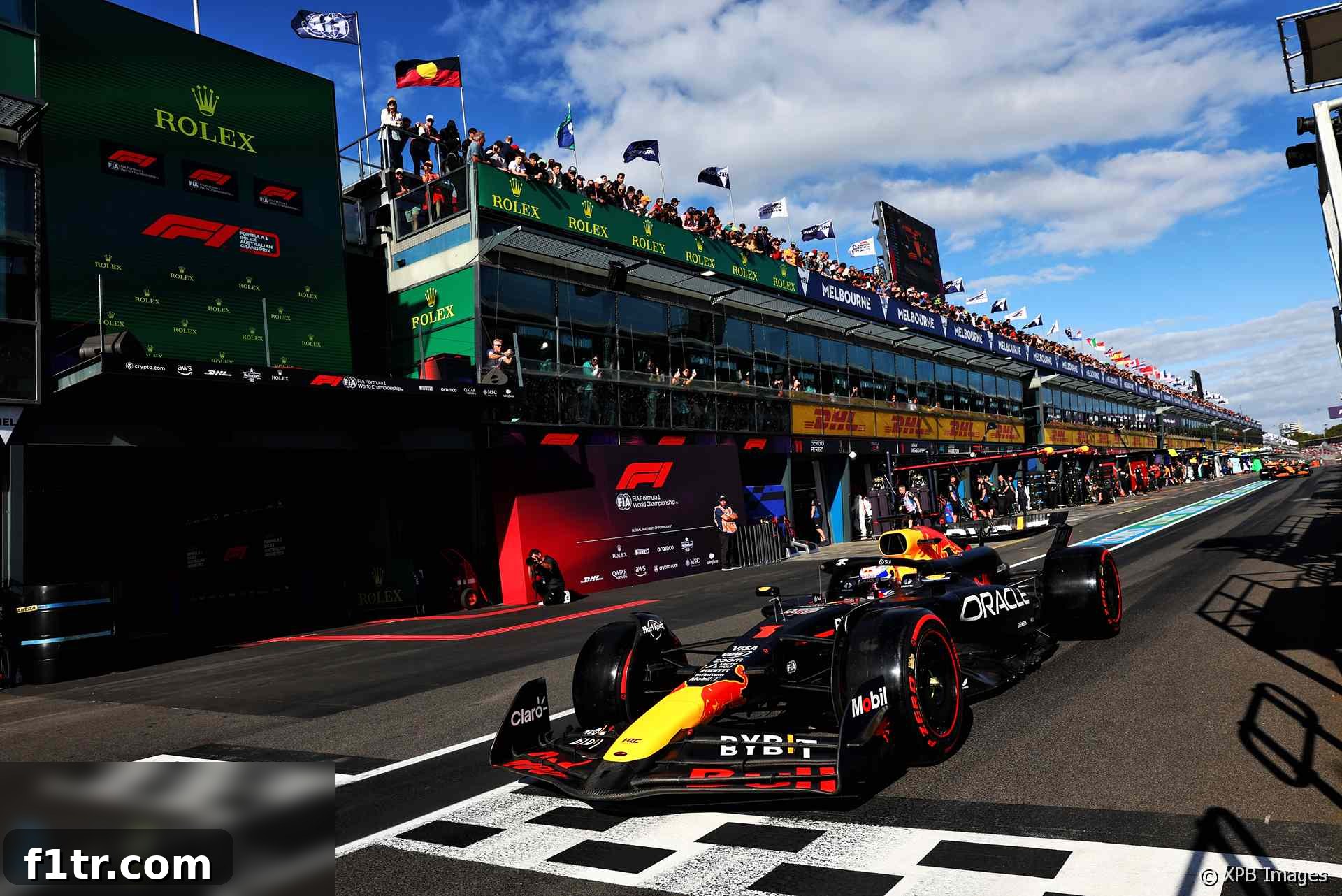
In a thrilling qualifying session that kept fans on the edge of their seats, Max Verstappen demonstrated his unparalleled skill by securing pole position for the Australian Grand Prix. The Red Bull ace admitted his surprise at topping the time sheets, having not led any session throughout the weekend until the crucial Q3. This unexpected turn of events sets the stage for a captivating race at the iconic Albert Park Circuit, highlighting the unpredictable nature of Formula 1 and the constant challenge posed by formidable rivals.
Verstappen’s Unforeseen Triumph at Albert Park
The reigning world champion, Max Verstappen, candidly expressed his astonishment at claiming his third consecutive pole position of the season. His triumph was particularly sweet given the difficulties encountered earlier in the weekend, where his Red Bull RB20 appeared to struggle with balance and grip. “It was a bit unexpected,” Verstappen commented after qualifying, reflecting on the challenging practice sessions where understeer had been a persistent issue. This struggle with the car’s handling meant that Red Bull had to work tirelessly behind the scenes to fine-tune the setup, making his ultimate Q3 performance all the more impressive.
Verstappen’s journey to pole position was a testament to his adaptability and the team’s relentless pursuit of perfection. He highlighted the significant improvement in his car’s performance during the final qualifying segment. “I was very happy with Q3. I think both of those laps, they felt really, really nice and that was very enjoyable,” he added, emphasizing the palpable difference in the car’s feel when it truly came alive. This ability to extract maximum performance when it mattered most underscored why Verstappen is considered one of the sport’s greatest talents. The transition from a “tricky weekend” to a dominant Q3 display showcases the subtle art of car setup and the driver’s profound understanding of his machine. His exceptional performance under pressure not only solidified his front-row start but also sent a clear message to his competitors: even when challenged, Verstappen finds a way to prevail.
Ferrari’s Resurgent Challenge: Sainz Leads the Charge
Sharing the front row with Verstappen will be Ferrari’s Carlos Sainz Jnr, whose remarkable return to the cockpit after recent appendix surgery has been nothing short of heroic. Sainz’s impressive pace throughout the weekend, leading both practice sessions and the initial qualifying segments (Q1 and Q2), signals a strong threat from the Scuderia. Ferrari’s F1-75 has looked genuinely quick, especially over a single lap, raising eyebrows within the Red Bull camp. The Spanish driver’s performance, just weeks after undergoing surgery, speaks volumes about his determination and resilience. His ability to immediately get back up to speed and challenge for pole position is a remarkable feat, adding an intriguing layer to the race narrative.
Verstappen himself acknowledged the potency of the Ferrari challenge, particularly their demonstrated long-run pace, which could prove decisive in the race. “They seem very quick also in the long run,” the world champion noted, expressing a degree of caution about what Sunday might hold. “So a bit of a question mark for tomorrow. But I guess that makes it very exciting.” This sentiment highlights the strategic chess match that is expected to unfold, with both teams possessing distinct strengths. Ferrari’s resurgence in Australia, coupled with Sainz’s incredible comeback story, positions them as formidable contenders, threatening Red Bull’s dominant start to the season. The Albert Park Circuit, known for its challenging layout and propensity for high tyre degradation, could very well play into Ferrari’s hands if their long-run pace translates into consistent performance during the Grand Prix.
Perez’s P3 and the Impeding Investigation
Red Bull’s second driver, Sergio Perez, secured a strong third position on the grid, ensuring both Red Bulls start within the top three. However, his qualifying session was not without its complications, as he found himself under investigation for allegedly impeding Nico Hulkenberg during the Q1 session. While the stewards’ decision is pending, such incidents can carry grid penalties, potentially altering the starting order. Despite this overhang, Perez managed to qualify just three-tenths of a second behind his teammate, a respectable margin given Verstappen’s exceptional Q3 performance.
Perez admitted there was “definitely a bit more in it” regarding his own performance, particularly lamenting a subpar first sector on his final attempt. “My first sector was not great, especially turn one on my final attempt,” he explained. “I didn’t hook in the whole combination, which straight away is a tenth, tenth and a half.” Despite this minor self-critique, Perez expressed satisfaction with his overall progression throughout the weekend. “But I’m happy. I think given how we’ve been in the weekend I think it’s been a very nice progression.” This improvement instills confidence in his ability to challenge for a podium finish, and potentially even the win, should opportunities arise. The Mexican driver’s focus will undoubtedly be on executing a clean race and managing the tyre degradation effectively, particularly if the impeding penalty doesn’t materialize or is lenient.
High Degradation: A Strategic Battle Awaits
The Australian Grand Prix is poised to be a tactical masterclass, with tyre degradation expected to play a crucial role. Pirelli has supplied a softer range of compounds for this year’s race compared to last season, a decision that significantly alters the strategic landscape. Sergio Perez was quick to highlight this factor, predicting a challenging race for all competitors. “I think tomorrow we’ve got a fight on our hands to the Ferraris and to the rest of the field because I think the degradation is going to be very high,” he stated, underlining the intensity of the upcoming battle.
High tyre degradation at the Albert Park Circuit means that drivers will need to be particularly judicious with their tyre management, and teams will have to be agile with their pit stop strategies. The softer compounds will offer more grip initially but will likely wear out faster, potentially leading to multiple pit stops and complex strategic choices. This scenario also suggests that starting position, while always important, might be less critical than usual. “So I think starting position is not that relevant at the moment,” Perez added, emphasizing that effective tyre management and on-track pace over a full stint will be paramount. Red Bull, known for its strategic prowess, has already indicated a shift in approach. “We’ve changed a bit our strategy for tomorrow and let’s see who can survive the most on the degradation side,” Perez revealed, hinting at a proactive plan to tackle the tyre challenge. This adaptability could be key to their success in what promises to be a gruelling race, where endurance and strategic acumen will be tested to their limits.
Albert Park: A Circuit of Challenges and Opportunities
The Albert Park Circuit in Melbourne is renowned for its semi-street circuit characteristics, combining temporary street sections with permanent track elements. This unique blend presents a demanding challenge for both cars and drivers. The circuit features a mix of high-speed sections and intricate technical corners, requiring a finely balanced car setup. Overtaking opportunities are present but often difficult, placing a premium on qualifying performance and strategic execution. However, with the increased tyre degradation expected this year, the dynamic of the race could shift, potentially opening up more possibilities for drivers to make moves later in their stints as rivals struggle with worn rubber.
The unforgiving nature of the circuit means that even small errors can be severely punished, adding to the pressure on the drivers. The narrower sections and proximity to walls demand precision and confidence, while the varying grip levels can catch even the most experienced off guard. Coupled with the softer Pirelli compounds, which magnify the challenge of tyre management, the Australian Grand Prix is set to be a true test of skill, strategy, and endurance. Teams will be closely monitoring track temperature, wind conditions, and driver feedback to make real-time adjustments to their race plans, highlighting the complex interplay of factors that contribute to success in Formula 1. The stage is set for a thrilling spectacle where consistent performance, clever strategy, and a touch of daring will ultimately determine the victor.
Conclusion: An Australian Grand Prix Not to Be Missed
Max Verstappen’s unexpected pole position at the Australian Grand Prix has ignited anticipation for what promises to be an enthralling race. The Red Bull driver’s ability to overcome earlier weekend struggles and deliver a stellar Q3 performance underscores his championship pedigree. Yet, the formidable challenge posed by Ferrari, led by the remarkably resilient Carlos Sainz, and the looming strategic battle dictated by high tyre degradation, means Verstappen’s path to victory is far from guaranteed. With Sergio Perez also starting strongly from third, Red Bull aims to manage the race dynamics, but the unpredictability of Albert Park, combined with softer tyre compounds, could throw up surprises. All signs point to a captivating contest where strategy, driver skill, and tyre management will be paramount. Fans can look forward to a thrilling showdown as the 2024 Formula 1 season continues its exciting trajectory.
2024 Australian Grand Prix Insights
Delve deeper into the latest news and analysis from the Australian Grand Prix:
- Alonso calls Australian GP penalty a ‘one-off I’ve had too many of’
- Red Bull saw warning sign of Australian GP brake problem on Saturday – Verstappen
- Failing to punish Alonso would have “opened a can of worms” – Russell
- Leclerc sure “many team principals” are pursuing Sainz for 2025 seat
- “Don’t put me under pressure” – The best unheard team radio from Melbourne
Browse all 2024 Australian Grand Prix articles