Max Verstappen’s Monza Mayhem: Unpacking the Italian Grand Prix Penalty and Superlicense Impact
The hallowed grounds of Monza, steeped in motorsport history and renowned for its high-speed thrills, often serve as the stage for unforgettable Formula 1 drama. In a particularly contentious moment during the Italian Grand Prix, Red Bull Racing’s prodigious talent, Max Verstappen, found himself at the center of a heated debate after a collision with Mercedes-AMG Petronas driver Valtteri Bottas. This incident not only led to a significant time penalty for Verstappen but also resulted in the allocation of two crucial penalty points on his FIA Superlicense, reigniting discussions about aggressive driving and the sport’s ever-evolving regulations.
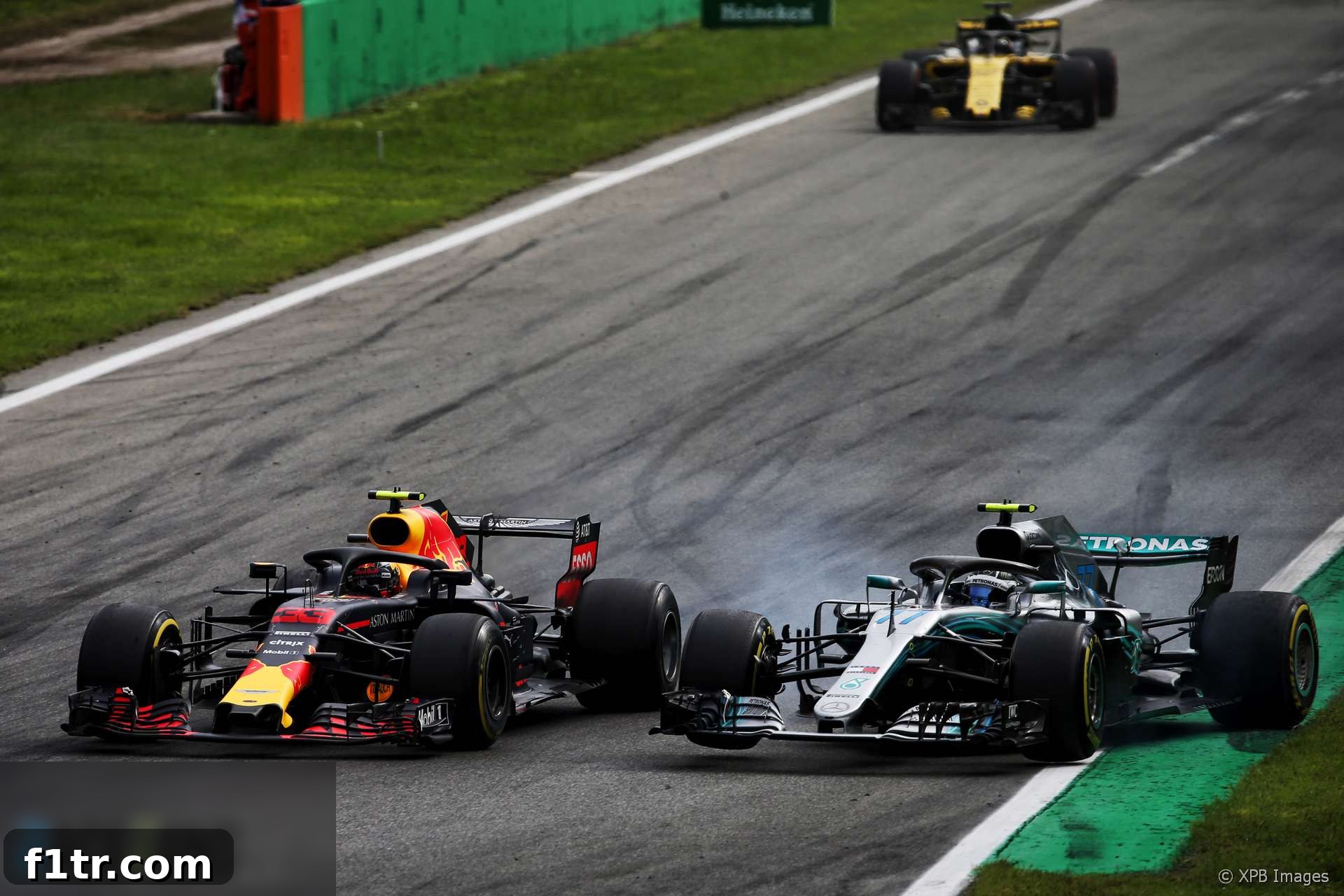
As the race entered its frantic closing stages, with positions fiercely contested, Verstappen was battling intensely for a podium finish. Positioned in third, he was under immense pressure from a charging Valtteri Bottas, who, driving a quicker Mercedes, sought to snatch the coveted spot. The decisive moment unfolded at the first chicane, a notorious pinch point at Monza known for its demanding braking zone and tight turns. Bottas, demonstrating characteristic determination, attempted an audacious overtake around the outside of Verstappen’s Red Bull.
What followed was a sharp, dramatic sequence of events. As both cars approached the apex, Verstappen appeared to move subtly towards the Mercedes under heavy braking, initiating contact. The impact was enough to disrupt Bottas’s line, forcing the Finn to take to the escape road and consequently lose several valuable seconds. While Verstappen managed to continue, the incident immediately caught the attention of the race stewards, who swiftly announced an investigation. This on-track confrontation became a flashpoint, highlighting the fine line between assertive racing and punishable contact in the high-stakes world of Formula 1.
The Monza Collision: A Detailed Look at Verstappen vs. Bottas
The Italian Grand Prix at the Autodromo Nazionale Monza is celebrated for its long straights and chicanes, demanding a unique blend of top-speed performance and precise braking. The first chicane, known as Variante del Rettifilo, is a prime overtaking spot, but also a notorious area for contact due to its tight entry and exit. It was here, in the crucible of this iconic corner, that Max Verstappen and Valtteri Bottas’s paths fatefully converged.
With just a handful of laps remaining, the battle for third place intensified. Verstappen, known for his uncompromising race craft, was determined to hold his position. Bottas, in a Mercedes that often found better traction and top speed, saw an opportunity to capitalize. His attempt to sweep around the outside of Verstappen at the entry to the chicane was a bold move, designed to gain a superior line through the corner. However, this maneuver relies heavily on the defending driver leaving sufficient space.
As the two cars braked from incredible speeds, the gap between them diminished rapidly. Onboard footage and trackside replays showed Verstappen’s Red Bull drifting marginally towards the Mercedes. Whether intentional or an unavoidable consequence of defending aggressively, the contact was undeniable. While the collision didn’t cause significant damage to either car, it undeniably compromised Bottas’s race, forcing him wide and off the track. This action, interpreted by the stewards as Verstappen “causing a collision,” set in motion a chain of events that would see the Dutch driver facing immediate consequences.
Stewards’ Ruling and Max Verstappen’s Vehement Reaction
Following a thorough review of telemetry data, video evidence, and consultation with both teams, the race stewards concluded their investigation. Their verdict was clear: Max Verstappen was deemed primarily responsible for the incident. As a result, a five-second time penalty was imposed, to be added to his final race time. This penalty proved significant, causing Verstappen to drop from a hard-fought third place on the road to fifth in the official final classification, a bitter pill to swallow for any driver battling for a podium.
Beyond the immediate time penalty, the stewards also awarded Verstappen two penalty points on his FIA Superlicense. These points, accumulated over a 12-month period, are a critical component of driver discipline in Formula 1, serving as a deterrent against repeated infringements. This double blow further amplified Verstappen’s frustration, which was palpable even before the checkered flag waved.
Verstappen’s Unfiltered Team Radio: “They’re Doing a Great Job of Killing Racing”
The announcement of the penalty during the race elicited a furious response from Verstappen, broadcast live to millions of viewers via his team radio. His raw emotions highlighted the tension and high stakes involved in F1 racing, as well as a prevalent debate within the sport about the balance between aggressive driving and regulatory oversight.
| To Verstappen | Okay Max, we’ve been given a five second time penalty. So we’ll need to push on now. Push on. |
| Verstappen | For what? |
| To Verstappen | Don’t worry about it, get your head down. |
| Verstappen | No, ‘don’t worry about it’. It’s [censored by FOM]. I gave him space. They’re doing a great job of killing racing, honestly. [Censored by FOM]. |
Verstappen’s heated words, particularly his assertion that the stewards were “killing racing,” resonated deeply with many fans and pundits. His sentiment articulated a common complaint among drivers: that increasingly strict rules and penalties stifle natural racing instincts and reduce the spectacle of wheel-to-wheel combat. From Verstappen’s perspective, he had defended his position legitimately, allowing what he perceived as sufficient space, and felt unjustly punished for a typical racing incident. This outburst underscored the mental pressure and the competitive fire that fuels top-tier Formula 1 drivers.
Understanding the F1 Superlicense Penalty System: A Driver’s Sword of Damocles
The FIA Superlicense is more than just a permit to race in Formula 1; it’s a privilege earned through extensive experience and proven skill. Integral to maintaining driver conduct and safety standards, the Superlicense comes with an accompanying penalty points system. This system acts as a crucial disciplinary mechanism, ensuring that drivers adhere to the rules and race responsibly.
Each time a driver commits a serious infringement or causes an avoidable incident, the race stewards have the authority to award penalty points. These points accumulate over a rolling 12-month period. The implications of reaching a certain threshold are severe: any driver who accrues 12 or more penalty points within this 12-month window will automatically be banned for one Grand Prix. This immediate race ban serves as the ultimate deterrent, forcing drivers to be acutely aware of their on-track conduct throughout the season.
Following the Italian Grand Prix incident, Max Verstappen’s Superlicense penalty points tally rose to a total of five points within a 12-month period. While five points might seem a considerable distance from the 12-point threshold, it immediately placed him on the radar. For a driver of Verstappen’s aggressive style, who frequently pushes the boundaries, this accumulation served as a stark reminder of the constant scrutiny and the potential for a forced absence from a race, which could have significant ramifications for championship aspirations.
The penalty points system is designed to provide consistency and fairness across all drivers, discouraging dangerous driving habits and promoting a culture of respect for both competitors and regulations. It ensures that repeated offenders face escalating consequences, ultimately protecting the integrity and safety of the sport. Drivers must manage their points carefully, knowing that every on-track skirmish or rule breach could bring them closer to the dreaded race ban.
The Wider Implications for Max Verstappen and the Future of F1 Racing
The Italian Grand Prix penalty, particularly the superlicense points, cast a long shadow over Max Verstappen’s immediate racing future and sparked broader conversations within the Formula 1 paddock. For Verstappen, who prides himself on his relentless pursuit of victory and his fearless driving style, the stewards’ decision was not merely about a few lost points in a single race but a challenge to his fundamental approach to racing. His “killing racing” comment highlighted the tension between pure, uninhibited competition and the strict framework of modern F1 regulations, a balance that the sport constantly grapples with.
This incident also served as a vivid example of the ongoing rivalry and intense competition that characterized the 2018 Formula 1 season. Red Bull, with Verstappen at the helm, was consistently challenging the established dominance of Mercedes and Ferrari. Every point, every podium finish, and indeed every penalty, carried significant weight in the constructors’ and drivers’ championships. The Monza incident, while seemingly localized, underscored the fierce battle being waged on multiple fronts, both on and off the track.
Ultimately, such penalties and the superlicense system are critical for the long-term health and credibility of Formula 1. They send a clear message that while aggressive racing is celebrated, it must always be conducted within acceptable limits of safety and fairness. For drivers like Max Verstappen, known for their fiery temperament and daring maneuvers, these moments serve as both learning experiences and reminders of the profound responsibility that comes with competing at the pinnacle of motorsport. The balance between allowing drivers to express their skill and ensuring safety will forever be a central theme in Formula 1, shaping the sport for generations to come.
2018 F1 season
- F1 feared “death knell” for Drive to Survive after Ferrari and Mercedes snub
- McLaren staff told us we were “totally crazy” to take Honda engines in 2018 – Tost
- ‘It doesn’t matter if we start last’: How Red Bull’s junior team aided Honda’s leap forward
- Honda’s jet division helped F1 engineers solve power unit problem
- McLaren Racing losses rise after Honda split
Browse all 2018 F1 season articles