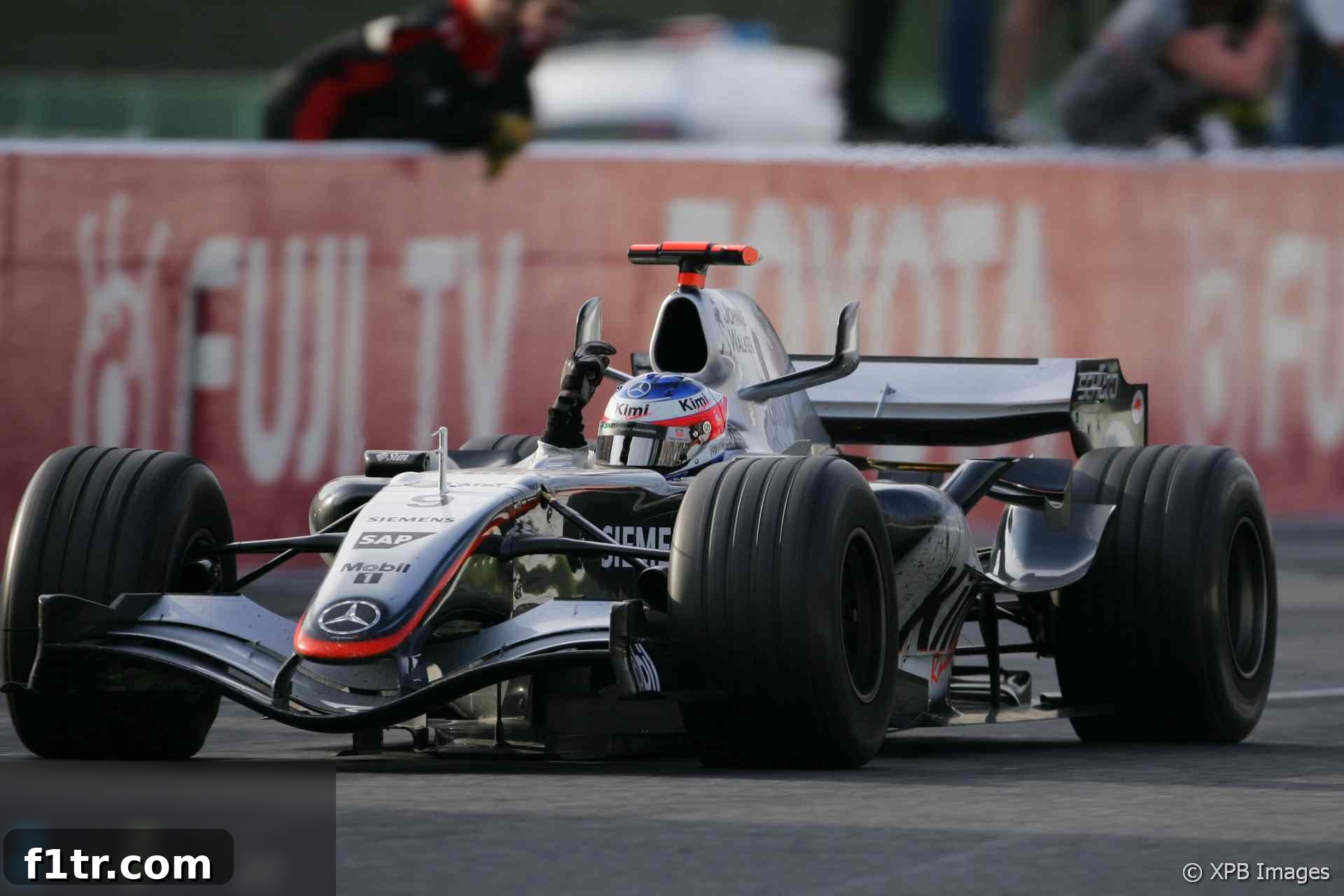
The 2005 Japanese Grand Prix at Suzuka remains etched in Formula 1 history as one of the most breathtaking and dramatic races ever witnessed. From start to finish, the event was a masterclass in motorsport theatre, featuring scintillating overtakes, strategic gambles, and a climactic finish that saw Kimi Raikkonen snatch an improbable victory from Giancarlo Fisichella on the very last lap. This race, often hailed as Raikkonen’s finest win and one of the best F1 encounters in years, showcased the raw talent and relentless spirit that defines a true champion, solidifying its place in the annals of Grand Prix racing lore.
Qualifying Drama Sets the Stage for Chaos
The groundwork for an unforgettable Sunday was meticulously laid by the unpredictable weather conditions that swept through Suzuka on Saturday. Persistent showers before and during qualifying turned the notoriously challenging circuit into a treacherous lottery. This meteorological intervention dramatically shuffled the established pecking order, lifting the usual front-runners such as Kimi Raikkonen, Fernando Alonso, and Juan Pablo Montoya out of their comfortable front-row positions and relegating them to the middle or back of the grid. It was a cruel twist for those vying for the championship but a delicious prospect for fans anticipating an upside-down grid.
Amidst the wet weather chaos, Ralf Schumacher delivered a stunning performance, securing Toyota their second-ever pole position on home soil, albeit under unconventional circumstances. He was joined on the front row by Jenson Button in the BAR-Honda, a testament to the team’s growing competitiveness. Giancarlo Fisichella, benefiting from a slightly delayed qualifying run and perhaps a touch of luck, secured an advantageous grid slot further down the order. His earlier failure to hold off Michael Schumacher in Interlagos had, in a perverse twist of fate, rewarded him with a more favourable qualifying position for this pivotal race. The stage was now perfectly set for an extraordinary Grand Prix, with championship contenders facing an uphill battle and unexpected challengers poised to seize glory.
A Chaotic Start and Early Safety Car
Despite the race being declared dry, the start was nothing short of chaotic, instantly igniting the drama that would define the entire event. As the lights went out, home hero Takuma Sato, undoubtedly feeling the immense pressure to deliver a career-saving performance in front of his adoring fans, lunged aggressively into the first corner. His desperation, however, proved his undoing as he speared off track, collecting Rubens Barrichello’s Ferrari in the process. The incident immediately cast a shadow over the start for two prominent drivers.
Moments later, David Coulthard, who had made a scintillating start, nearly squandered his early gains by running wide at the fearsome 130R corner. But the true mayhem erupted at the chicane. Kimi Raikkonen, starting from a lowly 17th position, was already aggressively making his way through the field. He attempted an ambitious move on Jacques Villeneuve, and in their close quarters battle, both drivers missed the corner. Bumping over the Astroturf runoff, they rejoined the track, unfortunately, directly into the path of Juan Pablo Montoya.
As Montoya instinctively pulled left to sweep past Villeneuve, the Sauber driver moved in the same direction, creating an unavoidable collision. The McLaren was pitched straight into the retaining wall, the impact instantly wiping off the left side of the car and bringing Montoya’s race to a premature and frustrating end. This dramatic incident immediately triggered the deployment of the Safety Car, which would remain on track for a crucial six laps, compressing the field and setting the stage for strategic mind games and further on-track battles.
Alonso’s Controversial Maneuvers and Mid-Race Shake-Up
When the Safety Car finally peeled into the pits, signalling the restart, Ralf Schumacher initially held onto his lead from Giancarlo Fisichella, who had expertly leapfrogged Jenson Button at the start. Further back, Michael Schumacher eased past a slow-moving Christian Klien. Fernando Alonso, ever the opportunist, attempted to emulate the elder Schumacher’s move at the chicane, but in doing so, he too went straight on. Displaying remarkable race craft and an acute awareness of the regulations, the savvy Alonso quickly ceded the position back to Klien, understanding he couldn’t legitimately hold it. Yet, almost immediately, he darted back past at Turn 1, seemingly daring the stewards to intervene and press home the full weight of the rules, a clear indication of his relentless pursuit of every possible advantage.
Amidst a growing cloud of confusion and deliberation, Alonso was finally instructed, a full three laps later, to let Klien past once more. This led to further complications; having already dropped back from Michael Schumacher to comply, he was then inexplicably told that he, in fact, did not have to yield the position, but by this point, Klien was already back ahead. It took another two frustrating laps before Alonso was able to regain his rightful place, by which time Kimi Raikkonen, displaying incredible pace and determination, had already clawed his way onto Alonso’s tail, creating a high-stakes three-way battle for midfield positions that felt more like a fight for the podium.
Meanwhile, Toyota’s initial competitiveness, underscored by Ralf Schumacher’s pole position, proved to be a fleeting illusion. Even with the advantage of six low-fuel consumption laps behind the Safety Car, Ralf pitted surprisingly early on lap 12. This suggested that his car had started with fewer than ten laps’ worth of fuel, a strategy that heavily compromised his race pace and position, exposing the team’s true performance limitations.
The Battle of Champions and Strategic Pit Stops
Just four laps after Ralf’s stop, Kimi Raikkonen had spectacularly joined Fernando Alonso and the formidable Michael Schumacher in a gripping, multi-car battle for fifth place. This wasn’t merely a fight for track position; it was a clash of titans, with three of the sport’s greatest drivers pushing each other to the absolute limit. After several tantalising half-opportunities, Alonso executed a breathtaking manoeuvre, seizing the chance to overtake Michael Schumacher around the outside of the fearsome 130R corner at an astonishing 180 mph. This daring move, just two laps before his own scheduled pit stop, underscored the Spaniard’s fearless commitment.
Raikkonen then stepped up to the plate, challenging the notoriously tough Ferrari driver. However, despite his relentless efforts, he couldn’t quite effect a clean pass. It soon transpired that this was partly due to both drivers carrying comparable fuel loads, which negated any significant strategic advantage. Consequently, they pitted together on lap 24 in a synchronised dance of strategy, resuming their battle in the same order but now both ahead of Alonso, who had pitted earlier. In similar circumstances two laps prior, Mark Webber had masterfully followed David Coulthard into the pits, only to emerge ahead, showcasing the critical role of swift pit stops. This was particularly welcome news for Williams, as Antonio Pizzonia had unfortunately spun out at Degner 2 on lap eight, reducing their car count.
The first round of pit stops significantly reshuffled the order, allowing Giancarlo Fisichella to rise into a comfortable lead with a clear track ahead. From this dominant position, it seemed he could finally assert control over the proceedings. Despite being briefly delayed by a sticking fuel flap during his own stop, Jenson Button found himself in a strong second place, ahead of an impressive Mark Webber, who was once again demonstrating the potent combination of Williams’s speed and his own aggressive driving. The intense Schumacher-Raikkonen-Alonso train, still locked in a fierce battle, now separated the Australian from Coulthard and the fading Ralf Schumacher.
Ralf was now the sole Toyota left running after a dramatic incident saw Jarno Trulli taken out of the race by his own teammate, Takuma Sato. Unsurprisingly, a furious Trulli had no kind words for the aggressive home driver in the aftermath. The stewards, after reviewing the footage, concurred with Trulli’s assessment, disqualifying Sato from the results for causing the avoidable crash, further cementing the impression of a chaotic and incident-filled race.
Raikkonen’s Relentless Charge and the Grandstand Finish
As the race progressed, Michael Schumacher could no longer parry the relentless attacks from Kimi Raikkonen. The Finn, driving with an almost supernatural precision, audaciously dived around the outside of Schumacher at Turn 1 on lap 28, a move that left spectators gasping. Four laps later, Fernando Alonso executed a similarly audacious overtake, having unnerved the veteran Ferrari driver into going off-line at the chicane. Raikkonen, now liberated from the clutches of the Ferrari, raced on, setting his sights on the intensifying Button-Webber battle for second place. However, knowing that this pair was running light on fuel, he displayed strategic patience, hanging back and waiting for their inevitable pit stops.
Giancarlo Fisichella, like Alonso, had opted for an earlier pit stop strategy compared to his McLaren rival. He soon pitted, dropping him temporarily to fourth place. The pivotal moment arrived on lap 41 when Jenson Button and Mark Webber pitted together. Once again, the Williams team delivered a lightning-fast pit stop for Webber, enabling him to gain a crucial position. Raikkonen, now with a clear track and two laps before his own stop, pressed home his advantage expertly, building a buffer. He emerged from his final pit stop with just nine laps to go, rejoining the track in an incredible second place, having somehow cut Fisichella’s commanding 20-second lead down to a mere nine seconds – a testament to his blistering pace and an almost perfect strategy execution.
While his teammate Fisichella seemed to be beginning to flag under immense pressure, Fernando Alonso, despite his earlier strategic setbacks and the FIA’s blunders, was as relentless and tenacious as Raikkonen himself. He charged past Button on lap 43, showcasing his fighting spirit, and executed an even more spectacular dive past Webber on lap 48, with two wheels momentarily on the grass as he approached Turn 1. It was a move born of sheer determination, yet even with his incredible efforts, he could do nothing to reel in the flying Raikkonen, left only to curse his less-than-optimal strategy and the stewards’ earlier indecision.
With Kimi Raikkonen bearing down on him at a terrifying rate of over a second per lap, the pressure finally began to take its toll on Giancarlo Fisichella. On lap 50, behind a backmarker, he panicked, momentarily baulking himself and bringing Raikkonen almost within striking range. The Italian began to block the inside of the run into the chicane, even when Raikkonen was too far back to realistically attempt a pass, a clear sign of his mounting anxiety. Then, as they began the final, nail-biting lap, Raikkonen tucked up tight behind the Renault down the main straight. In a move of incredible precision and daring, he darted to the left, missing the rear of the leader’s car by mere millimetres, and swept grandly around the outside of the first corner to complete an astonishing, improbable, and utterly magnificent overtake. The ‘Iceman’ had delivered a legendary victory, one that would be replayed and revered for decades to come.
A Race for the Ages and a Legacy Secured
Though the thrilling result of the Japanese Grand Prix meant that McLaren narrowly lost the lead of the Constructors’ Championship to Renault, nothing could dampen the immense elation of Kimi Raikkonen or his team principal, Ron Dennis. To have snatched victory against such formidable odds, in a race packed with drama from start to finish, was a triumph of skill, strategy, and sheer will. It mattered little that the Drivers’ Championship had already been settled; on this day, champions past, present, and undoubtedly future, fought a battle for victory as grand and enthralling as the sport has ever seen. Raikkonen’s drive was a testament to his raw talent and cemented his status as one of Formula 1’s most iconic figures, delivering a performance that elevated the race beyond mere points to a true sporting masterpiece.
Related Formula 1 Articles
- The ‘throwback weekend’ is back in fashion. But it’s a flawed concept – especially for F1
- Is Formula 1’s double race cancellation a blessing in disguise?
- Todt admits Schumacher crashed on purpose – but did it really cost him two titles?
- 25 of the most memorable radio exchanges from the ‘Max and GP show’
- FIA explains next steps after first meeting to discuss fixes for 2026 F1 rules
Browse all Formula 1 articles