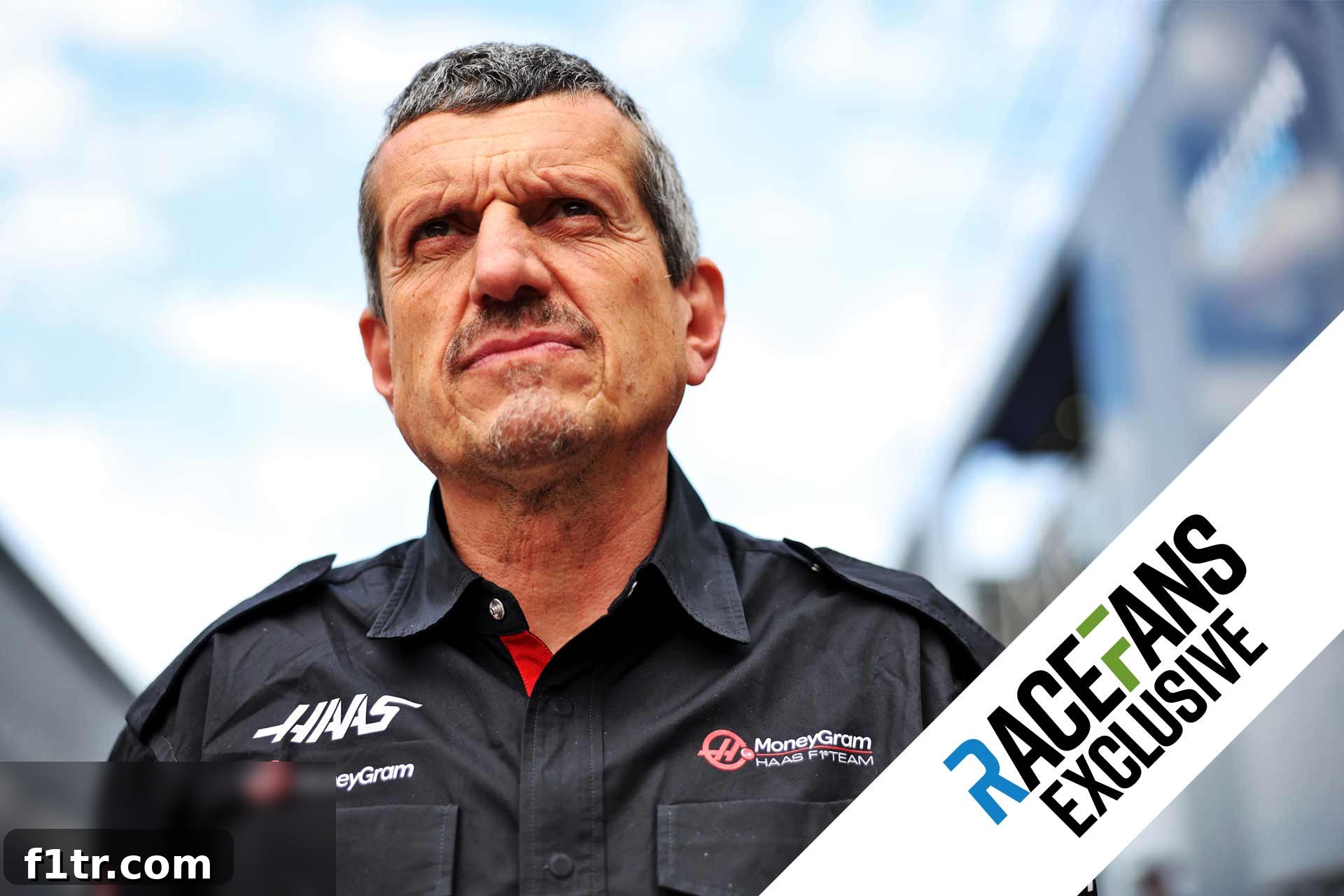
Guenther Steiner: The Unconventional Charisma of Formula 1’s Maverick Team Principal
In the high-stakes, hyper-technical world of Formula 1, where precision and corporate diplomacy often dictate the narrative, one figure stands out with an unmistakable, unvarnished charm: Guenther Steiner. The outspoken team principal of Haas F1, Steiner has carved a unique niche for himself, embodying a refreshing candor that many believe is increasingly rare in modern motorsport. His distinctive personality, often punctuated by memorable expletives and a no-nonsense approach, has not only endeared him to a global fanbase but also cemented his status as a true character in the paddock.
Christian Horner, the long-serving Red Bull team principal, recently reflected on the fading era of what he termed the ‘dinosaur’ archetype of F1 leadership. Horner, placing himself and Mercedes rival Toto Wolff in a lineage that includes legends like Ron Dennis, Eddie Jordan, and Frank Williams, lamented the shift towards leaders who are “much more technical than the entrepreneurial side.” He reminisced about a time when the sport boasted more “big characters and personalities.” While Horner’s observation holds merit, it’s perhaps ironic that he overlooked one of his former colleagues, a man who epitomizes the very essence of a larger-than-life personality: Guenther Steiner.
The Enduring Appeal of F1’s Unfiltered Leader
Steiner’s rise to cult status owes much to a certain Netflix documentary series, “Drive to Survive,” which catapulted his outraged outbursts and often vulgar vocabulary into the public consciousness. Fans worldwide resonated with his authentic frustration and passion, seeing in him a genuine voice amidst a sea of carefully crafted statements. Beyond the memes and viral clips, Steiner is a remarkably busy man, juggling multiple demanding roles. Not only does he steer the smallest team on the F1 grid, but he also manages his own composites design and manufacturing business in the United States. This year, at 58, he even added ‘published author’ to his impressive resume with the release of ‘Surviving to Drive’, offering a raw, personal account of Haas F1’s turbulent 2022 season.
During a candid conversation ahead of the Qatar Grand Prix, Steiner provided RaceFans with a glimpse into the relentless demands of his life. When asked how draining it truly is to be Guenther Steiner, his reply was characteristically honest and devoid of pretense.
“It is quite tiring,” he confessed amidst the familiar hustle and bustle of the paddock at the Losail International Circuit. “But in the end, if you choose to do something, you get that additional energy to do it.” He elaborated on the mental toll, acknowledging moments of doubt. “There are some days when you really think ‘why the hell do I do all this?’. Honestly, you just think about it.” Yet, he quickly pivots to a broader perspective: “But then again, I think it’s a privilege in life to do things you really like to do. I don’t hate any of the things I do. Obviously, I have to do jobs which I hate on a daily basis maybe, but it’s for 50 minutes, 20 minutes – like speaking with some journalist with red hair, that’s one of them…”
Steiner’s trademark grin and sarcastic wit perfectly betray his nature. He has earned the right to be cheeky, remaining firmly at the helm of the team he was hand-picked to lead by owner Gene Haas. Eight seasons into its existence, Haas F1 might not be a behemoth in the sport, but it stands as a viable, healthy competitor, a stark contrast to the numerous aspiring teams that have attempted to enter Formula 1 over the past three decades and failed. Their very survival is a testament to the team’s resilience and Steiner’s leadership.
Navigating the Grid: Haas F1’s Pursuit of Progress
Despite proving its capability to compete, Haas has grappled with achieving the necessary “escape velocity” to break away from the back of the grid and firmly establish itself in the midfield. Just days after this interview, the team regrettably ceded eighth place in the constructors’ championship to Alfa Romeo, underscoring the fierce competition and the tight margins in Formula 1.
Looking towards the future, Steiner has already announced the retention of experienced drivers Kevin Magnussen and Nico Hulkenberg for the 2024 season. This decision, following Hulkenberg’s recruitment to replace Mick Schumacher, clearly signals Steiner’s strategic betting on consistency and proven experience over unproven talent. While the team’s progress up the order has, at times, appeared stagnant, Steiner remains steadfast in his belief that brighter days lie ahead for Haas F1.
Driver Strategy and Team Foundation
“I think we’ve made steps,” he affirmed. “In Formula 1, to make steps like this, you cannot make them from today to tomorrow. You always need to keep on doing planning for the future.” He elaborated on the rationale behind their driver choices: “But when we made the decision last year that we wanted to go back to have experienced drivers, that was the reason why. We just want to be solid, knowing what is right, what is wrong. Just again strengthen the foundation of the team. It’s nice to see that it seems to be working.” While acknowledging the car’s performance shortcomings, “Obviously we are not, performance-wise with the car, where we want to be, but at least we know where we need to work at. It’s not the drivers. The car is just using the tyres too much in the race.” This clarity on identifying the core problem underscores the value of experienced feedback.
The Impact of Budget Cap and Strategic Upgrades
The team was set to introduce a highly anticipated upgrades package for their second home grand prix of the season in Austin. This development marked a significant departure from their 2022 strategy, a year marred by Mick Schumacher’s frequent errors that proved costly both in championship points and financially. In the era of the budget cap, Steiner shed light on the financial realities that constrained their development efforts in the previous season.
“I would say no, it wouldn’t have been possible,” he stated unequivocally when asked if a late-season upgrade was feasible in 2022. “Because I know the budget cap where we at last year, we couldn’t have afforded or we wouldn’t have stayed in the budget cap if we would have done an upgrade like this last year. We would’ve been outside of the budget cap.” This direct explanation highlights the stringent financial boundaries now governing F1 teams and how every development decision must be carefully weighed against the allocated budget.
The ability to introduce a substantial upgrade package at the end of the 2023 season further validates Steiner’s decision to prioritize experienced drivers like Hulkenberg. The stability provided by seasoned professionals allows the team to pinpoint car weaknesses more effectively and allocate resources for targeted development. “We can bring this upgrade this year because we didn’t do any in the beginning of the year because we couldn’t find any performance,” he explained. “People said ‘you don’t bring any upgrades’… even if you spend money, the car doesn’t go any faster! So why would I spend money? Therefore we made a change in the concept. We said instead of waiting for next year, we tried to do something this year to go already in the direction we want to go for next year.” This strategic pivot illustrates a pragmatic approach to development, focusing on long-term conceptual changes rather than incremental, ineffective updates.
The Andretti Conundrum: A Firm Stance on New Entries
Days prior to this interview, the FIA confirmed Formula 1’s worst-kept secret: Andretti-Cadillac’s bid to join the world championship as the 11th team had advanced to Formula 1 Management for consideration. While many fans embraced this news with excitement, Steiner has been consistently vocal in his opposition to another team being granted a place on the grid. Having been instrumental in the establishment of Haas F1 long before its first car hit the track, Steiner speaks with considerable authority on the immense challenges involved in building an entirely new Formula 1 team from the ground up.
“It’s not easy, to say the least,” Steiner remarked with a knowing tone. “It’s a big challenge.” He acknowledged the optimism inherent in such ambitious projects: “Obviously when you want to do it, you’re convinced you can do it.” However, he quickly tempered this with a dose of reality, referencing historical precedents. “But I think the best example is USF1 – they didn’t make it. Other people made it, but then they weren’t here for long because you need to also have the capability to stay here. It’s not only getting here – getting is almost as difficult as staying here. So I think it’s not easy.”
Steiner firmly believes that the sport’s evolution has only intensified these difficulties. “What I would like to say is that I don’t think it has gotten any easier than when we did it. It actually got a lot more difficult in my opinion. It’s just the intensity of the sport has grown in the last eight years massively. So I think it isn’t easy to do this and it shouldn’t be underestimated.” His perspective highlights that mere aspiration, even with significant backing, is often insufficient to overcome the immense operational and financial hurdles of sustained F1 participation.
Multi-Site Operations and F1’s Entry Barrier
Like Haas themselves, whose operations are strategically split across Kannapolis, North Carolina, Banbury in the UK, and Maranello at Ferrari’s Italian headquarters, Andretti has proposed a multi-site approach for their potential team. Steiner acknowledged the feasibility of such a model, based on his team’s own experience. “You can do a lot these days, being in different locations,” he confirmed. “Because we are in different locations – we’re in Italy, we are in England and we are in the US – but our base, our race team, is based in England for that reason.”
However, he expressed reservations about the specifics of Andretti’s plan due to a lack of transparency. “I don’t really know how Andretti would split it up because I haven’t seen any of their plans, obviously. I think only the FIA has seen them because there was nowhere written how exactly they going to do it. It’s all like ‘we’re going to do it a little bit here, a little bit there,’ but I don’t know. You can do some of the stuff in America – as we do – but the race operation we decided to have in the UK.” This pragmatic view suggests that while distributed operations are possible, the devil is in the details of execution and logistical efficiency, especially for race-critical functions.
Despite Formula 1’s soaring popularity in the United States and a regulatory revolution supposedly leveling the financial playing field, Steiner maintains that a new team entering the sport would find it even harder today, precisely because of the formidable strength of the current 10 competitors.
“It’s not that easy. Formula 1 has got very difficult and it’s getting more and more difficult,” he explained. “Actually it’s one of the things, you think ‘will there ever be an 11th F1 team?,’ just of being possible to do it. Because you haven’t got five years to build up to it, because you need to be very wealthy to do that one.” He referenced the high-profile example of Porsche’s flirtation with Red Bull, which ultimately saw the Volkswagen Group-owned brand abandon its F1 entry plans.
“A big corporate like Volkswagen, they opted to buy a team and when they couldn’t buy a team with one of their other brands, Porsche, they opted not to do it. So I actually think there is an awareness of how difficult this has become now. And going forward, it could be a concern as well.” Steiner believes the established F1 teams are robust and financially stable, making it difficult for an entirely new entity to compete effectively without immense capital and patience. “But maybe not, because there are 10 solid teams and if somebody’s really interested he just has to wait until something is for sale like everything else. At some stage everything comes and goes. But starting from zero will be very difficult.” This reflects a pragmatic, market-driven view where acquisition might be a more viable path than ground-up construction.
Haas F1’s Horizon: Independence and the 2024 Season
While Haas operates as its own manufacturer, its deeply integrated relationship with power unit supplier Ferrari is well-documented. Haas traditionally utilizes as many Ferrari-designed parts as regulations permit, a strategy that brings both benefits and inherent challenges. Chief among these challenges is the necessity for Haas to largely align with Ferrari’s aerodynamic concept, for better or for worse. Looking ahead, the question arises: can Steiner foresee his team ever completely cutting the cord and pursuing an entirely independent path?
“I think that’s a little bit too early to say,” he admitted cautiously. “We need to first get more solid before we do the next step. That’s our plan for the short-term, the next two years, just to get these things right, like this year. If we didn’t find improvement in the car, we should have changed direction earlier.” This statement underscores a philosophy of incremental, measured progress. Haas is focused on solidifying its current operational structure and performance before contemplating such a seismic shift. “We still need to learn a little bit. Once we get everything solid, under control, then we can think about it. But at the moment we don’t even think about it. We can make improvements with other things we do for the team then changing now or going on our own. Because, again, there are risks involved with it.” This pragmatic outlook prioritizes stability and proven gains over the significant risks associated with full independence, particularly in a budget-capped environment.
The Pivotal 2024 Season
While Haas’s final position in the 2023 standings was determined over the remaining rounds, attention naturally turns to the future. With the Austin upgrades deployed and a stable driver line-up confirmed, Steiner believes 2024 could prove to be a pivotal season for the team.
“Yeah, it could be,” he acknowledged, but with a realistic understanding of F1’s inherent unpredictability. “But it’s always the same. You do a new car, you really never know what you’ve got until you go out there and test, because you don’t know what the other ones are doing. Maybe we think we are great, but what if the other ones are great or if we’re still behind them. So it’s one of those things you just find out when you really get there in February.” This perspective highlights the perpetual uncertainty and competitive secrecy that define Formula 1, where every team strives for gains while being blind to their rivals’ true progress until pre-season testing.
Guenther Steiner: Authenticity in a Polished World
Guenther Steiner may not possess the polished eloquence of some of his counterparts, such as Williams team principal James Vowles, but his profound impact lies in his unwavering authenticity. His frank and honest answers to any question, irrespective of its difficulty, are his superpower, cutting through the typical corporate jargon of modern F1.
“That’s who I am,” Steiner insisted with a shrug. “I don’t have to create it. If you ask people who know me a long time, I haven’t changed. I never do this just to brush it away. No need for that.” This self-assurance is rare and highly valued. In an era where every team principal must meticulously consider every utterance, both on social media and in strategic meetings, Steiner’s experience and established reputation afford him a unique freedom to speak more openly. He is not one of the “new, modern ‘professionals'” Christian Horner referred to; instead, he represents a refreshing throwback to an era of unbridled personality.
While he could undoubtedly choose a less demanding path, Steiner shows no intention of relinquishing his role at Haas F1 anytime soon. His commitment stems from a deep-seated enjoyment of the challenge and the dynamic nature of the sport. “In life I think I’m fortunate because I can do what I want to do,” Steiner reflected.
“Is it hard, yeah. Could I have an easier life? Yes. But would I be bored pretty quick? Yes. So do this and just live sometimes with it. If I would take it a little bit slower, it would be better because it’s also the excitement, what you get with it. Every day, something new, different and good. I still enjoy it. The day I don’t enjoy it anymore, I know when to leave.” For Guenther Steiner, the relentless demands of Formula 1 are not just a job, but a privilege and a source of constant invigoration, making him one of the sport’s most compelling and irreplaceable figures.