For the second consecutive Grand Prix, the thrilling, season-long battle for the Formula 1 World Championship between Max Verstappen and Lewis Hamilton finds itself under threat of becoming a mere subplot. Instead, the spotlight shifts to a McLaren driver, chasing an unexpected, yet increasingly plausible, victory that could electrify the championship narrative even further.
Advert | Become a Supporter & go ad-free
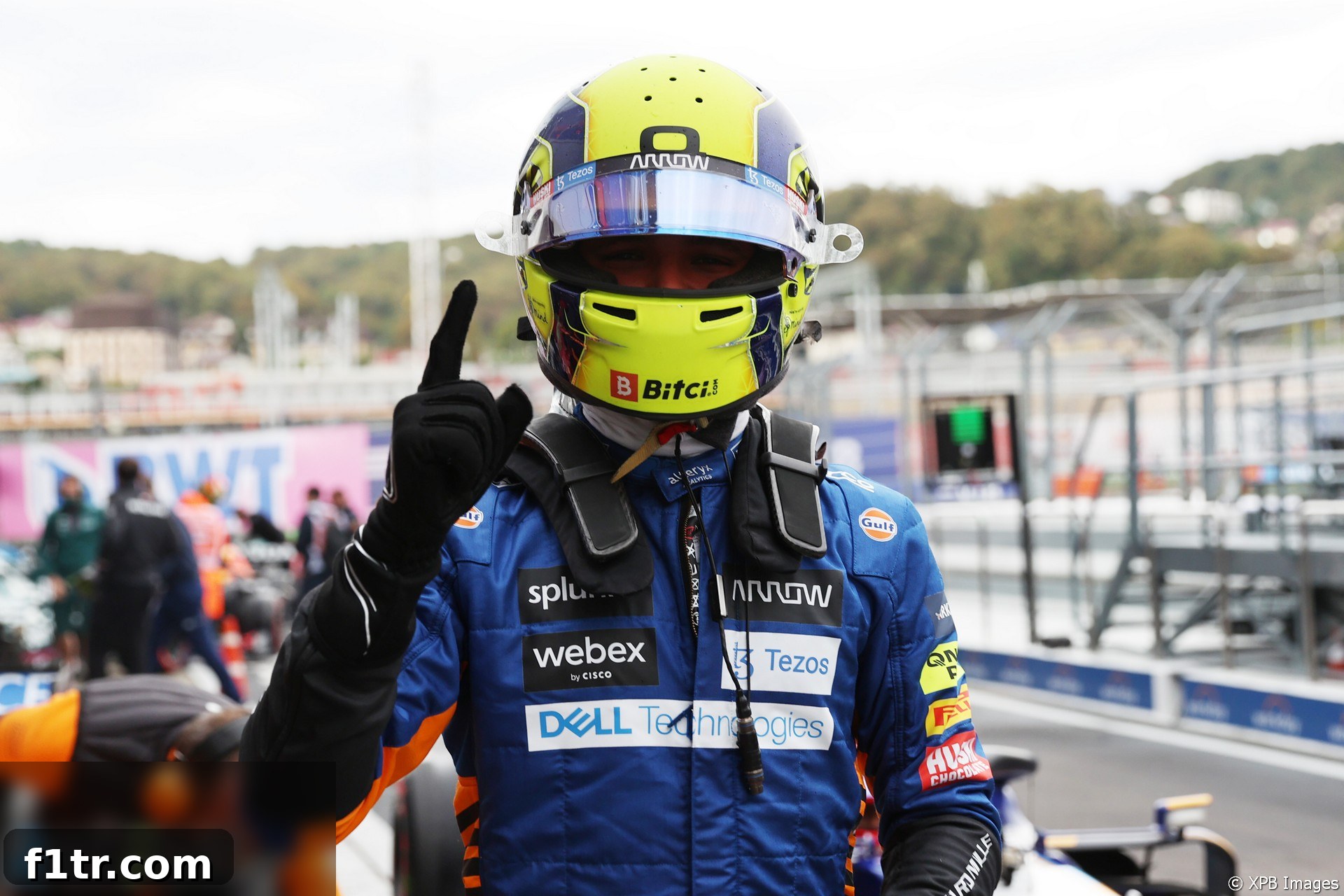
Lando Norris, the prodigious talent from McLaren, dramatically secured his maiden pole position in Formula 1. He achieved this feat by mastering the treacherous, drying conditions of the Sochi Autodrom qualifying session, delivering a blistering lap on soft tyres. This achievement instantly ignited a very legitimate prospect for McLaren: could they follow up their triumphant victory at Monza – their first in 170 grands prix – with another sensational win at the very next race weekend?
While McLaren proved their mettle and pace at Monza, expertly holding off their rivals throughout the race, replicating that dominant performance over the full 53 laps around the unique Sochi Autodrom presents an entirely different challenge. The Russian Grand Prix circuit, with its long straights, technical sections, and specific tyre demands, offers a contrasting test compared to Monza’s high-speed temple.
Leading into the Italian Grand Prix at Monza, McLaren had expressed confidence in their ability to maintain a lead if they could seize it at the start, even without a pole position. Their prediction proved accurate, aided significantly by the championship contenders, Verstappen and Hamilton, eliminating each other from the race at half-distance. However, Norris approaches the Russian Grand Prix with a more measured, yet determined, perspective regarding his chances of converting pole position into victory on Sunday.
“Do I think we can win? I would love to answer,” Norris mused, reflecting his ambition and realism. “I believe we can, there’s an opportunity for it. But Mercedes are still as quick as they have been all season, it’s probably one of their best circuits of the whole season. So it’s going to be a good challenge, but I’m up for it.” This statement perfectly encapsulates the blend of McLaren’s newfound confidence and the stark reality of competing against a formidable Mercedes team on a circuit traditionally favouring their package.
Norris and McLaren’s initial hurdle towards a potential victory will be the frantic dash down to the first true corner, Turn 2. This almost 900-meter sprint from the grid is notorious for its slipstream opportunities and the potential for dramatic position changes. To secure the lead, Norris will have to expertly defend against his former teammate, Carlos Sainz Jnr, driving for Ferrari, who qualified alongside him on the front row. Sainz will undoubtedly be looking to maximize the tow and gain an advantage into the first braking zone of the race, a critical moment that often dictates the early rhythm of the Russian Grand Prix.
Sainz elaborated on his strategic thinking for the start: “I think there’s two options. I either get a good getaway and it’s a direct race into Turn 2, or if not, obviously I’ll need to try to find a slipstream, because we know we are not the fastest on the straights and we are going to need to find some tow, some draft, because if not, it’s going to be a long run down into Turn 1.” This highlights the tactical dilemma faced by many drivers at Sochi – the balance between outright launch speed and leveraging the aerodynamic advantage of following another car.
Go ad-free for just £1 per month>> Find out more and sign up
Adding another layer of intrigue to the race start is George Russell, positioned directly behind both Norris and Sainz. After yet another stellar performance in a wet qualifying session, which saw him put his Williams surprisingly high up the grid, Russell was uncharacteristically bullish about his team’s prospects, not only at the start but also throughout the entire Grand Prix. His consistent ability to extract maximum performance from his machinery in challenging conditions has been a recurring theme of the season, and Sochi presents another prime opportunity.
“We’re pretty slippery on the straights and hopefully Lando will give me a nice little slipstream into Turn 1,” a confident Russell declared. His strategic insight into leveraging the Williams’ low-drag characteristics, combined with the power unit advantage provided by Mercedes, could make him a significant threat on the opening lap. “We’ve been scoring points now – three in the last four again. There’s no reason why we just can’t keep on going and we’ve got to be aiming for the podium. We’ve got nothing to lose and we’re just going to go for it.” This audacious ambition, coming from a Williams driver, underscores the unpredictability of the grid and the unique opportunities presented by the Russian Grand Prix.
Even Mercedes team principal Toto Wolff, usually composed, couldn’t resist a playful remark, suggesting the potential for an extraordinary start. “I would not be surprised if George is leading the race after Turn 3,” he joked, hinting at the possibility of both Mercedes’ future and current drivers – Russell and Hamilton – leading at the end of the opening lap. Such an outcome, however unlikely, speaks volumes about the respect Russell has earned for his qualifying prowess.
Should Norris successfully navigate the perilous opening laps and emerge from Turn 2 with his lead intact, his prospects for victory would be significantly boosted. A crucial advantage lies in the fact that most of the grid’s fastest cars – notably the dominant Red Bulls and Mercedes – are positioned multiple places behind him on the grid. This buffer provides an early window for Norris to establish a rhythm and potentially pull away, before the inevitable charge of the championship contenders begins.
The championship leader, Max Verstappen, faces an uphill battle, starting from the very back of the grid due to a combination of two penalties. Meanwhile, Lewis Hamilton, the reigning champion, starts from fourth. This scenario poses one of the most intriguing questions of the race: how far up the order will each championship contender manage to climb by the time the chequered flag falls? Their recovery drives will be pivotal in shaping the championship standings, adding immense pressure to every strategic decision and overtaking manoeuvre.
A significant element that could heavily influence the course of the Russian Grand Prix is the impact of Saturday’s semi-washout qualifying session. The chaotic conditions meant that drivers in the top 10 were not obligated to start on the tyres they used to set their fastest Q2 times, a rare occurrence outside of the sprint qualifying format. This provides every driver starting from a top-ten grid slot with the strategic flexibility to choose any compound of tyres they desire for the race start.
Intriguingly, this tyre choice freedom makes Sunday’s Grand Prix resemble races that utilise F1’s new sprint qualifying format, as seen most recently at the previous round in Monza. There, Mercedes capitalized on this unusual opportunity to start Hamilton on hard compound tyres, allowing for an extended opening stint. While Mercedes might have improvised their strategy in Monza to cover Verstappen after his pit stop delay, it will be fascinating to observe if they opt to play a patient game once more at Sochi, especially with Verstappen starting so far down the grid. The potential for varied tyre strategies among the front runners could lead to thrilling tactical battles throughout the race.
A longer first stint, enabled by more durable tyre compounds, may be particularly attractive to teams given the “green” nature of the Sochi surface. The track received a thorough washing on Saturday, leading to a relative lack of rubber build-up compared to a typical dry race weekend. This “green” track, combined with the unique characteristics of the Sochi tarmac, increases the likelihood that drivers will have to meticulously manage tyre graining. Although, the projected higher temperatures for the race start may offer some marginal relief, reducing the severity of graining to a small degree.
Red Bull’s Sergio Perez, keenly aware of these conditions, commented on the potential tyre challenges. “I think the degradation could be really high tomorrow because of the green track. The first couple of laps are going to be critical in that regard. So it will be interesting to see what happens with the strategy because we’re going to find a track that’s very different to expectations.” His observations underscore the uncertainty surrounding tyre performance and the strategic lottery facing every team.
The other crucial element determining the outcome of the race will be the extent of progress Perez’s teammate, Max Verstappen, can make from the back of the field. His primary objective will be to limit the damage to his drivers’ championship aspirations, having chosen this particular round to incur a power unit penalty. Verstappen has a history of navigating through the field at Sochi; he famously climbed from 19th to fifth in the 2018 Russian Grand Prix. However, with no dry running during Saturday’s practice sessions, even he remains unsure about the true performance comparison between his Red Bull and the formidable Mercedes on a dry track.
“It was a little bit difficult, but they still look very strong,” Verstappen conceded, referring to the Mercedes’ pace. “Of course, they will have turned up their engines in second practice for a fast lap and, from my side, I knew that I was starting in the back, so there was no reason to do that. So I guess we’ll have to wait and see how competitive we are going to be.” His measured assessment reflects the tactical nuances of F1, where engine modes and qualifying strategies are carefully managed, especially when grid penalties are a factor. The true pace of the Red Bull in a race situation from the back remains an unknown, but one that promises an exhilarating recovery drive.
Finally, the unpredictable weather could once again play a pivotal role in the proceedings. While there may only be a 20% chance of rain currently forecast throughout the course of the race, this low probability is not to be entirely dismissed in the world of Formula 1. Verstappen himself admitted that he expects overtaking to be significantly easier for him should the track turn wet. Given his grid position and the difficulty of passing at Sochi in the dry, he could be forgiven for secretly hoping that this seemingly low percentage of rain increases overnight, potentially creating the chaotic conditions that often favour audacious recovery drives and strategic gambles.
Whatever the weather conditions may bring, all the ingredients are present for what could undoubtedly be the most intriguing Russian Grand Prix we have witnessed to date. The tantalizing prospect of another new race winner stands as high as it has ever been, offering a refreshing shake-up to the established order. Concurrently, the championship battle between Verstappen and Hamilton could experience another significant swing, adding yet more drama and unpredictability to an already captivating Formula 1 season. From the start line to the chequered flag, every lap promises to be a spectacle of skill, strategy, and sheer determination.
Quotes: Dieter Rencken
Advert | Become a RaceFans supporter andgo ad-free
Qualifying times in full
| Driver | Car | Q1 | Q2 (vs Q1) | Q3 (vs Q2) | |
| 1 | Lando Norris | McLaren | 1’47.238 | 1’45.827 (-1.411) | 1’41.993 (-3.834) |
| 2 | Carlos Sainz Jnr | Ferrari | 1’47.924 | 1’46.521 (-1.403) | 1’42.510 (-4.011) |
| 3 | George Russell | Williams | 1’48.303 | 1’46.435 (-1.868) | 1’42.983 (-3.452) |
| 4 | Lewis Hamilton | Mercedes | 1’45.992 | 1’45.129 (-0.863) | 1’44.050 (-1.079) |
| 5 | Daniel Ricciardo | McLaren | 1’48.345 | 1’46.361 (-1.984) | 1’44.156 (-2.205) |
| 6 | Fernando Alonso | Alpine | 1’47.877 | 1’45.514 (-2.363) | 1’44.204 (-1.310) |
| 7 | Valtteri Bottas | Mercedes | 1’46.396 | 1’45.306 (-1.090) | 1’44.710 (-0.596) |
| 8 | Lance Stroll | Aston Martin | 1’48.322 | 1’46.360 (-1.962) | 1’44.956 (-1.404) |
| 9 | Sergio Perez | Red Bull | 1’46.455 | 1’45.834 (-0.621) | 1’45.337 (-0.497) |
| 10 | Esteban Ocon | Alpine | 1’48.099 | 1’46.070 (-2.029) | 1’45.865 (-0.205) |
| 11 | Sebastian Vettel | Aston Martin | 1’47.205 | 1’46.573 (-0.632) | |
| 12 | Pierre Gasly | AlphaTauri | 1’47.828 | 1’46.641 (-1.187) | |
| 13 | Yuki Tsunoda | AlphaTauri | 1’48.854 | 1’46.751 (-2.103) | |
| 14 | Charles Leclerc | Ferrari | 1’48.470 | ||
| 15 | Nicholas Latifi | Williams | 1’48.252 | ||
| 16 | Kimi Raikkonen | Alfa Romeo | 1’49.586 | ||
| 17 | Mick Schumacher | Haas | 1’49.830 | ||
| 18 | Antonio Giovinazzi | Alfa Romeo | 1’51.023 | ||
| 19 | Nikita Mazepin | Haas | 1’53.764 | ||
| 20 | Max Verstappen | Red Bull |
Sector times
| Driver | Sector 1 | Sector 2 | Sector 3 |
|---|---|---|---|
| Lando Norris | 36.517 (3) | 34.685 (1) | 30.791 (1) |
| Carlos Sainz Jnr | 36.549 (4) | 34.793 (2) | 31.168 (2) |
| George Russell | 36.308 (2) | 34.860 (3) | 31.815 (6) |
| Lewis Hamilton | 36.281 (1) | 35.656 (7) | 31.456 (3) |
| Daniel Ricciardo | 37.170 (9) | 35.062 (4) | 31.885 (7) |
| Fernando Alonso | 36.957 (7) | 35.133 (5) | 31.786 (5) |
| Valtteri Bottas | 36.847 (5) | 35.932 (8) | 31.554 (4) |
| Lance Stroll | 36.936 (6) | 35.410 (6) | 32.106 (12) |
| Sergio Perez | 37.106 (8) | 36.166 (10) | 31.905 (9) |
| Esteban Ocon | 37.355 (10) | 35.979 (9) | 32.075 (10) |
| Sebastian Vettel | 37.632 (13) | 36.714 (12) | 32.093 (11) |
| Pierre Gasly | 37.411 (11) | 36.693 (11) | 31.894 (8) |
| Yuki Tsunoda | 37.552 (12) | 36.845 (13) | 32.354 (13) |
| Charles Leclerc | 38.090 (15) | 37.303 (14) | 32.585 (14) |
| Nicholas Latifi | 37.753 (14) | 37.512 (15) | 32.987 (15) |
| Kimi Raikkonen | 38.456 (17) | 37.917 (16) | 33.213 (16) |
| Mick Schumacher | 38.233 (16) | 37.993 (17) | 33.604 (17) |
| Antonio Giovinazzi | 39.191 (19) | 38.202 (19) | 33.630 (18) |
| Nikita Mazepin | 39.912 (20) | 38.853 (20) | 34.999 (19) |
| Max Verstappen | 38.599 (18) | 38.060 (18) |
Speed trap
| Pos | Driver | Car | Engine | Speed (kph/mph) | Gap |
|---|---|---|---|---|---|
| 1 | Lewis Hamilton | Mercedes | Mercedes | 307.1 (190.8) | |
| 2 | Nicholas Latifi | Williams | Mercedes | 304.5 (189.2) | -2.6 |
| 3 | Sergio Perez | Red Bull | Honda | 304.2 (189.0) | -2.9 |
| 4 | Valtteri Bottas | Mercedes | Mercedes | 302.7 (188.1) | -4.4 |
| 5 | George Russell | Williams | Mercedes | 301.1 (187.1) | -6.0 |
| 6 | Yuki Tsunoda | AlphaTauri | Honda | 301.0 (187.0) | -6.1 |
| 7 | Pierre Gasly | AlphaTauri | Honda | 299.6 (186.2) | -7.5 |
| 8 | Lance Stroll | Aston Martin | Mercedes | 298.9 (185.7) | -8.2 |
| 9 | Sebastian Vettel | Aston Martin | Mercedes | 298.4 (185.4) | -8.7 |
| 10 | Lando Norris | McLaren | Mercedes | 296.2 (184.1) | -10.9 |
| 11 | Charles Leclerc | Ferrari | Ferrari | 295.4 (183.6) | -11.7 |
| 12 | Carlos Sainz Jnr | Ferrari | Ferrari | 294.8 (183.2) | -12.3 |
| 13 | Esteban Ocon | Alpine | Renault | 294.7 (183.1) | -12.4 |
| 14 | Kimi Raikkonen | Alfa Romeo | Ferrari | 292.5 (181.8) | -14.6 |
| 15 | Fernando Alonso | Alpine | Renault | 292.0 (181.4) | -15.1 |
| 16 | Daniel Ricciardo | McLaren | Mercedes | 291.1 (180.9) | -16.0 |
| 17 | Mick Schumacher | Haas | Ferrari | 289.8 (180.1) | -17.3 |
| 18 | Antonio Giovinazzi | Alfa Romeo | Ferrari | 279.7 (173.8) | -27.4 |
| 19 | Nikita Mazepin | Haas | Ferrari | 276.9 (172.1) | -30.2 |
| 20 | Max Verstappen | Red Bull | Honda | 274.3 (170.4) | -32.8 |
Advert | Become a RaceFans supporter andgo ad-free
Over to you
Will Norris, Sainz, or Russell seize this extraordinary opportunity to score their first Formula 1 victory at the Russian Grand Prix? Which of the championship contenders, Max Verstappen or Lewis Hamilton, will ultimately come out ahead in their crucial battle to limit or extend their championship lead?
Share your predictions and insights on the unfolding drama of the Russian Grand Prix in the comments section below. Your thoughts on the potential strategies, tyre gambles, and outright race pace are vital to the discussion.
2021 Russian Grand Prix
- Norris says he missed few chances to win in 110-race wait for first F1 victory
- Sochi disappointment will make Norris and McLaren stronger, says Seidl
- F1 race start times could be brought forward to avoid Spa-style wash-outs
- New technology in Ferrari’s power unit update vital for 2022 – Binotto
- Mercedes have left too many points on the table, admits Wolff
Browse all 2021 Russian Grand Prix articles