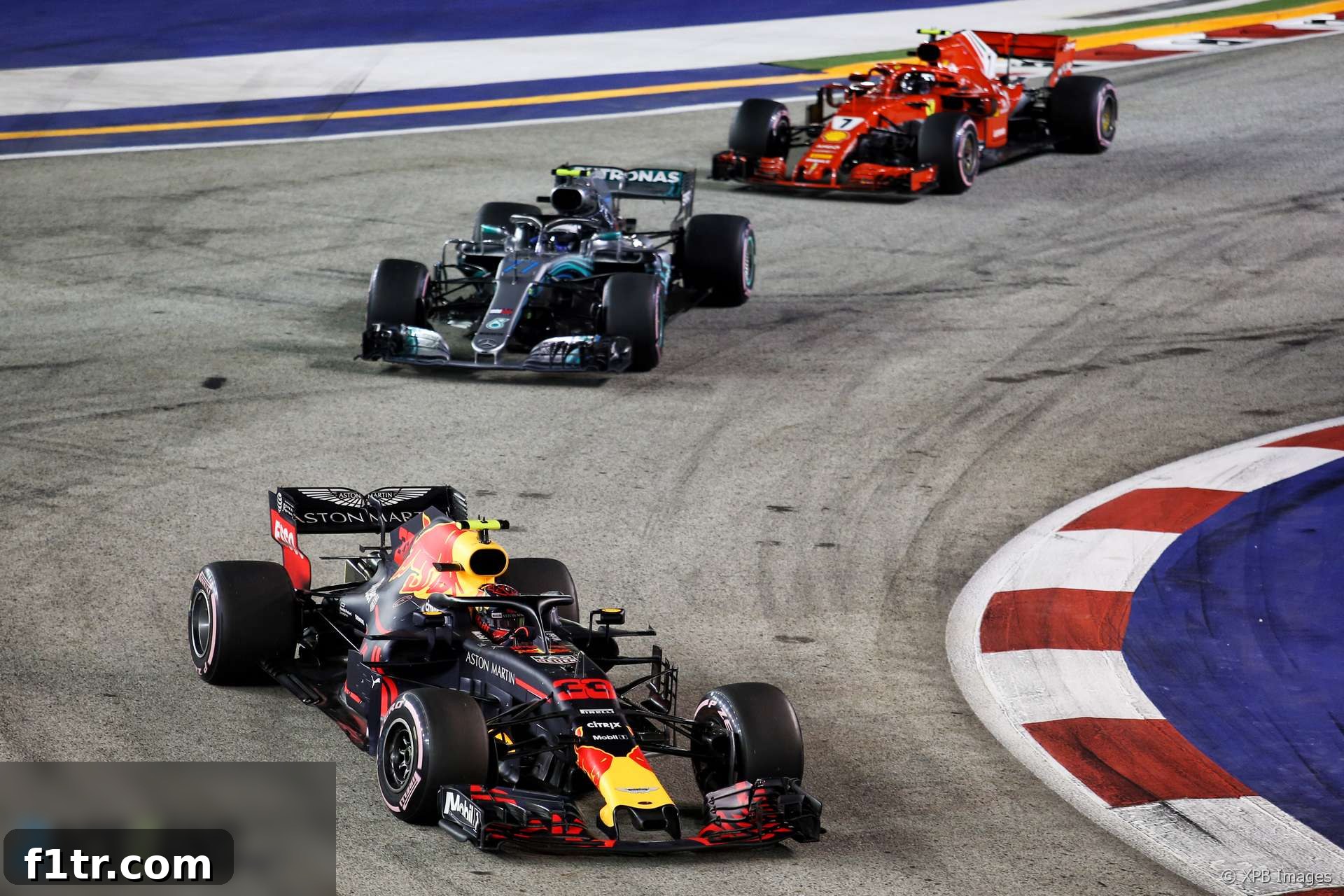
In the thrilling world of Formula 1, where every race promises a spectacle of speed, strategy, and unpredictability, certain events stand out for their unusual characteristics. The Singapore Grand Prix, a dazzling night race held on the challenging Marina Bay Street Circuit, often delivers memorable moments. However, its 2018 edition, much like the Monaco Grand Prix earlier that year, garnered attention for a peculiar statistic: the top six drivers on the grid maintained their exact starting positions when the chequered flag fell. This rare occurrence, signaling a procession rather than a fierce battle for positions, prompted discussions about the evolving dynamics of modern Formula 1 and the impact of various regulations designed to enhance racing excitement.
The shared characteristic between Singapore and Monaco in 2018 wasn’t limited to static top-six finishes. Both races also marked the appearance of Pirelli’s hypersoft tyre compound, introduced with the intention of injecting more strategic variation and unpredictability into Grand Prix weekends. The hypersoft, designed to offer maximum grip but with a shorter lifespan, aimed to force teams into more aggressive or unconventional pit stop strategies. Yet, despite its debut in these high-profile races, it didn’t quite deliver the desired effect. The inherent nature of street circuits like Monaco and Singapore, with their tight corners, limited overtaking opportunities, and emphasis on track position, often overrides the strategic potential of tyre choices. This left many questioning whether F1’s increasingly complex tyre rules truly achieve their goal of generating consistent intrigue and closer racing throughout the field.
Mercedes’ Mastery and Hamilton’s Unstoppable Momentum
For years, the Marina Bay Street Circuit held a reputation as Mercedes’ ‘bogey track’ – a circuit where the dominant Silver Arrows consistently struggled to match their pace from other venues. This perception was particularly solidified after their notably weak performance in 2015. However, recent history tells a different story. Since that challenging season, Mercedes has undergone a remarkable transformation at Singapore, securing two pole positions and three victories in the subsequent three races. This impressive turnaround firmly establishes Singapore as a track where Mercedes has not only overcome past demons but has also forged a formidable record, proving their exceptional engineering prowess and adaptability to even the most demanding conditions.
Central to Mercedes’ recent success, and indeed the entire 2018 season, has been the unparalleled form of Lewis Hamilton. The British driver now stands as a four-time winner on the floodlit streets of Singapore, an achievement that places him alongside his fierce rival, Sebastian Vettel, in the history books for most victories at this challenging venue. The 11 Singapore Grand Prix races held to date have seen only four different winners: Hamilton, Vettel, Nico Rosberg, and Fernando Alonso. While some might recall the controversies surrounding the inaugural race, which Alonso famously won amidst the ‘Crashgate’ scandal, Hamilton’s consistent triumphs underscore his exceptional skill and focus on this unique urban circuit.
Hamilton’s championship charge in 2018 was a masterclass in consistency and strategic brilliance. Over the five races leading up to Singapore, he had dropped a mere seven points from a potential haul of 125, demonstrating an almost flawless performance streak. During this pivotal period, Hamilton utterly dominated his rivals, outscoring Sebastian Vettel, who was the next-highest scorer, by an astonishing 118 points to 70. This relentless accumulation of points propelled Hamilton to a commanding 40-point lead in the drivers’ championship standings. Such was his position of strength that, even if Vettel were to win all the remaining races, Hamilton could still secure the title by consistently finishing second. This incredible advantage was forged not just through raw speed, but also through an uncanny ability to maximize every opportunity, avoid costly mistakes, and deliver under immense pressure.
Interestingly, Hamilton’s formidable lead came despite some statistics that, on paper, favored Vettel. The Ferrari driver boasted a superior average qualifying position (2.13 compared to Hamilton’s 2.87) and had spent more laps in the lead (341 laps to Hamilton’s 299). These figures highlight the nuances of a Formula 1 championship: while outright pace and qualifying performance are crucial, race craft, strategic execution, reliability, and the ability to convert adverse situations into valuable points often prove to be the deciding factors. Hamilton’s consistency in points scoring, coupled with fewer significant errors or misfortunes, allowed him to build an almost unassailable lead, showcasing the relentless nature of his championship campaign.
Milestones, Records, and Midfield Triumphs
While the top echelons of Formula 1 are often defined by the fierce battles between the sport’s biggest names, the Singapore Grand Prix also offered moments of celebration for teams and drivers further down the grid. As Lewis Hamilton added to his impressive career totals for pole positions (79) and race victories (69), the event also witnessed a significant first for Kevin Magnussen and the Haas F1 team: their maiden fastest laps in Formula 1 history. Magnussen’s achievement made him the 130th driver to set a fastest lap in F1, a feat his father Jan, who also competed in the sport, never accomplished. For Haas, becoming the 34th different team to achieve a fastest lap underscored their impressive journey as a relatively new privateer entry, consistently punching above their weight and proving their mettle against established manufacturers.
The challenging nature of the Singapore Grand Prix circuit often plays into the hands of cars with strong aerodynamic packages, and Red Bull Racing has historically excelled here. The 2018 race continued this impressive trend, marking the ninth consecutive year a Red Bull car had finished on the podium at Marina Bay. Furthermore, for the fourth year running, it was a second-place finish for the Austrian outfit. This time, however, it wasn’t the familiar face of Daniel Ricciardo spraying the champagne, but rather the rising star Max Verstappen, who delivered a mature and controlled performance to secure the strong result, showcasing his growing experience and ability to maximize opportunities.
Elsewhere on the grid, Fernando Alonso, in what was proving to be a challenging season for McLaren, managed to extract a commendable performance. His result in Singapore marked McLaren’s best finish since the Azerbaijan Grand Prix, a rare glimmer of hope for the struggling British team. Crucially, it was also only the second time since that Baku race that Alonso had managed to finish on the lead lap, a testament to his enduring skill and ability to push his car to its absolute limits, even when competitive pace was a distant dream for McLaren.
The race also saw a significant career milestone for Nico Hulkenberg, who marked his 150th Formula 1 Grand Prix start. Despite his extensive experience and consistent performances throughout his career, the German driver’s elusive quest for a maiden podium appearance continued. Hulkenberg’s journey highlights the often-unforgiving nature of F1, where talent and consistency don’t always translate into top-tier results without the machinery to match. Meanwhile, another veteran, Kimi Raikkonen, was quietly setting himself up to break one of the sport’s most enduring records.
With 285 starts already to his name by the Singapore Grand Prix, Kimi Raikkonen, often dubbed ‘The Iceman’, was firmly on course to surpass Rubens Barrichello’s long-standing record for the most race starts in Formula 1 history. His newly announced two-year deal with Sauber was the crucial factor that would propel him past Barrichello’s impressive tally of 322 starts. It was projected that Raikkonen would achieve this remarkable milestone sometime during the 2020 F1 season, further cementing his legendary status in the sport. Had Raikkonen not taken a two-year sabbatical from Formula 1 between 2010 and 2011, during which he missed 38 races, he would have likely broken the record much earlier, possibly even at the very weekend of the Singapore Grand Prix. His enduring passion for racing, combined with his unique personality and undeniable talent, continued to make him a fan favorite and a true icon of Formula 1 longevity.
Looking Ahead: The F1 Season in Review
The 2018 Singapore Grand Prix provided a mixed bag of insights into the season’s unfolding narrative. While the top-six procession highlighted ongoing concerns about overtaking on certain circuits, it also showcased the strategic dominance of Mercedes and the unwavering consistency of Lewis Hamilton. The midfield battles, however, continued to deliver engaging stories, from Haas’s historic fastest lap to Alonso’s determined drive. As the championship headed into its final stages, Hamilton’s commanding lead suggested that the focus would soon shift from who would win the title to when and how he would mathematically secure it. The intricacies of tyre strategy, the demanding nature of diverse circuits, and the relentless pursuit of perfection by teams and drivers all contributed to a captivating season of Formula 1.
For those eager to delve deeper into the statistical intricacies of the year, a comprehensive review of the season’s data is readily available:
- 2018 F1 championship points
- 2018 F1 season records
- 2018 F1 race data
- 2018 F1 qualifying data
- 2018 F1 retirements and penalties
- 2018 F1 strategy and pit stops
Did you uncover any other fascinating statistics or noteworthy facts from the Singapore Grand Prix? We encourage you to share your findings and insights in the comments section below.
2018 Singapore Grand Prix: Related Articles
- How Singapore showed F1’s problem with processions again
- 2018 Singapore Grand Prix Star Performers
- Top ten pictures from the 2018 Singapore Grand Prix
- Hamilton closes on title as Mercedes deny Ferrari in Singapore
- Vote for your 2018 Singapore Grand Prix Driver of the Weekend
Browse all 2018 Singapore Grand Prix articles