In a significant development signaling the intense preparations for Formula 1’s transformative 2026 season, Aston Martin has confirmed it will not utilize its full allocated testing days for its new challenger. This decision positions them as the second team, following Williams, to opt for a more selective approach to the crucial initial shakedown of their groundbreaking machinery. The highly anticipated first official tests for cars built to F1’s sweeping new technical regulations commenced today at the iconic Circuit de Catalunya in Barcelona, marking the dawn of a new era for the pinnacle of motorsport.
Advert | Become a Supporter & go ad-free
Under the revised regulations, each Formula 1 team is permitted to run their new car for up to three of the first five testing days. However, the Honda-powered Aston Martin team was notably absent from the initial proceedings, choosing a more measured start to their program. Williams, the first to declare its intentions, had already confirmed it would not partake in this initial Barcelona test at all, underscoring varied strategic approaches among the constructors as they grapple with the demands of the new rules.
Aston Martin officially stated today that their AMR256 will not commence track running until at least the fourth day of the scheduled five-day shakedown. “The AMR256 will be in Barcelona later this week for its shakedown,” the team announced via its social media channels. “Our intention is to run [on] Thursday and Friday.” This measured debut suggests a meticulous internal preparation schedule, perhaps allowing for final checks and calibrations away from the immediate gaze of competitors and the limited public eye.
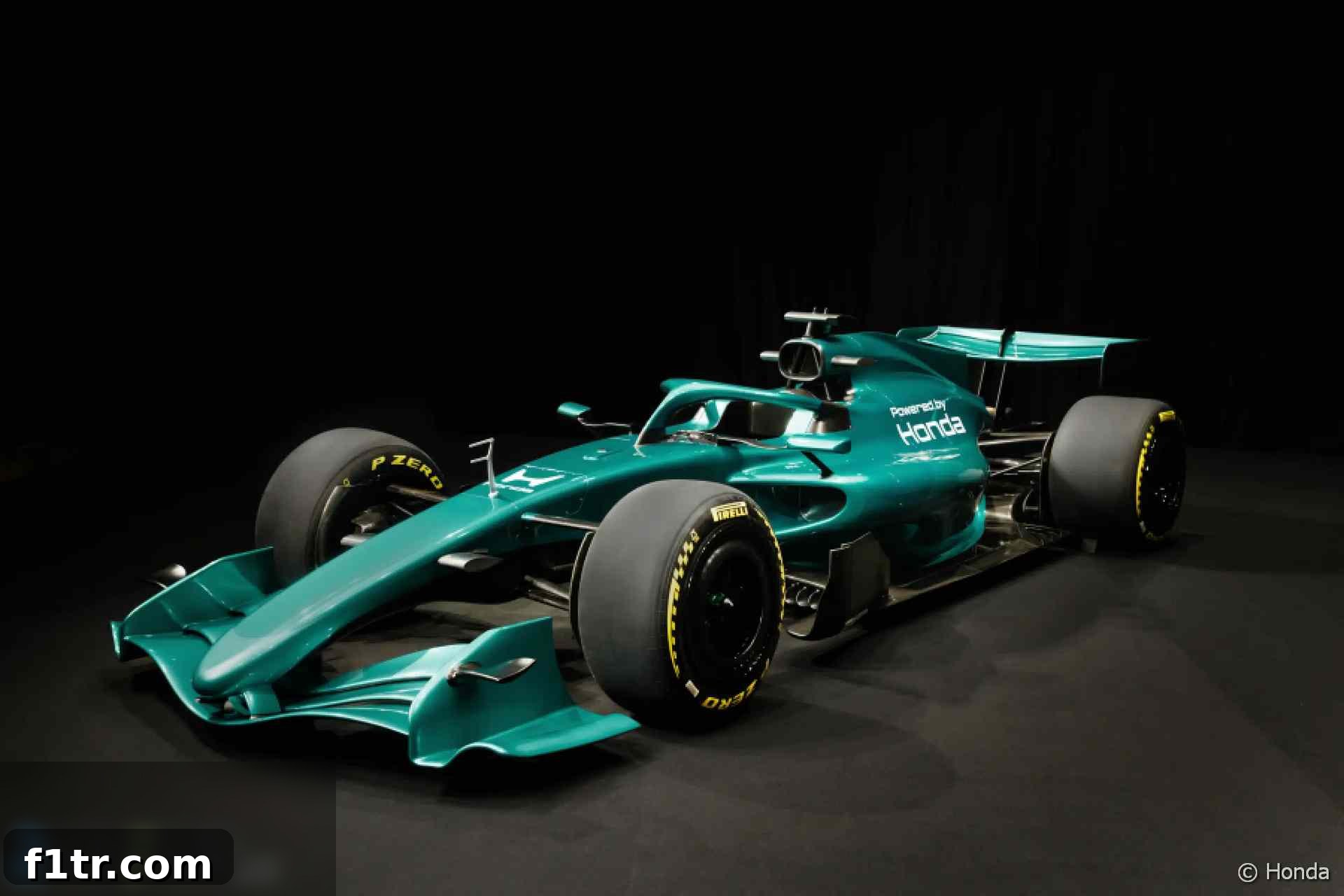
To date, Aston Martin has maintained a tight veil of secrecy around its 2026 contender, revealing no specific details of its new car’s design or its eagerly awaited livery. However, their new power unit supplier, Honda, which takes over from Mercedes in a pivotal strategic shift for the British team, offered a tantalizing glimpse earlier this month. Honda released images of its new power unit, designated the RA626H, showcased alongside an Aston Martin show car, providing the first visual hint of the partnership that aims to propel Aston Martin to championship contention.
The Barcelona Shakedown: A First Glimpse into F1’s Future
The F1 opening five-day test, officially dubbed the ‘Barcelona Shakedown,’ commenced with seven teams eagerly hitting the track. This initial contingent included championship titans Red Bull and its junior team Racing Bulls, Mercedes, and its new engine customer Alpine, along with the much-anticipated newcomers Cadillac and Audi, and established midfield runner Haas. Conspicuously absent from day one, besides Aston Martin and Williams, were perennial front-runners Ferrari and the reigning world champions McLaren. Both of these esteemed teams are widely expected to join the test proceedings on day two, adding further competitive intrigue to the evolving picture.
While Formula 1 tests have historically been open to observers, allowing media and fans a rare, up-close look at the development process, Formula One Management (FOM) has imposed a significant change for this inaugural test of the 2026-spec cars. For reasons of competitive secrecy and potentially to manage the narrative surrounding these early, experimental runs, FOM has explicitly barred media representatives from covering the test in person. Furthermore, fans are also not permitted to attend, creating an unprecedented air of mystery around the initial development phase of F1’s next generation of machinery.
Advert | Become a RaceFans supporter andgo ad-free
Strategic Implications of Delayed Testing
The decisions by Aston Martin and Williams to delay or limit their participation in the initial shakedown raise pertinent questions about strategic development and resource allocation. For Aston Martin, a team with significant investment and ambition, a delayed start could imply a focused, methodical approach to validating their new car and the integration of their Honda power unit. This might allow them to gather more complete data from their simulations and dyno tests before committing to track time, ensuring a more refined package from the outset. It’s a calculated gamble, balancing immediate track feedback against potential development lead time and avoiding early public scrutiny of a raw, unoptimized machine.
Williams’ decision, on the other hand, might stem from different considerations. As a team with more constrained resources compared to top-tier outfits, every minute of testing, simulation, and manufacturing is critical. Prioritizing development at their factory, or focusing on specific component testing, could be a more efficient use of their budget and engineering bandwidth, rather than an early track outing with a potentially underdeveloped chassis. Both approaches highlight the diverse challenges and opportunities presented by a major regulation change, where every team must find its optimal path to competitive advantage.
The Dawn of 2026: A Technical Revolution in Formula 1
The 2026 Formula 1 season is poised to usher in one of the most significant technical overhauls in the sport’s modern history. At its core are radical changes to both the power units and the chassis regulations, designed to make the sport more sustainable, competitive, and relevant to future road car technology. The new power unit regulations are arguably the most transformative. They mandate a near 50/50 split between internal combustion engine (ICE) power and electrical power, significantly increasing the electrical component compared to current specifications. Crucially, the complex and costly MGU-H (Motor Generator Unit – Heat) will be removed, a move intended to simplify the power units, reduce costs, and attract new manufacturers like Audi and Cadillac into the sport. Furthermore, the engines will run on 100% sustainable fuels, a key pillar of F1’s commitment to achieving net-zero carbon by 2030.
On the chassis and aerodynamic front, the 2026 cars are expected to be smaller, lighter, and feature ground-breaking active aerodynamics. This includes active front and rear wings that can dynamically adjust to reduce drag on straights – dubbed ‘Z mode’ for high speed and ‘X mode’ for higher downforce in corners. The aim is to make the cars less dependent on dirty air, thereby promoting closer racing and more overtaking opportunities. These dramatic changes require an entirely fresh engineering philosophy from the ground up, making early testing, even if limited, invaluable for understanding the real-world behavior of these complex machines.
The Significance of Honda’s Return with Aston Martin
The partnership between Aston Martin and Honda for the 2026 season represents a monumental shift for both entities. Honda, having recently achieved unparalleled success as a power unit supplier with Red Bull Racing, brings a wealth of knowledge, winning pedigree, and cutting-edge hybrid technology to Silverstone. This alliance immediately elevates Aston Martin’s aspirations, placing them firmly in the conversation for championship contention. The RA626H power unit will be bespoke to Aston Martin, signifying a deeper integration and collaboration than their previous customer engine deals.
For Honda, this marks a renewed commitment to Formula 1 following their previous “official” withdrawal, demonstrating the magnetic pull of the sport’s new regulations and the potential for technological innovation. The synergy between Aston Martin’s ambitious chassis development and Honda’s proven engineering prowess could prove to be a formidable combination, and the success of this partnership will be a defining narrative of the 2026 era. The world waits to see if this Anglo-Japanese alliance can replicate the championship-winning success Honda found with Red Bull.
The Veil of Secrecy: FOM’s Rationale
FOM’s unprecedented decision to exclude media and fans from the initial 2026 car shakedown has sparked debate across the motorsport community. While frustrating for enthusiasts and journalists eager for the first insights, the rationale likely centers on several key objectives. Firstly, it allows teams to conduct their initial runs in a highly controlled and private environment, free from immediate external pressure and scrutiny. This is particularly crucial when dealing with completely new technical regulations, where cars are likely to be experimental and potentially far from their optimal performance envelope. This secrecy allows teams to work through any teething problems away from the public eye.
Secondly, it enables Formula 1 Management to tightly control the narrative surrounding the new era. By delaying widespread reporting and imagery, FOM can build anticipation for official launches and curated media events, ensuring a consistent and positive message about the future of the sport. While some argue it detracts from transparency, the move aims to protect the competitive integrity of the sport’s nascent development phase, preventing rivals from gaining immediate visual or acoustic intelligence on innovative solutions. This strategy will certainly amplify the excitement when the new cars are finally unveiled in their full glory.
The road to 2026 promises to be one of the most fascinating development cycles in Formula 1 history. As teams like Aston Martin and Williams embark on their unique paths through this period of profound change, every strategic decision, every technological breakthrough, and every testing lap will play a crucial role in shaping the competitive landscape of the sport’s exciting new era.
Miss nothing from RaceFans
Get a daily email with all our latest stories – and nothing else. No marketing, no ads. Sign up here:
Formula 1
- One of F1’s greatest races happened 15 years ago today. Or did it?
- “Overtaking is overtaking”: Domenicali denies F1’s yo-yo racing is “artificial”
- The crashes F1 is trying to prevent may be rare – but the danger is obvious
- F1 returning to India soon after 2027 sounds like wishful thinking
- Verstappen loathes F1’s new generation of cars – but what do his rivals reckon?
Browse all Formula 1 articles