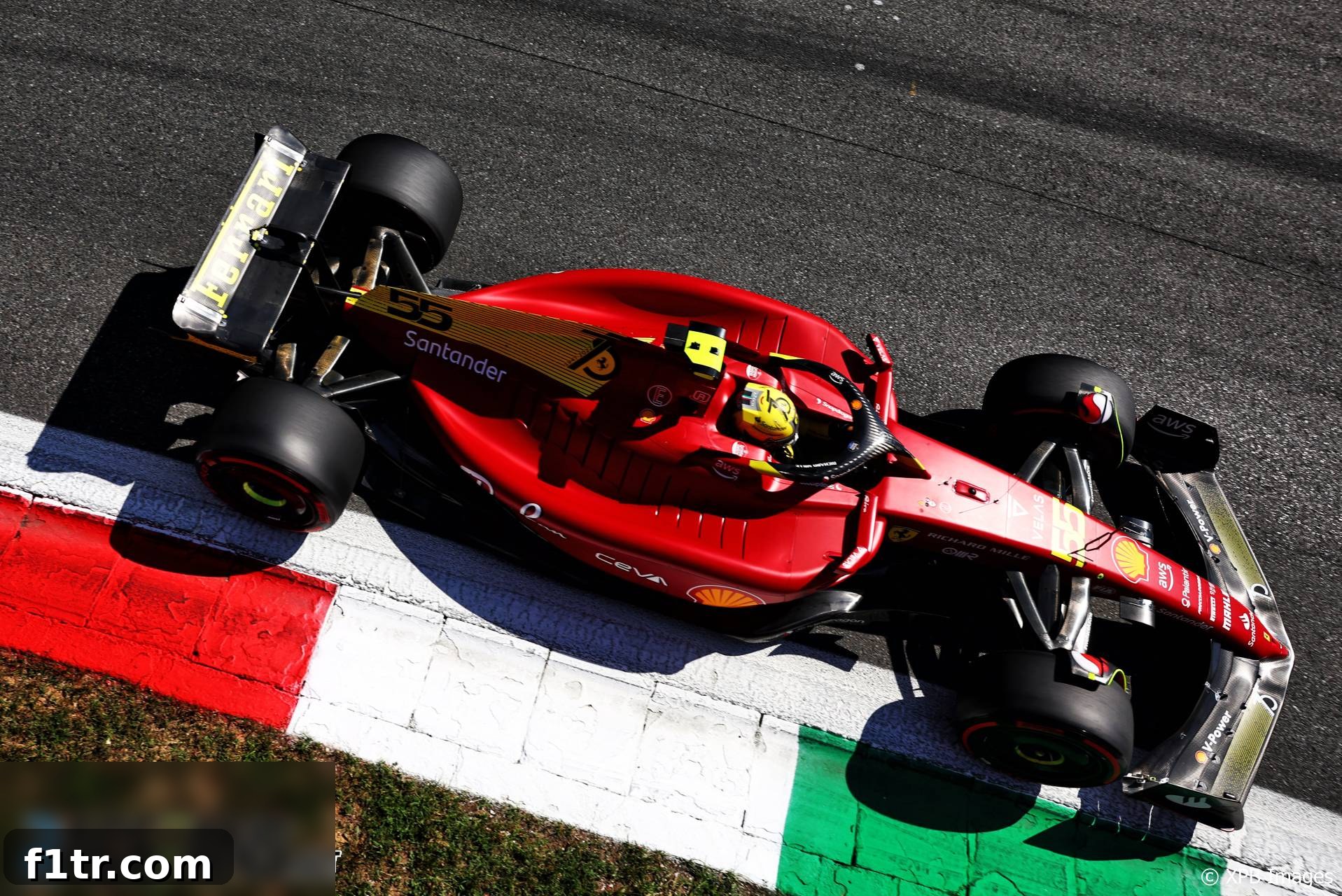
The high-stakes world of Formula 1 demands precision, speed, and unwavering adherence to safety regulations. For Ferrari driver Carlos Sainz Jnr, a recent incident at the iconic Monza circuit has placed him precariously close to an automatic 10-place grid penalty, a consequence that could significantly impact his and his team’s championship aspirations. Having accumulated his fourth reprimand of the season following an incident during final practice at the 2022 Italian Grand Prix, Sainz is now walking a tightrope, knowing that just one more driving reprimand will trigger the punitive grid drop.
Advert | Become a Supporter & go ad-free
Carlos Sainz’s Monza Incident: A Close Call with Valtteri Bottas
The incident that led to Sainz’s fourth reprimand unfolded during the final practice session (FP3) at the Autodromo Nazionale Monza, a circuit renowned for its blistering speeds and challenging chicanes. Sainz, driving his Ferrari, was deemed to have driven “unnecessarily slowly” at the Rettifilo chicane, commonly known as Turn 1. This lapse in judgment created a potentially dangerous situation for Alfa Romeo’s Valtteri Bottas, who was forced to take evasive action to avoid a collision with the slowly moving Ferrari.
Following the session, Sainz was summoned to the stewards to explain his actions. The Spanish driver stated that he was intentionally driving slowly to cool his tires, a common practice in motorsport to manage tire temperatures and prolong their life. However, the stewards meticulously reviewed the telemetry data and found a significant discrepancy in Sainz’s explanation versus the observed facts. They noted that Sainz had reduced his speed to a mere 50 kilometers per hour (kph) at that point on the track. This speed was approximately 20 kph slower than any other driver navigating the same section of the circuit during the entire practice session.
Stewards’ Verdict: Unnecessarily Slow and Potentially Dangerous
The stewards acknowledged that Sainz was aware of his surroundings, noting that he checked his mirrors six times between the start/finish line and the first corner. This indicated a degree of caution and awareness of other cars. Nevertheless, their final ruling underscored the gravity of the situation: “However, the fact remains that he drove unnecessarily slowly and as a result, a potentially dangerous situation was created.” The core issue wasn’t the intent to cool tires, but the excessive and unexpected reduction in speed on a high-speed circuit, which poses a significant risk to other competitors operating at race pace or on fast laps.
This incident at Monza serves as a stark reminder of the fine line drivers must tread between managing their equipment and maintaining a safe environment for everyone on track. In the fast-paced, high-pressure world of Formula 1, every action, no matter how minor it may seem to a driver, is scrutinized for its impact on safety and fairness.
Ferrari’s Warning: A Crucial Reminder for Team Communication
The repercussions of the incident extended beyond Carlos Sainz alone. Ferrari, as a team, also received an official warning from the stewards. The ruling highlighted a critical breakdown in communication, instructing the team to “be more alert in informing its drivers of approaching cars and that it is wrong to assume that cars will always do a cool-down lap after a push lap.” Crucially, the stewards added, “In this case the driver received no information at all from the team about the rapid approach of car 77 [Bottas].”
This admonition underscores the vital role of the pit wall and race engineers in Formula 1. Teams are expected to provide real-time information to their drivers regarding traffic, track conditions, and potential hazards. A lack of such communication, particularly on a track like Monza where closing speeds are immense, can lead directly to dangerous scenarios. Ferrari’s warning serves as a significant reminder for all teams to bolster their communication protocols and ensure drivers are never left in the dark, potentially causing a safety incident or incurring a penalty.
Understanding Formula 1’s Reprimand System: The Path to a Grid Penalty
Carlos Sainz’s situation shines a spotlight on Formula 1’s disciplinary system, specifically the accumulation of reprimands. A reprimand is an official warning issued by the stewards for a minor infringement of the sporting regulations. While not carrying an immediate time penalty or grid drop, reprimands are cumulative over a championship season and can lead to more severe consequences if a driver repeatedly falls foul of the rules.
According to the FIA Formula 1 Sporting Regulations, a driver will incur a 10-place grid penalty upon receiving their fifth reprimand in a single Championship season. However, there’s a critical caveat: at least four of these five reprimands must have been for “driving infringements.” This distinction is important, as not all reprimands are categorized as driving-related. The system is designed to penalize drivers who repeatedly demonstrate unsafe or unsporting conduct during on-track action.
Sainz’s current tally of four reprimands, with the Monza incident being his third driving-related one (as per our detailed breakdown below), means he is just one driving reprimand away from this automatic grid drop. The sword of Damocles now hangs over him for the remainder of the season, adding immense pressure to every lap he drives.
Carlos Sainz’s Reprimand History: A Pattern of Infringements
To fully grasp the gravity of Sainz’s position, it’s essential to look at his previous reprimands during the 2022 season:
- Australian Grand Prix (Driving Reprimand): Sainz received his first reprimand for impeding Zhou Guanyu during a practice session. Impeding is a serious offense in F1, as it can disrupt another driver’s hot lap or create dangerous situations at high speed.
- Monaco Grand Prix (Driving Reprimand): The notoriously tight and traffic-heavy streets of Monaco saw Sainz pick up another driving reprimand, this time for impeding Lance Stroll. Such incidents are particularly frowned upon at Monaco due to the minimal run-off areas and high potential for contact.
- Bahrain Grand Prix (Non-Driving Reprimand): While not directly related to on-track driving, Sainz was given a reprimand for an unsafe incident in the pit lane involving Fernando Alonso. This highlights that safety extends beyond the track itself and into the operational areas of the paddock.
- Italian Grand Prix (Driving Reprimand): The recent incident at Monza, for driving unnecessarily slowly and creating a dangerous situation for Valtteri Bottas, marks his third driving reprimand and fourth overall.
Therefore, Sainz currently stands at three driving reprimands and one non-driving reprimand, totaling four reprimands. If he receives another *driving reprimand*, he will reach five reprimands with four of them being for driving infringements, thus triggering the 10-place grid penalty. Should he receive a *non-driving reprimand* next, his total would be five (three driving, two non-driving), which would *not* meet the condition of “at least four driving infringements” and thus wouldn’t trigger the penalty. The distinction here is crucial, emphasizing the specific danger of on-track driving errors.
The precedent for such penalties was recently set by AlphaTauri driver Yuki Tsunoda, who incurred a 10-place grid penalty at the very race in question – the Italian Grand Prix – precisely for accumulating five reprimands. This serves as a potent and recent example for Sainz and Ferrari of the real-world consequences of repeated infringements.
Advert | Become a RaceFans supporter andgo ad-free
The Impact of a Grid Penalty and the Road Ahead for Sainz and Ferrari
For a team like Ferrari, locked in a fierce battle for championship points, a 10-place grid penalty can be catastrophic. It can derail an entire race weekend, forcing a driver to start deep in the pack and undertake a challenging recovery drive, potentially sacrificing valuable points. With the championship nearing its conclusion, every point becomes even more critical, both for the Drivers’ and Constructors’ Championships.
The threat of this penalty will undoubtedly weigh heavily on Carlos Sainz’s mind for the remaining races of the season. He will need to exercise extreme caution in every practice, qualifying, and race session to avoid any further infringements. This added pressure could influence his driving style, perhaps making him more conservative in certain situations, which might not always be conducive to extracting maximum performance from the car.
For Ferrari, the warning from the stewards regarding communication is a direct call to action. They will need to reassess and potentially overhaul their pit wall procedures to ensure seamless and comprehensive information flow to their drivers. The safety of their drivers and competitors, as well as the integrity of the sport, depends on it.
Conclusion: A Call for Precision and Discipline
Carlos Sainz’s fourth reprimand at Monza is more than just a minor slap on the wrist; it’s a critical moment that highlights the rigorous standards of Formula 1. It underscores the paramount importance of driver discipline, proactive team communication, and unwavering adherence to safety protocols. With the looming threat of a 10-place grid penalty, Sainz and Ferrari are now navigating a challenging period, where every decision and every maneuver will be under intense scrutiny.
As the Formula 1 season progresses, all eyes will be on Sainz to see how he manages this pressure and avoids further infractions. For Ferrari, the incident serves as a crucial reminder that success in Formula 1 is not just about raw speed, but also about flawless execution, meticulous communication, and an unyielding commitment to safety and fair play on the world stage.
2022 Italian Grand Prix
- Helmet rows, hot mics and more forgotten motorsport stories from 2022
- McLaren ‘surprised two teams found more performance than everyone else’ in 2022
- Alpine confident for Singapore and Suzuka races after “massive” floor upgrade
- Red Bull’s RB18 suits Verstappen more than Perez now – but that’s not by design
- “We’ll have four racing laps’: How F1’s Safety Car confusion unfolded at Monza
Browse all 2022 Italian Grand Prix articles