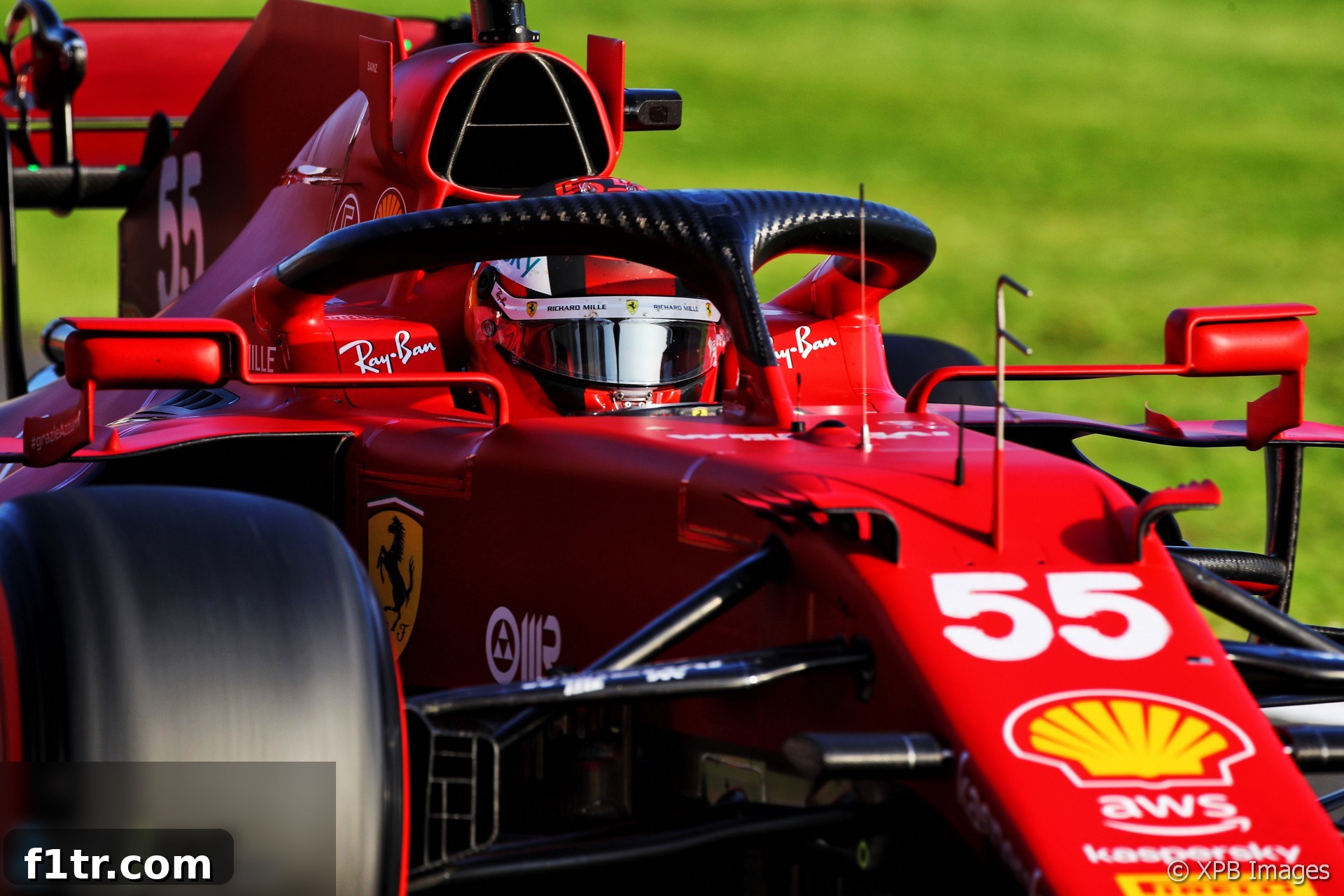
Ferrari’s highly-regarded driver, Carlos Sainz Jr., expressed strong conviction that he possessed the outright pace to secure a podium finish at the 2021 British Grand Prix. Despite navigating a challenging weekend marred by an early incident and a costly pit stop, the Spaniard’s performance underscored the significant progress made by the Scuderia, hinting at their burgeoning competitiveness at the sport’s pinnacle.
Advert | Become a Supporter & go ad-free
Sainz’s Silverstone weekend began with an unfortunate turn of events during the inaugural sprint qualifying race. The innovative format, designed to shake up the traditional Grand Prix weekend, instead delivered an early setback for the Ferrari ace. A first-lap collision with then-Williams driver George Russell saw Sainz lose crucial track position. Starting from ninth on the grid, the entanglement forced him to drop significantly down the order. Demonstrating impressive recovery, he managed to claw his way back to 11th place by the checkered flag, a position that was subsequently elevated to tenth on the official grid after Russell received a penalty for the incident. This initial misfortune meant Sainz entered Sunday’s main event with an uphill battle ahead, already playing catch-up to his rivals.
The Grand Prix itself saw Sainz launch a spirited charge through the field. In the opening laps, he showcased Ferrari’s improved package and his own adept race craft, steadily climbing to sixth position. His strategic positioning and the timing of rivals’ pit stops even saw him momentarily elevate to second place, demonstrating the raw potential that lay within the SF21. However, the delicate dance of strategy and execution in Formula 1 can be unforgiving. Sainz’s own pit stop proved agonizingly slow, costing him precious seconds and, crucially, a position to McLaren’s Daniel Ricciardo. This was particularly frustrating as Sainz had already engaged in a thrilling battle with the Australian earlier in the race and found himself unable to re-pass him after the pit stop.
“Unfortunately, we had that slow pit stop that cost us a position to Daniel,” Sainz reflected post-race, a hint of disappointment in his voice. “The pit stops all year have been great, and it’s the first average pit stop that we do. It was a real shame because, up until that point, our strategy was unfolding perfectly, and I felt genuinely strong in the car. That single moment altered the trajectory of my race entirely.”
Despite the pit stop mishap, Sainz remained remarkably positive about the performance of his car. “I think today was one of the best balanced cars I’ve had all year,” he stated, highlighting the team’s engineering prowess. “And considering that 60 laps ago we were last, to finish sixth is not that bad at all. It speaks volumes about our recovery capabilities and the underlying pace we had.” This sentiment echoed a growing confidence within the Ferrari camp, suggesting that their car was becoming a more consistent and predictable machine, especially under race conditions.
Sainz’s impressive recovery and underlying pace were further validated by the performance of his teammate, Charles Leclerc. Leclerc delivered a standout performance, leading the majority of Sunday’s British Grand Prix and fiercely battling Lewis Hamilton for the victory until the closing stages, ultimately finishing a commendable second. The fact that Leclerc could sustain such a high level of performance at the front of the pack underscored Ferrari’s improved competitiveness. Sainz’s car, however, finished a considerable 40 seconds behind Leclerc, primarily because he was unable to overcome Ricciardo’s straight-line speed advantage for a significant portion of the race. This difference in finishing gaps, according to team principal Mattia Binotto, was largely attributable to one driver enjoying clean air for much of the race while the other was stuck in traffic.
Ferrari team principal Mattia Binotto confirmed the cause of Sainz’s slow pit stop, attributing it to a specific problem with one of the team’s wheel guns. He meticulously explained the situation, emphasizing that such incidents were rare for the usually efficient Ferrari pit crew. Regarding the pace differential between his two drivers, Binotto clarified, “If you compare our two drivers, one of the two has been stuck behind rivals, and the other has done a very good pace. But when Carlos was in clear air, he had pace similar to Charles.” This statement provides crucial context, suggesting that Sainz, when unimpeded, was indeed extracting a performance level comparable to his teammate, who was contending for the win.
Sainz himself reinforced this analysis, noting Leclerc’s pace “shows that the car today in clean air was not there to quite win, because in the end the Mercedes is clearly a bit quicker, but very close to the podium and really great to drive.” He added his own car “had the pace for the podium,” a claim substantiated by his impressive ability to manage tire degradation and maintain strong lap times, even on aging rubber.
“At some point I was setting fastest laps on 25-lap-old mediums. So it shows that the tyre deg and the set-up and the car balance is improving,” Sainz proudly stated. This highlights a critical area of development for Ferrari: tire management. In modern Formula 1, the ability to make tires last and extract performance consistently across a stint is paramount, and Sainz’s feedback indicated significant strides in this department. “We are indeed looking to improve all the areas still. But today, at this circuit that we thought it was not going to be very good for us, we delivered, and the car was very nice to drive.” This admission about Silverstone not being an expected stronghold for Ferrari makes the performance even more encouraging, suggesting a broader operational window for the SF21.
The British Grand Prix served as a litmus test for Ferrari’s progress. A high-speed, demanding circuit like Silverstone typically exposes any weaknesses in a car’s aerodynamic package and power unit. To not only be competitive but also show podium potential and challenge for the lead, even momentarily, was a powerful statement from the Scuderia. While a win eluded them, and Sainz’s individual result was impacted by external factors, the overall takeaway was overwhelmingly positive. It demonstrated that Ferrari was firmly in the hunt for ‘best of the rest’ and, on certain weekends, could even put pressure on the dominant Mercedes and Red Bull teams. For Sainz, it solidified his reputation as a tenacious and adaptable driver, capable of delivering strong performances even when faced with adversity. His continued integration into the team and his growing confidence in the car bode well for the remainder of the season, as Ferrari aims to solidify its third-place position in the Constructors’ Championship.
Advert | Become a RaceFans supporter andgo ad-free
2021 British Grand Prix
- Verstappen reveals “vision problems” since 2021 Silverstone crash with Hamilton
- Who was to blame for Verstappen and Hamilton’s collision at Silverstone?
- Hamilton penalty “harsh” for move within FIA’s overtaking guidance – Allison
- Why Hamilton “wasn’t seen as wholly to blame” for the Verstappen crash
- Sainz convinced he had pace to challenge for podium without British GP setbacks
Browse all 2021 British Grand Prix articles