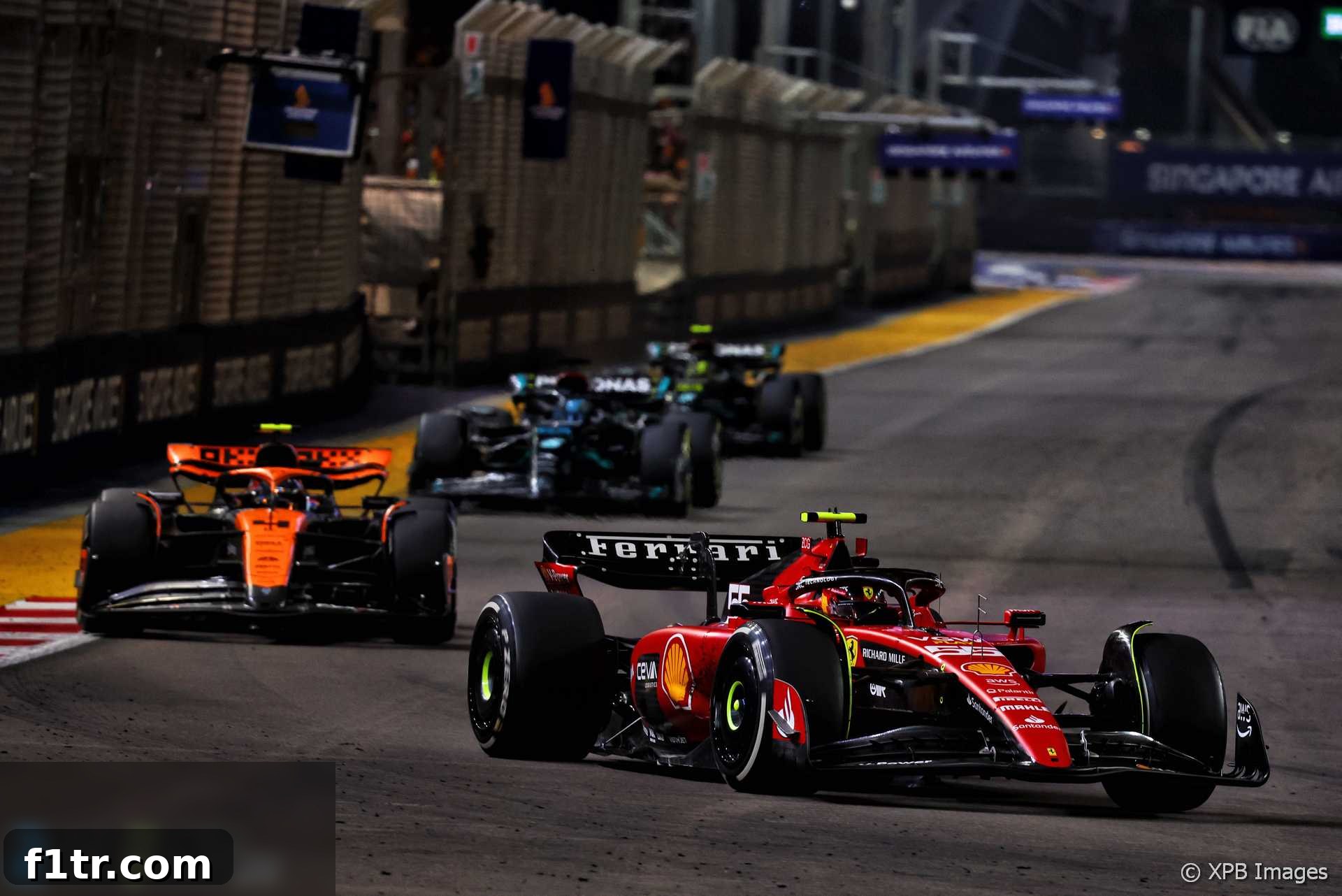
Carlos Sainz Jnr masterfully orchestrated one of Formula 1’s most audacious and brilliant strategic victories, admitting afterwards that his game-changing decision to deliberately slow down could have backfired spectacularly. The Ferrari driver, against all odds, chose a high-risk, high-reward tactic: allowing Lando Norris behind him to benefit from DRS (Drag Reduction System). This unconventional move was meticulously designed to fend off the rapidly approaching Mercedes challengers and ultimately secured Sainz his first victory of the season at a demanding street circuit.
The Singapore Grand Prix: A Battle of Wit and Pace
The challenging Singapore Grand Prix, renowned for its tight corners, unforgiving walls, and limited overtaking opportunities, sets the stage for a race where strategic prowess often trumps raw pace. Starting from pole position, Sainz knew that merely leading from the front would not guarantee victory, especially with the competitive field behind him. His objective was clear from the outset: prevent his rivals from exploiting any potential speed advantage. “It was very difficult to tell before the race whether we would have the race pace to win,” Sainz reflected. “I felt like even if we didn’t, by managing and controlling the gaps and controlling the pace and the tyre degradation, I could create myself the opportunity to win.” This early insight into his methodical approach foreshadowed the extraordinary events that would unfold.
Advert | Become a Supporter & go ad-free
The initial phase of the race saw Sainz expertly holding his lead, setting a controlled pace. The complexion of the race dramatically shifted after a Virtual Safety Car (VSC) period with 17 laps remaining. While Sainz initially held a comfortable one-and-a-half-second lead over Norris, with his Ferrari teammate Charles Leclerc 4.5 seconds adrift, and Mercedes’ George Russell a significant 16 seconds back in fourth, the VSC offered a critical strategic window. The chasing Mercedes drivers capitalized on this by pitting again, equipping their cars with fresher, faster tyres. This decision immediately put them at a considerable tyre advantage, transforming them into a formidable threat against the front-running Ferrari and McLaren. They swiftly dispatched Leclerc, closing the gap to Norris and Sainz with alarming speed, intensifying the pressure on the leaders in the crucial final stages of the race.
Sainz’s Strategic Gambit: A Calculated Risk
As the Mercedes threat loomed large, Sainz realized his initial assessment of having “a lot of pace in hand” was no longer accurate due to unexpectedly high tyre degradation. “I felt like as soon as I started pushing, my tyre degradation started to kick in,” he explained. “And I think Lando and I were sliding a lot, then it surprised me quite a lot how quickly the Mercs managed to pass Charles and close the gap on Lando and me.” Faced with rapidly diminishing grip and the relentless pursuit of George Russell, who had now advanced to third and was just 1.1 seconds behind Norris, Sainz knew a radical shift in strategy was essential. His mission evolved: maintain a gap to Norris that would keep Russell outside of DRS range, effectively using Norris as a strategic shield.
The core of Sainz’s audacious plan was deceptively simple yet incredibly complex to execute: deliberately slow his Ferrari down to allow Norris to get within one second, thereby granting the McLaren driver DRS activation. The Drag Reduction System (DRS), a movable rear wing flap, provides a significant speed boost on specific straights, enabling a chasing car to overtake more easily. By giving Norris DRS, Sainz aimed to enable him to defend his position more effectively against Russell. If Norris could successfully repel Russell, it would prevent the Mercedes from gaining DRS on Sainz himself, effectively disrupting the Mercedes’ charge and protecting the lead. This intricate “DRS train” concept required precise judgment and immense trust, as a slight miscalculation could have easily seen Norris not just defend, but potentially attack Sainz for the lead. It was a perilous tightrope walk, but one Sainz was prepared to undertake to secure victory.
Execution Under Pressure: Navigating the DRS Train
Sainz’s tactical brilliance shone brightest in the execution of this high-stakes strategy. He had to meticulously manage his pace, ensuring Norris remained close enough for DRS activation without ever letting him get *too* close. It took 11 tense laps for Norris to get within a second of Sainz after the VSC, a period during which Russell relentlessly closed in. The strategy “worked to perfection,” as Norris successfully defended his position, thus protecting Sainz’s lead. Sainz admitted that simply pulling away was no longer an option, particularly if Russell had managed to secure second place, which would have given Mercedes a direct shot at his Ferrari.
Advert | Become a RaceFans supporter andgo ad-free
The Ferrari driver explained the crucial decision-making process: “I had to give Lando a bit of a cheeky DRS boost, and that helped us to keep them behind and win the race and get the win for Ferrari that feels great.” This bold maneuver carried inherent risks, as providing Norris with DRS also presented the McLaren driver with an opportunity to attack. Sainz candidly acknowledged considering this before committing to assist his rival. “You cannot have a single mistake or a snap because it means that then Lando’s going to have a chance to overtake you if he’s on DRS,” Sainz elaborated. “At that point you decide to give him the DRS, hoping that that’s going to be enough to keep the Mercs behind.”
One specific moment highlighted the extreme difficulty of this strategy: “There was in particularly one lap that I think Lando defended into [turns] 16-17, and then I had to slow down a lot into [turns] one-two-three to give him DRS again.” This was on lap 60, a critical juncture where Russell’s attack on Norris had momentarily pushed the McLaren driver out of DRS range of Sainz. The split-second decision to dramatically reduce pace at the start of the lap was a testament to Sainz’s quick thinking and unwavering commitment. “I think that move actually, saved my race, saved also Lando’s P2,” Sainz asserted, “because I feel like there, if not, I would have been also dead meat. If the Mercs would have passed Lando, I think they could have got past me pretty easily.” It was a strategic gamble that required nerves of steel and perfect execution, showcasing Sainz’s exceptional race craft and mental fortitude under immense pressure.
A Testament to Race Craft and Strategic Acumen
Advert | Become a RaceFans supporter andgo ad-free
Sainz aptly described his strategy as something “easy to have in mind, but it’s a lot more difficult to execute.” It demanded more than just theoretical understanding; it required “that commitment to do it and to put yourself under that extra risk continually.” Yet, for Sainz, it was the only viable path to victory. “But I felt like that was my only real chance of winning the race and I wanted to win.” This profound desire to win, coupled with an unparalleled understanding of race dynamics, empowered him to make such bold calls. The moment he heard the 1.3-1.4-second gap to Norris after a spirited defense into turn 16, the decision to slow down again through turns one and three was made with a hopeful, yet confident, “well, I hope this works because if not it could look really, really bad on me.”
Carlos Sainz’s triumph at the Singapore Grand Prix will undoubtedly be remembered as one of Formula 1’s most strategically brilliant victories. It showcased an extraordinary blend of race management, tactical foresight, and the courage to implement a highly unconventional plan under immense pressure. In a sport often dominated by raw pace, Sainz proved that intelligence, adaptability, and psychological fortitude can be equally, if not more, decisive. His ability to turn a potential vulnerability (tyre degradation) into a strength (using Norris as a defensive buffer) cemented his reputation as a thinking driver, capable of delivering race-winning performances even when the odds are stacked against him. This victory was not just a win for Ferrari; it was a masterclass in strategic F1 racing, providing a thrilling reminder of the intricate chess match that unfolds on track, lap after agonizing lap.
Advert | Become a RaceFans supporter andgo ad-free
Bringing the F1 news from the source
RaceFans strives to bring its readers news directly from the key players in Formula 1. We are able to do this thanks in part to the generous backing of our RaceFans Supporters.
By contributing 1 per month or 12 per year (or the equivalent in other currencies) you can help cover the costs involved in producing original journalism: Travelling, writing, creating, hosting, contacting and developing.
We have been proudly supported by our readers for over 10 years. If you enjoy our independent coverage, please consider becoming a RaceFans Supporter today. As a bonus, all our Supporters can also browse the site ad-free. Sign up or find out more via the links below:
- Become a RaceFans Supporter
- RaceFans Supporter FAQ
2023 Singapore Grand Prix
- Sainz’s Singapore win made Leclerc focus on improving his race pace – Clear
- Singapore and Austin retirements cost me top 10 championship place – Ocon
- How Ocon’s “extreme” height for an F1 driver is helping other tall racers
- Steward’s admission Verstappen should have had penalty frustrates his rivals
- Drivers back Singapore qualifying tweak as rule changes again for Japanese GP
Browse all 2023 Singapore Grand Prix articles