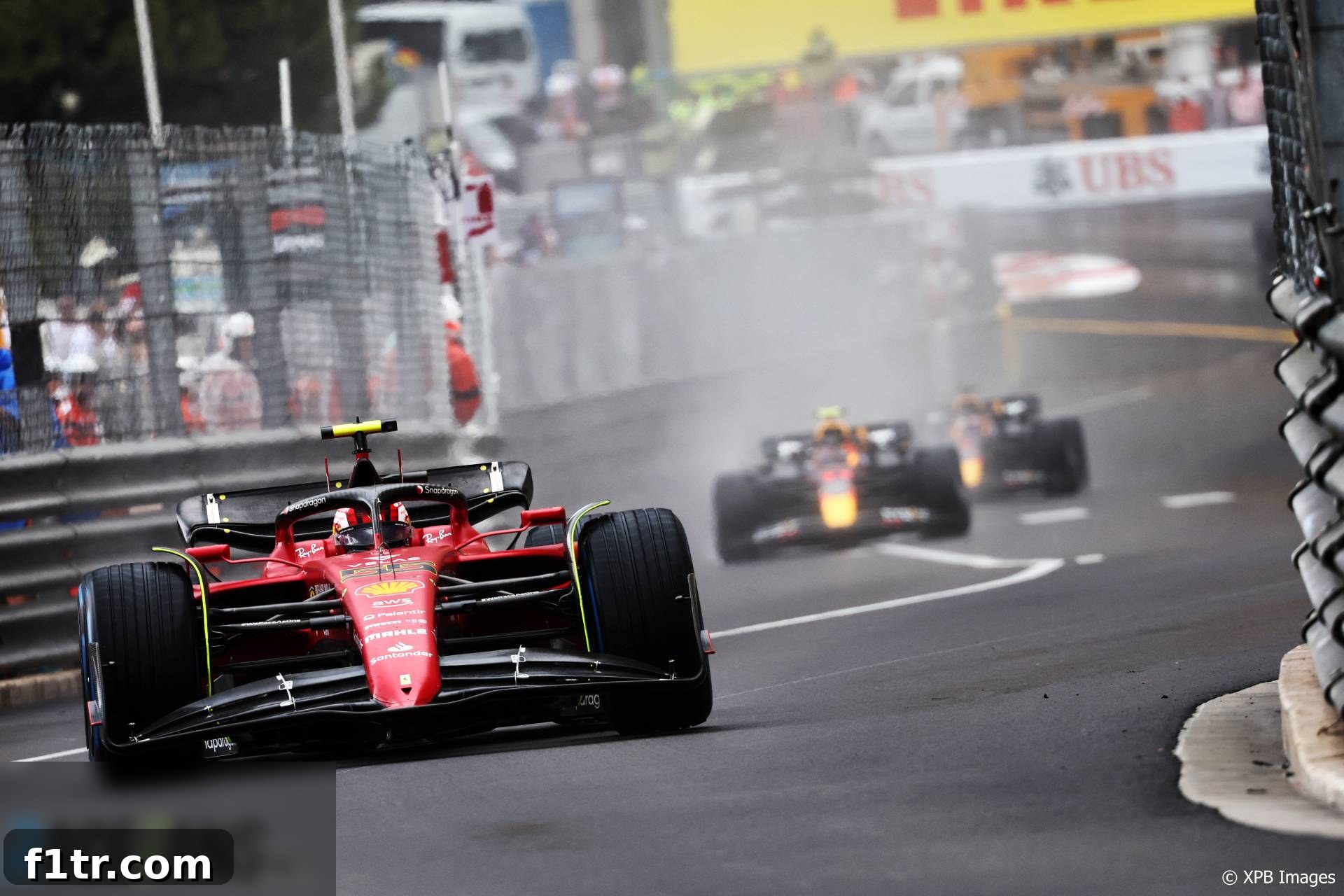
Carlos Sainz Jnr, the talented Ferrari driver, has expressed profound frustration, believing he was on track to secure a momentous victory at the Monaco Grand Prix if not for a critical time loss during his pit stop. The unforgiving streets of Monaco, known for their narrow confines and strategic complexity, once again proved to be a crucible where fortunes can turn in an instant, leaving Sainz with a bitter taste of what might have been.
Advert | Become a Supporter & go ad-free
The 2022 Monaco Grand Prix was an event fraught with tension and strategic gambles, largely dictated by the capricious weather conditions. Starting on a wet track, the race quickly evolved into a challenging mix as the surface began to dry. Sainz expertly navigated these treacherous early stages, maintaining a strong second position. His team mate, Charles Leclerc, initially held the lead, but an early decision to pit for intermediate tyres saw Leclerc lose valuable track position. This move propelled Sainz into the lead, demonstrating his calm under pressure and astute understanding of the track’s evolution.
Sainz’s strategy diverged significantly from his competitors and even his own team mate. While many drivers, including Sergio Perez of Red Bull and Leclerc, opted for a switch to intermediate tyres as the track transitioned from fully wet, Sainz resisted this temptation. He maintained his conviction that the drying track would soon be ready for slick tyres, a bold decision that, in theory, could grant a significant advantage by avoiding an extra pit stop. This strategic patience paid off temporarily as he moved ahead of Leclerc when both Ferraris eventually came in together to swap their wet weather tyres for hard compound slick tyres. The double stack pit stop, a testament to Ferrari’s operational efficiency, aimed to consolidate their strong positions.
However, the intricate dance of tyre strategy and track conditions had another twist in store. Sergio Perez, who had switched to intermediates earlier, then made his move to slick tyres. Critically, during Sainz’s crucial out-lap on the fresh, cold hard compound tyres, he encountered traffic. Being stuck behind a much slower, lapped car on the narrow streets of Monaco proved to be a disastrous impediment. This unavoidable obstruction cost Sainz vital seconds, allowing Perez to leapfrog him in the pit sequence and ultimately seize the lead, a lead he would not relinquish. The unique nature of Monaco, where track position is paramount and overtaking is notoriously difficult, meant that every fraction of a second lost carried immense consequences.
“I felt like we did everything that we had to do out there,” Sainz reflected after the race, his voice tinged with a mix of pride and palpable disappointment. “We stayed patient on the wets, we took the right decision to go onto the slick.” His confidence in Ferrari’s tyre call was unwavering, believing it was the optimal strategy to win. Yet, the fickle hand of fate intervened. “A terrible out-lap stuck behind a lapped car cost me a race win today,” he lamented, the weight of the lost opportunity clear in his words. The pure speed and strategic brilliance of his race were overshadowed by a circumstance largely beyond his control.
The frustration was understandable and raw. “You can understand the frustration because a clean out lap could have secured me the race win, but it’s how this sport is sometimes,” he added, acknowledging the unpredictable nature of Formula 1. The fine margins in Monaco amplify every incident, and being held up by a backmarker while on cold slick tyres, trying to generate heat and grip, is an absolute nightmare scenario for any driver. This particular incident highlighted how deeply traffic management and race execution play into the ultimate outcome, even when the underlying strategy is sound.
Sainz’s unwavering belief in his tyre strategy was evident even during the race. When informed on his team radio that Perez had opted for intermediate tyres, Sainz remained resolute. “I knew it from halfway through the first stint, I started to see the dry line and I started to realise that it was going to go straight into slicks,” he explained. This foresight suggested a deep understanding of the track’s drying characteristics and an audacious commitment to a single, decisive tyre change. “I think we did the right call as we were leading the race basically then we pitted for that hard tyre,” he reaffirmed, underscoring his conviction that the strategy itself was flawless.
However, the execution was hampered by an external factor. “Obviously hard [tyres are] never easy on the out-lap, but I had to do 12 corners like that behind a lapped car, that cost me at least a couple of seconds, that cost me a race win,” he articulated, detailing the precise cost of the traffic. On a circuit like Monaco, where the smallest time difference can mean multiple grid positions, a “couple of seconds” is an eternity. It represented the exact margin between victory and second place, illustrating the brutal efficiency required to win at motorsport’s most glamorous event.
Despite the immense disappointment, Sainz also displayed a philosophical perspective, recognizing the inherent ebb and flow of luck in racing. “I’m not going to complain too much, I know that this sport is like that,” he stated, demonstrating maturity and resilience. He drew parallels with his competitor, Sergio Perez. “I know that Checo was unlucky in Jeddah with he did a great race plus he got a bit lucky with myself and this podium will turn around one day.” This acknowledgement speaks volumes about the camaraderie and understanding among top-tier drivers, where luck often balances out over a season, even if it feels unfair in the moment. It was a nod to the unpredictable nature of the sport, where fortunes can shift dramatically from one Grand Prix to the next.
The race was later suspended due to a significant crash involving Mick Schumacher, which resulted in a red flag. This pause offered teams another opportunity to assess their strategies and make further tyre changes. Red Bull capitalised on this by switching Perez to the medium compound tyres for the final leg to the flag. Ferrari, however, kept Sainz on his hard tyres. While the hard compound offered greater durability, the medium tyres on Perez provided a potential grip advantage for the sprint to the finish, especially from a standing start.
In the tense final stint, Sainz, on his hard tyres, fiercely pressured Perez. The gap remained minimal, and Sainz was constantly on the hunt for an overtaking opportunity, particularly in the notoriously challenging corners of Monaco. The hard tyres, while durable, began to show signs of graining, a phenomenon where rubber peels off the tyre surface, reducing grip. “I had quite a lot of graining myself, especially on the rear which made the entry to the tunnel quite difficult to get close and to pass,” Sainz explained. This lack of optimal grip, particularly on the rear axle, hindered his ability to get a strong exit out of corners and challenge Perez down the straights or into braking zones.
Monaco’s unique layout, with its tight turns and minimal run-off areas, makes overtaking an art form, requiring absolute precision and often a significant tyre advantage. Sainz meticulously studied Perez’s lines, seeking any chink in the armour. “A couple of times I was really, really close to launching a move into Mirabeau,” he revealed, highlighting his aggressive intent. However, the track conditions, still partially damp in some areas, coupled with Perez’s defensive driving, made such a move exceedingly risky. “It was still a bit wet in the inside, Checo was braking quite late so I think if I was braking any later I would have taken him out with me.” This candid assessment underscores the fine line between a heroic overtake and a catastrophic collision, a choice that every driver must make in the heat of battle, especially on the streets of Monaco.
Ultimately, despite a valiant effort, Sainz had to settle for second place. While a podium finish at Monaco is always a commendable achievement, the lingering feeling of a missed victory clearly weighed heavily. The 2022 Monaco Grand Prix served as a stark reminder of how a seemingly perfect strategic call can be undone by unforeseen circumstances, leaving drivers and teams to ponder the ‘what ifs’ that define the sport’s most dramatic moments. For Carlos Sainz, it was a race that showcased his immense talent and strategic prowess, but also one that highlighted the brutal, often cruel, unpredictability of Formula 1 racing, particularly in the Principality.
Advert | Become a RaceFans supporter andgo ad-free
2022 Monaco Grand Prix
- Whatever triggered it, Verstappen’s defiance of his own team makes little sense
- Transcript: How Red Bull seized a win that ‘Ferrari looked like they had in the bag’
- Verstappen now has as many poles as Leclerc – but six times as many wins
- Schumacher’s chassis-splitting crash shows effects of rising car weight – Alonso
- Norris still can’t drive McLaren the way he wants to, despite strong results
Browse all 2022 Monaco Grand Prix articles