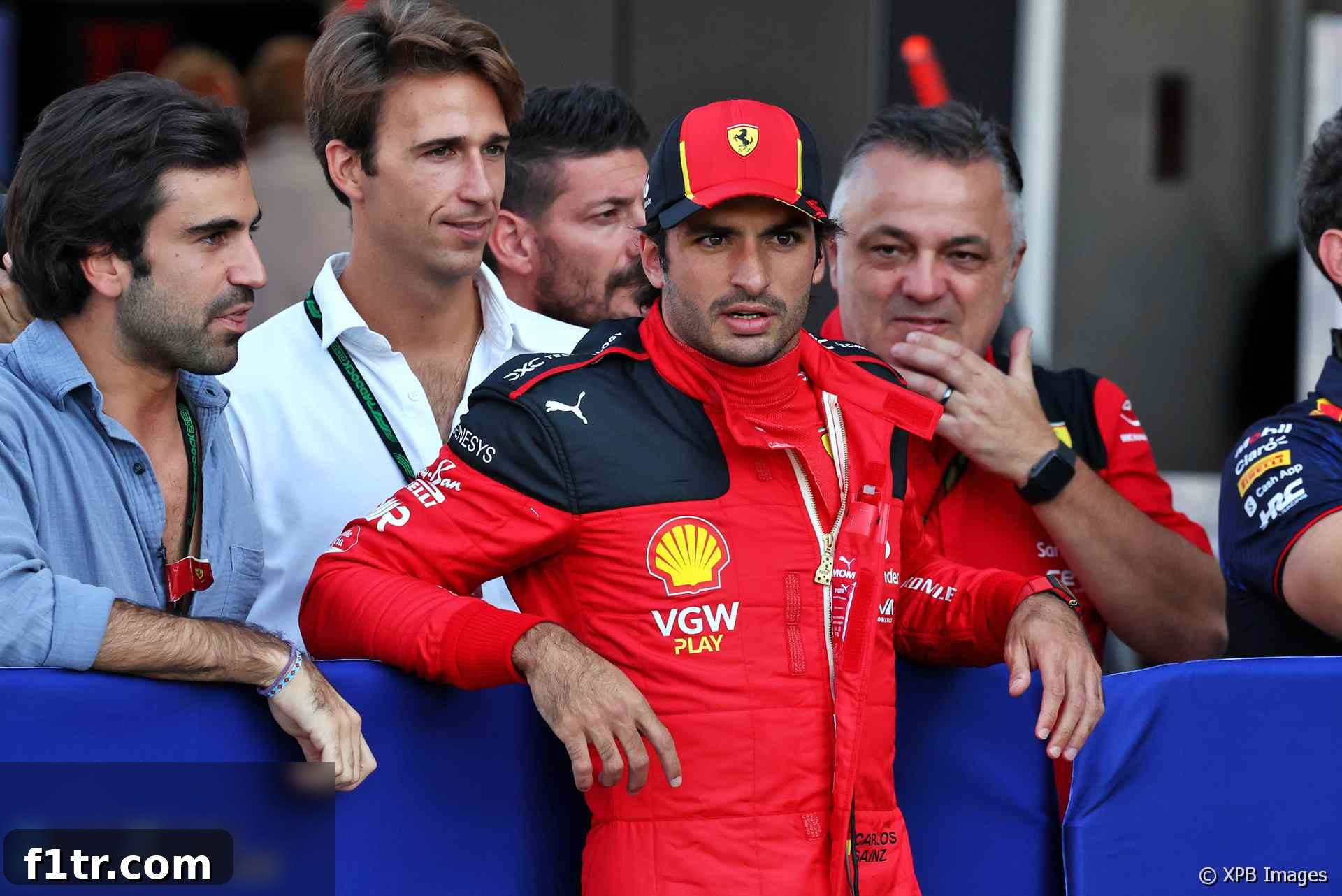
Carlos Sainz Puzzled by Ferrari’s Enigmatic Performance at Mexican Grand Prix Qualifying
Carlos Sainz Jr. found himself in a familiar yet perplexing position after qualifying for the Mexican Grand Prix. Securing a coveted front-row starting spot, just six-hundredths of a second behind his Ferrari teammate Charles Leclerc, was undoubtedly a strong result. However, the Spanish driver’s immediate reaction was one of bewilderment rather than pure celebration, as he grappled with the inconsistent and at times mystifying behavior of his SF-23 throughout the demanding weekend.
The Autódromo Hermanos Rodríguez circuit presents unique challenges to Formula 1 teams, primarily due to its high altitude. The thin air impacts aerodynamic performance, engine power, and cooling, making car setup and tyre management particularly intricate. It was within this complex environment that Sainz’s Ferrari displayed a Jekyll and Hyde personality, leaving the driver searching for answers despite his impressive pace.
The Paradox of the “Cleaner” Lap: A Qualifying Conundrum
Sainz’s qualifying session was a microcosm of his weekend-long struggle to unlock consistent performance. He made a dramatic improvement of over 1.1 seconds from Q2 to his first flying lap in Q3, a testament to his skill and the car’s latent potential. Yet, the subsequent and seemingly superior effort in his final Q3 run yielded no further improvement, a scenario that deeply perplexed him.
“For me it was a bit of a weird one because the second lap felt a lot cleaner than the first one,” Sainz articulated, reflecting on the qualifying outcome. “It felt like it was my second clean lap or my second good lap of the weekend.” This candid admission underscores the difficulty he faced in extracting the car’s maximum potential consistently. In Formula 1, a driver’s feel for the car and the track is paramount, and when that intuition clashes with the stopwatch, it signals a deeper technical mystery.
The Spaniard strongly suspects that the subtle differences in his tyre preparation between the two Q3 runs were the decisive factor. “Like always at this track, you look at the lap time and then I went a tenth slower, which I don’t understand,” he continued. “That lap felt a lot cleaner and a lot better.” This sentiment highlights the razor-thin margins in F1 qualifying, where a mere fraction of a second can separate glory from frustration. Tyre management at high altitude is an art form; the optimal window for grip is extremely narrow, and factors like out-lap speed, braking zones, and even the amount of scrubbing can drastically alter tyre temperature and performance over a single flying lap.
Sainz elaborated on his hypothesis: “So it was just the same thinking as the whole weekend, not really understanding why some laps come better than the others, even though some laps feel better than others. It’s something to do with the tyre preparation, the tyre grip that it gives you. Even if it’s a cleaner lap, you just have a little percentage less grip during the whole lap because of the tyre preparation and just the lap doesn’t click. So this is a bit what happened to me in there in the last lap.” This profound insight from a top-tier driver reveals the intricate dance between man and machine, where minute details in setup and execution can have profound impacts on overall performance. The “feel” of the car, which drivers rely on instinctively, can sometimes deceive them when the underlying grip levels are subtly compromised.
A Tricky Weekend: The Ferrari SF-23’s Dual Nature
The challenges weren’t confined to a single qualifying lap; Sainz revealed that the entire weekend leading up to Q3 had been a struggle to complete a truly satisfactory lap. “It’s been a tricky weekend again,” he admitted. “Putting laps together has been extremely difficult for me on the soft tyre.” This suggests an underlying issue with how the Ferrari SF-23 interacts with the softer compounds, particularly in the unique conditions of Mexico City. The circuit’s low-grip surface, coupled with the thin air necessitating maximum downforce, means that finding the delicate balance for optimal tyre performance is critical.
His breakthrough moment only arrived during the first run of Q3, a sudden surge in performance that even caught him off guard. “Up until Q3 run one I hadn’t done a good lap all weekend and suddenly that lap, even though it had a snap in turn eight-nine that I nearly lost the car, it was a pretty good lap. But when I saw 17.2 on the dash I was like, I don’t know where this is coming from right now.” This sudden ‘coming alive’ of the car, despite a near-spin, indicates a narrow operating window where the SF-23 truly shines. For a team aiming for championship contention, such inconsistency, even if it culminates in a strong qualifying result, poses a significant hurdle for race strategy and driver confidence.
The observations from Sainz point to a recurring theme with Ferrari’s 2023 challenger: its unpredictable nature across different fuel loads, tyre compounds, and grip levels. “But it just shows there’s still something that we need to understand, something that we need to look at, why our car suddenly when it comes to low fuel and soft tyres and Q3, high grip, it comes alive. And then suddenly in some sessions or in higher fuel, more worn tyres, then it’s a trickier car.” This description paints a picture of a car that possesses immense potential but struggles with a consistent operating window. At high altitude, the relative impact of aerodynamic downforce is reduced, meaning mechanical grip and tyre interaction become even more critical.
The team’s ongoing efforts to tame this variability are crucial. “It’s something that we are working on and something that sometimes gives us some very good surprises and sometimes some other not-so-good ones. So we’ll work on it,” Sainz affirmed. This internal struggle for understanding underscores the complexity of modern Formula 1 car development, where fine-tuning a car for all conditions is an endless pursuit. For Ferrari, unlocking the secrets of their SF-23’s performance peaks and troughs is vital for their future aspirations, especially as they contend with highly consistent rivals.
The Mexican Grand Prix weekend serves as a stark reminder of the intricate challenges faced by F1 teams. While Sainz’s front-row start is a commendable achievement, the underlying questions about the car’s inconsistent behavior highlight the continuous quest for optimal performance. As the team moves forward, translating these qualifying flashes of brilliance into consistent race pace and understanding the nuances of tyre preparation will be key to unlocking the full potential of both driver and machine in the demanding world of Formula 1.
Advert | Become a RaceFans supporter andgo ad-free
2023 Mexican Grand Prix: Related Articles
- ‘I’m so s*** in qualifying’: Norris berates himself despite pole-winning lap
- Ferrari reaping the benefits of having F1’s most closely-matched team mates
- Norris had “no chance” to beat Verstappen in Mexico even without Q1 exit
- Transcript: How Ricciardo’s race went awry soon after he was told to “bring it home”
- Mercedes see “very encouraging signs” from Austin floor update
Browse all 2023 Mexican Grand Prix articles