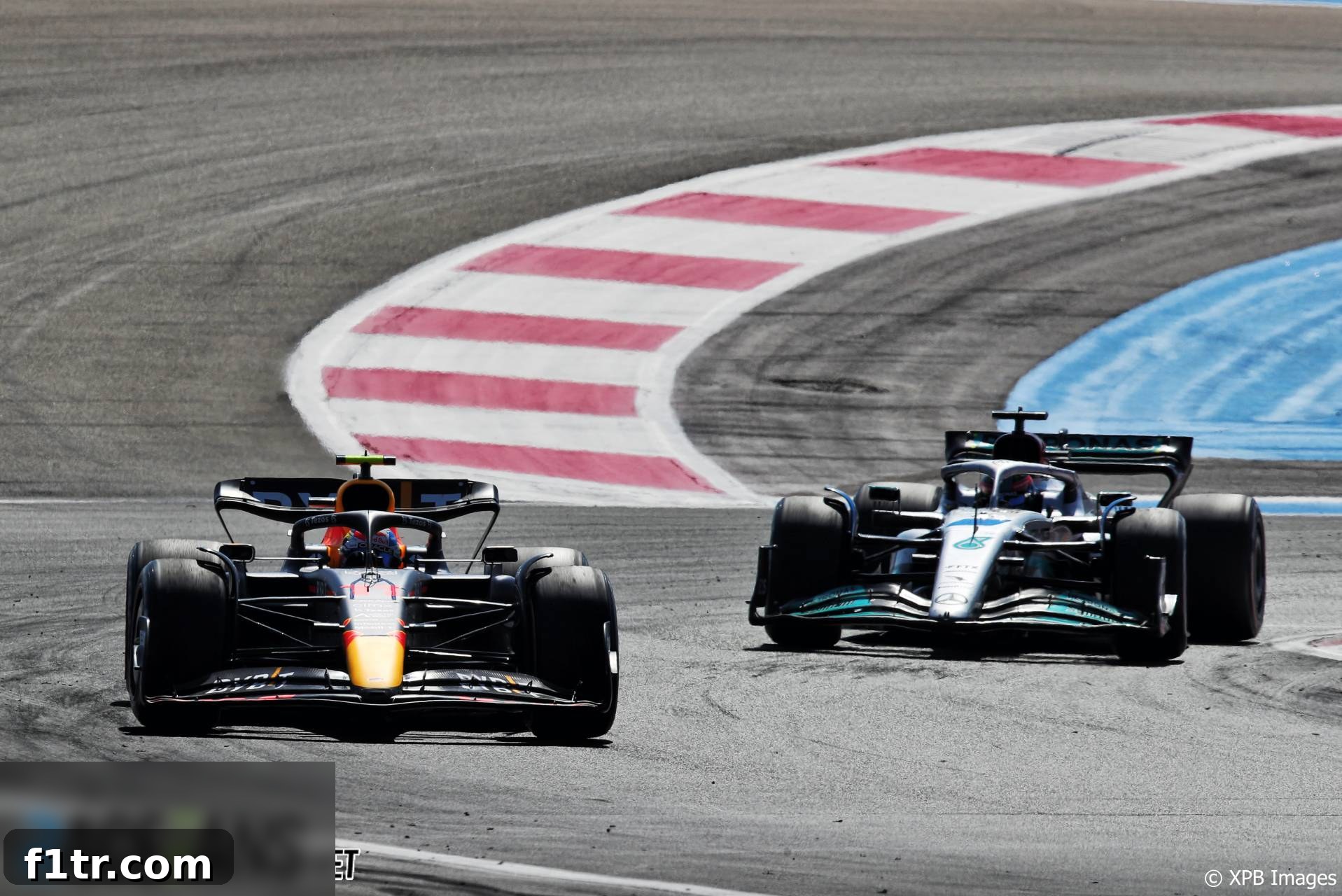
Controversial VSC Glitch Robs Sergio Perez of French Grand Prix Podium
The 2022 French Grand Prix delivered an unexpected twist in its closing stages, sparking heated debate and leaving Red Bull Racing’s Sergio Perez fuming. What he perceived as a critical error within the FIA’s Virtual Safety Car (VSC) system ultimately led to him losing a well-deserved final spot on the podium to George Russell of Mercedes-AMG Petronas F1 Team. This incident not only altered the race’s outcome but also ignited discussions about the reliability and fairness of critical race control procedures.
The Unfolding Drama: A Race-Defining Moment
With just four laps remaining in the race, a VSC period was triggered. As the race prepared to restart, the confusion began. Perez’s race engineer, Hugh Bird, initially informed him that the Virtual Safety Car period was ending as he approached Turn 8. Reacting swiftly, Perez accelerated, adhering to the “delta” time—a crucial component of VSC rules that dictates a maximum lap time drivers must not exceed. His aim was to rebuild as much of a lead over Russell as possible, believing the race was about to go green.
However, contrary to the initial message, the race did not restart. The VSC period unexpectedly continued, allowing Russell to close the gap significantly on Perez at the Beausset corner. A visibly confused Perez queried his team, asking, “Why isn’t it ending?” His engineer promptly reminded him to “stay on the delta,” emphasizing the continued VSC conditions.
Moments later, a second instruction to end the VSC period finally came through. This time, Bird informed Perez as he was rounding Bendor, Turn 12. Behind him, George Russell’s radio communications painted a similar picture of evolving instructions. Ricardo Muscconi, Russell’s engineer, first told him the VSC was ending as they neared the chicane. When the VSC persisted, Muscconi reiterated, “still VSC ending, watch your delta,” as Russell skillfully caught up to Perez. When the actual restart message arrived, both drivers were on the power. Crucially, Perez experienced more wheelspin than Russell, allowing the Mercedes driver to surge ahead and snatch third place on the approach to Turn 14.
Understanding the Virtual Safety Car System and “Delta” Times
The Virtual Safety Car system is a crucial safety mechanism in Formula 1, deployed when an incident on track requires drivers to reduce their speed without the need for a full Safety Car. During a VSC period, drivers must maintain a target maximum lap time, known as the “delta” time. This delta is continuously measured at various intervals around the track to ensure all drivers adhere to the reduced speed uniformly and safely.
The FIA sporting regulations clearly state that once teams receive the message “VSC ending,” the race is scheduled to restart “at any time between 10 and 15 seconds later.” This short, randomized window is designed to prevent drivers from anticipating the exact restart moment, thereby promoting fair competition. Drivers typically use this window to optimize their position relative to the delta time, ensuring they can accelerate immediately and powerfully once the green flags are waved.
Perez’s Frustration: “Totally Wrong” and a Disrupted Result
Following the race, Sergio Perez made no secret of his anger, declaring the VSC system “totally wrong” and claiming it had “interfered with the result” of the race. His primary grievance stemmed from the conflicting restart messages. Perez explicitly pointed out the disparity between being told the race was about to restart approaching Turn 8 and the actual restart occurring much later, at Turn 13. This discrepancy, he argued, placed him at a significant disadvantage, as his early acceleration under the false impression of a restart cost him crucial momentum and track position.
From Perez’s perspective, the system’s failure to end as initially communicated was not merely an inconvenience but a fundamental flaw that directly impacted the integrity of the competition for the final podium spot. His frustration was palpable, rooted in the belief that an avoidable technical glitch had unfairly denied him a hard-earned result.
The FIA’s Explanation: A Hardware Issue and Backup Systems
In response to the controversy, an FIA spokesperson offered clarity on the incident, attributing the confusion to a technical malfunction. “A second VSC ending message was sent due to a hardware issue, which led to an automated switch to backup systems that worked exactly as they should in that scenario,” the spokesperson informed RaceFans. The FIA emphasized that “the same information is supplied to all teams concurrently” and that “the VSC ending countdown time to the green light being displayed on the trackside panels is always random.”
This explanation confirms that a genuine technical issue occurred, necessitating the activation of redundant systems. While the FIA maintained that all teams received the same information simultaneously, the unusual circumstance of a delayed restart undoubtedly presented a novel challenge for drivers and engineers alike, testing their ability to react in unforeseen conditions.
Advert | Become a RaceFans supporter andgo ad-free
Team Reactions and Differing Interpretations
The VSC incident sparked varied reactions across the paddock, highlighting the complex interplay of human interpretation and system reliability in high-stakes racing.
Red Bull’s Concerns: Christian Horner’s Ambiguity
Red Bull team principal Christian Horner voiced his own uncertainty regarding the incident. “What was frustrating for him was there was an issue with race control, with the VSC, because they couldn’t turn it off, so they had to do a reset,” Horner stated. He added, “Just talking with him, he was saying he wasn’t getting the delta in his car. So he was bang on his delta and I think George either pre-empted it, but was within the delta, or maybe the information to that two cars was different. So we have to go and explore that.” Horner’s comments underscored a lingering doubt within the Red Bull camp about whether both drivers were truly operating with identical, real-time information, or if Russell had managed to gain an advantage through proactive anticipation.
Mercedes’ Opportunism: Russell’s Calculated Move
While Red Bull pondered the fairness of the situation, George Russell and Mercedes capitalized on the fluid circumstances. Russell’s engineer, Ricardo Muscconi, clearly communicated the evolving VSC status, allowing Russell to adjust his strategy. The fact that Russell demonstrated superior traction at the critical restart moment, coupled with his ability to maintain his delta effectively, speaks to a combination of driver skill and strategic execution under pressure. Mercedes’ ability to react effectively to the unforeseen VSC extension and subsequent restart played a pivotal role in securing Russell’s podium finish.
Other Teams: Annoying but Manageable
The confusion was not limited to Red Bull and Mercedes. When asked by RaceFans if the VSC situation caused any widespread bewilderment, Alfa Romeo’s head of track engineering, Xevi Pujolar, acknowledged the initial disruption. “No, it’s just annoying because we thought that, okay, the safety car is ending and it was not ending and then we didn’t know what was happening,” Pujolar explained. He added, “But then a few seconds later it was a message from race control and we informed the drivers that there was an issue. But other than that it was okay.” This perspective suggests that while the glitch caused temporary confusion, most teams eventually received the necessary information to manage the situation, lending credence to the FIA’s claim of concurrent information delivery.
The Delta Dilemma: Who Gained the Edge?
The core of the controversy lies in the “delta” time and how drivers navigate its intricacies during VSC periods, especially when a restart is imminent. Drivers are acutely aware of the need to stay within the delta time, but also to position themselves optimally for maximum acceleration at the exact moment the VSC ends. Perez’s early acceleration, based on an erroneous initial message, meant he had to abruptly back off, disrupting his rhythm and potential for a strong restart. Russell, on the other hand, was able to close the gap and then execute a clean overtake, potentially benefiting from a more consolidated run into the true restart.
While the FIA confirmed that all teams received the same information, the human element of reaction time, anticipation, and managing the car’s throttle response under confusing conditions undoubtedly played a significant role. It raises questions about how much responsibility lies with the system’s robustness versus a driver’s interpretation and quick adjustments in a split-second, high-pressure environment.
Implications and Future Considerations
This incident at the French Grand Prix serves as a crucial reminder of the critical importance of robust and flawless race control systems in Formula 1. Even with advanced backup mechanisms, a hardware glitch can have immediate and significant consequences on race outcomes, impacting driver standings and championship battles. While the FIA’s swift switch to backup systems prevented a more prolonged issue, the initial confusion highlights areas for potential refinement in communication protocols and system redundancies.
For drivers and teams, the incident underscores the need for constant vigilance and adaptability, even when facing unexpected system anomalies. It also reignites debates about the role of technology in dictating sporting fairness and the fine line between human error, mechanical failure, and strategic advantage.
Conclusion
The dramatic Virtual Safety Car incident at the French Grand Prix was a defining moment that cost Sergio Perez a valuable podium finish and allowed George Russell to seize an unexpected opportunity. While the FIA attributed the confusion to a hardware issue and an automated switch to backup systems, the episode left Perez understandably frustrated and sparked broader discussions within the paddock. It serves as a powerful illustration of how even minor technical glitches in critical race procedures can profoundly impact the outcome of a Grand Prix, emphasizing the relentless pursuit of perfection in the complex world of Formula 1.
Become a RaceFans Supporter
RaceFans thrives thanks in part to the generous support of its dedicated readers. By contributing a modest amount—£1 per month or £12 per year (or its equivalent in your local currency)—you can play a vital role in covering the costs associated with creating, hosting, and continuously developing RaceFans, both now and in the future.
Become a RaceFans Supporter today and enjoy an ad-free browsing experience on the site. Sign up or find out more through the links below:
- Become a RaceFans Supporter
- RaceFans Supporter FAQ
2022 French Grand Prix Related Articles
- Ferrari’s season of missed chances led to “difficult” criticism for Binotto
- McLaren looking into why their starts are “more inconsistent” this year
- Mercedes expect Hungarian GP will ‘expose our qualifying weakness’
- Hamilton and Russell ‘out-performing a car that’s not good enough’ – Wolff
- “We need to decide now”: Inside Sainz and Ferrari’s French GP strategy dilemma
Browse all 2022 French Grand Prix articles