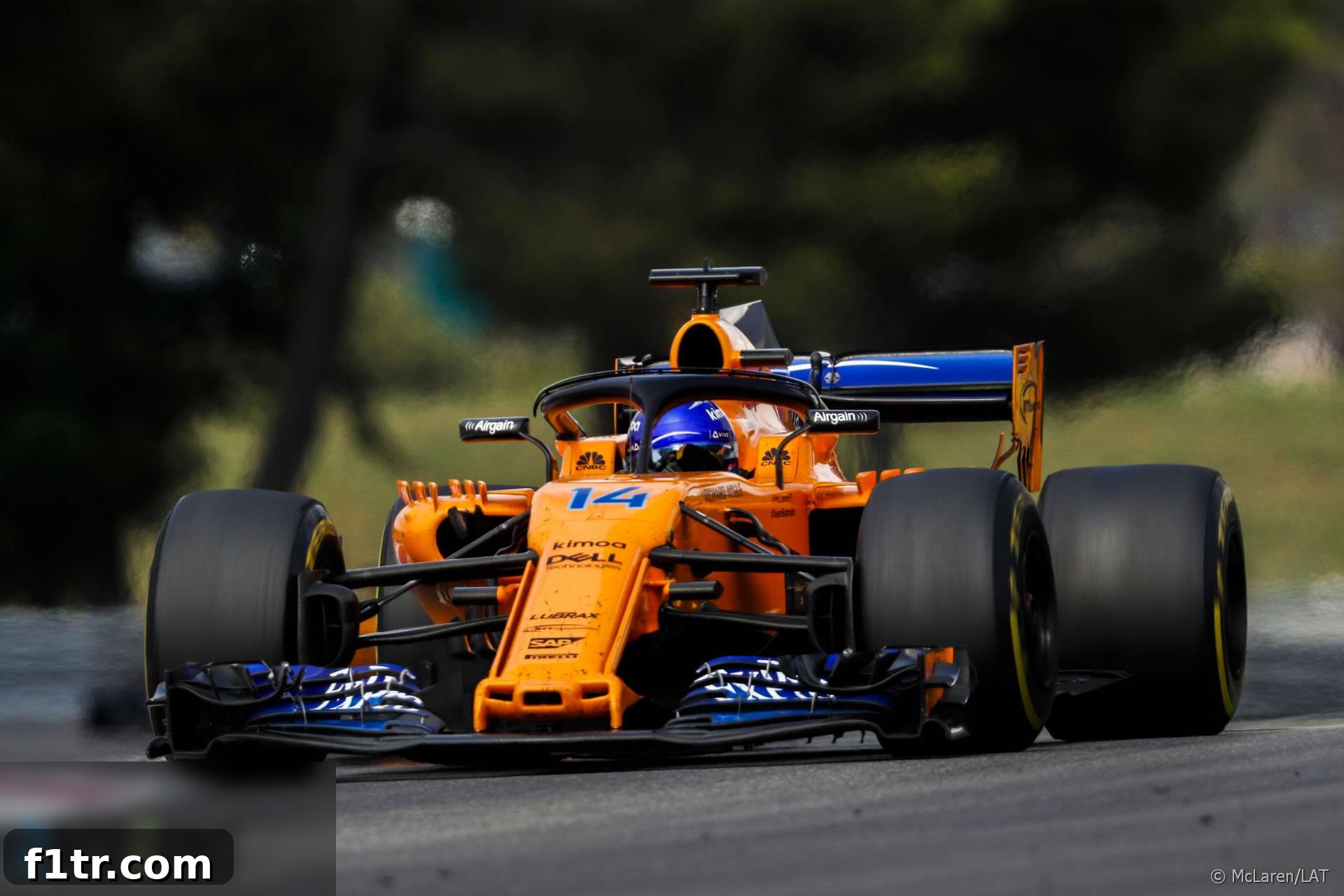
Fernando Alonso, the two-time world champion, has voiced his opinion that the media’s portrayal of McLaren’s performance during the current Formula 1 season has been significantly “exaggerated.” His comments emerged amidst intense scrutiny following a challenging weekend for the Woking-based team.
The French Grand Prix saw both McLaren cars failing to advance beyond the initial qualifying phase (Q1), a first for the season where neither car made it into Q2. This particular result fueled a fresh wave of critical media reports. However, Alonso firmly maintained that the team’s overall performance throughout the season, and even within that specific race weekend, was considerably better than what certain media outlets were presenting to the public.
“A weekend like that, the only problem is the media attention it attracts,” Alonso reportedly told media, including RaceFans, during an interview in Austria. He elaborated on the pressure and sensationalism prevalent in the sport: “Everything is exaggerated, especially in Formula One with all the polemics and all the things you need to sell every week. The narrative often becomes more about generating buzz than accurately reflecting the on-track reality.”
Alonso’s Candid Assessment of McLaren’s Form
Alonso acknowledged that the French Grand Prix was indeed a difficult outing for McLaren. “We had a quite poor weekend in terms of performance,” he admitted candidly. “We were uncompetitive on Friday, uncompetitive on Saturday, uncompetitive on Sunday. We are the first ones to know that. We realise that and we want to improve that.” This honest self-assessment from the Spanish veteran underscores the team’s internal awareness of their struggles and their commitment to finding solutions. Despite this challenging weekend, Alonso was quick to counter what he perceived as an overly pessimistic media narrative.
He emphatically clarified the team’s position, pushing back against the prevailing negativity. “At the same time, we are not last. We are not getting worse and worse. We are not the worst team in the paddock. We are not all these things that we’ve been hearing for the last three days.” Alonso’s words highlight the disparity between external perceptions and the team’s internal understanding of their competitive standing in the highly competitive Formula 1 landscape. He stressed that while improvement is always the goal, the situation was not as dire as it was being painted.
McLaren’s True Standing in the Championship
To further support his argument, Alonso pointed to McLaren’s position in the Constructors’ Championship, a crucial indicator of a team’s overall season-long performance. “We are fifth in the constructors’ championship,” he stated, emphasizing a respectable standing among formidable competitors. He also drew attention to his own performance in the Drivers’ Championship: “I’m eighth in the drivers’ championship. All the other ones that are doing a perfect season, they are behind us, so maybe they are not so perfect and we are not so bad.”
This comparison served as a direct challenge to the notion that McLaren was in freefall. Alonso suggested that many teams lauded for their “perfect seasons” were still trailing McLaren in the championship standings, implying that the media’s focus on individual bad weekends often overshadowed consistent overall performance. His perspective offers a valuable counter-narrative, urging a broader, more balanced view of team progress rather than succumbing to the immediate sensationalism of a single poor result.
The veteran driver reiterated the team’s commitment to improvement, while also offering a dose of realism about their journey. “We understand we have been uncompetitive, and we are the first ones that want to improve that,” he concluded, reinforcing the message that the team is not complacent but is also not succumbing to external pressure or exaggerated criticism.
Race Pace vs. Qualifying Performance: A Deeper Dive
Alonso went on to elaborate on a critical distinction often overlooked by casual observers and some media: the difference between qualifying pace and race performance. He argued that McLaren’s race-day execution in Paul Ricard was considerably stronger than their qualifying results suggested. “If you see the results, we were not good on Sunday,” he admitted, referring to the final finishing positions. “But if you look at the race trace, we were quite competitive on Sunday.”
This nuance is vital in Formula 1, where qualifying sets the grid, but race pace determines the actual outcome and the ability to fight through the field. Alonso provided specific examples from the French Grand Prix to illustrate his point about the team’s hidden potential and on-track competitiveness. “I started last, I respected the track limits in lap one so I was last. And then I changed from the back-up tyre for the yellow tyre on lap one, I was keeping the pace of the whole mid-group,” he explained, detailing his early race strategy and performance. This initial phase demonstrated that, even from the back, he could match the rhythm of the midfield.
The race was further complicated by an early incident involving Sebastian Vettel, which pushed Alonso even further back. “After the incident with Vettel, I was last by 10 seconds,” he recalled. Despite this significant setback, Alonso highlighted McLaren’s ability to maintain a competitive pace. “Even with that, when Sainz and Magnussen did a pit stop, they were just in front of us. So the pace of the whole first stint was very similar to Sainz and Magnussen, which was definitely not [the case] on Saturday, [when] we were 1.5 seconds behind them.”
This detailed analysis reveals a crucial aspect of McLaren’s performance. While their qualifying performance lagged significantly behind rivals like Carlos Sainz’s Renault and Kevin Magnussen’s Haas, their race pace on Sunday was comparable. This suggests that the car, while difficult to extract ultimate single-lap performance from, possessed a much stronger race trim, allowing for better management of tires and sustained speed over a longer distance. Alonso’s insights provide a more nuanced understanding, moving beyond headline-grabbing qualifying failures to appreciate the underlying race potential.
The media’s focus on qualifying results, while important for grid position, sometimes overlooks these critical nuances of race strategy and sustained performance. Alonso’s comments serve as a reminder that a complete picture of a team’s competitiveness requires looking beyond isolated incidents and considering the full scope of a Grand Prix weekend, including the race trace and championship standings.
Reflecting on the 2018 F1 Season and Beyond
The 2018 Formula 1 season presented unique challenges for McLaren as they embarked on a new chapter with Renault power units after a tumultuous period with Honda. Alonso’s candid remarks about media exaggeration and the team’s true standing are not just about a single race; they reflect the ongoing narrative and pressures faced by a storied team striving to return to the front of the grid. His comments underscore the delicate balance between managing internal expectations, maintaining team morale, and navigating external media scrutiny in the high-stakes world of Formula 1.
For fans and analysts alike, Alonso’s perspective offers valuable insight into the mindset of a top driver and the complexities of team performance measurement. It highlights how perception, often shaped by media headlines, can sometimes diverge significantly from the reality of on-track data and championship points. McLaren’s journey through the 2018 season, and indeed future seasons, will undoubtedly be watched closely, with Alonso’s voice continuing to be a significant part of the conversation.
Further Reading on the 2018 F1 Season
Explore more insights and discussions related to this pivotal season:
- Understanding Media Narratives in Formula 1
- A Deep Dive into McLaren’s 2018 Season Performance
- Fernando Alonso: A Career Defined by Resilience
- The Intensity of the Midfield Battle in 2018 F1
- How Constructors’ and Drivers’ Standings Reflect Performance
Browse all 2018 F1 season articles