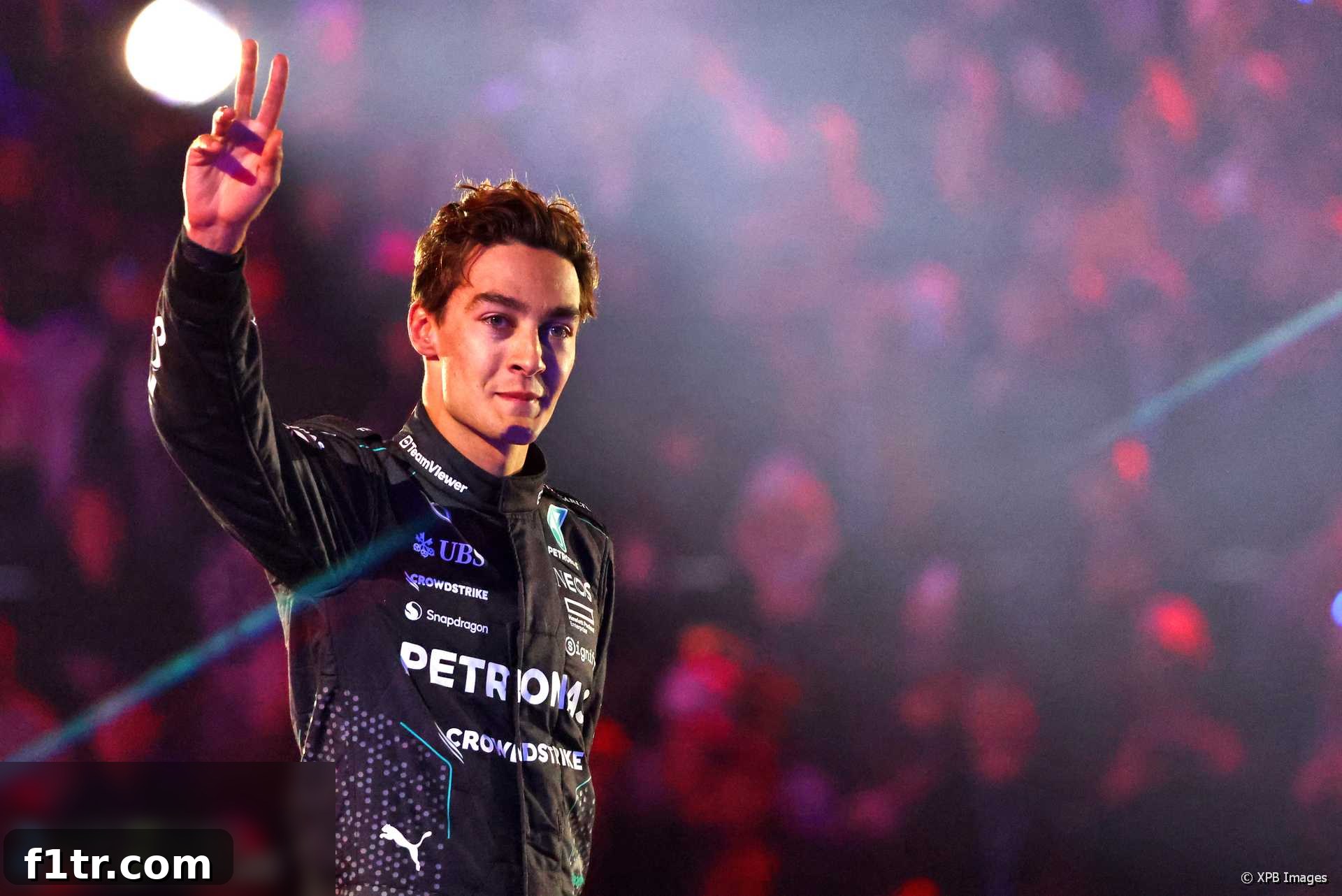
George Russell’s Las Vegas Grand Prix Triumph: A Mercedes Masterclass Against All Odds
Under the spectacular neon glow of the Las Vegas Strip, George Russell delivered a truly emphatic performance, steering his Mercedes-AMG Petronas Formula 1 car to a commanding victory at the Las Vegas Grand Prix. This triumph was not just a win; it was a profound statement, defying pre-race predictions and even the driver’s own expectations. Such was Russell’s initial skepticism about Mercedes’ competitiveness on the newly minted street circuit that he candidly considered a strategic engine swap, pondering whether to use an older power unit for Vegas to conserve his freshest engine for what he believed would be a more auspicious opportunity at the Losail International Circuit in Qatar.
However, the desert air held a surprise for the Silver Arrows. Mercedes quickly discovered an unexpected harmony between their W15 challenger and the unique demands of the high-speed, low-grip Las Vegas track. What began as a cautious approach swiftly transformed into a dominant display of pace. The team consistently topped every practice session throughout the weekend, laying a formidable groundwork. Russell’s exceptional form culminated in him clinching pole position, a crucial advantage that set the stage for Mercedes’ first victory in nine rounds and underscored a remarkable turnaround in fortunes for both driver and team.
From Doubt to Dominance: Russell’s Pre-Race Strategy and the Vegas Revelation
The lead-up to the Las Vegas Grand Prix was filled with strategic contemplation for George Russell. Prior to this pivotal trio of races, his gaze was firmly fixed on Qatar as Mercedes’ most viable shot at victory. “Going into this [trio of races] I had my sights set on Qatar,” Russell confessed, reflecting on his meticulous planning. “Even to the point that I wanted to take my freshest engine out and put an old engine in for Vegas, to save my best engine for Qatar. And I’m kind of glad we didn’t do that now.” This frank revelation highlights the significant contrast between pre-race expectations and the eventual outcome. Mercedes had grappled with inconsistent performance on various track layouts throughout the season, and Russell naturally gravitated towards Qatar’s well-established, smoother characteristics as a more favorable battleground.
The swift and dramatic shift in performance at Las Vegas was, therefore, genuinely astonishing. Russell openly admitted the team’s pleasant surprise, stating, “it’s been a real surprise seeing how strong our pace has been” around the sprawling six-kilometer street circuit. Securing pole position on Saturday was more than just a successful qualifying effort; it was a powerful affirmation of the team’s painstaking work and a clear signal that their initial assessments had been remarkably off the mark. The sheer satisfaction and palpable relief in Russell’s voice after clinching pole underscored the unexpected nature of their newfound competitive edge, transforming cautious optimism into burgeoning confidence.
Race Day Mastery: An “Exceptional” Stint One Secures the Win
When the lights went out for the Las Vegas Grand Prix, George Russell translated his pole position into a masterclass of race management and strategic execution. His opening stint was identified as the decisive phase of the race, a period where he established an unassailable advantage. “Then I think we won the race in stint one. To be honest, stint one was exceptional,” Russell articulated, emphasizing the critical importance of those early laps. This initial phase was characterized by Russell not only building a substantial lead but also by his meticulous management of the Pirelli tires, a particularly demanding task on a circuit renowned for its high-speed sections and abrasive surface, which often leads to tire degradation and graining.
Russell’s ability to precisely control his pace and expertly preserve the delicate rubber during this crucial first stint proved to be the bedrock of his victory. He demonstrated a profound understanding of the delicate balance required to maintain blistering speed without overworking the tires. “I knew from there on in the only way we would probably lose the victory is if I grained the tyres and opened them up. So it was just a case of managing my pace, managing in the right corners and bringing it home,” he explained. This disciplined and mature approach allowed him to create a comfortable buffer over his rivals, granting him the strategic flexibility to react to any challenges that emerged later in the Grand Prix. It was a testament to Russell’s evolving race craft, showcasing his capacity to dictate the terms of a race from the very front.
A Collective Triumph: Lewis Hamilton’s Resilient Drive Completes the One-Two
Adding a magnificent layer to Mercedes’ jubilant celebrations was the equally impressive performance of Lewis Hamilton. Starting from a challenging tenth position on the grid, the seven-time world champion embarked on a stellar recovery drive, meticulously navigating his way through the bustling field. His ascent was a blend of audacious overtaking maneuvers and astute strategic decisions, demonstrating the W15’s raw pace and Hamilton’s unparalleled skill. With unwavering determination, Hamilton climbed position after position, ultimately securing a remarkable second place, completing a glorious one-two finish for the Mercedes team.
A one-two result is far more than just a double points haul; it is a powerful declaration of a team’s collective strength, strategic brilliance, and the fundamental performance of its machinery. For Mercedes, this outcome signaled a potent resurgence, illustrating that when the specific conditions align with their car’s characteristics, their drivers are fully capable of challenging and dominating at the very pinnacle of motorsport. Hamilton’s spirited drive, in particular, underscored the underlying potential of the W15 and the team’s profound ability to adapt and deliver under pressure, even when starting from a compromised grid position.
The Smooth Track Advantage: Unpacking Mercedes’ Unexpected Strength
The pivotal factor behind Mercedes’ surprising dominance in Las Vegas can be attributed directly to the unique characteristics of the street circuit itself. Russell provided invaluable insight into how the track’s surface played perfectly into the strengths of their car, or more accurately, skillfully mitigated its inherent weaknesses. “It’s no secret that we struggle on the bumpy circuits and we have to lift the car[‘s ride height] quite a lot,” Russell clarified. This has been a persistent Achilles’ heel for Mercedes in recent seasons, particularly amplified by the ground-effect regulations. On circuits plagued by significant undulations and bumps, the team is frequently compelled to make substantial compromises to their car’s setup, primarily by increasing its ride height and softening the suspension.
While these adjustments are essential for enhancing driveability, preventing excessive porpoising, and avoiding the car bottoming out, they invariably push the W15 out of its optimal aerodynamic window. When the car is forced to run higher and softer, it sacrifices crucial downforce, which in turn diminishes its overall performance and lap time potential. “Then we’re in a downforce window where we don’t have any. It’s not that we just suddenly forget how to set the car up, it’s just certain circuits require us to put the car in a window it doesn’t like to be,” Russell elaborated. This explanation illuminates a core design characteristic of their car: it performs optimally when it can operate low to the ground and with a stiff suspension, thereby maximizing the ground effect and aerodynamic efficiency.
Crucially, the Las Vegas street circuit, despite being a temporary venue, offered an exceptionally smooth racing surface. This proved to be the critical differentiator. “On tracks like this where it’s relatively smooth, we can get the car quite low, quite stiff, with little or no bumps around the track, we fly,” Russell declared with evident satisfaction. The ability to configure the W15 in its preferred low and stiff setup allowed the car to function at its peak aerodynamic efficiency, generating the optimal downforce required to extract its absolute best performance. This key technical insight offers a comprehensive explanation for the dramatic surge in Mercedes’ competitiveness, transforming them from pre-race doubters into resounding race winners.
Broader Implications: A Glimmer of Hope for Mercedes’ Future Development
The victory at the Las Vegas Grand Prix carries substantial implications for Mercedes as they steadfastly continue their journey back to consistent championship contention. While a single dominant performance does not erase the collective challenges of an entire season, it provides invaluable data, a much-needed psychological boost, and crucial clarity. This win powerfully demonstrates that the fundamental design philosophy of the W15, when operating within its precise optimal window, is indeed capable of delivering race-winning pace against the toughest competitors. For the dedicated engineers and strategists at Brackley and Brixworth, this enhanced understanding of the car’s ‘sweet spot’ is paramount for future development, particularly as they refine their designs for the upcoming seasons.
The team will undoubtedly conduct exhaustive analyses of every facet of their Las Vegas setup and performance. Their goal will be to meticulously understand how they can replicate these ideal operating conditions on a broader spectrum of circuits. The lesson gleaned from Vegas is crystal clear: if Mercedes can either design a car that exhibits greater tolerance to bumps or innovate ways to achieve similar aerodynamic efficiency at incrementally higher ride heights, their overall competitiveness across the calendar will dramatically improve. This victory transcends mere points accumulation; it represents a rekindled confidence and provides a clearer, more defined path forward for their ambitious development trajectory.
George Russell: A Rising Star’s Continued Ascent
For George Russell personally, the Las Vegas victory further cemented his reputation as one of Formula 1’s premier talents. His remarkable ability to adapt, strategize, and execute under immense pressure was showcased brilliantly throughout the weekend. From his initial, candid doubts to his utterly commanding drive, Russell exemplified the mental fortitude and raw skill indispensable for success at the pinnacle of motorsport. This win, his second career victory, adds another significant accolade to his rapidly growing list of achievements and unequivocally reinforces his integral role in Mercedes’ long-term strategic plans. His precision in managing tire wear and controlling race pace, particularly during that critical first stint, underscored a growing maturity and a sophisticated race craft that promises great things for his future in the sport.
The Las Vegas Grand Prix, initially steeped in extravagant hype and surrounded by its fair share of logistical challenges, ultimately delivered a truly thrilling and memorable race. Mercedes’ unexpected success, masterfully spearheaded by Russell’s brilliant drive and magnificently complemented by Hamilton’s spirited charge, contributed a compelling and dramatic narrative to the inaugural event on the iconic Strip. It was a race that profoundly defied expectations, serving as a powerful reminder of the inherently unpredictable nature of Formula 1 and the immense, unwavering talent residing within the Mercedes team.
Related Content: Relive the 2024 Las Vegas Grand Prix
- “Disappointing” Las Vegas GP performance prompts ticketing changes for 2025 race
- Vowles clarifies Colapinto’s claim he was concussed in Las Vegas crash
- Norris lost title because McLaren weren’t competitive enough early on – Stella
- Ferrari are now in their longest-ever championship drought
- F1 “was trying too hard” in first year at Las Vegas – Sainz
Browse all 2024 Las Vegas Grand Prix articles