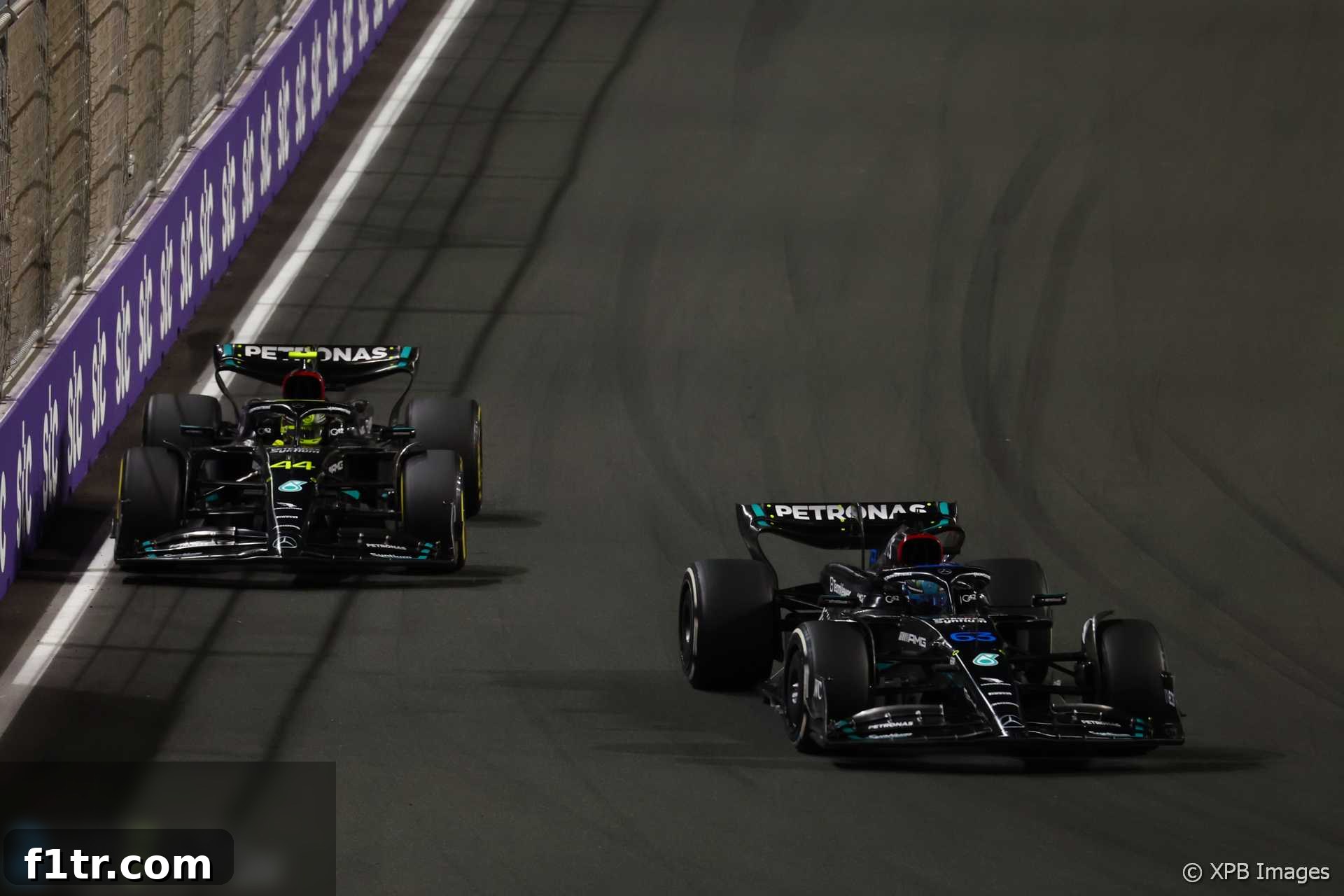
In the high-stakes world of Formula 1, where milliseconds define success and failure, the meticulous preparation of a car’s setup often goes unsung, yet it remains absolutely pivotal. Following the intense action of the Saudi Arabian Grand Prix, Mercedes driver George Russell expressed profound confidence in the setup direction he pursued with his team, a conviction that was notably underscored by his teammate, Lewis Hamilton, who candidly admitted his W14 lacked optimal pace in Jeddah. This divergence in performance, rooted in critical pre-race decisions, ignited conversations about driver intuition, engineering collaboration, and the intricate balance required to extract maximum potential from an F1 machine.
The Jeddah Corniche Circuit, with its formidable speeds and unforgiving walls, is a track that demands absolute precision and a perfectly balanced car. During the Saudi Arabian Grand Prix, both Mercedes drivers finished within the top five, with Russell securing fourth place ahead of Hamilton in fifth. However, the qualitative difference in their race weekend was palpable. Russell not only out-qualified Hamilton but also maintained a stronger race pace, leading his seven-time world champion teammate across the finish line. Post-race, Hamilton was forthright about his car’s characteristics, stating, “My car’s balance was a bit off,” and further conceding that “if I had the set-up that George had, I would have been in a bit of a better position.” This admission highlighted the significant impact of setup choices, a critical aspect that Russell attributed not to chance, but to diligent effort and strategic foresight.
Russell’s Unwavering Confidence in His Setup Strategy
For George Russell, the superior performance was a direct consequence of deliberate decision-making and meticulous teamwork. Dismissing any notion of luck, Russell firmly stated, “I don’t think there’s any luck in it at all. I think it’s down to the preparation you put in before the event.” This reflects the rigorous process undertaken by Formula 1 drivers and their engineering teams, involving countless hours in simulators, analyzing telemetry data, and fine-tuning every component to match the specific demands of a given circuit and prevailing conditions. The changes implemented overnight before qualifying proved to be the decisive factor for Russell.
He elaborated on his conviction, explaining, “The changes we made overnight, I knew that was going to be the right direction with the work we did with the team. And I believed it was going to be better than the set-up that Lewis opted for.” This statement speaks volumes about Russell’s evolving understanding of the Mercedes W14 and his growing influence within the team regarding car development and race strategy. It highlights the importance of a driver’s personal preference and confidence in their chosen direction, which can be as crucial as the raw data itself. In Formula 1, each driver possesses a unique driving style and comfort zone, necessitating a setup that complements their approach for optimal performance. Russell’s proactive engagement with his engineers to tailor the car to his liking paid dividends in Jeddah, demonstrating a mature and assertive approach to his craft.
Lewis Hamilton’s Setup Dilemma and Its Implications
Lewis Hamilton’s post-race comments provided a rare glimpse into the internal challenges faced by a top team when drivers pursue different setup philosophies. His observation that his car’s balance was “a bit off” suggests a car that was not responding ideally to his inputs, potentially leading to understeer or oversteer characteristics that compromised his ability to push to the absolute limit. In a sport where even a slight imbalance can translate to tenths of a second per lap, such a deficiency can be insurmountable over a full race distance. The fact that Hamilton openly acknowledged he would have been “in a better position” with Russell’s setup underlines the stark performance differential created by these choices.
This situation also raises pertinent questions about intra-team dynamics and the development trajectory of the Mercedes W14. While both drivers aim for the fastest car, their individual preferences for how that speed is achieved can diverge. One driver might prefer a more stable rear end, while another might favor a more responsive front end. Finding a universal setup that caters to both a veteran like Hamilton and an emerging talent like Russell is a continuous engineering challenge. The Jeddah weekend demonstrated that while Russell found a sweet spot, Hamilton struggled to unlock the car’s full potential, a scenario that Mercedes would be keen to avoid in subsequent races to maximize their points haul and challenge the front-runners consistently.
Jeddah: A Defining Weekend for Russell’s Mercedes Tenure
Despite the post-race penalty saga that temporarily elevated and then demoted him, George Russell unequivocally viewed the Saudi Arabian Grand Prix as one of his most accomplished performances since joining Mercedes full-time at the start of the previous season. “I felt like Saudi was probably one of my strongest weekends I’ve ever had with Mercedes,” he asserted, reflecting deep satisfaction with his execution across qualifying and the race.
His qualifying performance was particularly impressive, setting the stage for a strong Sunday. In the race, Russell demonstrated exceptional pace and race management, proving his capability to extract the maximum from the W14. Finishing P4, he felt, was the “absolute maximum we could have achieved” given the competitive landscape. He acknowledged the superior pace of some rivals, noting, “I think the Ferraris probably were a little bit faster than us that weekend.” Furthermore, he pointed to the threat posed by Lance Stroll from Aston Martin, who, despite eventually retiring due to a technical failure, had been firmly in contention behind the Mercedes. Russell’s ability to maximize points in a challenging scenario, coupled with his strong individual showing, cemented Jeddah as a significant milestone in his Mercedes career, showcasing his growing prowess and strategic acumen.
The Fernando Alonso Penalty Fiasco and Russell’s Reaction
The immediate aftermath of the Saudi Arabian Grand Prix was shrouded in confusion due to a contentious penalty imposed upon Fernando Alonso. Initially, Alonso was handed a five-second penalty for incorrectly lining up his car in the grid box at the start of the race. This was served during his pit stop. However, after the race, another ten-second penalty was issued for an alleged improper execution of the first penalty during the pit stop, specifically for a mechanic touching the car before the five seconds had elapsed. This second penalty temporarily elevated Russell to third place, a podium finish he had not earned on track.
However, the saga took another bizarre turn hours later when the stewards overturned the second penalty after Aston Martin presented compelling evidence, including video footage, arguing that the rule regarding touching the car during a penalty had been inconsistently applied and was not clearly defined. This reversal meant Alonso reclaimed his third place, and Russell was demoted back to fourth. The fluidity of the situation, with positions shifting hours after the chequered flag, caused considerable frustration and embarrassment for the sport.
Russell himself encountered Alonso directly amidst this unfolding drama. “Fernando was actually the first person to tell me that I’d lost the position because I bumped into him at the airport,” Russell recounted, a testament to the surreal nature of the post-race proceedings. He added, “So he clearly had some insider info.” Reflecting on the entire episode, Russell offered a pragmatic yet critical assessment. While he acknowledged the eventual decision to overturn the penalty was “the right decision” from a sporting integrity standpoint, he couldn’t hide his exasperation at the chaotic process. “It was just a bit of a shame what a mess it was for everybody else,” he remarked. He further clarified his personal stance: “I think from my side and our side, we didn’t feel like we deserved to finish in third position but obviously it’s quite a nice feeling when it’s handed to you. And then when it’s taken away from you again, it was just all a bit silly.” This sentiment encapsulates the frustration felt by many within the F1 paddock and among fans, highlighting the need for clearer regulations and more consistent stewarding decisions to maintain the sport’s credibility.
Looking Ahead: Mercedes’ Development Path and Driver Dynamics
The Saudi Arabian Grand Prix served as a crucial learning experience for Mercedes. The contrasting fortunes of George Russell and Lewis Hamilton regarding their setup choices underscored the delicate balance in car development and optimization. While having two top-tier drivers with distinct preferences can sometimes complicate the development process, it can also provide invaluable data points, offering diverse feedback that can lead to a more versatile and ultimately faster car. The team’s challenge lies in understanding the nuances of these preferences and evolving the W14 into a machine that consistently delivers peak performance for both drivers.
As the season progresses, Mercedes will undoubtedly analyze the Jeddah data intensely, aiming to understand why Russell’s setup proved more effective and how those learnings can be incorporated into future upgrades. The goal remains to close the performance gap to Red Bull and challenge for victories. The collaboration between Russell and Hamilton, despite their differing setup experiences in Saudi Arabia, remains vital. Their combined feedback and competitive spirit will be instrumental in pushing the team forward, iterating on the W14’s design, and ensuring that Mercedes returns to consistent contention at the very front of the grid.
Conclusion
George Russell’s performance and self-assuredness at the Saudi Arabian Grand Prix highlight his rapid growth and maturity as a leading Formula 1 driver. His unwavering confidence in his setup choices, which ultimately paid off against the struggles of his illustrious teammate Lewis Hamilton, speaks volumes about his meticulous preparation and astute understanding of the complex F1 machinery. While the post-race penalty saga surrounding Fernando Alonso created an unnecessary distraction and a momentary surge of false hope, Russell’s pragmatism and focus on his genuine on-track achievement reinforced his professional approach.
The Jeddah weekend served as a microcosm of the intense competition and intricate engineering challenges inherent in Formula 1. It underscored that beyond raw driving talent, the ability to collaborate with engineers, interpret data, and make decisive setup calls is paramount. For Mercedes, the experience offers critical insights into the W14’s characteristics and the divergent paths drivers might take to unlock its potential. As the 2023 season unfolds, the lessons learned from Russell’s strong showing and Hamilton’s setup woes in Saudi Arabia will undoubtedly shape Mercedes’ development trajectory, fueling their relentless pursuit of championship glory.
2023 Australian Grand Prix
- Australian GP to forbid fans from entering track at end of this year’s race
- I only missed one chance to score points this year – Albon
- Formula 1’s stewards should listen to drivers less, not more
- Mercedes unsure whether gains seen in Melbourne were ‘track-specific’
- Why Ferrari saw a ‘real step forward in pure performance’ in point-less Australian GP
Browse all 2023 Australian Grand Prix articles