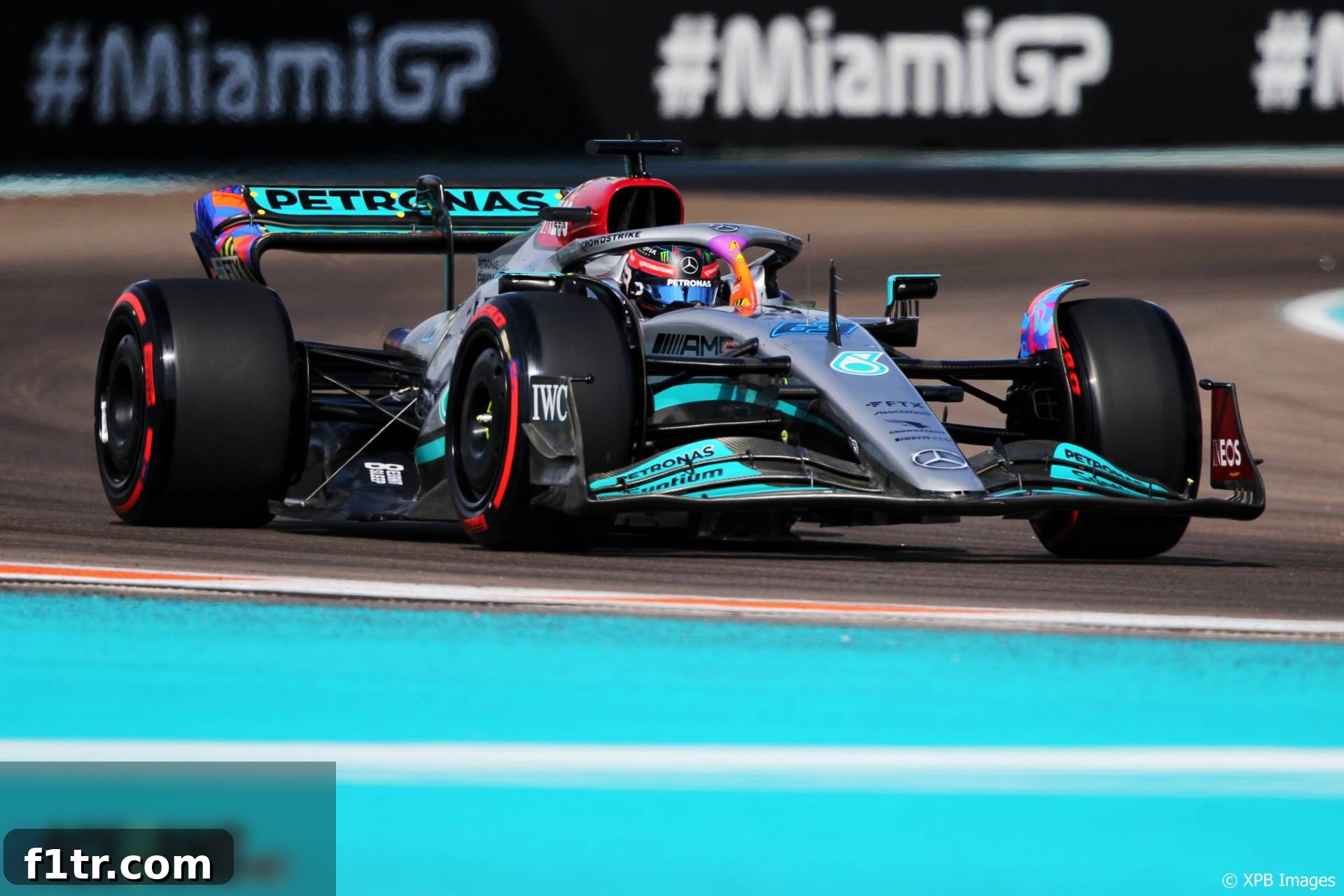
George Russell, a prominent voice among Formula 1 drivers, has issued a clear call to the management of the Miami International Autodrome: the track surface demands significant improvement before Formula 1 makes its anticipated return next year. The inaugural Miami Grand Prix, a highly anticipated addition to the F1 calendar, was met with a chorus of concerns from drivers regarding the unsettling lack of grip across various sections of the circuit, particularly off the racing line. This pervasive issue overshadowed much of the weekend’s on-track action, leading to a largely processional contest that only truly sparked to life following a late Safety Car period.
Drivers’ Disappointment: Lack of Grip and Its Consequences
Throughout the Miami Grand Prix weekend, drivers consistently voiced their apprehension about the challenging track surface. Following the main event, George Russell did not mince words, emphasizing that those responsible for the circuit’s operation “need to do something” about the tarmac for all future races. His remarks underlined a dual concern that resonates deeply within the sport: both safety and the fundamental quality of racing.
Russell articulated the critical nature of the problem, stating, “One, it’s a safety issue. Secondly, it just does not offer good racing.” He elaborated on how the peculiar characteristics of the surface severely limited drivers’ ability to engage in wheel-to-wheel combat: “You can’t go side-by-side with a car around the corner when there’s zero grip off-line.” This observation highlights a fundamental flaw in a circuit designed to promote overtaking. Modern F1 cars, with their intricate aerodynamics and sophisticated tire compounds, thrive on consistent grip. When this consistency is compromised, especially outside the narrow racing groove, it actively discourages aggressive, competitive maneuvers.
To further illustrate the challenging conditions, Russell drew a vivid analogy: “It’s kind of like driving in the wet when you’ve gone on the slicks in the wet and there’s one dry line.” While acknowledging that such conditions make the track “drive-able,” he quickly pivoted to the core question: “but it depends if you want to offer good racing and something good for the drivers.” This distinction is crucial; a circuit might be technically navigable, but if it stifles genuine racing spectacle and driver enjoyment, it fails to meet the high standards expected of a Formula 1 venue.
High Hopes Versus Harsh Reality: Miami’s Tarmac Conundrum
Prior to the inaugural weekend, a palpable sense of optimism permeated the paddock regarding the Miami track layout. Its flowing sections, combined with tighter, technical areas, initially promised a dynamic circuit conducive to exciting overtaking opportunities. However, these hopeful assessments rapidly shifted after drivers completed their initial laps. The immediate feedback was overwhelmingly negative concerning the track’s grip levels, a sentiment that only solidified as the weekend progressed.
Despite the drivers’ early concerns, Formula 1 team principals remained cautiously optimistic, expressing hope that the track would “rubber-in” sufficiently during the grand prix, thereby mitigating the grip issues. The expectation was that accumulating layers of tire rubber would gradually enhance surface adhesion, leading to improved conditions for Sunday’s race. However, Russell’s post-race analysis confirmed that these hopes were largely unfounded. He revealed that it proved “really difficult to race around this track” on Sunday, indicating that the predicted rubbering-in effect was insufficient to overcome the fundamental problems with the tarmac.
Russell’s frustration was evident as he questioned the composition of the track, exclaiming, “I don’t know what on earth they’ve done with the Tarmac but off-line it’s awful.” This strong statement underscores a critical issue for any new circuit aiming to host Formula 1. The quality and composition of the asphalt are paramount, directly influencing tire performance, driver confidence, and ultimately, the excitement of the racing.
Miami vs. Modern F1 Circuits: A Stark Contrast
The Mercedes driver also highlighted a perplexing inconsistency when comparing Miami to other recent additions or re-surfaced circuits on the F1 calendar. “It’s strange,” Russell added, “because every other new Tarmac on these other tracks – with Jeddah, with Melbourne – they’ve generally gone for really high grip, really good racing on and off line but here something’s gone a bit wrong.” This comparison is particularly telling. Circuits like Jeddah, a high-speed street track, and the re-profiled Albert Park in Melbourne have been lauded for their excellent, consistent grip levels, both on the primary racing line and in wider areas. Such surfaces encourage drivers to push the limits, explore different lines, and execute bold overtakes without the fear of suddenly losing all traction when venturing slightly wide.
The stark contrast suggests that the material selection, application process, or curing period for Miami’s tarmac might have been fundamentally different or flawed. A track surface that offers consistent grip across its width is not just a luxury; it’s a prerequisite for competitive Formula 1 racing. Without it, the spectacle of drivers battling side-by-side, frequently changing positions, and navigating complex corners with diverse strategies is severely curtailed, turning what should be a dynamic race into a predictable procession.
Beyond the Surface: The Pit Lane Entry Safety Oversight
Russell, who holds a significant position as a director of the Grand Prix Drivers’ Association (GPDA), also brought attention to another critical safety concern that had been raised by drivers but, disappointingly, not acted upon: changes to the pit lane entrance. The GPDA serves as a vital collective voice for F1 drivers, advocating for their interests, primarily regarding safety. Their recommendations are typically based on extensive experience and a deep understanding of the sport’s inherent risks.
“I almost crashed coming into the pit lane,” Russell recounted, vividly illustrating the peril of the existing design. He further explained the pre-race concerns: “We requested to get the pit entry blend line removed because we knew that with all the [tyre] marbles going outside, having to go around the outside of the corner, it’s going to cause a crash.” Tyre marbles, which are small pieces of rubber shed from the tires during a race, accumulate off the racing line and can dramatically reduce grip. Forcing drivers to navigate these slippery conditions when entering the pit lane, especially at speed and around a blend line, creates an unnecessary and significant accident risk. Russell’s disappointment was palpable: “So that was a shame not to see that implemented.” This highlights a concerning lapse in communication or responsiveness from the circuit organizers, particularly when driver safety is at stake.
Looking Ahead: Miami’s Path to Becoming a Premier F1 Venue
The inaugural Miami Grand Prix was undeniably a significant event, bringing Formula 1 to a vibrant new market in the United States and attracting a large, enthusiastic audience. However, the success of a Grand Prix is not solely measured by its off-track spectacle and attendance figures; the quality of the racing and the safety of the participants are paramount. George Russell’s pointed criticisms serve as an urgent reminder that infrastructure, particularly the track surface and critical safety elements like pit lane entry designs, must meet the sport’s stringent standards.
For the Miami International Autodrome to evolve into a truly premier Formula 1 venue, capable of delivering the thrilling, unpredictable racing that fans crave, addressing these fundamental issues is non-negotiable. The F1 community, from drivers and teams to the sport’s governing body, will be closely watching to see how the circuit management responds to these concerns. A commitment to re-evaluating and improving the track surface – potentially through re-surfacing, specialized cleaning, or different asphalt treatments – along with swift action on critical safety recommendations like the pit lane entry, will be essential. Only then can the Miami Grand Prix fully realize its potential, moving beyond initial fanfare to establish itself as a jewel in the Formula 1 calendar, offering both a spectacular event and genuinely world-class racing.