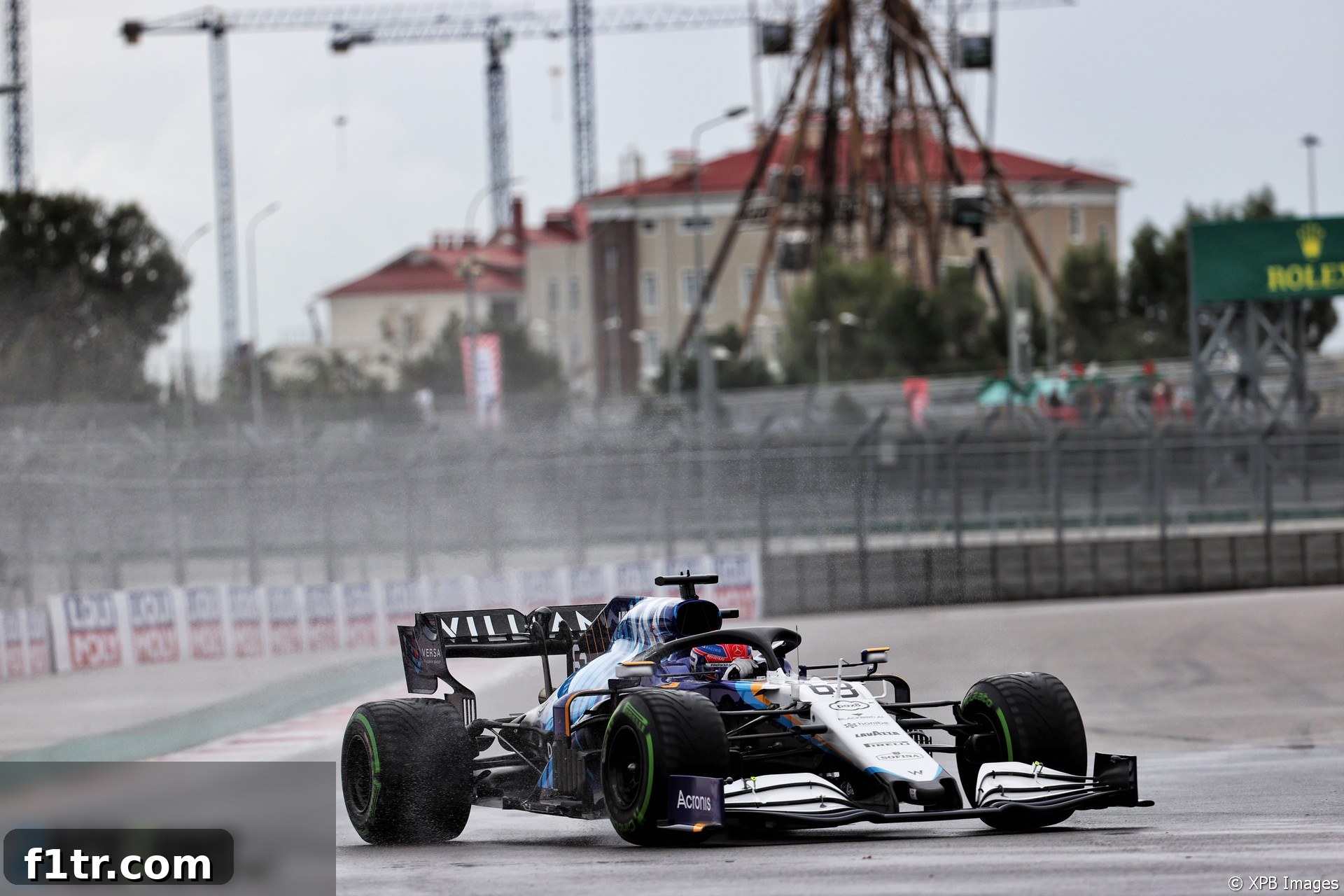
The 2021 Formula 1 Russian Grand Prix qualifying session at the Sochi Autodrom was a thrilling spectacle of rapidly changing conditions, strategic brilliance, and raw driving talent. Amidst the chaos of a drying track, Williams driver George Russell delivered a performance that captivated the motorsport world, securing a sensational third position on the grid. This remarkable feat was the culmination of an audacious tyre gamble, surprisingly initiated by a crucial miscommunication with his team, which ultimately showcased Russell’s exceptional skill, tactical acumen, and unwavering courage in high-pressure scenarios.
Advert | Become a Supporter & go ad-free
As the qualifying session unfolded, the rain that had earlier soaked the circuit began to subside, leaving behind a treacherously damp but progressively drying track. This evolving situation presented every team with the ultimate strategic conundrum: when to abandon the grooved intermediate tyres for the grippier, but riskier, slick compounds. Russell, already lauded for his prowess in challenging conditions, found himself at the forefront of this critical decision-making process, a choice that would define his afternoon and send ripples across the F1 paddock.
The Pivotal Tyre Gamble: A Miscommunication That Catalyzed Courage
The defining moment for George Russell arrived amidst the frantic intensity of Q3, where every second and every strategic call held immense weight. Russell’s initial radio message to his Williams pit wall was intended as a preparatory alert, signaling his anticipation of dry conditions: “I came on the radio to say to the guys, let’s get the slicks ready because it’s definitely going to go slicks.” This statement, a pre-emptive instruction to have the slick tyres standing by, was seemingly interpreted by his team as an immediate command for a pit stop. Russell vividly recalled the exchange, noting the potential misunderstanding: “And they replied saying, ‘okay let’s box this lap’. So I thought they may have misunderstood what I meant by that radio comment.”
In the high-stakes theatre of Formula 1 qualifying, where snap decisions can make or break a session, Russell faced a split-second choice. Instead of questioning or correcting the perceived misinterpretation, he chose to embrace the unexpected directive. With a characteristic blend of daring and confidence, he committed fully to the early switch. “I said, let’s go for it. We’ve got to go for it in these sessions. High risk, high reward, especially in these conditions,” he declared, embodying the very spirit of a racer willing to gamble for glory. This unplanned strategic deviation, born from a communication anomaly, transformed into a bold, calculated move, underscoring Russell’s incredible adaptability and his innate ability to seize unforeseen opportunities. His immediate acceptance of the ‘box this lap’ instruction, rather than dwelling on the miscommunication, highlighted his proactive racing mentality and his readiness to turn a potential hiccup into a tactical advantage.
A Leap of Faith on a Treacherous Track: Mastering the Unpredictable Elements
The decision to pit for slick tyres was just the first step; the true test lay in executing the change and then navigating a still-damp, treacherous circuit on dry-weather rubber. Emerging from the pit lane on cold slick tyres, with patches of standing water still posing significant threats, Russell faced an immediate and harrowing challenge. The peril was palpable, as he candidly admitted, “When I came out of the pit lane on the slicks I almost crashed straight out of the box.” This near-miss was a stark reminder of the razor-thin margin for error when pushing the boundaries of grip in rapidly transitioning conditions. The extreme difficulty of generating heat into slick tyres on a cooling, wet track, coupled with the ever-present danger of aquaplaning, makes such early tyre changes one of the most nerve-wracking maneuvers in motorsport.
For several subsequent laps, Russell engaged in a delicate dance with the limits of adhesion, masterfully wrestling his Williams through the corners. He meticulously searched for the emerging dry line, patiently building temperature in his tyres while simultaneously fending off any costly mistakes. His exceptional car control and profound experience were paramount during this critical phase. The Sochi Autodrom, with its unique blend of long straights and intricate, ninety-degree corners, demands absolute precision. While intermediate tyres offer a degree of predictability in damp conditions, slick tyres transform every damp patch into a potential incident, every corner entry a finely balanced judgment call between assertive driving and sheer survival. Russell’s remarkable ability to maintain control, progressively build confidence, and ultimately extract blistering performance under such immense, fluctuating pressure was a definitive testament to his prodigious talent behind the wheel, distinguishing him from many of his peers.
Securing a Stunning Grid Position: The Art of the ‘Killer Lap’
Despite the initial hair-raising moments and the relentless battle for grip, Russell persevered, steadily finding more pace as the track continued its transition from damp to dry. Qualifying sessions in changeable conditions often culminate in a dramatic final flurry, where the track reaches its optimum speed in the dying seconds. Russell understood this implicitly. “It was only on that last lap, I kept getting a little bit of traffic in there, I couldn’t complete the lap. So that was a bit frustrating,” he recounted, highlighting the additional challenge of managing other cars jostling for position while simultaneously attempting to extract every ounce of performance from his own machine.
With an intuitive understanding that the ultimate performance window would open only at the very end of the session, Russell strategically managed his earlier laps, meticulously saving his decisive attack for when it mattered most. “But as it was for everybody, I knew that last lap was going to be the killer lap. So we saved it all for then and here we are.” And ‘here we are’ was a truly astonishing third place on the grid, positioning his Williams behind only the McLaren of Lando Norris and the Ferrari of Carlos Sainz Jnr. This was an almost unbelievable achievement for a Williams car, which typically found itself contending further down the grid. His performance felt “a bit surreal,” a sentiment that resonated deeply within the paddock, where seasoned observers marveled at his extraordinary drive. This result marked his second top-three start in a mere four races, unequivocally solidifying his burgeoning reputation as a formidable competitor capable of conjuring extraordinary results from challenging circumstances.
Echoes of Spa: A Masterclass in Wet Qualifying and Strategic Acumen
George Russell’s sensational qualifying performance in Russia bore striking similarities to his earlier heroics at the Spa-Francorchamps circuit, where he had also stunned the grid by securing a front-row start. This wasn’t merely a stroke of luck, but a clear demonstration of a highly refined strategic approach and exceptional situational awareness in rapidly evolving conditions. Russell himself confirmed the inherent parallels: “So it’s similar to Spa to be honest.” His method involves a meticulous understanding of track evolution, combined with a disciplined approach to tyre management and optimal track positioning, a formula that has consistently delivered standout results.
He meticulously articulated his thought process: “I saw the dry line appearing and I knew if there wasn’t an interrupted session, it definitely would have been slicks. So I was pretty relaxed.” This profound calmness under pressure, stemming from a deep, almost intuitive understanding of racing physics and prevailing weather patterns, allowed him to plan several crucial steps ahead. He wasn’t just reacting to the immediate moment; he was actively anticipating the track’s progression. While pushing the boundaries of grip, he exercised judicious caution in the nascent stages of his slick tyre run: “I was pushing the limits but I wasn’t going too crazy because I knew that on that opening lap or the out-lap I could have easily ended up in the wall if you’re half a metre too wide and you get a wet patch.”
This calculated aggression is a cornerstone of his success in adverse conditions. He masterfully managed his track position, ensuring he had clean air and impeccable timing for his ultimate flying lap. “I was sort of saving it for that last lap and making sure I had the right track position.” He acknowledged encountering some traffic during his run but possessed the self-awareness to recognize that even without it, pole position might have been just out of reach at that specific juncture. This insight allowed him to channel his focus entirely on maximizing his potential for the crucial final run, rather than chasing an unattainable target too early. “I had a bit of traffic here and there, I still wouldn’t have been quick enough to fight for pole at that point. So I thought, let’s just save it and make sure we’re in a great position for that final lap and go for it.” This strategic discipline, coupled with his undeniable raw pace and exceptional car control, consistently positions him at the sharp end of the grid when the unpredictable elements dictate the racing narrative.
The Rising Star of Formula 1: George Russell’s Impact on Williams and Beyond
George Russell’s back-to-back qualifying heroics at Spa and Sochi were far more than just individual standout performances; they served as powerful, undeniable statements about his caliber as a Formula 1 driver. For the venerable Williams Racing team, these extraordinary results represented a monumental boost, offering rare and exhilarating glimpses of front-running potential in an era predominantly dominated by financially superior powerhouse teams. Russell’s consistent ability to extract more performance from his machinery than its perceived capability has become a defining hallmark of his career, justly earning him the affectionate moniker “Mr. Saturday” for his exceptional qualifying prowess.
His impressive performances have not only garnered invaluable media attention and significantly bolstered morale within the Williams garage but have also undeniably elevated his own profile within the upper echelons of the sport. These high-risk, high-reward gambles, executed with such surgical precision and unwavering confidence, are precisely the qualities that top-tier teams meticulously seek in a potential championship driver: blistering speed, profound intelligence, and the sheer courage to seize fleeting opportunities. The sophisticated strategic decision-making, the masterful car control demonstrated in the most challenging conditions, and the unshakeable self-belief in his own abilities collectively paint a vivid picture of a future world champion. His readiness to embrace the unknown, as exemplified by the slick tyre miscommunication, epitomizes his audacious approach to racing—an approach that consistently yields impressive and often unexpected dividends.
Beyond the immediate results, Russell’s consistent and spectacular showings in qualifying, particularly when faced with a rapidly changing and challenging environment, have irrevocably cemented his reputation as one of the most exciting and formidable talents on the current F1 grid. He embodies the archetype of the modern Formula 1 driver: analytical, incredibly adaptable, fiercely competitive, and relentlessly pursuing perfection. These memorable Saturday performances were not merely about securing a favorable starting position; they were about showcasing the relentless pursuit of excellence and illustrating the profound, transformative impact a single, exceptionally talented driver can have on a team’s fortunes, even when confronting significant technical disadvantages and resource limitations.
Advert | Become a RaceFans supporter andgo ad-free
Related Articles: 2021 Russian Grand Prix Insights
- Norris says he missed few chances to win in 110-race wait for first F1 victory
- Sochi disappointment will make Norris and McLaren stronger, says Seidl
- F1 race start times could be brought forward to avoid Spa-style wash-outs
- New technology in Ferrari’s power unit update vital for 2022 – Binotto
- Mercedes have left too many points on the table, admits Wolff
Browse all 2021 Russian Grand Prix articles