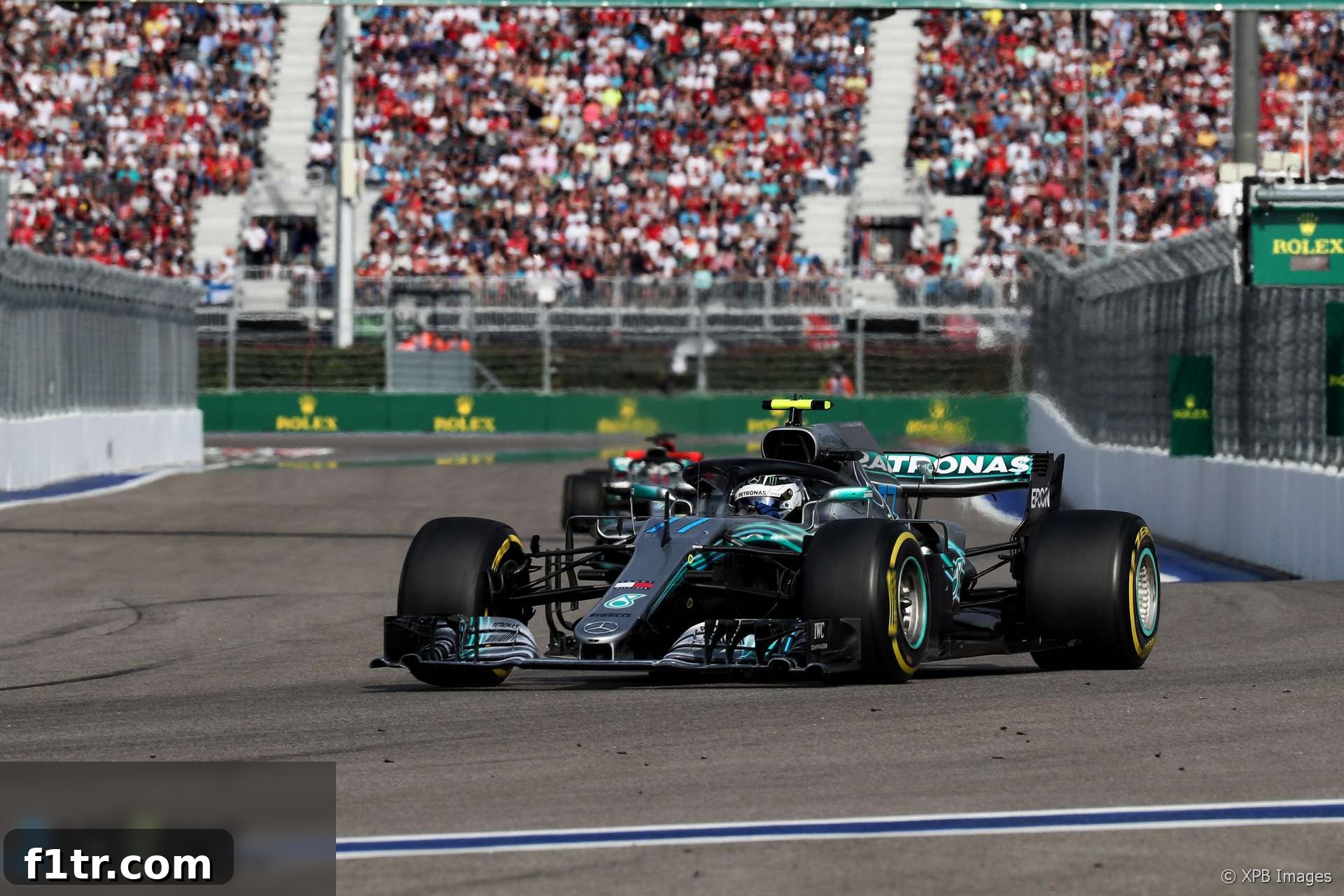
In the high-stakes world of Formula 1, where every point can dictate the trajectory of a championship, strategic decisions often spark fervent debate among fans and pundits alike. One such moment unfolded dramatically at the 2018 Russian Grand Prix, when Mercedes-AMG Petronas Motorsport employed team orders, prompting a widespread discussion that resonated throughout the paddock. This tactical intervention saw Valtteri Bottas, who was leading the race, instructed to yield his position to teammate Lewis Hamilton, thereby allowing Hamilton to secure a crucial victory and significantly extend his advantage in the Drivers’ Championship battle against Sebastian Vettel.
The decision was met with a degree of unease even within the Mercedes camp. Lewis Hamilton himself admitted that accepting the win under such circumstances “didn’t feel good,” highlighting the complex ethical dilemma inherent in team orders. Mercedes team principal Toto Wolff also voiced his reluctance to impose such directives on his drivers, underscoring the tension between sporting integrity and strategic necessity. However, amidst the swirling controversy, one prominent figure from a rival team offered a staunch defence of Mercedes’ actions: Otmar Szafnauer, the team principal of Force India, a Mercedes engine customer at the time.
Szafnauer’s Pragmatic Backing: A Strategic Imperative
Szafnauer’s perspective, rooted in the cutthroat realities of championship racing, provided a compelling counter-argument to those criticizing Mercedes. He articulated a pragmatic viewpoint, stating, “I think he did the right thing. I would have done exactly the same because you don’t know what tomorrow brings.” This statement encapsulates the core philosophy driving many strategic decisions in Formula 1 – the relentless pursuit of points and the mitigation of risk in an inherently unpredictable sport.
The Force India boss elaborated on the potential pitfalls that could derail a championship campaign, emphasizing the fragility of a points lead. “You can easily have some kind of car or power train failure and then you’re 25 points gone,” he explained. Modern F1 cars are marvels of engineering, but they operate at the absolute limit, making mechanical failures a constant threat. A sudden technical glitch, an engine component breaking down, or a transmission issue can instantly nullify a race-winning performance, turning a potential 25-point gain into a devastating zero. In such a high-attrition environment, securing maximum points whenever the opportunity arises is not just a preference but a strategic imperative.
Beyond mechanical vulnerabilities, Szafnauer also highlighted the risk of on-track incidents. “Someone can take you out inadvertently at the start. Probably not, [but] definitely possible in five races.” The start of an F1 race is a chaotic ballet of precision and aggression, where even the slightest misjudgment can lead to multi-car collisions. Furthermore, incidents can occur at any point during a Grand Prix, often through no fault of the driver involved. A rival’s error, a puncture from debris, or an unavoidable collision can prematurely end a race and erase precious championship points. With only a handful of races remaining in the season, as was the case at the Russian Grand Prix, the margin for error diminishes significantly, making every single point critically important.
Given these pervasive risks, Szafnauer concluded, “If you don’t finish two of them, there’s a battle for the championship. So I think you’ve got to take every opportunity to ensure you win both championships. They’re fighting for both the drivers and the constructors.” This perspective underscores the dual objective of every top-tier F1 team: securing both the Drivers’ World Championship for their lead pilot and the Constructors’ World Championship for the team itself. These two titles represent the pinnacle of success in motorsport, bringing immense prestige, significant financial rewards, and vital momentum for future seasons. Sacrificing one driver’s individual race win for the greater good of the team’s championship aspirations, particularly when one driver has a clearer path to the title, becomes a justifiable, albeit unpopular, strategic maneuver.
Force India’s Own Tactical Manoeuvres: A Parallel in Practice
Szafnauer’s support for Mercedes’ team orders wasn’t just theoretical; his own team, Force India, had employed similar tactics during the very same Russian Grand Prix. In their case, the team instructed Esteban Ocon and Sergio Perez to swap positions twice. The objective was to give Perez, who was believed to have a stronger pace or a better chance, the opportunity to attack Kevin Magnussen of Haas F1 Team for a higher points-paying position.
While Perez ultimately wasn’t able to successfully overtake Magnussen and was subsequently told to return the position to Ocon, Szafnauer remained steadfast in his belief that the attempt was warranted. “You don’t know until you try so how do you know? We have to try it. Had it worked we would have been better off. You should do it if you’re no worse off.” This statement highlights another facet of F1 strategy: the willingness to take calculated risks to explore potential gains, especially when the downside is minimal. In Force India’s scenario, if Perez had succeeded, the team would have gained valuable championship points. If he failed, as he did, the team could simply revert to the original order, incurring no net loss of positions or points. This “no worse off” principle makes such tactical swaps a relatively low-risk, potentially high-reward strategy in the mid-field battle.
The Broader Debate: Sporting Ethos vs. Strategic Reality
The incident at Sochi, and Szafnauer’s subsequent comments, reignited the perennial debate surrounding team orders in Formula 1. Historically, team orders have been a contentious issue, often drawing ire from fans who advocate for pure, unadulterated racing. Incidents like Ferrari’s infamous “Let Michael pass for the championship” at the 2002 Austrian Grand Prix, or “Fernando is faster than you” in Germany 2010, have left indelible marks on the sport’s memory, sparking accusations of unfairness and even explicit bans on team orders at various times.
However, the modern era of Formula 1 has largely accepted team orders as a legitimate, albeit often unpopular, strategic tool. The explicit ban on team orders was lifted in 2010, acknowledging the inherent right of a team to manage its own drivers and strategy. Proponents argue that F1 is ultimately a team sport, involving hundreds of engineers, strategists, and mechanics, all working towards common Constructors’ and Drivers’ Championship goals. In this context, individual glory must sometimes be subservient to the collective objective. The sheer financial investment required to compete in F1, coupled with the immense prestige of winning a world championship, makes every strategic advantage invaluable. Teams spend vast sums on research, development, and personnel, and it would be illogical to undermine their championship aspirations by allowing drivers to compromise each other’s races when a clear hierarchy or strategic path exists.
Opponents, however, contend that team orders diminish the spectacle of racing. They argue that it removes the competitive edge between teammates, which can be some of the most thrilling battles on track. Fans want to see drivers battling for every inch, regardless of their team allegiances, and feel cheated when a result is predetermined. Furthermore, team orders can have a profound psychological impact on the drivers involved. For a driver like Valtteri Bottas, being asked to move aside for a teammate, especially when leading, can be demotivating and raise questions about his perceived status within the team. For the benefiting driver, like Hamilton in this case, a victory achieved through team orders can feel hollow, as expressed by his own discomfort.
Impact on the 2018 Championship and Future Implications
The seven points gained by Lewis Hamilton at the 2018 Russian Grand Prix proved to be immensely significant. Hamilton went on to win the 2018 Drivers’ Championship, ultimately securing it with two races to spare. While it’s impossible to definitively state that those specific points alone decided the championship, they undeniably bolstered his lead, reduced pressure, and provided a psychological edge in a fiercely contested season against Sebastian Vettel. Mercedes also clinched the Constructors’ Championship that year, further validating their strategic approach.
The incident at Sochi, backed by Szafnauer’s pragmatic commentary, serves as a powerful reminder of the intricate balance between sporting purism and strategic reality in Formula 1. As the sport continues to evolve, with increasingly tight competition and complex regulations, team orders are likely to remain a controversial yet indispensable aspect of championship management. The tension between “let them race” and “secure the championship” will continue to fuel debates, but for team principals like Otmar Szafnauer and Toto Wolff, the ultimate goal of securing both titles often dictates that pragmatism must prevail over idealistic notions of fair play between teammates.
More from the 2018 F1 Season
- F1 feared “death knell” for Drive to Survive after Ferrari and Mercedes snub
- McLaren staff told us we were “totally crazy” to take Honda engines in 2018 – Tost
- ‘It doesn’t matter if we start last’: How Red Bull’s junior team aided Honda’s leap forward
- Honda’s jet division helped F1 engineers solve power unit problem
- McLaren Racing losses rise after Honda split
Browse all 2018 F1 season articles