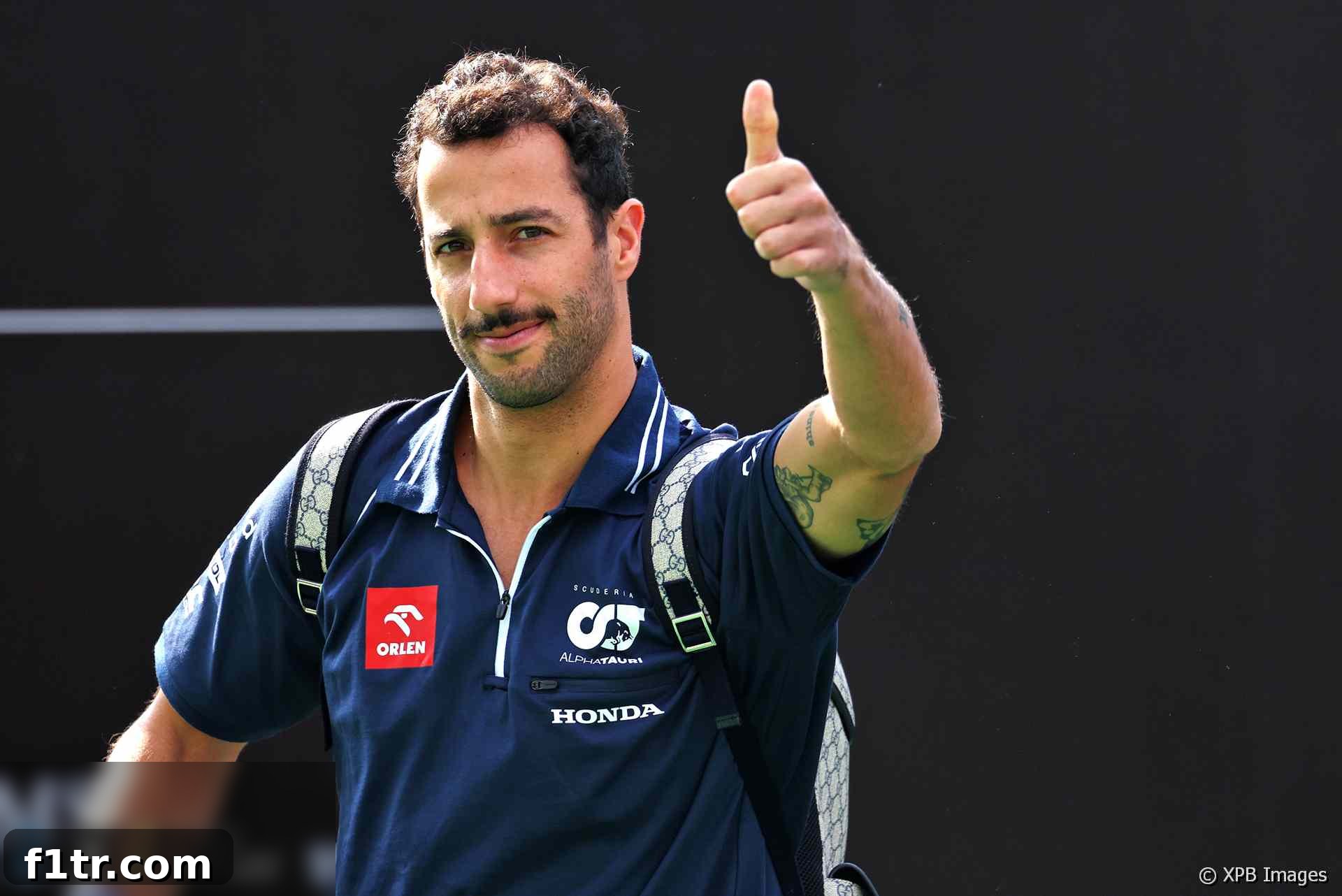
Daniel Ricciardo’s Resurgent F1 Comeback: A Masterclass in Resilience and Rediscovery
The 2023 Formula 1 season marked a pivotal chapter in Daniel Ricciardo’s illustrious career – a return to the grid that was both exhilarating and unexpectedly challenging. For the Australian fan-favourite, one moment from his half-season with AlphaTauri stands out vividly: the bone-breaking crash during practice for the Dutch Grand Prix, which left him with “some metal in my hand.” This incident, a stark reminder of motorsport’s inherent risks, temporarily sidelined the charismatic driver, yet it surprisingly failed to overshadow the overwhelmingly positive sentiment surrounding his comeback.
Ricciardo was thrust back into the competitive arena mid-season, replacing the struggling Nyck de Vries at AlphaTauri. His return was highly anticipated, a chance for the ‘Honey Badger’ to reclaim his form after a confidence-sapping stint with McLaren that culminated in him lacking both a seat and his characteristic swagger at the end of 2022. Despite the unfortunate injury, Ricciardo reflects on his seven-and-a-half weekends back in F1 with profound satisfaction.
A Journey of Unexpected Turns and Renewed Passion
“When I look back on this year, it’s a year I never would have expected in so many ways,” Ricciardo mused, reflecting on the tumultuous yet ultimately rewarding period. “I didn’t expect to be racing at all, let alone going through everything else.” His words encapsulate the unpredictable nature of Formula 1 and the twists his personal journey took. However, the overarching emotion for Ricciardo is one of contentment and joy. “So it’s something that I’m definitely happy about, the place I am and what I feel inside my heart. Ultimately, I’m really in a happy place and I’m happy being here racing again.”
This disrupted return has paradoxically fueled his hunger for more. As the winter break approached, Ricciardo admitted to an unusual longing. “It’s probably the first off-season that I would not really want an off-season,” he confessed. The customary desire for rest and recuperation was replaced by an eagerness to maintain momentum. “I want to keep racing and keep a bit of the flow going, but also the thought of having a little bit of a break and getting myself prepared for next year, that excites me as well.” This sentiment highlights a profound shift in his perspective, a rekindled passion that transcends the usual demands of a grueling F1 calendar.
Strategic Focus: Minimizing Distractions for Peak Performance
Ricciardo’s comeback has been characterized by an intense commitment to his craft, a deliberate pivot towards singular focus. He has channeled “all my energy into this,” consciously scaling back extracurricular commitments that had previously dovetailed with his Formula 1 career. This strategic realignment is a testament to his renewed dedication and understanding of what it takes to perform at the pinnacle of motorsport.
“I’ve definitely cut back on a lot of things outside of racing,” he explained. While acknowledging his enduring interest in various ventures beyond the track, he stressed, “For sure I still have some other interests outside of the sport which I’m involved in and I enjoy, but I’ve minimised a lot.” This disciplined approach is more critical than ever, especially with the ever-expanding 2024 F1 calendar set to feature a record 24 races. The relentless schedule demands absolute prioritization, leaving little room for distractions.
“I’m really trying to make sure that – I think it always has been – but to obviously make the racing the priority,” Ricciardo emphasized. “Especially with the calendar now and the schedule, if I’ve got some time off then I’m either in the gym or I’m putting my feet up and recovering for the next race.” This pragmatic outlook underscores a maturity and self-awareness gained from his brief hiatus from the sport. He now fully appreciates the delicate balance required to maintain peak physical and mental condition in such a demanding environment.
The time spent outside of active competition provided Ricciardo with invaluable clarity, allowing him to critically assess his past approaches. “There’s so much going on and there’s so many things that you can be doing and it’s all really exciting and really fun. I love that stuff, of course, because it’s a new experience and it’s great,” he reflected. “But having the time off at the start of the year, I realised that I was probably doing too much sometimes and probably even not prioritising myself in terms of my body and my recovery.” This realization has been a cornerstone of his revitalized approach, emphasizing self-care and optimal preparation as non-negotiable elements for sustained success.
The Profound Impact of a Break: Rediscovering the Love for Racing
Despite the immense satisfaction of his return, Ricciardo asserts that he would have been equally content remaining on the sidelines for the entire season. “If I didn’t race at all this year, if I had a whole 12 months off, that would have been no problem,” he stated, highlighting the profound benefits he reaped from his time away. “Because the power of time off for me was really, really beneficial and it gave me so much.” This period of introspection and detachment was instrumental in reigniting his passion and providing a fresh perspective.
“Fortunately I did find enough in those six months,” he added, referring to the mental and emotional recharge he experienced. His immediate performance upon returning offered clear evidence that he was not just physically but also mentally ready to compete at the highest level. The break allowed him to confront deeper questions about his career and his relationship with the sport.
“It should be the coolest thing that we do, right?” he pondered, referring to Formula 1 itself. “But when you’ve done it your whole life and when you’re winning it’s kind of easy, but when you’re not you go through some other challenging moments where you can become a little bit frustrated with it.” This candid admission sheds light on the psychological toll that competitive struggles can take. “Then on the competitive side, your confidence takes a hit. So then you’re asking yourself more questions and then that also makes you question the love for it. And then maybe you’re not as hungry in the other sides of the sport, in terms of preparation and that.” The time away, however, served as a powerful corrective. “Having the time off gave me the answer of how much I do love it, ultimately, how much it means to me.”
“It gave me a new perspective, which is really cool, and I’d recommend it to everyone,” Ricciardo asserted. “I can’t believe how much I’ve enjoyed this second half of the season. It’s pretty crazy what six months can do.” This profound shift from self-doubt to renewed appreciation underscores the therapeutic power of stepping back and gaining clarity.
Injury as Catalyst: A “Second Wind” for the Honey Badger
While Ricciardo wishes his injury “never happened because it was uncomfortable and painful,” he now views the entire year, including the setback, through a positive lens. “I still look back on this year as a positive,” he declared. The potential and renewed vigor he demonstrated during his limited appearances at AlphaTauri have left him “re-energised.” “I’ve definitely got a second wind,” he affirmed, a powerful metaphor for his renewed drive and motivation.
The severity of the hand injury, in an ironic twist, only strengthened his resolve. “If I then speak of the hand, for this not to feel like a setback probably speaks volumes,” he explained. He acknowledges that from an outsider’s perspective, such an incident could be seen as a sign to retire. “I could see how maybe some people would see that lame accident with a high consequence like ‘maybe Daniel should just give it up, that’s probably a sign that he should just call it a day’.” However, Ricciardo vehemently rejected this notion. “But I never thought that. I never felt like that. That was maybe even more power to the decision of trying to kick some butt.” This unwavering determination transformed a physical setback into a psychological boost, solidifying his commitment to competitive racing.
Highlights of a Limited Campaign: Moments of Pure Joy and Dominance
Despite his abbreviated 2023 season, two races stand out as clear highlights: his initial return at the Hungarian Grand Prix and his standout performance in Mexico. His first race back saw him qualify a commendable 13th, a result that brought immense personal satisfaction. He confessed to “having fun,” dispelling any lingering reservations about his ability to enjoy racing for a team towards the back of the F1 grid. It was a crucial early test, proving that his love for the sport transcended raw winning potential.
A few months later, the Mexican Grand Prix provided the definitive proof of his unlost touch. Ricciardo sensationally qualified fourth, an extraordinary feat for an AlphaTauri car, and then expertly converted it into a seventh-place finish in the race. “That’s a weekend where I felt everything I needed to feel again,” he reminisced, describing the culmination of his comeback efforts. “And obviously the team was very happy. Everyone was happy, and those things helped everything moving forward.” The elation within the AlphaTauri garage was palpable, a collective celebration of a performance that defied expectations.
“The fourth felt like a pole,” he elaborated, emphasizing the magnitude of his qualifying effort. “Because it felt like the AlphaTauri this year had no place to be on the second row of the grid. It just didn’t ever look like that, so that sort of stuff gets me excited. Definitely gets the butterflies going inside me.” This moment in Mexico encapsulated the essence of Daniel Ricciardo’s return: raw talent, unyielding passion, and the ability to extract extraordinary performance from challenging circumstances. His 2023 season, though curtailed by injury, was ultimately a triumphant tale of resilience, self-discovery, and a powerful reaffirmation of his place in Formula 1.