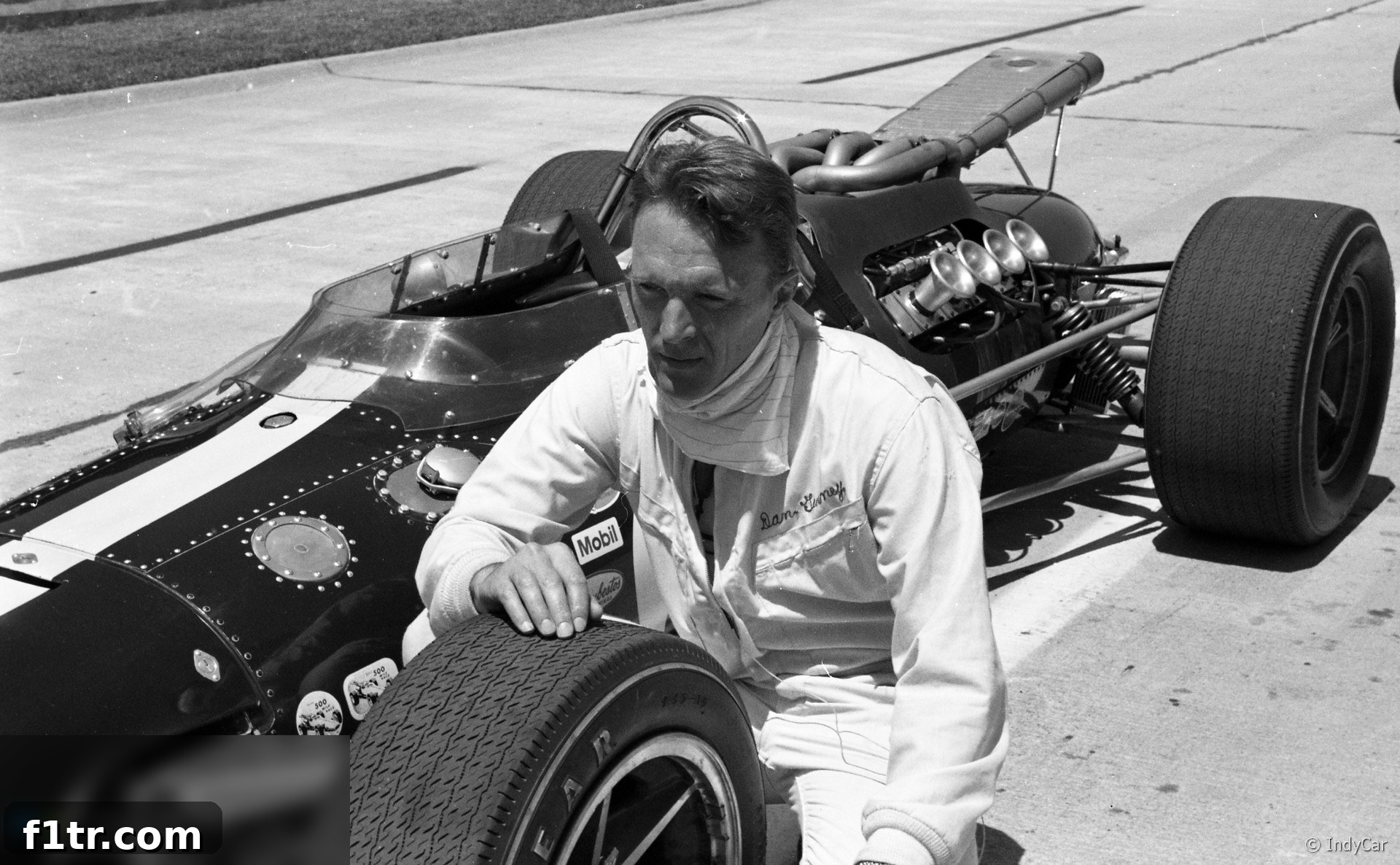
Dan Gurney, a true titan of American and international motorsport, whose illustrious career spanned multiple disciplines and left an indelible mark on racing, passed away at his California home at the age of 86. Universally acclaimed as one of the greatest racing drivers America has ever produced, Gurney’s legacy is far richer than mere statistics can convey. While his four victories in world championship Formula 1 races during a remarkable 12-year career might seem modest to some, they represent only a fraction of his profound impact and extraordinary talent. His prowess was perhaps best reflected in the profound respect he commanded from his peers, most notably from the legendary Jim Clark, who famously considered Gurney his fiercest and most admired competitor. This mutual admiration among giants speaks volumes about Gurney’s exceptional skill, courage, and sportsmanship on the track.
Gurney’s journey to the pinnacle of Formula 1 was unconventional and rapid. He famously quipped that by the time he lined up on the grid at Reims for his world championship debut in 1959, he had only participated in a mere 22 races. Yet, his raw talent was undeniable. It was Luigi Chinetti, the astute Ferrari importer, who first spotted Gurney’s potential during his early races in the United States and enthusiastically recommended him to the Scuderia. Following an impressive stint driving for the iconic Italian team at the Le Mans 24 Hours, Gurney was swiftly handed his golden opportunity to compete in the demanding world of Formula 1, a testament to his immediate impression on motorsport’s elite.
His Formula 1 debut, though unfortunately curtailed by a broken radiator, provided but a fleeting glimpse of his capabilities. However, his subsequent outing at the daunting AVUS circuit in Berlin saw him immediately make his mark, securing a sensational second-place finish behind his Ferrari teammate, Tony Brooks. This remarkable performance was quickly followed by a third and then a fourth place in his next two starts, providing undeniable evidence that a major new talent had arrived on the global motorsport stage. Gurney’s adaptability, speed, and racing intelligence were clear for all to see, setting the stage for a career that would redefine expectations for American drivers in Grand Prix racing.
Despite this promising start with Ferrari, Gurney’s early F1 career was also marked by a series of strategic decisions that, in hindsight, proved to be missteps. His move from Ferrari at the end of the 1959 season to join BRM proved particularly ill-timed. While BRM was an ambitious team, the 1960 season was plagued by mechanical unreliability, stifling Gurney’s opportunities to demonstrate his full potential. The irony was particularly acute as by 1961, Ferrari had developed the championship-winning car, leaving Gurney to lament what might have been. He then transitioned to Porsche’s works F1 team, where he encountered the inverse problem: the cars were exceptionally reliable but often lacked the outright speed required to challenge for regular victories. These early career changes highlighted the challenging landscape of Formula 1 in that era, where a driver’s success was intrinsically linked to the performance and reliability of their machinery.
Nevertheless, Gurney’s persistent talent eventually shone through. By 1962, the Porsche 804 had evolved into a competitive package, allowing him to claim his first momentous world championship race victory at the challenging Rouen circuit in France. This was followed by a non-championship triumph at Solitude, further cementing his status as a top-tier Grand Prix driver. Yet, despite these breakthroughs, Porsche’s interest in Formula 1 proved fleeting, and the German manufacturer unexpectedly withdrew from the sport at the close of the 1962 season. This left Gurney once again in search of a competitive drive, illustrating the constant flux and uncertainty that characterized much of his early career in Formula 1.
This turn of events led Gurney to join forces with another formidable driver-constructor, the legendary Jack Brabham, at his fledgling team. Over the subsequent three seasons, Gurney consistently demonstrated his superior pace and skill, often finishing ahead of his esteemed boss in the championship standings. Their partnership was a fascinating dynamic between two fiercely independent and talented individuals, both with ambitions extending beyond merely driving. However, history repeated itself in 1965 when Gurney chose to leave Brabham’s team, a decision that, once again, proved to be another ill-timed move. In a cruel twist of fate, Brabham, along with his new teammate Denny Hulme, went on to dominate the sport, securing the next two consecutive Formula 1 world championships. Gurney’s timing, while often impeccable on track, seemed to elude him in career choices during this phase, costing him potential championship glory.
Like his contemporary and former boss, Jack Brabham, Dan Gurney’s aspirations transcended the cockpit. He harbored a burning desire to design, build, and race his own cars, transforming from a mere driver into a pioneering driver-constructor. This ambition materialized in 1966 with the formation of Anglo-American Racers (AAR) and the birth of the magnificent Eagle, an American-designed Grand Prix machine. When mated with the powerful and distinctive Weslake V12 engine, the Eagle emerged as a potent and visually stunning competitor on the F1 grid. While initially plagued by developmental issues and characteristic unreliability, the car displayed flashes of brilliance that hinted at its immense potential, marking a new chapter in American motorsport history and Gurney’s remarkable career.
The following year, 1967, etched Gurney’s name deeper into the annals of Formula 1 lore. At the fearsome Spa-Francorchamps circuit, the Eagle Gurney-Weslake finally held together, allowing Gurney to deliver a masterful performance. After a thrilling battle, he sensationally passed the formidable Jackie Stewart to secure a historic victory. This was not only Gurney’s first win in his own car but also the first, and to date, only victory for an American-built and American-driven car in a Formula 1 World Championship race. It was a triumph of engineering, perseverance, and sheer driving artistry, a testament to Gurney’s vision and the dedication of the AAR team. In a season still characterized by developing reliability, the only other race the Eagle finished that year also saw Gurney on the podium, underscoring the raw speed and potential of his creation when it performed as intended.
June 1967 stands out as arguably the most spectacular and defining month of Dan Gurney’s storied career, cementing his status as a versatile motorsport legend. A mere week before his iconic Spa victory, Gurney had already tasted glory at another of the world’s most prestigious endurance races: the Le Mans 24 Hours. Sharing the cockpit of the mighty Ford GT40 with fellow American racing giant, AJ Foyt, they delivered a dominant performance, securing a historic victory for Ford. It was during the Le Mans podium celebrations that Gurney, in a spontaneous moment of jubilation, uncorked a magnum of champagne and famously sprayed the crowd, inadvertently igniting a tradition that has become synonymous with motorsport podiums worldwide and continues to this very day. This double triumph within a single week – Le Mans and Spa – showcased Gurney’s unparalleled adaptability and skill across vastly different racing disciplines, from endurance prototypes to single-seater Grand Prix cars.
Despite his widespread success, victory in another of America’s greatest races, the Indianapolis 500, tantalizingly eluded Gurney. He was at the vanguard of the revolutionary shift to rear-engine cars at the Brickyard, tirelessly working to bring modern Grand Prix technology to the oval. His relentless pursuit of the coveted Borg-Warner Trophy saw him achieve back-to-back second-place finishes in 1968 and 1969, agonizingly close to the ultimate prize. These near misses at Indy underscore his incredible versatility and determination to conquer every facet of motorsport, even as he was beginning to step back from the intense demands of full-time Formula One competition, paving the way for his transition into new roles within the sport.
Gurney’s brief return to Formula 1 was prompted by a tragic event that shook the motorsport world. The sudden death of another respected fellow racer-turned-constructor, Bruce McLaren, in a testing crash at Goodwood in 1970, compelled Gurney to offer his invaluable experience. The McLaren team, reeling from the loss of its founder, turned to Gurney for leadership and guidance. Just 12 days after McLaren’s passing, Gurney delivered an emotional and crucial victory for the team’s Can-Am effort at Mosport, demonstrating his unwavering resolve and commitment. He followed this up with another victory at Mont Tremblant, providing much-needed stability and success to the grieving team. He also drove for McLaren in Formula 1, scoring his final World Championship point at Clermont-Ferrand, marking a poignant end to his Grand Prix driving career. Soon after, Dan Gurney retired from active driving, emerging remarkably unscathed from an era of racing notorious for its dangers, a testament to his skill and perhaps a touch of good fortune.
Yet, Dan Gurney’s profound impact on motorsport extended far beyond his incredible achievements behind the steering wheel. His insatiable curiosity and engineering acumen made him an unparalleled innovator. After his retirement from driving, he continued to run his successful team in IndyCar racing, where his inventive mind led to a groundbreaking aerodynamic discovery in the early seventies: the “Gurney flap.” This simple yet incredibly effective device, a small lip angled at 90 degrees on the trailing edge of a wing, significantly increases downforce and performance. The Gurney flap remains in widespread use across almost all forms of motor racing today, from Formula 1 to sports cars, a testament to its genius and enduring relevance. After a temporary withdrawal in the eighties, Gurney revived his team in the nineties, continuing to push boundaries. He remained a vibrant force in championing new motor racing technology and design until late in his life, famously advocating for innovative projects such as the DeltaWing, consistently proving himself to be a visionary leader in motorsport.
Dan Gurney’s legacy is one of a true American racing icon – a magnificent driver who conquered Grand Prix victories, endurance classics, and even designed his own winning cars. He was a constructor whose Eagles left a lasting imprint and an innovator whose inventions like the Gurney flap continue to shape the aerodynamic landscape of modern racing. His career was a remarkable tapestry woven with courage, ingenuity, and an unwavering passion for speed and engineering excellence. He will forever be remembered as a multifaceted genius whose influence permeated every facet of motorsport, inspiring generations of drivers, engineers, and fans. His life was a testament to the pursuit of excellence and a defining chapter in the history of American motor racing.
Dan Gurney’s funeral will be a private ceremony. His family and colleagues respectfully request that in lieu of flowers, donations be made to the Hoag Hospital Foundation in Newport Beach, California, honoring his memory and philanthropic spirit.
F1 History: Explore More Iconic Moments and Figures
- When Did F1 Last Experience a Mid-Season Break Longer Than Five Weeks? A Look Back to 1990
- Did Norris Actually Win Formula 1’s Closest Championship Fight of All Time? An In-Depth Analysis
- Hamilton Becomes Ferrari’s First New Driver in 44 Years to Complete a Season Without a Podium Finish
- Ferrari on the Brink of Losing an F1 Record They’ve Held Since 2004: A Historical Perspective
- Red Bull in 2010 or Ferrari in 1979? How Past Title Fights Illustrate McLaren’s Current Dilemma
Browse All F1 History Articles and Uncover More Legendary Tales