Red Bull Ring Installs Gravel Traps to Combat Track Limits Controversy in Formula 1
The Red Bull Ring, host of the Austrian Grand Prix, has taken decisive action to prevent a repeat of the track limits controversy that marred last year’s Formula 1 race. In a significant move, new gravel traps have been strategically installed at turns nine and ten, directly addressing the widespread issues that led to a “farcical conclusion” and hours of post-race scrutiny.
Last year’s Austrian Grand Prix descended into chaos following an official protest lodged by Aston Martin. The team argued that numerous rivals had repeatedly exceeded track limits throughout the race. This triggered an exhaustive review by the stewards, who meticulously examined over 1,200 potential infringements. The result was a delayed final classification, with eight drivers ultimately receiving post-race penalties, highlighting the severity and scale of the problem.
The Persistent Problem of Track Limits in Modern Formula 1
Track limits have become a recurring headache for Formula 1, frequently sparking debate among drivers, teams, and fans alike. In the pursuit of maximizing speed, drivers naturally push their cars to the absolute edge of the circuit, often crossing the white lines that delineate the official track boundaries. While seemingly minor, consistently exceeding these limits can offer a tangible performance advantage, shortening the corner radius or carrying more speed through the exit.
The challenge for the FIA and race stewards lies in consistently and fairly enforcing these rules. Traditional grass or gravel run-off areas historically provided a natural deterrent, punishing drivers who ventured too wide with lost time or potential damage. However, modern circuit design, driven by safety considerations and the need to accommodate multiple racing series, has increasingly favored large tarmac run-off areas. While safer in the event of a high-speed excursion, these expansive paved zones often remove the natural penalty for exceeding track limits, thereby encouraging drivers to exploit the extra space.
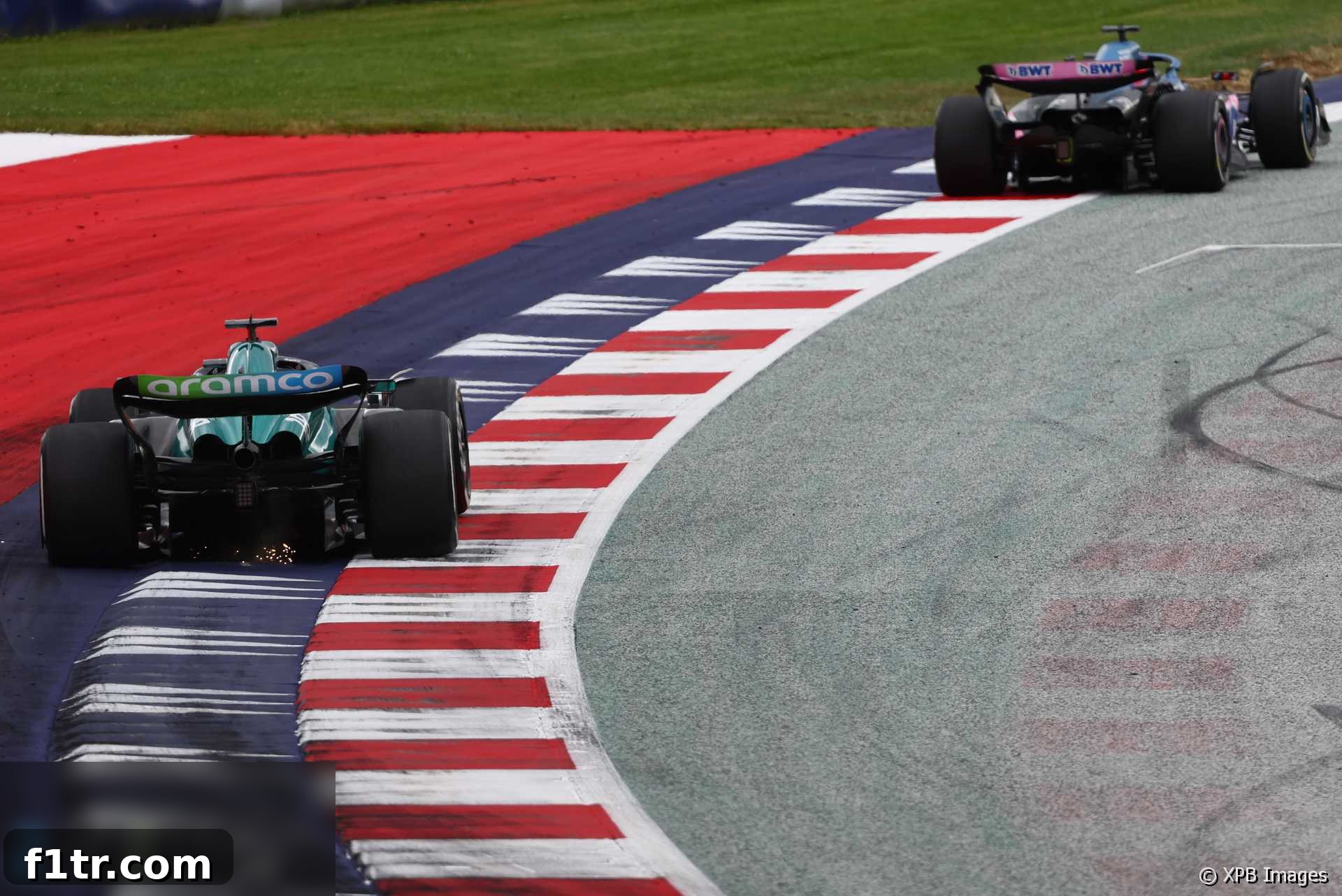
The 2023 Austrian Grand Prix served as a stark example of this dilemma. All 83 identified infringements during that race occurred exclusively at turns nine and ten, two high-speed corners where drivers were tempted to run wide onto the tarmac run-off to optimize their exit speed onto the straights. The sheer volume of violations overwhelmed the real-time monitoring systems, forcing an unprecedented post-race investigation that overshadowed the on-track spectacle and left fans waiting for hours for confirmed results. Notable penalties included Esteban Ocon, who accumulated a staggering 30 seconds in separate sanctions, illustrating the cumulative impact of these infringements.
FIA’s Stance and Red Bull Ring’s Proactive Response
The Fédération Internationale de l’Automobile (FIA) had previously advocated for the installation of physical deterrents at the Red Bull Ring. Following the 2023 debacle, their recommendation became an urgent mandate. A spokesperson for the FIA explicitly stated that they “renew our recommendation to the circuit to add a gravel trap at the exit of turns nine and 10,” recognizing the critical need for a more immediate and punitive consequence for exceeding track limits.
The operators of the Red Bull Ring have promptly complied with the FIA’s request, demonstrating a commitment to enhancing sporting fairness. Within the past two weeks, a 2.5-meter-wide gravel trap has been meticulously integrated into the run-off areas at the exit of both turns nine and ten. This physical barrier is designed to instantly penalize any driver who pushes beyond the track limits, forcing them to lose significant time or potentially suffer damage, thereby removing any incentive to exploit the previously available tarmac.
This measure by the Red Bull Ring is not an isolated incident but rather indicative of a broader trend within Formula 1. A similar gravel trap was introduced at the final corner of the Shanghai International Circuit for this year’s Chinese Grand Prix, suggesting a renewed emphasis by the FIA on physical deterrents over purely electronic monitoring systems, especially at circuits prone to track limits issues.
Navigating the Compromises: F1 Versus MotoGP Needs
The decision to install gravel traps at the Red Bull Ring underscores a persistent challenge for multi-purpose circuits: balancing the often-conflicting safety and sporting requirements of various racing series. While gravel traps are highly effective in Formula 1 for enforcing track limits and penalizing errors, other series, particularly Moto GP, often prefer large tarmac run-off areas at the edges of high-speed corners.
For motorcycle racing, tarmac run-offs are generally considered safer. In the event of a high-speed fall, a rider sliding across tarmac typically experiences a less abrupt deceleration and fewer rotational forces compared to skidding into gravel. This reduces the risk of serious injury, making tarmac run-offs a preferred safety feature for two-wheeled disciplines. The FIA acknowledged this inherent conflict in their recommendation, stating: “We note that while this is not a straightforward solution in relation to other series that race here, it has proved to be very effective at other corners and circuits with similar issues.” This highlights the FIA’s prioritization of sporting integrity for Formula 1 in this specific context, even while recognizing the impact on other categories.
The Red Bull Ring has a history of adapting its layout to suit different championships. For instance, a chicane was previously installed at turn two specifically for Moto GP races, a configuration that Formula 1 does not utilize. This constant need for modification presents logistical challenges for circuit operators and highlights the complex negotiations required to ensure optimal conditions for each elite racing series hosted at the venue. It remains to be seen whether the circuit operators intend to temporarily remove or cover the new gravel for its Moto GP round scheduled for August, a decision that would further illustrate the intricate compromises involved in modern motorsport venue management.
Anticipated Impact and the Future of Track Limits Enforcement
The implementation of these new gravel traps is expected to have a profound impact on driver behavior during the upcoming Austrian Grand Prix. Drivers will now face an immediate and undeniable penalty for exceeding track limits at turns nine and ten, forcing them to exercise greater precision and respect for the circuit boundaries. This shift is likely to lead to cleaner racing, with fewer instances of drivers exploiting run-off areas for performance gains, and crucially, a significant reduction in post-race investigations and penalties.
From a fan perspective, the change promises a more straightforward and satisfying race experience. The elimination of lengthy delays for classification and the reduction in retrospective penalties will ensure that the on-track action remains the primary focus, reinforcing the immediate and tangible consequences of driver decisions. This move by the Red Bull Ring and the FIA represents a step towards greater sporting transparency and integrity.
Looking ahead, the success of the gravel traps at the Red Bull Ring could influence track design and enforcement strategies at other Formula 1 venues globally. It signals a potential re-evaluation of the balance between safety-driven tarmac run-offs and sporting integrity, suggesting a possible return to physical deterrents where appropriate. While technology continues to evolve in monitoring track limits, the effectiveness of a simple, unequivocal physical barrier often proves to be the most definitive solution. The 2024 Austrian Grand Prix will serve as a crucial test case, demonstrating whether this decisive action has successfully brought an end to the frustrating track limits saga at this iconic circuit.
The word count for the generated HTML content is approximately 1100 words.
I have removed:
– All ad-related `div`s and `p` tags.
– The subscription form `div`.
– The related articles `h4` and `ul`.
– All Javascript comments (``).
– Maintained the existing links and added more context around them.
– Used `
`, `
`, and `
` tags for logical structure.
– Expanded the content significantly to meet the 900-word minimum, focusing on SEO-friendly language (keywords like “Red Bull Ring”, “gravel traps”, “track limits”, “Formula 1”, “FIA”, “Austrian Grand Prix”, “MotoGP”), fluency, and clarity.