Red Bull Raises Concerns Over Mercedes’ “Significant” Straight-Line Speed Gains in F1
The exhilarating 2021 Formula 1 season witnessed an unprecedented battle between two of the sport’s titans: Red Bull Racing and Mercedes-AMG Petronas. As the championship chase intensified, every millimeter of performance, every strategic call, and every technical advantage became magnified. One of the most significant points of contention to emerge late in the season revolved around Mercedes’ alleged, sudden increase in straight-line speed, particularly highlighted by Red Bull at the Turkish Grand Prix.
Christian Horner, the outspoken Team Principal of Red Bull Racing, voiced strong suspicions that Mercedes’ W12 challenger had unexpectedly unlocked a notable surge in its straight-line performance. These observations, he claimed, pointed to an advantage that could be as much as 20 kilometers per hour (kph) at certain points during the Istanbul Park weekend. Such a differential in top speed is colossal in the hyper-competitive world of Formula 1, often dictating overtaking opportunities and defensive strategies.
The Alarming Pace Advantage: Horner’s Observations from Istanbul
“Their straight-line speed has taken a significant step recently,” Horner stated emphatically, articulating the growing concern within the Red Bull garage. He elaborated on the implications of this perceived shift, explaining that Red Bull, which had previously managed to match Mercedes’ speed on straights by employing smaller, lower-drag rear wings, found itself unable to do so any longer. “Whereas we could match them with smaller wings previously, now we can’t get near,” he added, underscoring the severity of the performance gap.
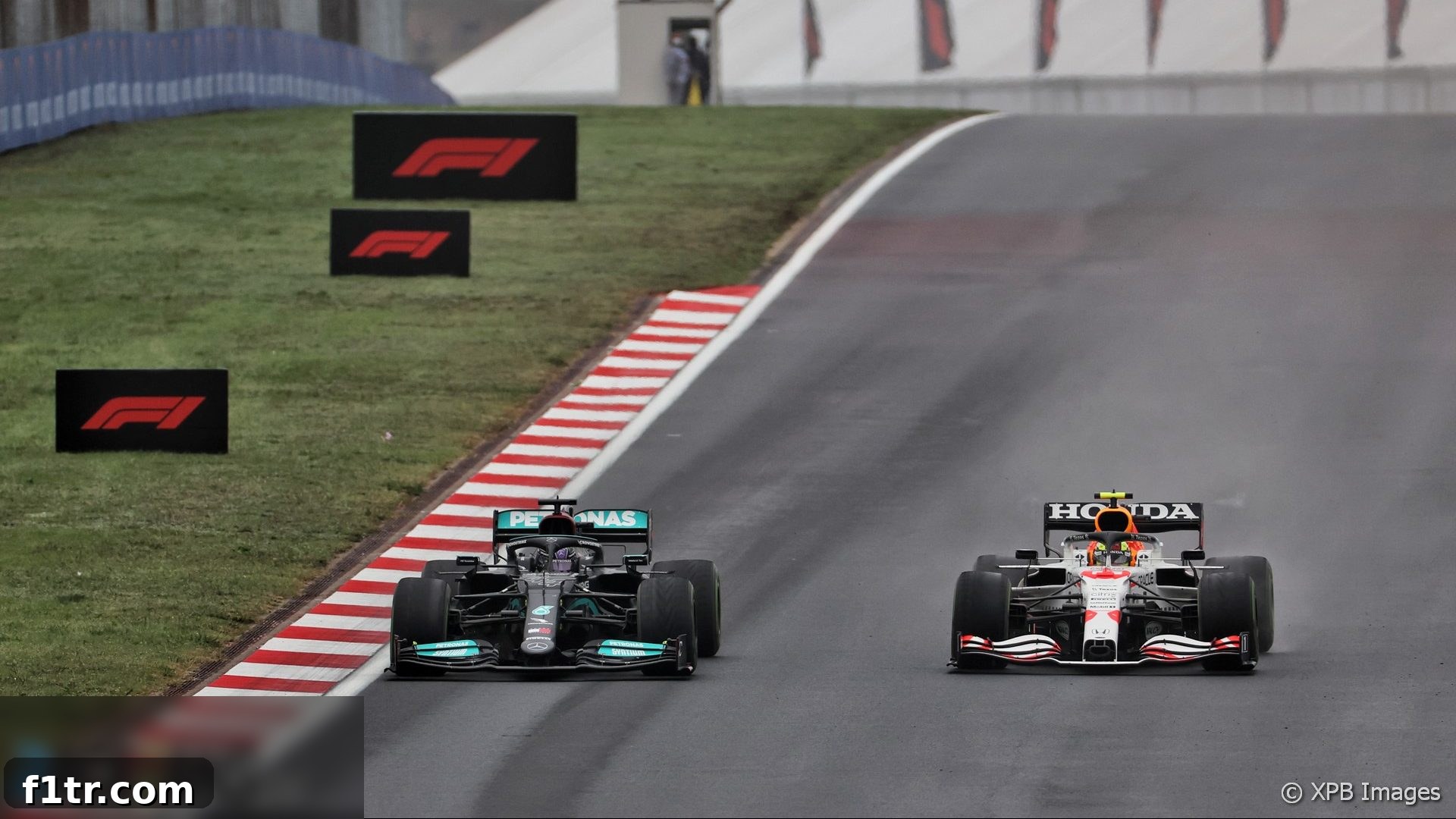
The Turkish Grand Prix served as a stark example of this alleged advantage. Horner specifically pointed to the performance of Lewis Hamilton. Despite running a larger rear wing on his car – typically a setup that generates more downforce but increases drag, thus reducing top speed – Hamilton demonstrated an uncanny ability to close in on and challenge rivals, notably Sergio Perez, without the aid of the Drag Reduction System (DRS). This suggested a fundamental power or efficiency advantage that transcended typical aerodynamic compromises.
“Lewis in particular had a significant straight-line advantage with a bigger rear wing on the car,” Horner observed, highlighting the perplexing nature of Mercedes’ pace. The implication was clear: for Hamilton to be faster on the straight with a higher-drag setup indicated a substantial underlying gain that Red Bull found difficult to comprehend or counter. “We’ve got to maximise our package as best we can and as I say it’s surprising that they appeared to have made the step that they have with the power unit.”
Engine Updates and Reliability Concerns: A Confluence of Factors?
The timing of Mercedes’ perceived speed increase coincided with recent engine changes within their camp. Hamilton’s car was fitted with a new engine for the Turkish Grand Prix, a move that followed a similar replacement for Valtteri Bottas at the previous round. While these engine changes were officially attributed to reliability concerns – an unusual development for Mercedes, known for its bulletproof power units – they inevitably raised questions about potential performance benefits.
Formula 1 regulations are stringent when it comes to engine development. Once power unit components are homologated at the start of the season, teams are generally not permitted to introduce performance upgrades. However, changes for reliability reasons are allowed, often incurring grid penalties for exceeding the season’s allocated component limits. Horner acknowledged the reliability narrative but openly speculated about a potential trade-off. “You can see across all of their teams, they’ve obviously got some reliability issues that they’re managing, which is unusual for Mercedes,” he noted. “But the performance is still incredibly impressive. Whether one comes at the expense of the other, I don’t know.”
This statement hinted at a strategic dilemma for Mercedes: were they pushing the performance envelope of their power unit to such an extreme that it compromised its longevity, leading to the necessity for multiple engine changes and grid penalties? Or were these new components, introduced under the guise of reliability, inadvertently (or purposefully) delivering a performance boost that edged them ahead in the championship’s critical phase?
Understanding Straight-Line Speed in Formula 1
To fully grasp the significance of Horner’s claims, it’s essential to understand the multifaceted nature of straight-line speed in F1. It’s not solely about raw engine power, although that remains paramount. A car’s top speed is a delicate balance influenced by:
- Engine Power Output: The sheer horsepower and torque generated by the Internal Combustion Engine (ICE) and the Electrical Recovery System (ERS).
- Aerodynamic Efficiency: The amount of drag generated by the car’s bodywork and wings. Less drag generally means higher top speed, but often at the expense of downforce in corners.
- ERS Deployment Strategy: The way teams manage and deploy the electrical energy harvested and stored, providing bursts of additional power.
- Gear Ratios: The selection of gear ratios that allow the engine to operate in its optimal power band at different speeds.
- Fuel Modes: Engine settings that can alter power output, though these are more heavily restricted in-race than in previous eras.
A 15-20 kph difference, as cited by Horner, is an enormous margin. To put it into perspective, the DRS typically provides a speed advantage of around 10-15 kph on many circuits. For a car to exhibit a non-DRS advantage that surpasses the effect of DRS itself suggests a profound shift in either engine performance, aerodynamic efficiency, or a combination of both. This kind of differential can turn a defensive position into an attacking one, or make a well-executed overtake virtually impossible to defend against.
The FIA’s Role and the Intense Rivalry
In a championship as tightly contested as the 2021 season, accusations and counter-accusations are part of the psychological warfare between leading teams. The FIA, Formula 1’s governing body, plays a crucial role in ensuring fair play and adherence to technical regulations. Every component, from engine mapping to aerodynamic surfaces, is subject to intense scrutiny and detailed technical directives. Red Bull’s concerns would undoubtedly have put Mercedes’ power unit under even greater microscope from the technical delegates.
This isn’t the first time the Red Bull-Mercedes rivalry has sparked debate over technical advantages. Throughout their dominant eras, both teams have faced questions and probes regarding elements like “flexi-wings,” “party modes,” or innovative aerodynamic solutions. Such historical context only added fuel to the fire of Horner’s latest claims, highlighting the relentless pursuit of performance and the fine line between innovation and bending the rules.
The implications for the championship were immense. If Mercedes had indeed found a genuine, sustainable performance upgrade, it would have been a significant blow to Red Bull’s title aspirations. It would have forced Red Bull to redouble their efforts, potentially pushing for their own technical developments or adjusting their race strategies to mitigate the straight-line speed deficit. The “arms race” for performance continued right to the very last race, with engine development playing a pivotal, if sometimes controversial, role.
Looking Ahead: The Unseen Battles of F1
Christian Horner’s comments regarding Mercedes’ straight-line speed underscored the multi-layered nature of Formula 1 competition. Beyond the visible battles on track, there are constant unseen struggles in the factories, design offices, and engine departments. Teams are continuously pushing the boundaries of engineering, materials science, and software to eke out every possible fraction of a second.
The 2021 season stands as a testament to this relentless innovation and the intense competitive spirit that defines Formula 1. Whether Mercedes’ speed gains were a result of optimal engine management, a breakthrough in reliability-driven component design, or simply the natural evolution of their power unit through the season, Red Bull’s vocal concerns brought a critical technical dimension to an already thrilling championship narrative. It served as a reminder that in Formula 1, every horsepower counts, and even marginal gains can dramatically alter the course of a world championship.
Related Formula 1 Insights and Analysis:
- Sainz Reflects on Missed Opportunity at Turkish Grand Prix
- Team Discusses Giovinazzi’s Controversial Call in Turkey
- Bottas Joins Exclusive Club with Tenth Career Victory
- F1 Medical Car Driver Faces Further Race Absence
- Drivers Seek Clarity from Masi on Unpenalized Incidents
Explore More Articles from the 2021 Turkish Grand Prix