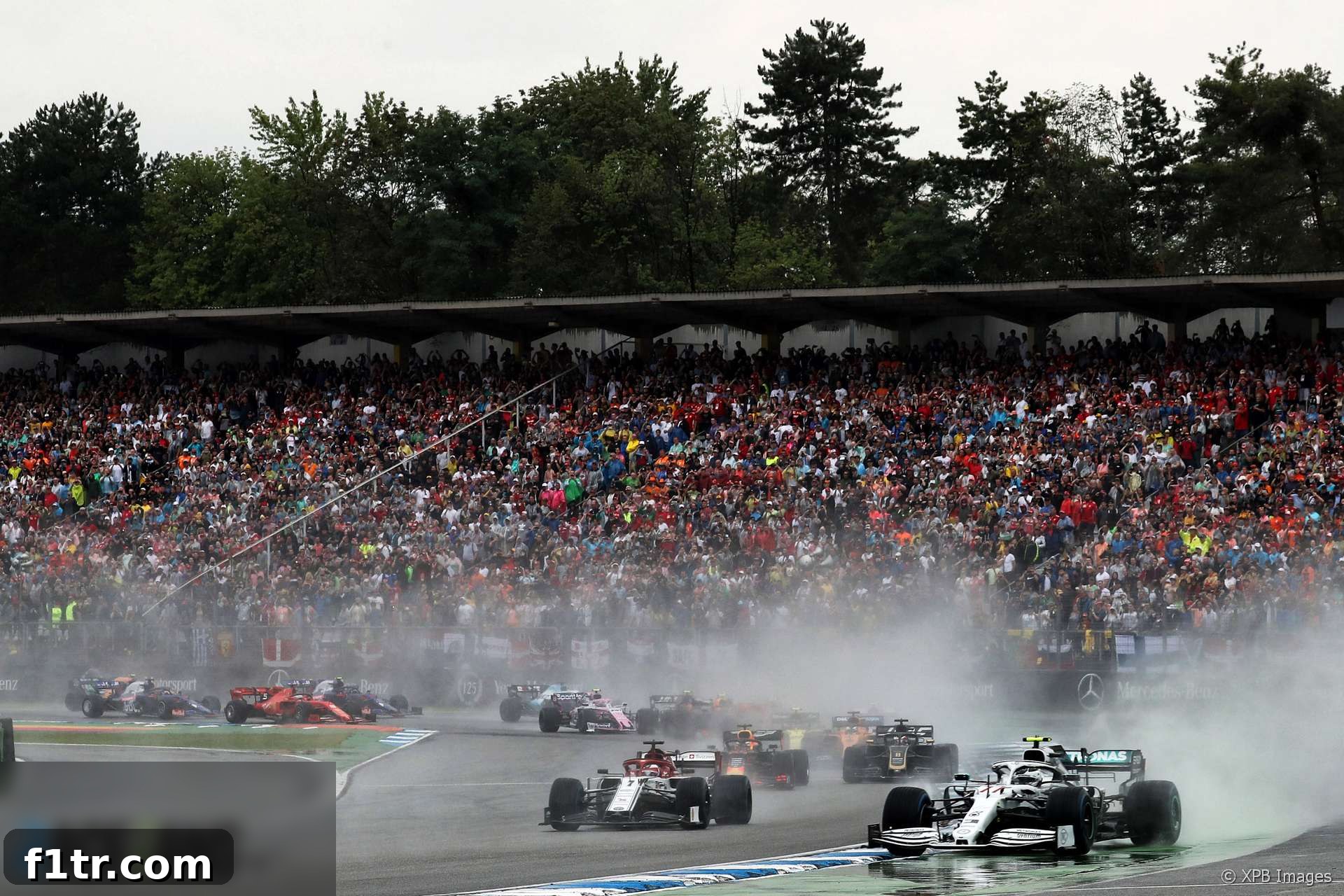
In the high-stakes world of Formula 1, every millisecond counts, especially at the start of a race. The 2019 German Grand Prix at Hockenheim proved to be a particularly challenging event, marked by unpredictable weather, dramatic racing, and post-race controversy. At the heart of this controversy for Alfa Romeo Racing was a technical infringement related to clutch behavior, which led to significant penalties for both of their drivers, Kimi Raikkonen and Antonio Giovinazzi. Raikkonen, a veteran known for his calm demeanor and exceptional race craft, found himself in an unexpected predicament following a start that he himself described as merely “normal,” despite gaining several crucial positions.
The initial moments of the German Grand Prix were a whirlwind of action. As the lights went out, Kimi Raikkonen, starting from fifth position, expertly navigated his Alfa Romeo C38 through the opening sequence of corners, emerging in an impressive third place. This immediate jump of two positions seemed like an excellent start to many observers, particularly given the challenging, slippery conditions on track. However, the Finn offered a characteristically understated assessment of his initial getaway. “I think it was a pretty normal start,” Raikkonen explained. He clarified that his apparent success was less about his own outstanding performance and more about the struggles of those ahead. “It only looked like it was good because the Red Bulls just made a bad start themselves.” This candid observation highlighted the fine margins in F1 starts, where relative performance rather than absolute execution often dictates early gains.
Yet, what appeared to be a strong start for Alfa Romeo soon became the subject of intense scrutiny from race stewards. Following the race, the FIA launched an investigation into the clutch systems of both Alfa Romeo cars. It was ultimately determined that the clutch torque applied by both Raikkonen and his teammate, Antonio Giovinazzi, was not compliant with Article 27.1 of the FIA Formula 1 Sporting Regulations and Article 9.2 of the FIA Formula 1 Technical Regulations. Specifically, the stewards found that the clutch demanded torque did not correspond to the torque available, indicating a potential deviation in how the clutch operated during the crucial launch phase. This technical breach, though not overtly performance-enhancing in the traditional sense, was deemed significant enough to warrant a severe penalty.
The stewards’ decision resulted in a hefty 30-second time penalty being added to the race times of both Raikkonen and Giovinazzi. For Kimi Raikkonen, this ruling had a profound impact on his race classification. He had originally crossed the finish line in a commendable seventh position, securing valuable points for Alfa Romeo in what was a chaotic and unpredictable race. However, with the additional 30 seconds, his final standing plummeted from seventh to twelfth. This demotion meant a complete loss of the points he had fought hard to earn, effectively erasing Alfa Romeo’s entire points haul from the challenging German Grand Prix. The penalty also affected Giovinazzi, who finished 13th on track but was also pushed further down the order. The immediate ramifications were clear: a promising result for the Swiss-Italian team had been undone by a technicality, casting a shadow over an otherwise spirited performance.
Unsurprisingly, Alfa Romeo Racing did not accept the stewards’ verdict lying down. The team quickly confirmed their intention to appeal the decision, signaling their belief that they had grounds to overturn the penalties. Such appeals are a common, albeit complex, part of Formula 1, often involving detailed technical data analysis and legal arguments presented to the FIA International Court of Appeal. When asked about the ongoing appeal, Raikkonen maintained his characteristic pragmatism. “I know the appeal has been done, but I don’t know how it is going to go,” he stated, emphasizing his focus on driving rather than the intricate legal battles. “I have absolutely zero else to say about it.” This response, while typical of Raikkonen, underscored the technical nature of the dispute, which largely fell outside the drivers’ direct purview. For Alfa Romeo, overturning the penalty was crucial, not just for the lost points but also for maintaining their standing in the intensely competitive Constructors’ Championship, where every point can mean millions in prize money and prestige.
Beyond the technical dispute and the ensuing penalty, Raikkonen also reflected on the race itself, acknowledging that better results might have been achievable even without the post-race sanctions. The 2019 German Grand Prix was notoriously difficult, with intermittent rain creating a constantly evolving track surface that challenged every team’s strategy and every driver’s skill. “For sure we were a bit disappointed,” Raikkonen admitted, articulating a sentiment shared across the Alfa Romeo garage. “We could have done a few things better. There was scope to have much more points.” He highlighted the collective feeling that, despite securing some points initially, the team recognized areas for improvement. “I think it was great we got a few points but I think the whole team felt we could do a better job and we learned from this.”
Raikkonen’s comments also touched upon the strategic challenges presented by the mixed conditions. “There was a few times we did the wrong thing but it’s so easy in this kind of conditions to change the wrong type of tyre, it’s small things but it can impact a lot in this kind of thing.” This candid assessment pointed to the delicate balance between risk and reward in wet races, where a single tyre choice can make or break a Grand Prix. The “Iceman” acknowledged the common wisdom that hindsight is 20/20: “It’s so easy to say afterwards, it’s very obvious, but that’s how it goes.” His reflections painted a picture of a race fraught with tough decisions, where even minor errors in judgment could compound under pressure, affecting the final outcome for a midfield team like Alfa Romeo aiming to maximize every opportunity.
The incident involving Raikkonen and Giovinazzi’s clutches at the 2019 German Grand Prix serves as a stark reminder of the intricate technical regulations that govern Formula 1. In a sport where technological innovation is paramount, strict adherence to rules is enforced to ensure fair competition. Clutch behavior, specifically related to the anti-stall system and the drivers’ ability to manage torque delivery at launch, has long been an area of focus for the FIA. Teams invest immense resources in developing sophisticated systems to optimize starts, but these must always operate within the stipulated parameters. A deviation, even if marginal or unintended, can lead to severe consequences, as Alfa Romeo experienced firsthand. This event underscored the constant battle between engineering prowess and regulatory compliance, a cornerstone of modern Formula 1.
Ultimately, the 2019 German Grand Prix was a rollercoaster of emotions and results for Kimi Raikkonen and Alfa Romeo. What began with a seemingly opportunistic start quickly devolved into a technical dispute and a disappointing points forfeiture. The team’s appeal reflected their determination to fight for every advantage in a fiercely competitive environment. While the outcome of the appeal would remain to be seen, the incident highlighted the critical importance of technical precision and strategic foresight in Formula 1. Raikkonen’s typically honest appraisal of his performance and the team’s missed opportunities provided valuable insight into the challenges faced by drivers and teams navigating the unpredictable world of Grand Prix racing, solidifying the narrative of a team striving for excellence amidst complex regulations and fierce competition in the 2019 F1 season.
2019 F1 season
- Crying in the Melbourne car park at 2019 grand prix was my career low – Ocon
- McLaren Racing reports reduced £71 million loss in 2019
- Kvyat: Hockenheim podium last year was “my biggest achievement” so far
- How the FIA’s new encrypted fuel flow meter targets Ferrari’s suspected ‘aliasing’ trick
- “He smashed my office door”: 23 must-see moments from ‘Drive to Survive’ season two
Browse all 2019 F1 season articles