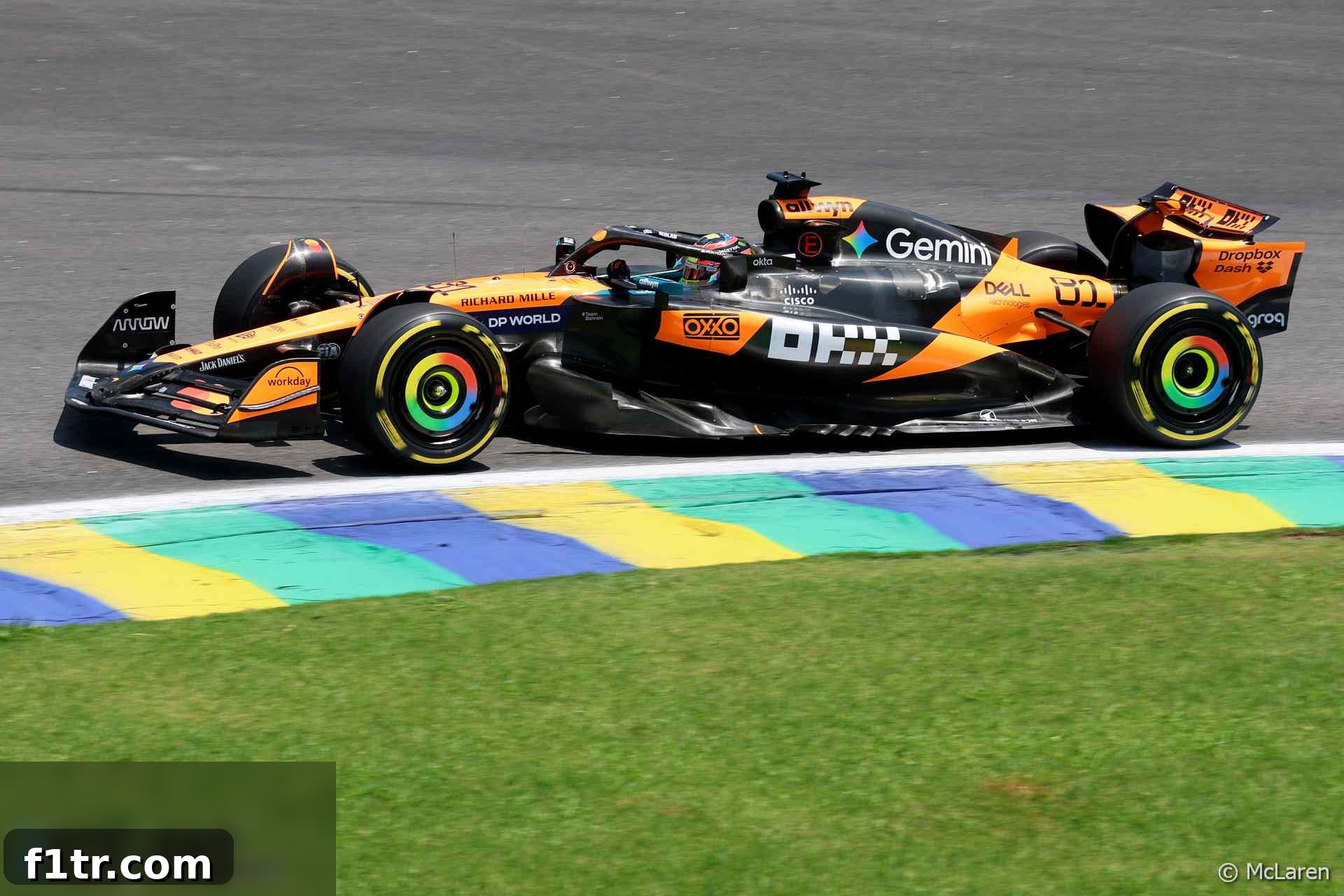
In the high-stakes world of Formula 1, every performance fluctuation is scrutinized, particularly for burgeoning talents like Oscar Piastri. The young Australian, a pivotal figure in McLaren’s recent resurgence, has faced a challenging period marked by a dip in form. However, according to McLaren team principal Andrea Stella, Piastri has demonstrably reversed this trend at the iconic Interlagos circuit, hinting at a return to the blistering pace that defined much of his rookie season.
Piastri’s Recent Challenges and the Mexican Grand Prix
The immediate lead-up to the Brazilian Grand Prix saw Piastri navigate a particularly arduous stretch, culminating in a noticeable performance gap to his McLaren teammate, Lando Norris. The Mexican Grand Prix, the preceding round, served as a stark example. There, Piastri not only surrendered his championship lead to Norris but also qualified nearly six-tenths of a second adrift, ultimately finishing a distant fifth. This significant disparity in pace raised questions among observers and within the team, marking the second consecutive weekend where Piastri struggled to match Norris’s rhythm.
Stella, known for his methodical and analytical approach, acknowledged the situation at the time, attributing the struggles primarily to the unique, low-grip conditions prevalent at the circuits hosting the previous two rounds. These conditions, often a crucible for driver skill and car setup, presented an “unnatural” challenge for Piastri, requiring a driving style that diverged from his inherent strengths. The tracks in question – the Circuit of the Americas in Austin and the Autódromo Hermanos Rodríguez in Mexico City – are renowned for their distinct characteristics, including often slippery surfaces and varying altitudes, which profoundly impact tire behavior and aerodynamic efficiency. Adapting to these nuances while maintaining peak performance is a testament to a driver’s versatility, and it appeared Piastri was undergoing a steep learning curve.
Andrea Stella’s Insight: A Deeper Look into Performance Dynamics
Stella’s assessment of Piastri’s difficulties goes beyond simple metrics, delving into the intricate relationship between driver feel and track conditions. His confidence in Piastri’s inherent talent, however, remained unwavering. The McLaren boss meticulously observed the young driver’s performance during the practice sessions at Interlagos, a circuit demanding precision and confidence. His observations provided compelling evidence that Piastri had indeed found his footing again.
“Oscar has already provided the answers to this question in free practice one,” Stella remarked, highlighting the immediate and positive shift. “Pretty much every time he was setting a lap time it was the fastest in the session.” This immediate return to competitive pace was a strong indicator. Stella further elaborated on the qualitative feedback from Piastri: “He’s confident. His comments in the car, his comments in the debrief go back to the comments where he feels the car. He is in tune with the car and he feels that what he’s doing generates lap time in a very natural way.”
This “natural way” of generating lap time is crucial. For an elite racing driver, feeling connected to the car – understanding its limits, its responses, and how every input translates into on-track performance – is paramount. When this connection is disrupted, as it was in the preceding two races, performance inevitably suffers. The low-grip conditions, according to Stella, demanded a driving approach that felt alien to Piastri, forcing him to adapt his finely tuned instincts to an unfamiliar environment. This often involves subtle changes in throttle application, braking points, and steering input, all of which can collectively shave or add tenths of a second per lap.
Adapting to Adversity: The Learning Curve in Formula 1
The journey of a Formula 1 driver is one of constant evolution and adaptation. Piastri’s experience in Mexico serves as a prime example of this relentless learning curve. Despite the initial struggle, Stella noted Piastri’s commendable efforts to adapt. “He learned pretty rapidly,” Stella stated, emphasizing the young driver’s capacity for quick adjustments even under pressure. However, the constraints of race day dynamics often limit the ability to showcase such progress.
In Mexico, Piastri’s low qualifying position became an insurmountable hurdle in the main race. Being stuck in traffic, a common predicament for drivers starting further down the grid, severely hampered his ability to demonstrate any improvements in pace. Overtaking in Formula 1 is a complex art, and the clean air required to exploit a car’s full potential is a luxury often reserved for those at the front. “It was a bit of a shame that he couldn’t show the pace in the race because he was blocked in traffic pretty much all of the race during the Mexican Grand Prix,” Stella explained, underscoring the frustration of having potential unrealized due to external factors.
The Interlagos circuit, with its flowing corners and undulating terrain, offered a fresh start and a different set of challenges. The early signs from Brazil were overwhelmingly positive, reinforcing McLaren’s belief in their young star. “So I think we have a very strong Oscar here, and hopefully we’ll be able to confirm this throughout the weekend,” Stella concluded, his optimism palpable.
Interlagos: A Proving Ground for Piastri’s Resurgence
The Brazilian Grand Prix at Interlagos often provides some of the most thrilling and unpredictable racing on the calendar. Its unique layout, with a mix of high-speed straights, technical corners, and elevation changes, demands a versatile and confident driving style. For Piastri, this circuit proved to be an ideal stage for his comeback. His performance in the sprint race qualifying session was a clear affirmation of his renewed confidence and pace. Securing third on the grid, he was within two-tenths of a second of his formidable teammate, Lando Norris, a testament to his recovered form.
This performance was particularly noteworthy given a minor setback during his flying lap. Piastri encountered a slight mistake at Turn One, a critical corner that sets up the rest of the lap. Despite this momentary imperfection, he managed to deliver a lap time that placed him firmly among the front-runners, demonstrating not only raw speed but also composure under pressure. This ability to recover and still extract performance, even with a minor error, speaks volumes about a driver’s maturity and understanding of their car’s limits.
The mental aspect of Formula 1 cannot be overstated. A dip in form, especially for a rookie or a young driver, can sometimes lead to a crisis of confidence. However, Piastri’s swift recovery, supported by a clear analysis from his team principal, highlights his mental resilience and ability to internalize feedback and adapt. This inherent strength is a hallmark of future champions.
Looking Ahead: Implications for Piastri and McLaren
Piastri’s resurgence at Interlagos holds significant implications for both his personal trajectory and McLaren’s overall team performance. For Piastri, it solidifies his position as one of the most exciting talents on the grid, reaffirming the team’s faith in his long-term potential. It demonstrates his capacity to overcome challenges, learn from setbacks, and return stronger – qualities essential for sustained success in Formula 1.
For McLaren, having both drivers consistently performing at the sharp end of the grid is crucial for their Constructors’ Championship aspirations. The dynamic between Piastri and Norris, while competitive, is also a powerful engine for innovation and progress within the team. Two drivers pushing each other, providing diverse feedback, and extracting maximum performance from the car creates a virtuous cycle of improvement.
The unique characteristics of Formula 1 circuits, from the low-grip surfaces of Mexico to the elevation changes of Brazil, consistently test a driver’s adaptability. Piastri’s journey through this challenging phase underscores the complexity of achieving peak performance week in and week out. It’s a blend of raw talent, meticulous preparation, engineering support, and an innate ability to connect with a highly complex machine. Andrea Stella’s nuanced understanding of his drivers’ strengths and weaknesses, combined with Piastri’s undeniable talent and rapid learning capability, bodes well for McLaren’s future. The young Australian’s ability to bounce back suggests that his initial struggles were merely a chapter in his ongoing development, rather than a defining narrative, reinforcing the belief that Oscar Piastri is indeed a very strong presence, destined for continued success in Formula 1.
Related Articles: Brazilian Grand Prix
- 2026 rules will stop F1 teams making “strategic” engine changes for performance
- Tsunoda admits he could have “easily” scored points in Brazil
- Top 10: Most controversial penalty calls during a Formula 1 title fight
- Verstappen is eighth F1 driver to race from pits to podium: Brazilian GP stats
- Verstappen’s latest setback makes this season look even more like a 2007 repeat
Browse all 2025 Brazilian Grand Prix articles