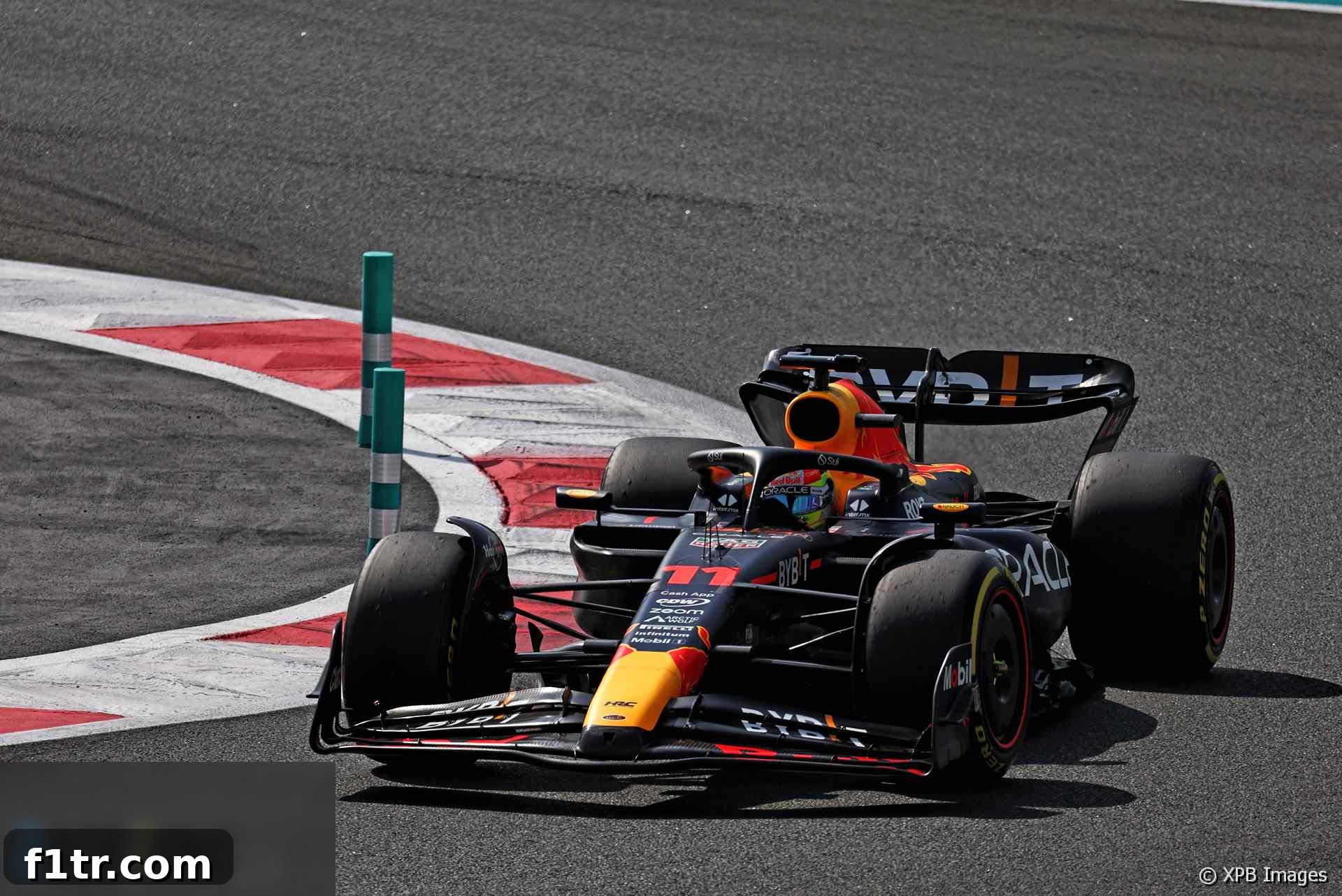
Sergio Perez, the accomplished Red Bull Racing driver, has unequivocally stated that his formidable race day performances were the cornerstone of his impressive runner-up finish in the 2023 Formula 1 Drivers’ Championship. Despite piloting the dominant Red Bull RB19, Perez candidly acknowledged a consistent battle with qualifying performance throughout the challenging season. His ability to recover and advance through the field on Sundays proved to be a critical factor in solidifying his position as the second-best driver of the year.
Perez’s Paradox: Race Day Dominance vs. Qualifying Conundrums
The 2023 season presented a fascinating paradox for Sergio Perez. While the Red Bull RB19 proved to be an engineering masterpiece, setting new benchmarks for dominance in Formula 1, Perez frequently found himself at odds with its characteristics during the crucial qualifying sessions. He managed to secure two pole positions over the season – a testament to his raw speed when things aligned – but only started from the front row on two other occasions. This stood in stark contrast to his teammate, Max Verstappen, who recorded a staggering twelve pole positions and boasted an average starting position of 3.2, significantly better than Perez’s 9.3.
Reflecting on this dichotomy after the season-ending Abu Dhabi Grand Prix, Perez emphasized his strength on race day. “I think the Sunday form has been very, very strong this year. That’s the only reason we finished P2 in the championship,” he asserted. His candid assessment continued, highlighting the areas for improvement: “Definitely Saturdays have been very difficult this season and it’s something we’ve got to work on and make sure that we take a gear there and we improve for next year.” This acknowledgement underscores a clear focus for the Mexican driver and his team as they look ahead to the next campaign.
Navigating the Grid: The Art of the Recovery Drive
Perez’s season was often characterized by exceptional recovery drives, turning challenging grid positions into valuable championship points. His ability to manage tyres, execute precise overtakes, and maintain strong race pace even when out of position became a hallmark of his 2023 campaign. This resilience was particularly evident in the Abu Dhabi season finale, where he climbed from ninth on the grid to finish fourth, showcasing the determination that ultimately secured his P2 spot. These Sunday heroics, however, often masked the underlying qualifying struggles that forced him into such positions in the first place.
The vast performance gap between Perez and Verstappen in qualifying became a central narrative point of the 2023 season. While Verstappen consistently extracted maximum performance from the RB19 in a single lap, Perez often grappled with the car’s evolving balance, particularly as the Red Bull development pushed the car further in a direction that arguably suited Verstappen’s aggressive driving style more inherently. This subtle but critical difference presented a formidable challenge for Perez, forcing him to adapt and find alternative ways to secure strong results.
The Indispensable Post-Season Test: A Glimpse into 2024 Preparations
Just two days after the intense competition of the Abu Dhabi Grand Prix, Sergio Perez was back on track for the crucial post-season test day. With no new car parts to evaluate, the focus was entirely on development specification tyres and, critically, on refining his own driving style and understanding of the car. This rare opportunity for dedicated testing, a luxury often denied in modern Formula 1’s restrictive regulations, proved invaluable for Perez.
“It’s so much learning, so productive as well,” Perez remarked, highlighting the intensity and benefit of the session. “It was good and important to put in the time, and it’s been another productive day. Especially coming out of a race, everything is really fresh.” The immediacy of testing after a race weekend allows drivers to directly correlate their race experience with the data gathered during development runs, providing clearer insights into car behavior and potential improvements.
Perez concluded the test as the fourth fastest driver, a mere 0.322 seconds off the pace. Significantly, he was 0.951 seconds faster than Formula E champion Jake Dennis, who drove Verstappen’s car during the same session, underscoring Perez’s direct involvement in development and his competitive pace when given focused track time. This performance in a low-pressure, development-focused environment provided a much-needed boost and offered tangible data for him and the team to analyze over the winter break.
The Value of Learning in a Restricted Testing Era
The modern era of Formula 1 severely limits in-season testing, making post-season and pre-season sessions critically important for driver and car development. Perez emphasized this point, stating, “It is very important to be able to have these sort of days together with the team, because we get some homework to hone, that we are able to work on and be productive.” He believes that having similar opportunities earlier in the season could have profoundly altered his championship trajectory. “Obviously these days you don’t have any testing. And even in the testing, you are so restricted with the things you can play on and with the time and with the tyres.”
This limitation places immense pressure on drivers and engineers to extract maximum value from every minute of track time. For Perez, the test day was an opportunity to delve deeper into the Red Bull philosophy, to understand the intricacies of the car’s concept, and to work collaboratively with his engineering team on addressing the issues that plagued his Saturdays. The insights gained from such focused testing are not just about raw lap times, but about building a cohesive understanding between driver and machine, which is fundamental for consistent performance.
Looking Ahead to 2024: Hopes for a More Harmonious Balance
Despite the challenges, Perez remains optimistic and determined. “It’s been dominant for Red Bull, yes, but it was quite tough for me. So it is what it is. I’m sure we’re going to have a great car again next year,” he articulated. His primary hope for the upcoming season revolves around finding a more comfortable balance within the car. “Hopefully a little bit nicer balance on my side, and hopefully we can keep this domination going as a team.”
The 2023 season, with all its highs and lows, has been a profound learning experience for Perez. “But overall I’m grateful for the difficult season I had because it taught me a lot about the car, about the philosophy in Red Bull, understanding a lot more the concept of the car, and I really hope that this will pay off next year.” This sentiment highlights a mature perspective, recognizing that adversity often leads to growth and a deeper understanding that can be leveraged for future success.
As Red Bull Racing looks to continue its championship dominance, the performance of Sergio Perez will be under intense scrutiny. His ability to translate the learnings from a challenging 2023 and a productive post-season test into a more consistent and competitive 2024 will be crucial. A more harmonized relationship with the car and a renewed focus on qualifying speed could see Perez not just secure another top-three championship finish, but also pose a more formidable challenge to his formidable teammate, cementing his place as a key player in the Red Bull legacy.