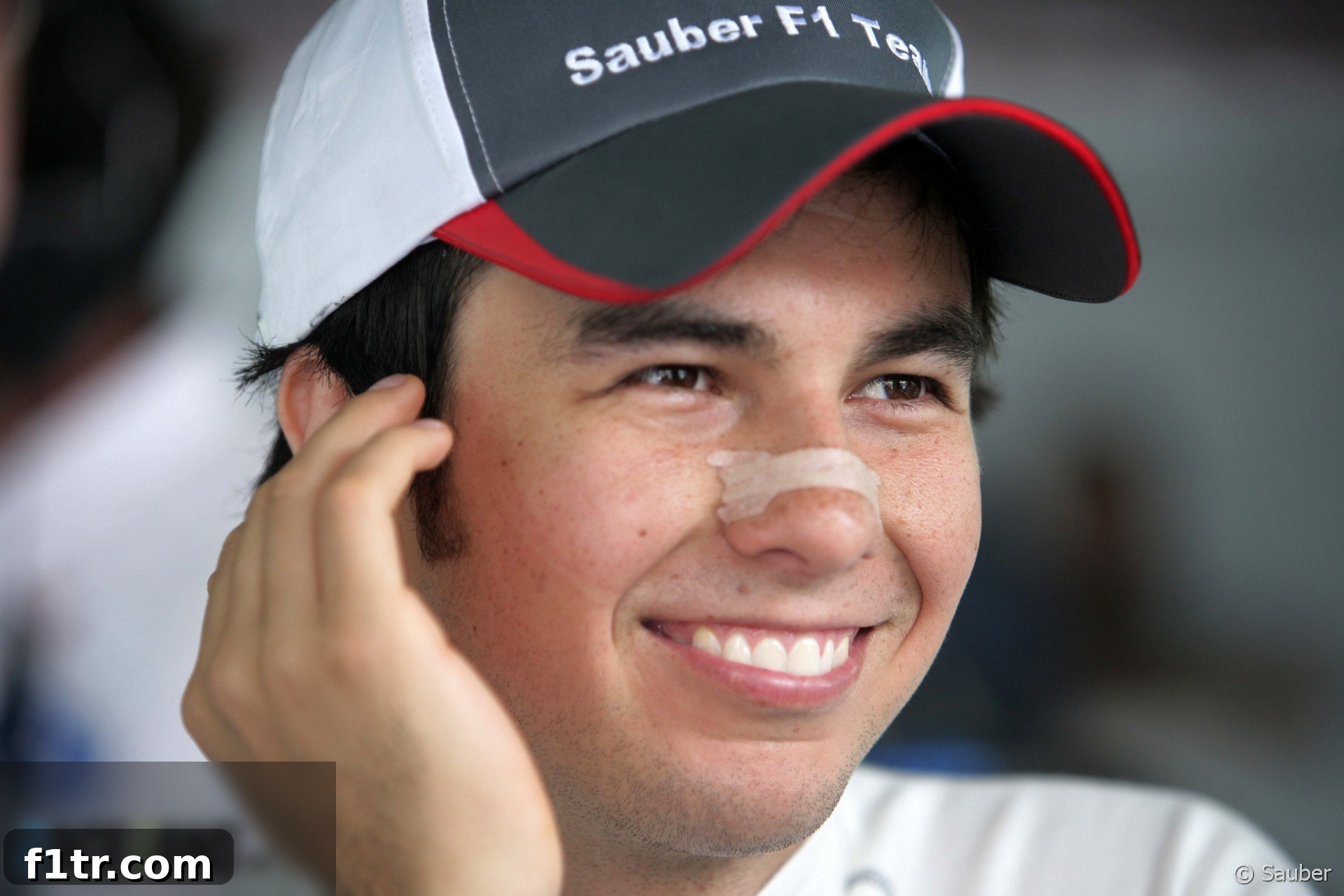
In the high-stakes world of Formula 1, a single career decision can redefine a driver’s trajectory, impacting their legacy and championship aspirations. For Mexican driver Sergio Perez, one such pivotal moment arrived in 2012, when he faced an unenviable choice between two of the sport’s most iconic teams: an immediate move to McLaren for the 2013 season, or a patient wait for a guaranteed Ferrari seat in 2014. Perez ultimately chose the former, a decision he would later reflect upon with a mix of pragmatism and regret, shaping the course of his illustrious, albeit challenging, F1 journey.
Perez’s ascent through the junior categories was marked by steady progress and flashes of brilliance, culminating in his Formula 1 debut with Sauber in 2011. It was during the 2012 season that he truly burst onto the scene, delivering a series of performances that sent ripples through the paddock. Driving for the midfield Sauber team, Perez achieved three spectacular podium finishes – a second place in Malaysia, followed by third-place finishes in Canada and Italy. These results were not merely impressive; they were extraordinary, showcasing his raw speed, exceptional tire management, and formidable race craft, particularly in challenging conditions. His ability to extract maximum performance from the C31 chassis, often outperforming the car’s perceived capabilities, made him a hot commodity in the driver market.
At this time, Perez was more than just a promising talent; he was a member of the prestigious Ferrari Driver Academy. This affiliation naturally positioned him as a strong candidate for a future seat at Scuderia Ferrari, a dream for any aspiring Formula 1 driver. The pathway seemed clear: continue to hone his skills, perhaps for a third season with Ferrari’s engine customer, Sauber, before making the anticipated step up to Maranello. Indeed, discussions with Ferrari’s then-team principal, Stefano Domenicali, were well underway. Perez himself revealed to the official F1 website that Domenicali had proposed a “pre-contract” for a 2014 drive, contingent on him spending one more year with Sauber in 2013. This offer represented long-term security and a direct route to arguably the sport’s most legendary team.
However, the allure of an immediate opportunity proved too strong to resist. As Perez’s stock soared in 2012, he found himself courted by multiple top-tier teams. “At that time, Mercedes was interested, Ferrari was, and McLaren, so I was in a really strong position back then,” Perez recalled. The prospect of joining a competitive outfit immediately, rather than waiting a year, became increasingly tantalizing. McLaren, in particular, presented a compelling case. The Woking-based team had been a perennial championship contender, renowned for its technical prowess and history of success. In the five years leading up to 2012, McLaren had consistently fought for titles and won races, even clinching the Constructors’ Championship in 2008. The team’s 2012 car, the MP4-27, was a formidable machine, winning seven races and demonstrating incredible speed, especially in the hands of Lewis Hamilton and Jenson Button.
The timing of McLaren’s approach was critical. With Lewis Hamilton announcing his blockbuster move to Mercedes for 2013, a coveted seat at McLaren suddenly became available. For Perez, the decision felt “quite an obvious thing.” He envisioned himself stepping into a race-winning car, capable of competing for the championship straight away. “I thought to myself, ‘I need to get into a competitive car because I can win the title’,” he explained. The immediate gratification of joining a front-running team, rather than waiting a year for Ferrari, seemed like the logical, career-accelerating choice. It was a gamble on present glory over future certainty.
Perez formally signed with McLaren for the 2013 season, a move that necessitated severing his ties with the Ferrari Driver Academy. This commitment marked a significant departure from the well-laid plans for his future with the Scuderia. His excitement was palpable, but the reality of the 2013 season quickly dampened expectations. McLaren, surprisingly, endured one of its most challenging campaigns in recent memory. The MP4-28, a radical departure from its successful predecessor, proved to be an ill-conceived design. The car lacked both pace and consistency, plagued by fundamental aerodynamic issues that left both Perez and his experienced teammate Jenson Button struggling to compete for podiums, let alone victories.
For Perez, who had just come from a season of punching above his weight with Sauber, the sudden drop in competitiveness was a cruel twist of fate. He found himself in a car that demanded a different driving style, struggling to adapt and extract performance from an inherently flawed package. While he scored a career-best sixth place at the Bahrain Grand Prix and had strong outings, including a memorable battle with Jenson Button in the closing stages of the same race, the overall picture was one of frustration and underachievement for the team. Perez finished the season 11th in the drivers’ standings with just 49 points, a stark contrast to the team’s ambitions. At the end of his solitary season, McLaren opted not to renew his contract, leaving him without a seat for 2014. “I think probably, given how McLaren was at that time, that ride came just at the wrong moment for me,” Perez reflected, acknowledging the unfortunate confluence of his ambition and the team’s unforeseen decline.
Looking back, Perez identified a critical misstep in his McLaren contract negotiations: the decision to sign a mere one-year deal. “I think the mistake there was to sign a one-year deal. My management at the time didn’t do a solid job with the contract,” he candidly admitted. A multi-year agreement could have provided him with stability, allowing more time to adapt to a new team and car, or at least provided leverage in a difficult situation. The abrupt termination after a single season, through no fault of his own regarding the car’s performance, undeniably impacted his standing in the highly competitive Formula 1 paddock. Being dropped by a front-running team can cast a shadow on a driver’s reputation, irrespective of the mitigating circumstances.
The “what if” scenario of choosing Ferrari for 2014 remains a fascinating hypothetical. Had Perez opted for the patient path, a future alongside Fernando Alonso at Ferrari could have materialized, potentially offering him a more stable and competitive environment. Ferrari, while not always dominant, consistently fought at the sharp end of the grid. His career trajectory might have been dramatically different, perhaps even leading to championship contention sooner. However, F1 history is replete with such pivotal moments, and hindsight is always 20/20.
Despite the setback at McLaren, Perez’s resilience and talent were undeniable. He quickly secured a seat with Force India (later Racing Point), a move that proved to be a turning point. With a more stable environment and a team that believed in him, Perez rebuilt his reputation, consistently delivering strong performances and earning the moniker “King of the Midfield.” He secured multiple podiums with the Silverstone-based outfit, often outperforming the car and demonstrating the same race craft and tire management skills that first caught the eye of top teams. This consistency eventually led to another coveted opportunity: a seat at Red Bull Racing in 2021, where he finally achieved his first Grand Prix victory and has cemented his place as a championship contender, supporting Max Verstappen.
Sergio Perez’s decision in 2012 stands as a powerful testament to the volatile nature of Formula 1 careers. It highlights the delicate balance between seizing immediate opportunities and securing long-term stability, and the unpredictable ebb and flow of team fortunes. While his McLaren tenure was brief and challenging, it ultimately served as a crucible that forged his character, preparing him for the sustained success he would later achieve. It’s a story of ambition, misjudgment, resilience, and ultimately, the triumph of talent against adversity, cementing his place as one of Formula 1’s most enduring figures.
F1 history
- When did F1 last have a mid-season break longer than five weeks? 1990
- Did Norris actually win Formula 1’s closest championship fight of all time?
- Hamilton is Ferrari’s first new driver in 44 years to complete season without a podium
- Ferrari are on course to lose an F1 record they’ve held since 2004
- Red Bull in 2010 or Ferrari in 1979? Past title fights illustrate McLaren’s current dilemma
Browse all history articles