IndyCar’s Blue Flag Dilemma: The Benjamin Pedersen Incident and the Enduring Debate
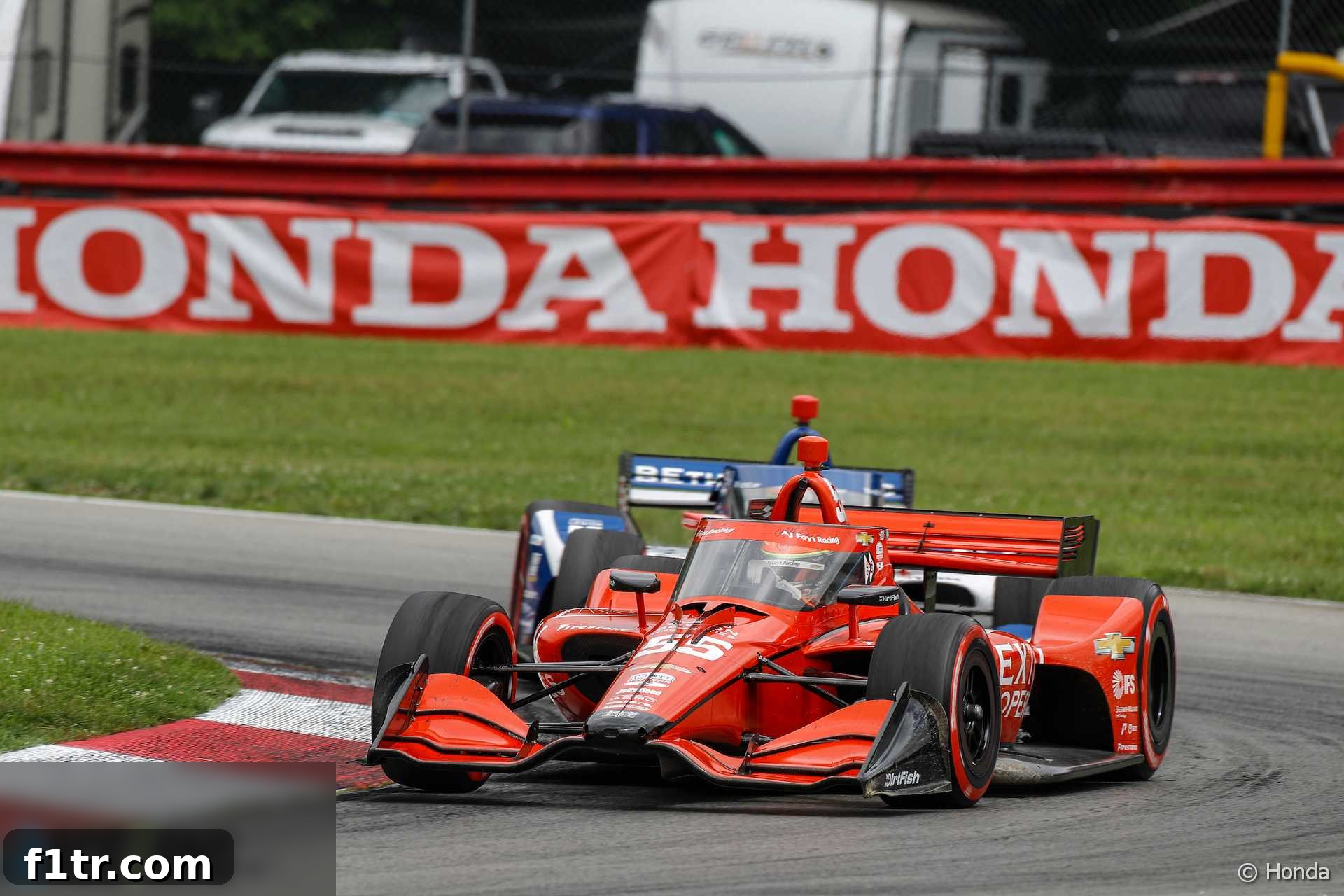
The recent Indy 200 at Mid-Ohio brought to light a long-standing point of contention in IndyCar racing: the series’ unique approach to lapped cars. Rookie Benjamin Pedersen found himself at the center of this debate, drawing the ire of seasoned front-runners like Alex Palou, Will Power, and Scott McLaughlin. While Pedersen committed no rule infringements, his assertive efforts to remain on the lead lap significantly impacted the leaders’ races, reigniting the discussion about blue flag protocols in American motorsport.
Advert | Become a Supporter & go ad-free
Pedersen’s spirited defense, though entirely within IndyCar’s regulations, had tangible consequences. Race leader Alex Palou, who had established a comfortable eight-second advantage over Colton Herta, saw his hard-earned lead evaporate as he struggled to navigate past AJ Foyt Racing’s Pedersen. This impediment forced Palou to expend precious time, fuel, and tire life, effectively neutralizing his strategic advantage. Once Palou eventually cleared the rookie, other championship contenders like Power and McLaughlin faced similar hurdles, having to fight considerably harder than anticipated to pass a car that ultimately finished several laps down in 26th position.
The Mid-Ohio Confrontation: Leaders vs. The Backmarker
The frustration was palpable after the race. Scott McLaughlin, who finished fifth, confronted Pedersen directly in the pit lane. “He’s not going to make any friends if he holds people up,” McLaughlin stated, emphasizing the core issue: “He’s not even in our race.” He acknowledged that Pedersen was likely fighting his own battle, but stressed the unwritten rule of “give-and-take” within the series. McLaughlin’s pointed comment highlights the fundamental disconnect between a leader vying for a championship and a backmarker fighting for every possible position.
“I get he’s in a race of his own,” McLaughlin continued, “but it’s give-and-take in this series – and if I’m a lap down and the number 55 [car of Pedersen] is behind me, who knows what I’m going to do.” This sentiment underscores the unwritten code of conduct that many top drivers believe should govern interactions with lapped traffic, a code that IndyCar’s official rules don’t strictly enforce in the same way some other series do.
This incident has thrust the practice of how lapped cars are managed – a common feature across many major American motorsport series – back into the spotlight. The essence of the debate lies in striking a balance between allowing every competitor to race fiercely and ensuring that the outcome of the race is not unduly influenced by drivers who are no longer competing for the win.
Understanding Blue Flag Rules: A Motorsport Comparison
In motorsport, the blue flag is a universally recognized signal instructing a slower car to yield to a faster car that is attempting to lap it. However, the interpretation and enforcement of this rule vary significantly across different racing disciplines, leading to varying levels of impact on race outcomes and driver frustration.
A key distinction exists between IndyCar and series like Formula 1, particularly concerning how cars at the tail end of the lead lap are handled. In Formula 1, the rules are notably stringent. If a car is caught by the race leader while still on the same lap but significantly slower, race control typically displays the blue flag, obliging the driver to yield in a timely fashion. The race director’s notes for each Grand Prix meticulously detail the procedures and the penalties for non-compliance, such as ignoring multiple blue flags. This strict enforcement aims to minimize interference with the race leaders and maintain the integrity of the competitive battle at the front.
IndyCar, by contrast, operates under a different philosophy. Drivers are generally not compelled to yield position unless they are already a full lap down to the entire field. This crucial difference means that drivers still on the lead lap – even if they are significantly slower and about to be lapped – are permitted to actively fight to maintain their track position or even attempt to get back onto the lead lap. The caveat is that they must not become an excessive nuisance or demonstrably impede the lead car or those battling for podium positions. This rule allows for more aggressive racing throughout the field but often comes at the cost of the leaders’ momentum.
NASCAR employs a policy somewhat similar to IndyCar for cars at the tail end of the lead lap or just behind the leader after being lapped. Drivers are typically informed that leaders are approaching, but they are not immediately required to let the faster cars pass. Historically, NASCAR even allowed drivers under a full-course caution to race back to the start-finish line to reclaim a lost lap, a practice that continued until 2003. While the immediate race-back rule under caution has changed, the underlying principle of allowing lapped cars to contend for track position remains influential in American oval racing culture.
This approach is generally accepted when a genuinely fast car, perhaps hampered by an early race misfortune, is trying to fight its way back onto the lead lap, demonstrating comparable pace to the leaders. However, it becomes highly controversial and unwelcome when a backmarker, clearly lacking the outright speed, aggressively defends against the leaders. This is where the Benjamin Pedersen incident, and others like it, draw sharp criticism.
A Recurring Frustration: Historical Precedents
Pedersen is certainly not the first driver to incur the wrath of IndyCar’s front-runners by fiercely defending a position while fighting to stay on the lead lap, and he likely won’t be the last. Mid-Ohio, with its challenging layout and limited overtaking opportunities for high-powered single-seaters, often exacerbates these situations, turning a minor impedance into a major strategic headache for the leaders.
Advert | Become a RaceFans supporter andgo ad-free
One notable incident occurred in 2017 when Will Power expressed strong displeasure with Esteban Gutierrez, then a Dale Coyne Racing driver and a veteran of three F1 seasons. Gutierrez’s efforts to stay on the lead lap nearly resulted in a collision with Power’s teammate, Josef Newgarden, following a Safety Car restart.
“It’s actually not Gutierrez’s fault,” Power commented after the 2017 race, shifting blame from the driver to the regulations. “The rules for IndyCar are kind of ridiculous, that the team would tell him to stay and push and he’s not even in the lead.” Power’s remarks highlight the team strategy aspect: backmarkers are often instructed to fight, not just out of personal determination, but due to team objectives driven by the series’ points and prize money structure.
Will Power has consistently advocated for adopting a model closer to Formula 1’s, which actively discourages drivers from fighting to stay on the lead lap when being passed by leaders. He voiced similar concerns after being held up by James Hinchcliffe during his victory at the 2021 Brickyard Grand Prix at Indianapolis Motor Speedway. His recent comments following the Pedersen incident confirm his unwavering stance on the matter.
Driver Perspectives: A Plea for Change
The reigning IndyCar champion, Will Power, articulated his long-standing grievance clearly. “I think that the blue flag rule, it’s crazy,” he asserted. “You use push-to-pass up and have to race somebody that’s going to be a lap down like you’re racing for position. The series is so tight and competitive, and everyone is so good now, that I think we could have a blue flag rule.” Power’s argument emphasizes the energy and strategic resources (like push-to-pass, which offers a temporary boost in horsepower) that leaders are forced to expend against drivers who are not competing for the same ultimate prize.
Power also pointed out that modern IndyCar racing offers fewer opportunities for drivers to regain a lost lap due to frequent full-course cautions. “It’s not like we have yellows constantly and you’re going to get your lap back,” he explained. “Maybe they do it in the second half of the race, but it’s ridiculous when a leader gives up 10 seconds.” This highlights a strategic shift in IndyCar, where green-flag running is often prolonged, making it harder for lapped cars to recover through caution periods, thereby increasing the incentive to fight hard on track.
Advert | Become a RaceFans supporter andgo ad-free
Alex Palou, whose only significant impediment en route to his fourth victory in five IndyCar races was his encounter with Pedersen, largely echoed Power’s sentiments. “I know the rules, but at the same time, it’s very frustrating when you are leading and you try to open the gap, and they don’t let you pass – but they are using the overtake, like 20, 30s a lap, to try to stay up front,” Palou stated, clearly exasperated. He further lamented the aggressive defending tactics employed by backmarkers. “On top of that once you are side-by-side, they are so aggressive defending. Obviously it’s really frustrating when you are leading.”
Palou also highlighted the cumulative toll on leaders: “You are using more fuel, you are using more tyres, and you’re not able to do the race you want just because of a backmarker car that wants to stay on the lead lap.” He also observed a curious pattern: “The issue is that once you pass them, they let everybody pass because they already lost the lap, right?” This suggests that the intense resistance is often a desperate, last-ditch effort before surrendering.
Despite the strong opinions, Power indicated that attempts to engage the series on this issue have largely been ignored. “We should have a talk about it, I think,” he said. Palou, too, expressed a sense of resignation about the unlikelihood of rule changes. “It’s frustrating. I know it’s the rules. I would like it to change. It’s not going to change,” he conceded, reflecting a common sentiment among frustrated drivers.
Seeking Solutions: Driver Suggestions and Series Inertia
To mitigate the issue without completely overhauling the rules, Will Power offered a practical alternative: “disabling the push-to-pass” for drivers who are on the verge of being lapped. This would significantly reduce their ability to aggressively defend against faster cars, making it easier for leaders to pass without expending excessive resources. Power believes this “would be a big step” towards resolving the problem.
Advert | Become a RaceFans supporter andgo ad-free
Currently, IndyCar does possess the authority to disable a car’s ‘overtake button’ (push-to-pass equivalent), but only if that car has fallen a full lap behind the entire field, not merely the race leader. This distinction is critical, as it means a driver fighting to avoid being lapped can still utilize their push-to-pass system, contributing to the prolonged battles and the leaders’ frustrations.
Why the Difference? Points, Prize Money, and the “Leaders Circle”
Understanding why IndyCar, NASCAR, and other American motorsport series handle backmarkers differently from Formula 1 often comes down to fundamental differences in their financial and points structures. In F1, championship points are awarded only to the top ten finishers, and prize money is predominantly distributed at the end of the season based on constructor standings. This system inherently prioritizes performance at the very front of the field.
Conversely, in IndyCar and NASCAR, championship points and prize money are typically distributed to every car and driver who starts a race, often for every single position down the order. This creates a powerful incentive for every competitor to fight for every possible gain, even if it’s for 20th place. Every position gained or retained directly translates into more points and, critically, more money. This competitive drive is significantly curtailed if a driver is definitively pinned a lap or more down and stripped of the ability to defend their track position.
This financial aspect becomes particularly relevant in cases like Benjamin Pedersen’s. While he may not be contending for the overall championship in his rookie season, every point is vital. High enough finishes in the standings are crucial for teams to secure one of the 22 coveted IndyCar Leaders Circle bonus payments at the end of the season. This significant financial incentive – a one-million-dollar bonus – can often be the deciding factor in whether a team has the budget to field a full-time entry in the subsequent season. Thus, fighting for every position, even when about to be lapped, is not just about pride; it’s about the very survival and competitiveness of a team.
The Enduring Debate: A Potential Path Forward?
Is there a more equitable solution that satisfies both the leaders’ need for a clear track and the backmarkers’ fight for crucial points and prize money? Two years ago, reflecting on his encounter with the lapped Hinchcliffe, Will Power suggested a straightforward alternative that could benefit all parties involved. “Just bloody give them their lap back if it goes yellow,” Power stated with his characteristic directness. “Give anyone who’s a lap down their lap back. Give them one simple fix.”
He elaborated on the potential benefits: “I don’t even think the guys that are trying to stay on the lead lap like it, because they don’t want to be a pain in the ass. They would like to get out of the way, and it’s such a simple fix.” This idea, often seen in other series (like NASCAR’s “free pass” or “lucky dog” rule), would provide a legitimate pathway for lapped cars to regain a lap under caution, thus removing the immediate, high-stakes pressure to fight leaders under green. It would allow backmarkers to remain in contention for higher-paying positions without directly impeding the race for the win.
While Formula 1 drivers and officials have occasionally pondered adopting certain IndyCar rules – such as penalizing drivers who cause red flags in qualifying – the flow of innovative ideas could certainly work in both directions. Until a definitive rule change is implemented, or if one is ever implemented, drivers like Benjamin Pedersen will continue to exercise their right to fight for every available position. And in doing so, they will undoubtedly continue to get under the skin of IndyCar’s top contenders, keeping the blue flag debate a persistent fixture in the sport.
Advert | Become a RaceFans supporter andgo ad-free
IndyCar Insights
- IndyCar driver McLaughlin cleared of injury after crashing through barrier at Barber
- Schumacher says his IndyCar feels like ‘an F2 car, just with better tyres’
- IndyCar “way faster than Formula 1” in some corners, says Grosjean
- FIA to award more F1 superlicence points to IndyCar drivers from 2026
- Schumacher to race full-time in IndyCar with RLL in 2026
Browse all IndyCar articles