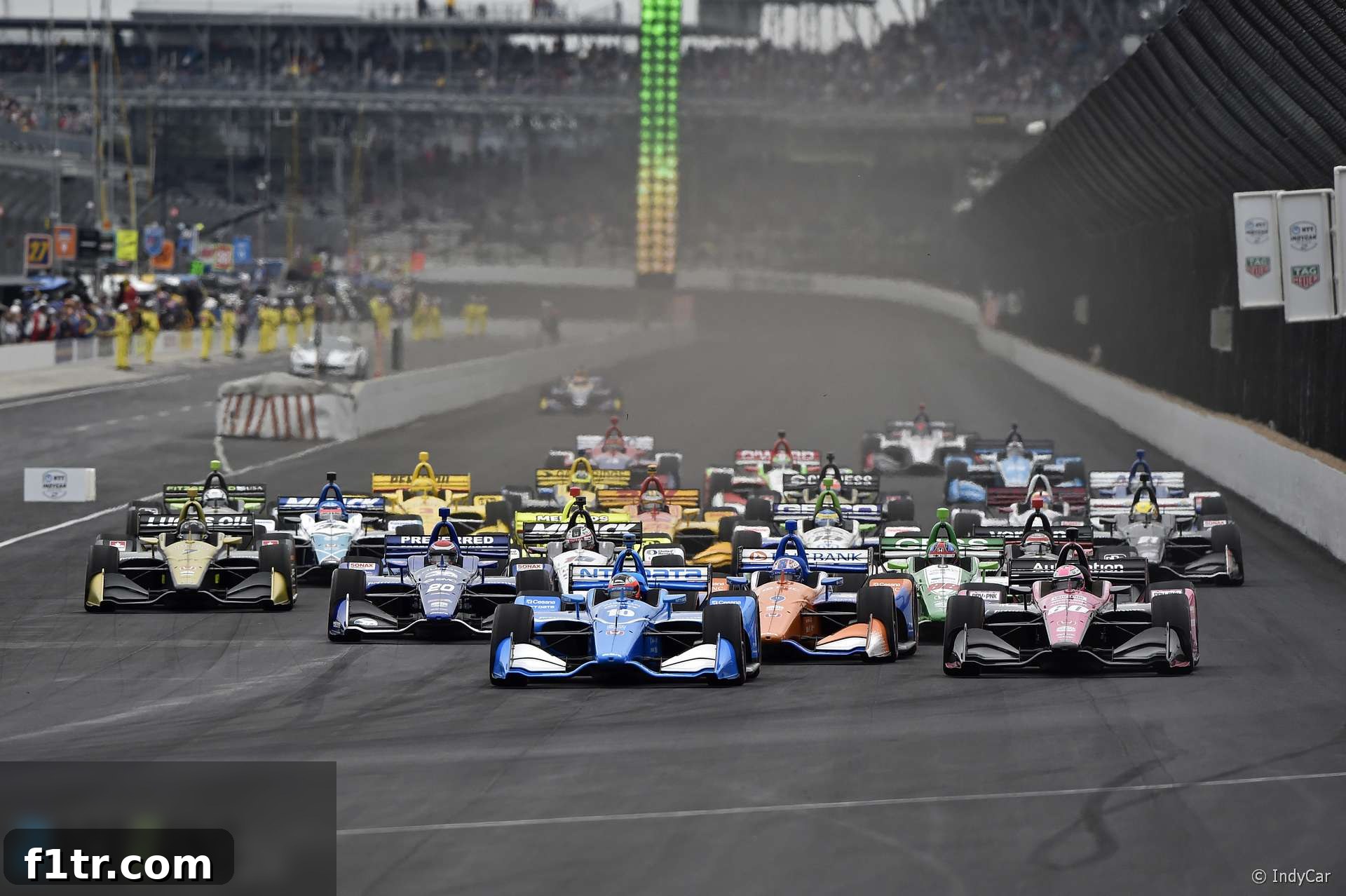
In a breathtaking display of strategic brilliance and sheer driving talent, Simon Pagenaud emerged victorious in a rain-soaked thriller on the Indianapolis Motor Speedway road course. The Penske driver executed a masterful comeback, snatching the lead from Scott Dixon on the penultimate lap to secure his first IndyCar win in over a year, solidifying his reputation as a formidable competitor in adverse conditions.
The race was a compelling narrative of ever-changing fortunes, where unpredictable weather, daring pit strategies, and relentless driver performance converged to deliver a spectacle. Pagenaud’s path to victory appeared fraught with peril when intensifying rain forced him to relinquish the lead during a late caution period, compelling him to pit for wet-weather tires. This decision, seemingly a setback at the time, laid the groundwork for one of the most remarkable charges witnessed on the iconic Indianapolis asphalt.
As the green flag waved for the final sprint, Pagenaud, armed with fresh wet tires, unleashed a blistering pace. He systematically carved his way through the field, dispatching Spencer Pigot, Ed Jones, Matheus Leist, and Jack Harvey with clinical precision. His pursuit of Scott Dixon, who had inherited the lead, was relentless, closing the gap at an astonishing rate of up to two seconds per lap. The climax arrived when Dixon, pushing the limits in the challenging conditions, ran wide at Turn 7. Pagenaud, sensing the opportunity, pounced decisively, executing a breathtaking overtake around the outside of the very next corner, seizing a hard-fought lead that he would not relinquish.
The race had been eventful from the very first lap, right after polesitter Felix Rosenqvist had skillfully maintained his lead. Behind him, Jack Harvey demonstrated early intent by sweeping past Dixon into second place, signaling his strong form for the day. However, the initial stability was short-lived. Marcus Ericsson, Harvey’s Schmidt Peterson Motorsports teammate, initiated the first caution period by losing control and spinning into the Turn 14 barrier, famously known as Turn 1 of the oval course. This incident immediately reshaped the top order, as Dixon expertly utilized the ensuing restart to outmaneuver both Rosenqvist and Harvey, ascending to the lead of the race.
The track conditions continued to challenge drivers, and another caution period wasn’t far off. James Hinchcliffe, in the other Schmidt Peterson car, was involved in a controversial incident, making contact with Ryan Hunter-Reay and sending him into a spin. Hinchcliffe was subsequently penalized for his role in the collision. During this phase, strategic divides began to emerge within the paddock. While Dixon and his immediate rivals opted to stay on track, maintaining their hard-won positions, a determined Josef Newgarden and a cluster of other drivers gambled on an early pit stop, hoping to gain an advantage later in the race as conditions evolved.
Upon the resumption of racing, Dixon initially established a clear lead, demonstrating his characteristic poise and speed. Yet, the intermittent rain refused to abate, making the conditions progressively trickier and demanding for every driver on the circuit. This fluctuating weather introduced a fascinating dynamic to the mid-race strategy. Harvey and Pagenaud, showcasing their increasing confidence and pace, gradually reeled in Dixon. The tension built as the trio converged, ultimately pitting as one unit in a synchronized sequence that proved pivotal. In a testament to his pit crew’s efficiency and his own track positioning, Pagenaud gained a crucial advantage during this stop, leapfrogging Harvey to latch onto Dixon’s tail.
Not all pit stops were as seamless, however. Felix Rosenqvist, who had started from pole, endured a particularly problematic sequence of visits to the pits. His Ganassi crew faced alarming issues, with the right-rear quarter of his car catching fire not once, but twice. Despite these terrifying setbacks and the time lost, Rosenqvist displayed immense resilience and determination, managing to make it to the finish line, a testament to his composure under pressure and the team’s ability to recover from critical failures.
As the rain intensified further, pushing the track beyond its limits, it precipitated the final, and most impactful, caution period of the race. Series returnee Helio Castroneves, after pitting, dramatically spun as he rejoined the track on slick tires, highlighting the treacherous nature of the conditions and the critical decision-making involved in tire choice. This lengthy caution period provided a tense interlude as the rain grew even heavier, saturating the circuit. It was during this critical juncture that Scott Dixon made a decisive tactical move, leading the charge into the pits for wet-weather tires. This bold decision by the seasoned veteran prompted a ripple effect, with the rest of the field swiftly following his lead, confirming the necessity of wets and effectively handing Dixon an inherited lead as the race prepared for its dramatic conclusion.
The stage was set for an epic showdown over the final 20 laps, a sprint to the finish that would test nerves, skill, and strategy to their absolute limits. Dixon, initially benefiting from his tire choice and clear track, managed to stretch his lead to an impressive six seconds at one point, seemingly in control. However, Pagenaud’s relentless pursuit defied expectations. Even running out of ‘push-to-pass’ activation, a crucial overtaking aid, he continued to close in on the Ganassi driver with astonishing speed. His eventual triumph, overcoming not only the challenging conditions and a mid-race setback but also a lack of an essential power boost, rendered his victory all the more remarkable and a true testament to his unwavering determination and superior wet-weather driving prowess.
Behind the lead battle, Jack Harvey delivered a stellar performance, holding on valiantly to secure his first career IndyCar podium finish in what was only his 14th start. This was a significant milestone for the young driver, marking a breakthrough moment in his burgeoning career. Matheus Leist also showcased his talent, crossing the finish line in a strong fourth position, ahead of Spencer Pigot, Ed Jones, and the ever-competitive Will Power, who secured seventh. Despite his pit lane woes, Felix Rosenqvist managed an admirable eighth place, followed by Graham Rahal. The battle for tenth place was particularly feisty, with Santino Ferrucci engaging in a wheel-banging duel with his teammate Sebastien Bourdais, ultimately prevailing to round out the top ten.
The race was not without its share of misfortune for other prominent drivers. Josef Newgarden, a strong contender, found his race severely compromised when his pit crew experienced a critical error, dropping one of his wheels during a restart. This costly mistake sent him to the back of the field, from where he could only recover to finish 15th. He finished behind Zach Veach, Marco Andretti, and Takuma Sato, who himself endured a late-race spin during the final Safety Car period, further highlighting the treacherous nature of the track. Long Beach winner Alexander Rossi faced an even more challenging day, his race effectively ruined at the very start when he clouted the pit wall. This incident relegated him to 22nd position, four laps down, a stark reminder of how quickly fortunes can change in IndyCar racing.
Ultimately, Simon Pagenaud’s triumph on the Indianapolis road course stands as a testament to the unpredictable thrills of IndyCar racing. It was a victory forged in adversity, showcasing not only his individual brilliance but also the crucial interplay of strategic calls, team execution, and the sheer mental fortitude required to conquer a rain-soaked circuit. This race will undoubtedly be remembered as a classic, a masterclass in strategic gambles and audacious overtakes that culminated in a thoroughly deserved victory for the French driver.
IndyCar Insights and Analysis
- IndyCar driver McLaughlin cleared of injury after crashing through barrier at Barber: A look at safety protocols and driver recovery.
- Schumacher says his IndyCar feels like ‘an F2 car, just with better tyres’: Comparing driving experiences across different motorsport categories.
- IndyCar “way faster than Formula 1” in some corners, says Grosjean: An expert perspective on the unique speed and handling characteristics of IndyCar.
- FIA to award more F1 superlicence points to IndyCar drivers from 2026: The growing recognition of IndyCar talent on the global motorsport stage.
- Schumacher to race full-time in IndyCar with RLL in 2026: Insights into driver career paths and team developments in IndyCar.
Browse all IndyCar articles for comprehensive coverage and updates.