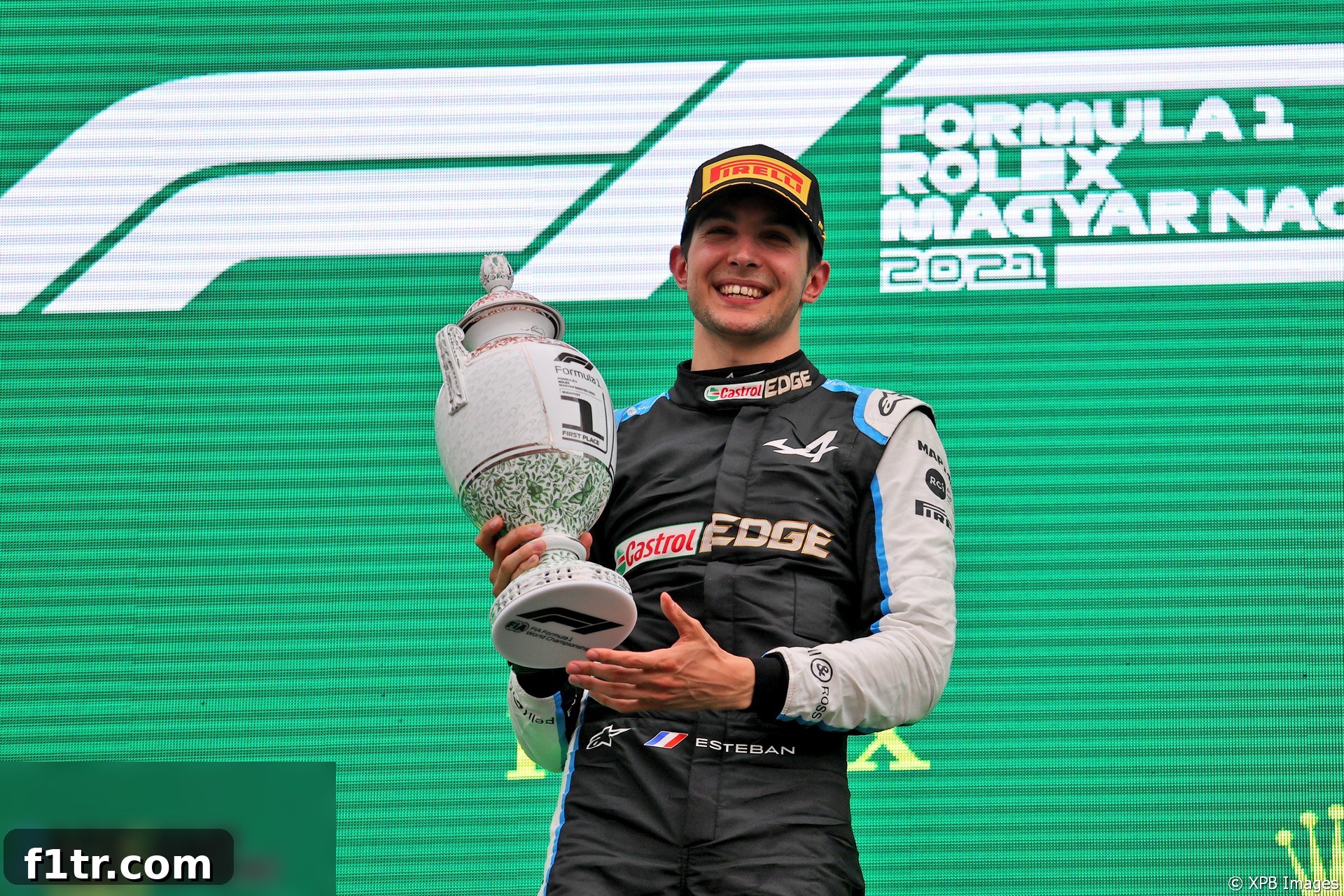
Just one year prior, Esteban Ocon had described his Hungarian Grand Prix weekend as “horrible,” a sentiment that encapsulated his challenging return to Formula 1 after a year and a half on the sidelines. His comeback hadn’t quite clicked, culminating in a frustrating 14th-place finish at the Hungaroring. He had struggled with tyre strategy on a drying track, losing the advantage of a strong start, and was ultimately relegated by Lando Norris on the final lap. Fast forward to a year later, under eerily similar mixed conditions, and Ocon would etch his name into Formula 1 history, claiming a maiden Grand Prix victory that blended opportune circumstances with immense skill and unwavering composure. This unforgettable race not only marked a career milestone for the young Frenchman but also delivered a crucial triumph for the Alpine F1 Team.
Advert | Become a Supporter & go ad-free
The 2021 Hungarian Grand Prix was destined to be a spectacle, unfolding with a dramatic turn of events that reshaped the championship narrative and propelled an unexpected victor to the top step of the podium.
Bottas Unleashes Chaos in Hungarian Grand Prix
A pre-race downpour had left the Hungaroring circuit wet but rapidly drying, setting the stage for a strategic gamble as temperatures began to rise. As the 20 cars navigated their way to the starting grid on intermediate tyres, Antonio Giovinazzi made an early, bold call, diving into the pits for slick tyres—a move that hinted at the rapidly evolving track conditions. At the front, championship protagonists Lewis Hamilton and Max Verstappen, starting first and third respectively, executed clean getaways. However, the driver positioned between them, Valtteri Bottas, suffered significant wheelspin, immediately dropping behind Verstappen, his Red Bull teammate Sergio Perez, and a brilliantly starting Lando Norris, who had rocketed up from sixth in his McLaren.
The situation escalated into a full-blown crisis for several top teams as Bottas, approaching Turn Two with reduced downforce and braking too late, careened into the back of Norris’s McLaren. The impact sent Norris into Verstappen’s Red Bull, while Bottas himself subsequently collided with Perez. The chaos wasn’t confined to this group; further back, Lance Stroll also misjudged his braking into Turn One, triggering a collision that sent Charles Leclerc into the other McLaren of Daniel Ricciardo. This chain reaction created one of the most costly first-corner pile-ups in recent Formula 1 history, drawing immediate comparisons to Romain Grosjean’s infamous Spa incident in 2012.
The repercussions were immediate and severe. Both Bottas and Stroll were forced to retire on the spot, later receiving five-place grid penalties for the next race. For Red Bull, the incident was particularly devastating: Sergio Perez’s race ended prematurely, and his car sustained significant engine damage, likely leading to a future grid penalty. Even more critically for the championship, Max Verstappen’s car was severely compromised, leaving him with a “walking wounded” Red Bull, albeit still circulating. Christian Horner, Red Bull’s Team Principal, vented his frustration, stating hours later, “He’s done a great job for Mercedes in taking out both of our cars,” highlighting the immense cost of Bottas’s error, coming just two weeks after the controversial Hamilton-Verstappen collision at Silverstone.
McLaren shared Red Bull’s pain, with Norris out of the race and Ricciardo’s car badly damaged. Leclerc’s Ferrari also retired. With debris scattered across the first corner, the race was promptly red-flagged—a sight that has become increasingly common in modern F1. Amidst the chaos, some drivers found themselves unexpectedly elevated. Esteban Ocon, who started eighth, skillfully navigated the mayhem to emerge in second place. Sebastian Vettel, whose initially slow getaway from tenth, paradoxically, proved to be a blessing in disguise.
Vettel himself acknowledged his good fortune: “I had a really bad start and it turned out to be the right place to be, so I did get lucky,” he admitted. “I took a bit of margin. In these conditions, it’s so easy to make a mistake, and as we saw, it can be quite costly. I really planned to be on the inside, and it turned out to be the place to be. Other people were taking each other out, and I had a clear track.” He successfully emerged from Turn One in a remarkable third position, setting the stage for a compelling race ahead.
Advert | Become a RaceFans supporter andgo ad-free
Mercedes’ Tactical Misstep and the Restart Drama
As the race prepared for its standing restart, the Hungaroring track had dried out considerably, presenting a critical strategic dilemma. The entire field initially left the pits on intermediate tyres, but one by one, drivers began to realize that slick tyres were the unequivocally correct choice for the rapidly improving conditions. With one monumental exception: Lewis Hamilton, leading the pack, opted to stick with his intermediates, a decision that would send shockwaves through the Mercedes garage and dramatically alter the course of the Hungarian Grand Prix.
Sebastian Vettel, among others, expressed surprise at Hamilton’s choice, noting, “I was surprised to see Lewis staying out.” While F1’s radio restrictions on formation laps would have prevented communication at the original start, these rules did not apply during the restart, making Mercedes’ decision even more perplexing. Esteban Ocon and his race engineer, Josh Peckett, critically assessed the conditions and swiftly concluded that slick tyres were the only viable option. “If we were not able to talk, probably it would have been a different story,” Ocon commented. “But it was clear to me that it was dry, so I was discussing it with the team what to do. What put me in a bit of doubt was Lewis continuing straight – because Lewis and the team, Mercedes, they usually don’t make mistakes at all. So I got a bit in doubt once that happened but it was definitely the clear thing to do, so we boxed.”
Hamilton’s solitary position on pole for the restart, with an entirely empty grid behind him, must have prompted a moment of self-doubt. The unique scenario meant that once Hamilton pulled away and passed the pit lane exit, the rest of the field, all on slick tyres, was released to pit. His rivals instantly clocked significantly faster sector times on their out-laps. As Hamilton completed his lonely first tour and headed for the pits, the true magnitude of Mercedes’ strategic oversight became painfully evident. After being fitted with a set of medium compound slicks, he rejoined the race in 14th place, now at the very back of the field, facing an arduous climb.
Hamilton’s charge through the field began slowly. He dispatched Giovinazzi but found Pierre Gasly’s AlphaTauri too quick on the straights. Ahead, Max Verstappen, in his grievously damaged Red Bull, engaged in a thrilling scrap with Mick Schumacher’s Haas, eventually muscling past. Christian Horner ruefully observed, “Schumacher had more downforce that Max today,” underscoring the severity of Verstappen’s car damage. Both Gasly and Hamilton subsequently demoted the Haas. Mercedes, aware they needed a tyre advantage to make significant headway, brought Hamilton in early for a set of hard compound tyres. Red Bull attempted to cover this move, but even with a two-second lead before pitting, Verstappen’s compromised car meant he emerged behind Hamilton, as did Daniel Ricciardo, who was also struggling.
Hamilton continued his relentless pursuit, quickly re-passing Schumacher and making short work of Nicholas Latifi, who pitted from a surprising third place in his Williams. Yuki Tsunoda proved a tougher nut to crack, taking several laps for Hamilton to pass. This move, however, tipped Ferrari’s hand: they pitted Carlos Sainz Jr. to ensure he emerged ahead of Hamilton on fresher tyres, temporarily stalling the Mercedes driver’s impressive recovery.
Meanwhile, at the front of the pack, Esteban Ocon and Sebastian Vettel circulated in close proximity. From lap 23, the Alpine began to slowly extend its lead. Vettel’s window for an undercut diminished as Aston Martin strategists eyed the gap to Fernando Alonso, behind whom Vettel was projected to emerge if he pitted. Finally, on lap 35, with Ocon now holding a 2.6-second advantage, Aston Martin called Vettel in. “I pushed really hard on the way in and probably a bit too hard,” Vettel recounted. “I locked the rears and triggered the anti-stall. Then I pushed like crazy on the out-lap. It was close.”
Advert | Become a RaceFans supporter andgo ad-free
Ocon pitted on the very next lap and successfully maintained his lead over Vettel. He attributed this critical success to the Aston Martin team spending over a second longer in the pits during Vettel’s stop. “That’s probably what made the difference because they would probably have undercut us on that,” Ocon stated, praising his crew: “the guys in the garage, again, top job by them.” Fernando Alonso, in the other Alpine, briefly led for two laps before making his own pit stop. This sequence restored Ocon to the lead, with Vettel breathing down his neck, Carlos Sainz almost seven seconds adrift, Hamilton in relentless pursuit, and Alonso, now in fifth, 16 seconds behind but about to play a pivotal role.
Alonso’s Decisive Defense: A Masterclass in Teamwork
With Lewis Hamilton rapidly closing in, Carlos Sainz Jr. in third place could anticipate the approaching challenge. “I was trying to read a bit through the race to see how we were going to manage to finish in front of Lewis for that podium,” Sainz explained. “In the end, he did what I was expecting him to do, which is what he’s done here the last two years: Box for a fresh tyre and then come back through the field. He has the car with a capacity to overtake – we don’t. So we decided not to cover him.” True to form, Hamilton pitted again on lap 48 for another fresh set of medium tyres, rejoining the race in fifth, 22 seconds behind race leader Esteban Ocon, with three cars still separating him from the Alpine at the front.
Mercedes Team Principal Toto Wolff was quick on the radio, urging Hamilton that a win was still within reach. Hamilton’s response, though respectful, revealed his skepticism: “He’s got a great heart, Toto,” Hamilton later said, “but with all due respect, when I got the call, I was like, ‘I want whatever they’re smoking at the end of this race!’” Hamilton initially deemed catching the cars ahead “impossible.” However, the driver who ultimately made the decisive difference in Ocon’s victory was his teammate, Fernando Alonso, who delivered an extraordinary defensive drive, a true masterclass in strategic teamwork.
For an agonizing ten laps, Alonso, a two-time world champion, resisted every single attack Lewis Hamilton launched. The Mercedes driver pressed relentlessly, even attempting an optimistic outside line into the super-quick Turn Four, only to be expertly rebuffed by the cunning Spaniard.
“That was a really great battle,” Hamilton acknowledged after the race. “When I was approaching him, I was like ‘God, this is going to be the hardest’, because he’s very, very tough, I would say probably one of the toughest drivers to overtake. It was very, very much on the limit, if slightly over some stages. But wheel-to-wheel battling in racing is good and in hindsight now watching, I’m sure if I watch it back it’ll just be close and we both finished, so that’s how racing should be.”
Despite his post-race magnanimity, Hamilton’s radio communications during the battle betrayed his frustration, complaining at one point that Alonso had squeezed him too hard. Finally, in a desperate attempt to defend into Turn One, the Alpine driver snatched a brake, ran slightly wide, and Hamilton seized his hard-earned advantage. Next in his sights was Carlos Sainz, whom Hamilton managed to pass with comparative ease after the immense challenge posed by Alonso. While the Mercedes driver still had sufficient tyre life to bring the leaders into view by the final lap, the time lost behind Alonso was crucial. Unquestionably, had he cleared Alonso a lap earlier, a shot at second place would have been realistic, and perhaps another lap or two earlier could have even given him a chance at challenging for the lead.
Ocon Resists Vettel’s Relentless Pressure for Maiden F1 Win
While Alonso bravely defended against Hamilton, Esteban Ocon faced his own intense pressure from Sebastian Vettel in the second stint. The Aston Martin, seemingly more comfortable on the hard compound tyres, mounted a formidable challenge. “I tried everything to push him into a mistake,” Vettel admitted. “He had some minor lock-ups, but nothing big. It’s obviously not easy to pass here but it’s also not easy to stay controlled and smooth like he did under pressure.” Ocon’s composure under the relentless pursuit of a four-time world champion was truly remarkable.
The race leader experienced a particularly worrying moment when lapping Antonio Giovinazzi. Conscious of his own history, having famously tipped Max Verstappen out of the lead of the Brazilian Grand Prix while a lap down three years prior, Ocon exercised extreme caution with the backmarker, now finding himself on the other side of the blue flags. “I was not enjoying blue flags,” he confessed. “Blue flags and me is not a great story, either behind or now in front. It was very, very close. Once I got the dirty air, I think we were a little bit slower overall than Sebastian in this race and that slowed me down, basically. I was struggling to get into the blue flag for Antonio, for him to clear, and Sebastian got DRS because of that, and he almost made a move. He was very, very close. A bit too close for comfort. I just managed to put the gap then in the tight section – the car felt amazing in that tight section.” This near-miss highlighted the razor-thin margins Ocon was operating within.
When the chequered flag finally fell, the gap covering the top three drivers had shrunk to less than three seconds. Esteban Ocon, having been chased by a pair of drivers with a combined 11 world titles and 152 Grand Prix victories between them, had successfully joined the elite ranks of Formula 1 race winners. It was a testament to his mental fortitude and the Alpine team’s robust strategy.
Ocon and Vettel returned to parc fermé on foot, though for vastly different reasons. Ocon, unfamiliar with the podium procedures, had mistakenly driven past the pit lane entrance and stopped at the pit exit, earning him a reprimand. Vettel, however, had come to a halt with a critical fuel shortage, a far more serious infraction. He was subsequently disqualified from the race as the necessary one-litre fuel sample could not be extracted from his car. Provisionally, he remained second in the classification, with his team indicating their intent to appeal the decision, adding another layer of controversy to an already dramatic event.
Behind the podium contenders, Carlos Sainz and Fernando Alonso secured valuable points for their teams. The AlphaTauri drivers followed, with Yuki Tsunoda, who had sensationally run fourth after the Turn One carnage, dutifully waving his quicker teammate Pierre Gasly by on lap 48 as instructed. The Hungarian Grand Prix also marked a significant turning point for Williams Racing, who, after two years without scoring a single point, saw the floodgates open. Nicholas Latifi delivered an outstanding performance, taking eighth place on the road after expertly passing his teammate George Russell at the start and holding position. Russell himself had emerged from the pits in second after the restart but was forced to allow a string of cars past due to an illegal overtake, costing him a stronger finish.
Max Verstappen’s reward for his incredibly arduous day, grinding out performance in a severely battered RB16B, was a single point for tenth place. This solitary point could yet prove vital in the tightly contested championship outcome, though he left Hungary provisionally six points behind Lewis Hamilton. This deficit would extend to eight points if Vettel’s disqualification were ultimately upheld, underscoring the championship implications of every point, regardless of how hard-won.
Esteban Ocon Savours Breakthrough Triumph
While Lewis Hamilton’s championship profit from the race should have been greater, he was among the first to welcome Formula 1’s newest winner. “I’m so happy for you buddy,” he genuinely told Ocon during the post-race press conference, “it’s been a long time coming.” For Ocon, this breakthrough victory arrived 14 years and 99 Grand Prix victories after Hamilton’s own maiden win. Ocon was now experiencing the view from the top step of the podium, a sight he had dreamt of and found to be precisely as he had hoped.
It was a poignant and fitting twist of fate that Ocon’s career-defining victory occurred at the very circuit where he had endured such a challenging weekend just 12 months prior. “It can sound weird,” Ocon admitted, “it’s not the favourite track of many drivers, I would say. But it is one of my favourites, for sure. On the calendar, it is in the top two. Probably step one now.” From a “horrible” weekend to a glorious triumph, the Hungaroring had become the stage for Esteban Ocon’s unforgettable ascent to Formula 1 victory.
Go ad-free for just £1 per month>> Find out more and sign up
2021 Hungarian Grand Prix
- Ocon congratulated by past French F1 aces after breakthrough win
- Alpine doubt first win signals a performance breakthrough
- Vettel disqualification hearing to take place on Monday
- Why no one received a Grosjean-style race ban for the Hungarian GP pile-up
- Ocon’s “beautiful” late-stint pace was other key to Alpine’s breakthrough win
Browse all 2021 Hungarian Grand Prix articles
F1 race reviews
- Antonelli lucks in for second win and becomes youngest F1 championship leader
- Emotional Antonelli grabs first Formula 1 victory in Chinese Grand Prix
- Russell sees off Ferrari threat to lead Mercedes one-two in Melbourne
- Norris clinches F1 title by two points as Verstappen wins finale at Yas Marina
- McLaren strategy blunder in Losail hands Verstappen crucial win and shot at title
Read all F1 race reviews