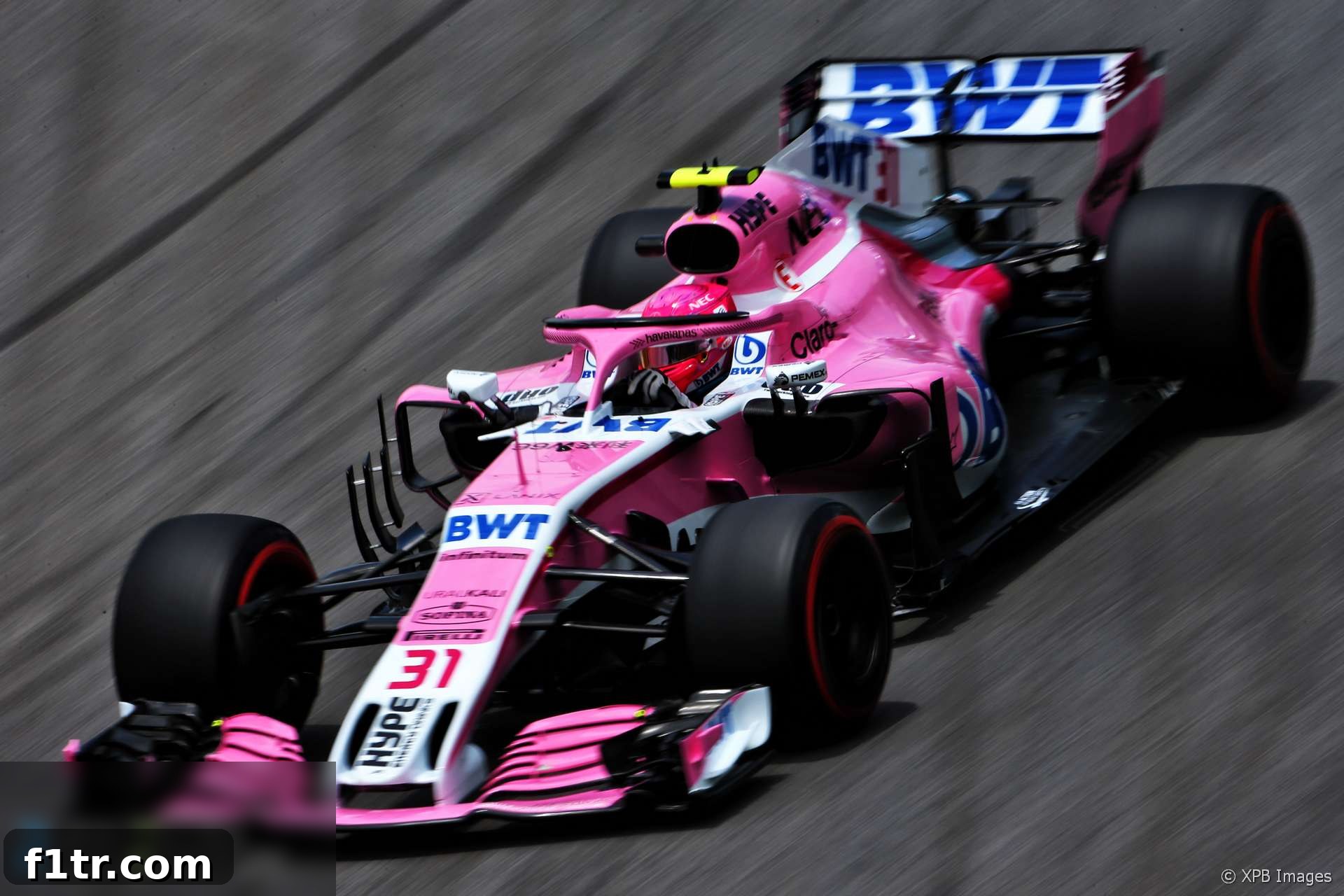
Esteban Ocon Hit with Grid Penalty for Brazilian Grand Prix After Gearbox Change
In a significant setback for the upcoming Brazilian Grand Prix, Force India driver Esteban Ocon has been handed a five-place grid penalty. The penalty stems from an unscheduled gearbox change on his VJM11 ahead of the crucial Interlagos race weekend, a move that contravenes Formula 1’s stringent technical regulations regarding component lifespans. This development casts a shadow over Ocon’s ambitious weekend targets and adds another layer of challenge for the Anglo-Indian team.
The decision to install a new gearbox comes despite Ocon not having completed the mandatory six consecutive race events with his previous unit. Under current FIA regulations, a gearbox must be used for at least six successive races before it can be replaced without incurring a penalty. Any change outside this stipulation, or due to a retirement that doesn’t count as ‘completing’ a race, typically results in a five-place demotion on the starting grid for the Grand Prix. This rule is a cornerstone of Formula 1’s efforts to control costs and promote reliability among its competitors.
Advert | Become a Supporter & go ad-free
Ocon’s Optimism Tarnished by Penalty News
Prior to the announcement of the gearbox penalty, Ocon had expressed a palpable sense of optimism regarding his performance during Friday’s practice sessions at the legendary Autódromo José Carlos Pace. The young French driver felt positive about the work put in and the initial feel of the car, looking forward to a strong showing in qualifying and the race.
“It was a good day, considering everything,” Ocon remarked, reflecting on his initial track time. “It’s always a difficult circuit to get everything right, especially with the elevation changes and the demanding corners. You need to work a lot on the car to put everything together and find that perfect balance. The track is short, and the lap times are incredibly tight between everyone, so it’s going to be an interesting day tomorrow in qualifying.”
His initial target for the weekend was clear and ambitious: “We will see how we get on, but the objective is always to get into Q3 and secure good points in the race.” This statement, however, now carries a different weight following the grid penalty. A five-place drop significantly complicates the path to Q3 and, more importantly, the crucial points-scoring positions. Achieving his original goals will now require an exceptional qualifying performance to mitigate the penalty’s impact, followed by a strong race drive to climb through the field at a circuit known for its challenging overtaking opportunities, despite some key zones.
The Intricacies of F1 Gearbox Rules and Other Drivers’ Fortunes
The Formula 1 regulations surrounding gearboxes are designed to test the endurance of components and prevent teams from frequently changing parts to gain performance advantages. While Ocon’s situation highlights the punitive aspect of these rules, it’s also worth noting how other drivers on the grid manage their gearbox usage without incurring penalties.
For instance, drivers like Lewis Hamilton, Kevin Magnussen, and Lance Stroll were also scheduled to take new gearboxes this weekend. Crucially, these drivers completed the required six consecutive events with their previous units, meaning their changes are entirely within the regulations and incur no penalties. This demonstrates sound component management and reliability planning from their respective teams.
Furthermore, an exception to the rule allows drivers who retire from the previous race to change their gearbox without penalty. This provision is designed to prevent a situation where a driver is forced to start a race with a potentially damaged or compromised component from an incident in the prior event. Benefiting from this specific clause, Daniel Ricciardo and Carlos Sainz Jnr – both of whom retired from the previous Grand Prix – will also take new gearboxes for Interlagos without any grid drops. This distinction underscores the importance of understanding the precise application of F1’s complex technical regulations.
Force India’s Troubled Friday: A Double Blow
The gearbox penalty for Esteban Ocon compounds what was already a challenging Friday for the Force India team. Ocon’s teammate, Sergio Perez, also experienced a significant disruption to his practice schedule, limiting the team’s valuable track time and data collection.
Perez had to sit out the entirety of the first free practice session (FP1) as the team opted to run reserve driver Nicholas Latifi in his car. While providing Latifi with experience is beneficial for the team’s long-term strategy, it meant Perez missed crucial early running on a circuit that requires a nuanced setup. This absence often puts a driver on the back foot for the rest of the weekend, needing to play catch-up in subsequent sessions.
Adding to Perez’s woes, he then lost valuable track time in the afternoon’s second free practice session (FP2) due to a technical issue. The team was forced to change his power steering assembly, a mechanical repair that consumed a significant portion of the session. Limited running in both practice sessions meant Perez had less opportunity to fine-tune his car’s setup, understand tire degradation, and gather crucial data for qualifying and race strategy. These collective issues for both drivers represent a significant hurdle for Force India as they aim to maximize their performance in Brazil and continue their fight in the Constructors’ Championship.
The 2018 Formula 1 season has been a rollercoaster for Force India, marked by significant financial challenges that ultimately led to the team’s administration and subsequent acquisition mid-season. Despite these off-track distractions, the team has consistently fought hard on track, demonstrating resilience and competitive spirit. A grid penalty for one of their drivers and technical issues for the other underscore the demanding nature of F1 and the constant battle teams face to deliver consistent performance against well-resourced competitors.
The Interlagos Challenge: Overcoming the Odds
Interlagos is renowned for its unique characteristics and demanding nature. The short, undulating circuit, with its mix of fast sweeps and tight corners, presents a formidable challenge for both drivers and engineers. The unpredictable Brazilian weather, often featuring sudden downpours, can also throw race strategies into disarray, potentially offering opportunities for those starting out of position.
For Ocon, starting five places lower than his qualifying position means he will need to rely heavily on strategy, clean driving, and perhaps a stroke of luck to move up the order. Overtaking at Interlagos, while possible in certain zones like the main straight and Turn 1, is far from straightforward. The tight midfield battles mean every position gained is hard-fought. A good start, intelligent tire management, and capitalizing on any safety car periods or rival mistakes will be paramount for Ocon to salvage points from this weekend.
The situation for Force India as a whole is now more challenging. With one driver facing a grid penalty and the other having reduced practice time, the team’s collective effort to secure vital Constructors’ Championship points will be severely tested. Every decision, from setup changes to race strategy calls, will be scrutinized as they aim to overcome these early setbacks.
Don’t miss anything new from RaceFans
Follow RaceFans on social media to stay updated with the latest Formula 1 news, analysis, and exclusive content:
- Join RaceFans on Facebook
- Follow RaceFans on Twitter
- Get daily email updates from RaceFans
Advert | Become a RaceFans supporter andgo ad-free
Related Articles from the 2018 F1 season
For more insights and news from the thrilling 2018 Formula 1 season, explore these related articles:
- F1 feared “death knell” for Drive to Survive after Ferrari and Mercedes snub
- McLaren staff told us we were “totally crazy” to take Honda engines in 2018 – Tost
- ‘It doesn’t matter if we start last’: How Red Bull’s junior team aided Honda’s leap forward
- Honda’s jet division helped F1 engineers solve power unit problem
- McLaren Racing losses rise after Honda split
Browse all 2018 F1 season articles