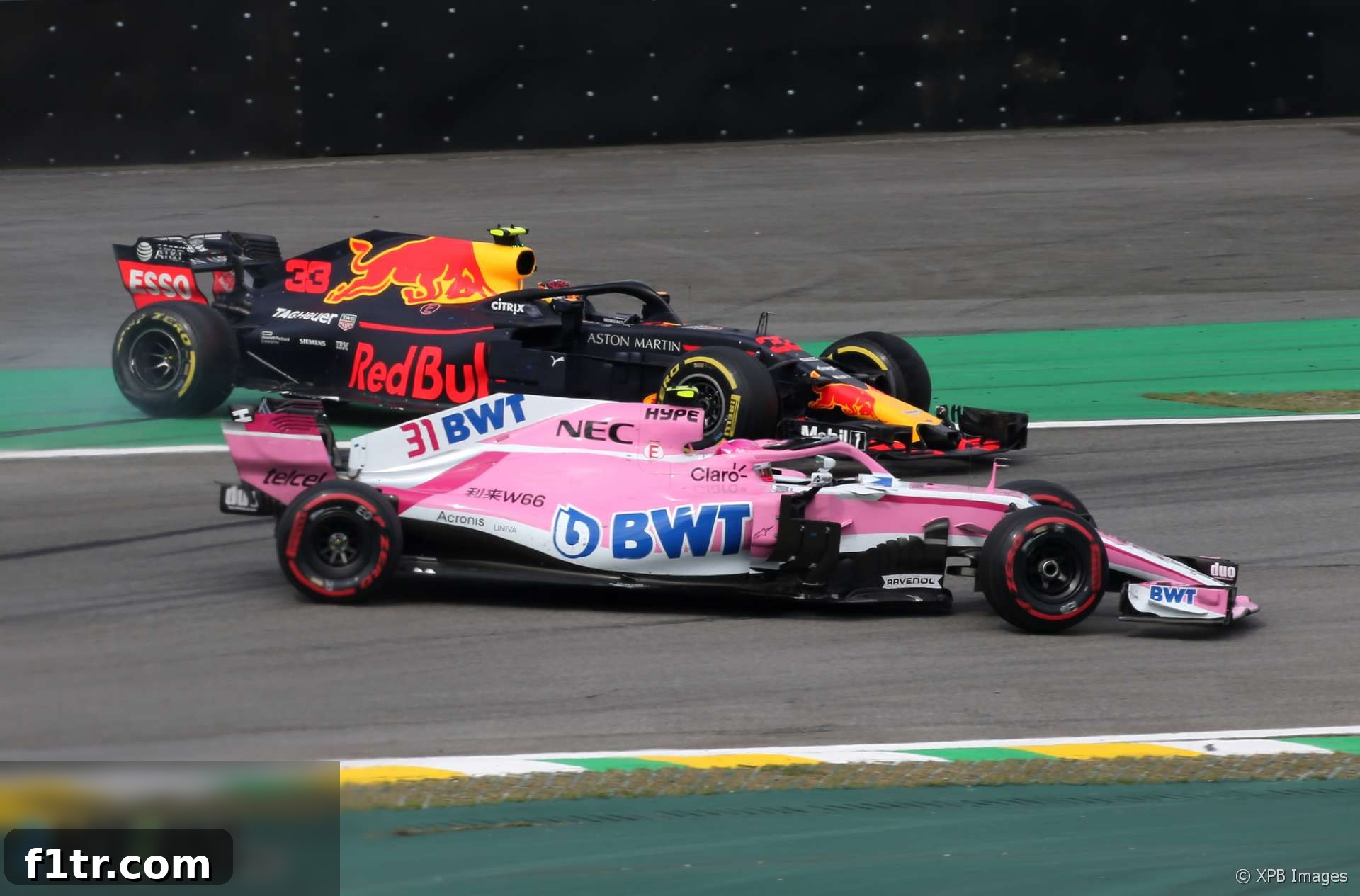
The Infamous Verstappen-Ocon Collision: F1 Drivers Weigh In on Brazil 2018
The 2018 Formula 1 Brazilian Grand Prix delivered one of the season’s most controversial and talked-about moments: a mid-race collision between then-race leader Max Verstappen and backmarker Esteban Ocon. The incident not only robbed Verstappen of a likely victory but also sparked a fiery confrontation between the two drivers post-race, igniting a passionate debate among fans, pundits, and indeed, their fellow competitors. While the immediate aftermath focused on the physical altercation, the underlying questions about racing etiquette, driver responsibility, and sportsmanship continued to resonate long after the checkered flag.
The collision itself was a high-stakes moment that unfolded rapidly. Max Verstappen, driving for Red Bull Racing, had established a commanding lead and was seemingly on course for a dominant victory at Interlagos. However, Force India’s Esteban Ocon, having just pitted for fresh tires, found himself a lap down and aggressively attempted to un-lap himself from the Dutchman. While it is not uncommon for backmarkers to un-lap themselves, the manner and timing of Ocon’s move, particularly against the race leader, were immediately called into question. As the two cars went side-by-side through the Senna ‘S’ corners, contact was inevitable. The collision sent Verstappen’s Red Bull spinning, costing him precious time and ultimately, the race lead. He recovered to finish second, but the bitterness of the missed win was palpable.
A Divided Paddock: Examining the Blame
The incident quickly divided opinion within the Formula 1 paddock, with drivers offering a range of perspectives on who was primarily at fault and how the situation could have been avoided. Their insights, drawn from years of high-speed racing and intense competition, provided a fascinating look into the unwritten rules and expectations that govern Grand Prix racing.
Sergio Perez: A Nuanced View on Shared Responsibility
Among the first to offer a nuanced perspective was Sergio Perez, Ocon’s then-teammate at Force India. Perez, who had his own history of on-track clashes with Ocon during their tumultuous tenure as teammates, brought a unique insight into the dynamic. He acknowledged the ambition of Ocon but also pointed a finger at Verstappen for not leaving adequate room.
“Obviously, it’s not great to see that kind of incident,” Perez remarked to RaceFans reporters shortly after the event. “It was a difficult decision for both of them. There was a point where I feel that Esteban tried too much with the race leader. But also, the race leader didn’t give him any room to avoid the contact. There was a point where Esteban tried too much, but there was a point also where he couldn’t do anything. He had no space.”
Perez’s assessment highlighted the delicate balance between a backmarker’s right to un-lap and a race leader’s right to defend their position. He suggested that while Ocon’s aggressive move was questionable, Verstappen’s uncompromising line left little room for the Force India driver to maneuver, contributing to the inevitable contact. “So it was very unfortunate,” Perez continued. “I think what happened wasn’t great, but it should not harm his reputation more. I think a lot of people have been very harsh on him the past week. He’s a very good driver, he did a mistake, and he knows that, but at the same time, I also feel that Max did a mistake too not to have avoided the accident.” Perez’s comments underscored a belief that in such a critical moment for the race leader, a more cautious approach from Verstappen might have averted the disaster, even if it meant momentarily yielding to a car that posed no threat to his position.
Valtteri Bottas: Defending the Race Leader’s Prerogative
In stark contrast to Perez’s view, Mercedes driver Valtteri Bottas, who had a ringside seat to the drama, expressed greater empathy for Max Verstappen’s situation. Bottas focused on the inherent expectation that a race leader holds when encountering a backmarker – an expectation of respect and non-interference.
“I can see Max’s frustration,” Bottas stated, acknowledging the emotional toll of being knocked out of the lead. “He was going for the win. When you’re overtaking a backmarker normally you do expect respect and not a collision. So for sure it’s unexpected for him, what happened. So I do see the frustration.” Bottas highlighted the established hierarchy on track: the race leader is paramount, and other drivers, especially those a lap down, are expected to facilitate their progress, not impede it. While Ocon had the theoretical right to un-lap himself, the manner in which he pursued it against the race leader was seen as an overstep.
Bottas further elaborated on the question of whether Verstappen could have given Ocon more space. “If you would have wanted to play it safe – I don’t know how much there was margin behind someone – sure it would have been possible,” he admitted. However, he quickly qualified this by adding, “But in the end, he doesn’t have to because he’s overtaking a backmarker.” This statement perfectly encapsulates the race leader’s prerogative: while a defensive or cautious line might prevent a crash, there’s no sporting obligation to concede space to a car that is not in competition for position. For Bottas, the onus was squarely on Ocon to execute his move safely and without impacting the race leader.
Post-Race Confrontation: A Step Too Far
While Bottas defended Verstappen’s on-track actions, he, like many others, drew a clear line when it came to the post-race physical confrontation between Verstappen and Ocon. Verstappen, visibly furious, sought out Ocon in the parc fermé and engaged in a heated exchange that escalated into shoves and pushes.
“Honestly, I don’t see the point in pushing anyone. What does it help?” Bottas questioned, criticizing Verstappen’s behavior. “We’re all free to say anything we think, but I think for the sport in general, sportsmanship in all the sports, it’s not right. That’s why he got a punishment for that. So I think that’s solved.” The stewards agreed, handing Verstappen a two-day public service penalty for his actions, underscoring that while emotions run high in motorsport, physical altercations are unacceptable and undermine the spirit of sportsmanship.
Fernando Alonso: Aggression as a Double-Edged Sword
Two-time world champion Fernando Alonso, known for his own fiercely competitive nature, echoed Bottas’s sentiments regarding the physical confrontation but offered a deeper psychological insight into Verstappen’s character. Alonso acknowledged that while pushing was not ideal, Verstappen’s aggressive and emotional traits are intrinsically linked to his success as a racing driver.
“I would not support that because I think personal contact should not be the way to go,” Alonso said, clearly disapproving of the physical interaction. “But everyone is different. Max is very aggressive, very emotional as well. But it’s part of his success as well. Everyone is different.” Alonso’s comments highlight a crucial paradox in elite sports: the very traits that drive a competitor to the pinnacle of their discipline – fierce aggression, unyielding determination, and raw emotion – can sometimes spill over into controversial behavior. For drivers like Verstappen, who push the boundaries on track, that same intensity can manifest off-track, leading to moments of regrettable conduct. Alonso’s seasoned perspective suggested that while the physical contact was wrong, it was a byproduct of the same competitive fire that makes Verstappen a formidable force in Formula 1.
The Broader Implications for Formula 1
The Verstappen-Ocon collision at the 2018 Brazilian Grand Prix transcended a simple racing incident; it became a focal point for discussions about a variety of critical topics within Formula 1. The incident brought renewed attention to the etiquette surrounding backmarkers and blue flags, questioning the extent to which a driver a lap down can aggressively race the leader. While rules permit un-lapping, the context and risk involved were debated intensely.
Furthermore, the post-race altercation underlined the fine line between passion and unprofessionalism. It served as a reminder that while the raw emotion of motorsport is a significant draw for fans, there are boundaries that drivers are expected to uphold. The incident also contributed to the narrative surrounding Max Verstappen himself – a driver of immense talent and speed, but one who often found himself at the center of controversy due to his uncompromising style and fiery temperament. His aggressive driving, coupled with his emotional reactions, made him both a thrill to watch and a frequent subject of debate.
The incident also reflected on Esteban Ocon’s determination and ambition. Despite being a backmarker, his refusal to yield and his drive to un-lap himself, while controversial, showcased a competitive spirit that many admired, even if its execution was flawed on that particular occasion. The collision, therefore, became a complex case study in driver psychology, racing regulations, and the unpredictable nature of Formula 1.
Conclusion: An Enduring Legacy
The Verstappen-Ocon collision at the 2018 Brazilian Grand Prix remains one of the most memorable and divisive moments in recent Formula 1 history. It encapsulated the high stakes, intense emotions, and fierce competition that define the sport. The mixed reactions from fellow drivers, ranging from shared blame to staunch defense of the race leader, highlighted the subjective nature of such incidents and the varied interpretations of racing etiquette. While the immediate furor eventually subsided, the incident left an enduring legacy, contributing to the ongoing narrative of both Max Verstappen and Esteban Ocon’s careers and cementing its place as a classic example of F1 controversy.
2018 F1 season
- F1 feared “death knell” for Drive to Survive after Ferrari and Mercedes snub
- McLaren staff told us we were “totally crazy” to take Honda engines in 2018 – Tost
- ‘It doesn’t matter if we start last’: How Red Bull’s junior team aided Honda’s leap forward
- Honda’s jet division helped F1 engineers solve power unit problem
- McLaren Racing losses rise after Honda split
Browse all 2018 F1 season articles