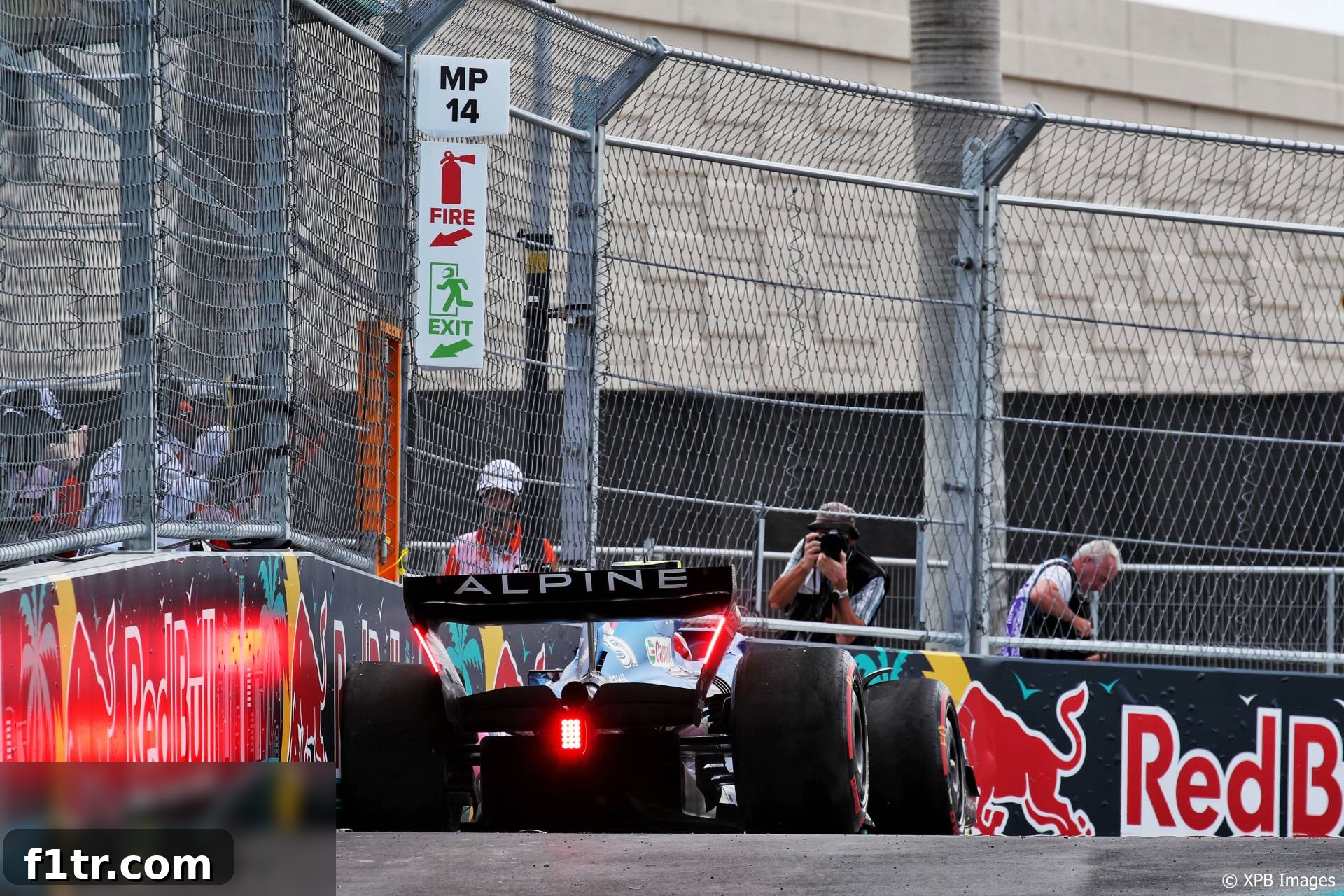
In a significant setback for the Alpine F1 Team, Esteban Ocon was regrettably confirmed to be out of contention for the qualifying session of the inaugural Miami Grand Prix. The unfortunate incident, which occurred during the final practice hour, left his car with extensive damage, rendering it impossible to repair in time for the crucial qualifying shootout.
The Frenchman’s session-ending crash took place at the challenging Turn 14, a corner that had already proven to be a demanding section of the new Miami International Autodrome. Ocon lost control of his A522 machine, spinning violently into the concrete barrier. The impact was severe, raising immediate concerns for both the driver’s well-being and the structural integrity of his car.
Following the shunt, Ocon was promptly taken to the circuit’s medical centre for precautionary checks. Thankfully, he was quickly released, with Alpine confirming his physical health. “Esteban is physically fine and will race tomorrow,” the team stated, alleviating fears of any serious injury. This news offered a silver lining amidst the disappointment of missing qualifying, ensuring Ocon would still participate in Sunday’s main event, albeit starting from the very back of the grid.
However, the severity of the car’s damage presented an insurmountable challenge for the mechanics. Alpine issued an official statement outlining the extent of the impact: “We can confirm that sadly Esteban won’t be taking part in qualifying this afternoon. His chassis was cracked in the impact with the barrier and cannot be changed in time.” A cracked chassis is a critical structural failure that necessitates a complete replacement, a procedure far too complex and time-consuming to complete within the tight schedule between practice and qualifying.
A visibly frustrated Esteban Ocon expressed his apologies to the team for the incident that abruptly curtailed his qualifying hopes. “Clearly it is frustrating to be here and not being able to race in qualifying, so I have to apologise to the team,” he conveyed. The missed opportunity was particularly galling for Ocon, who felt confident about Alpine’s performance potential on the nascent Miami circuit. “There was a lot possible, I hope Fernando is going to be able to deliver to show what the car can do,” he added, referencing his teammate Fernando Alonso and the car’s perceived pace. “I’ve lost the rear in the worst possible place. I think we went the right direction with the set-up; I knew it was going to be a good race car for this weekend, so that’s a shame.”
Beyond the personal disappointment, Ocon voiced significant concerns regarding the nature of the impact, revealing it registered a staggering 51G. This exceptionally high G-force measurement for an incident he perceived as not “such a big impact” immediately reignited conversations about track safety, specifically the unforgiving barriers at Turn 14.
Safety Concerns at Miami: The Perilous Turn 14/15 Chicane
Ocon’s crash was not an isolated incident at the Turn 14/15 chicane. Just the day prior, Carlos Sainz Jnr of Ferrari also suffered a heavy shunt at precisely the same corner. Sainz’s incident, much like Ocon’s, resulted in substantial damage to his car and prompted drivers to collectively raise questions about the suitability of the concrete barriers lining that section of the track. Many drivers advocated for the use of more energy-absorbing barriers, such as TecPro, which are designed to deform upon impact, dissipating kinetic energy more effectively and reducing the peak G-forces experienced by drivers.
The contrasting properties of concrete and TecPro barriers are well understood within motorsport. Concrete walls offer absolute containment but transfer the full force of an impact directly back into the car and driver. TecPro barriers, constructed from polyethylene blocks, absorb impact energy, significantly softening the blow and reducing the risk of injury to drivers, as well as minimizing damage to the expensive and complex F1 machinery. The fact that two drivers experienced such high G-force impacts at the same location within 24 hours underscored the urgency of this safety discussion.
Despite the strong appeals from the driver contingent, the track configuration and barrier choice at Turn 14 remained unchanged for Saturday’s qualifying. This decision sparked further debate among fans and pundits alike, highlighting the ongoing tension between track design, safety standards, and the perceived “show” of Formula 1. The FIA, as the governing body, continuously evaluates safety measures, but changes to track infrastructure can be complex and often require more lead time than an overnight adjustment.
The Inaugural Miami Grand Prix: A Weekend of High Stakes and High Drama
The Miami Grand Prix marked a highly anticipated addition to the Formula 1 calendar, bringing the pinnacle of motorsport to the vibrant city for the first time. Street circuits inherently present unique challenges, with close concrete walls offering little margin for error. The Turn 14/15 chicane, designed to create an exciting, technical section, unfortunately became a focal point for crashes and safety discussions, overshadowing some of the initial excitement surrounding the new venue.
For the Alpine F1 Team, Ocon’s absence from qualifying was a significant blow to their aspirations for a strong points haul. With both drivers having shown promising pace throughout practice, the team aimed to secure good grid positions to challenge their midfield rivals. Fernando Alonso would now carry the sole responsibility of representing Alpine at the sharp end of the grid, while Ocon faced the daunting task of navigating through the field from last place in Sunday’s race. The incident not only affected Ocon’s individual race but also had broader implications for Alpine’s standing in the Constructors’ Championship, where every point is fiercely contested.
Esteban Ocon’s Road Ahead: From Last Place to Points?
Starting from the back of the grid is one of the toughest challenges in Formula 1, particularly on a new circuit where overtaking opportunities might still be a relative unknown. However, Esteban Ocon, a proven talent, has demonstrated his ability to fight through the field in the past. His primary objective for the Miami Grand Prix will be to keep his car clean, manage his tires effectively, and capitalize on any incidents or safety car periods that could offer strategic advantages. The team will undoubtedly be analyzing various race strategies to help him climb as many positions as possible.
The mental resilience required after a heavy crash, especially one that sidelines a driver from qualifying, is immense. Ocon’s commitment to racing on Sunday demonstrates his unwavering spirit. His comments about the car’s potential suggest that if the Alpine A522 indeed has strong race pace, a points finish from the very back, while challenging, is not entirely out of the question. The synergy with Fernando Alonso will also be crucial, as Alonso’s performance in qualifying and the race will be vital for Alpine to maximize their overall team points.
Understanding the 2022 F1 Season and Car Design
The 2022 Formula 1 season introduced a radical overhaul of technical regulations, designed to promote closer racing. The new ground-effect aerodynamics have led to cars that behave differently, particularly in fast corners and when drivers push the limits. While these new cars are incredibly robust in many aspects, heavy impacts, especially those involving the chassis, can still lead to significant structural damage that is not easily repairable. The chassis, being the fundamental safety cell and structural core of the car, is paramount to driver safety. Any crack compromises its integrity and necessitates replacement, highlighting the precision engineering and safety standards inherent in modern F1.
Conclusion: A Focus on Safety and Resilience
Esteban Ocon’s unfortunate withdrawal from Miami Grand Prix qualifying cast a shadow over what was meant to be a celebratory weekend for Formula 1 in the United States. While the immediate focus was on the damage to his Alpine car and his missed opportunity, the incident, coupled with Carlos Sainz’s earlier crash, brought critical safety discussions to the forefront. The debate over rigid concrete barriers versus energy-absorbing TecPro solutions at high-speed chicanes remains a crucial ongoing conversation for the sport’s future safety evolution.
As the grid prepares for Sunday’s main event, all eyes will be on Ocon as he attempts a recovery drive from the back. His physical well-being confirmed, his mental determination intact, Esteban Ocon will be looking to prove that even from the most challenging starting positions, points are still within reach, reinforcing the unwavering spirit of Formula 1 drivers in the face of adversity.
Related Articles: 2022 Miami Grand Prix Insights
- Why TecPro barriers weren’t used at Miami chicane where Sainz and Ocon crashed
- Miami’s track surface is ‘a safety issue and does not offer good racing’ – Russell
- Miami Grand Prix draws F1’s largest live US television audience
- Alpine complain they had no say over penalty which cost Alonso points
- Red Bull wary of Ferrari’s high-speed cornering strength in Barcelona
Browse all 2022 Miami Grand Prix articles