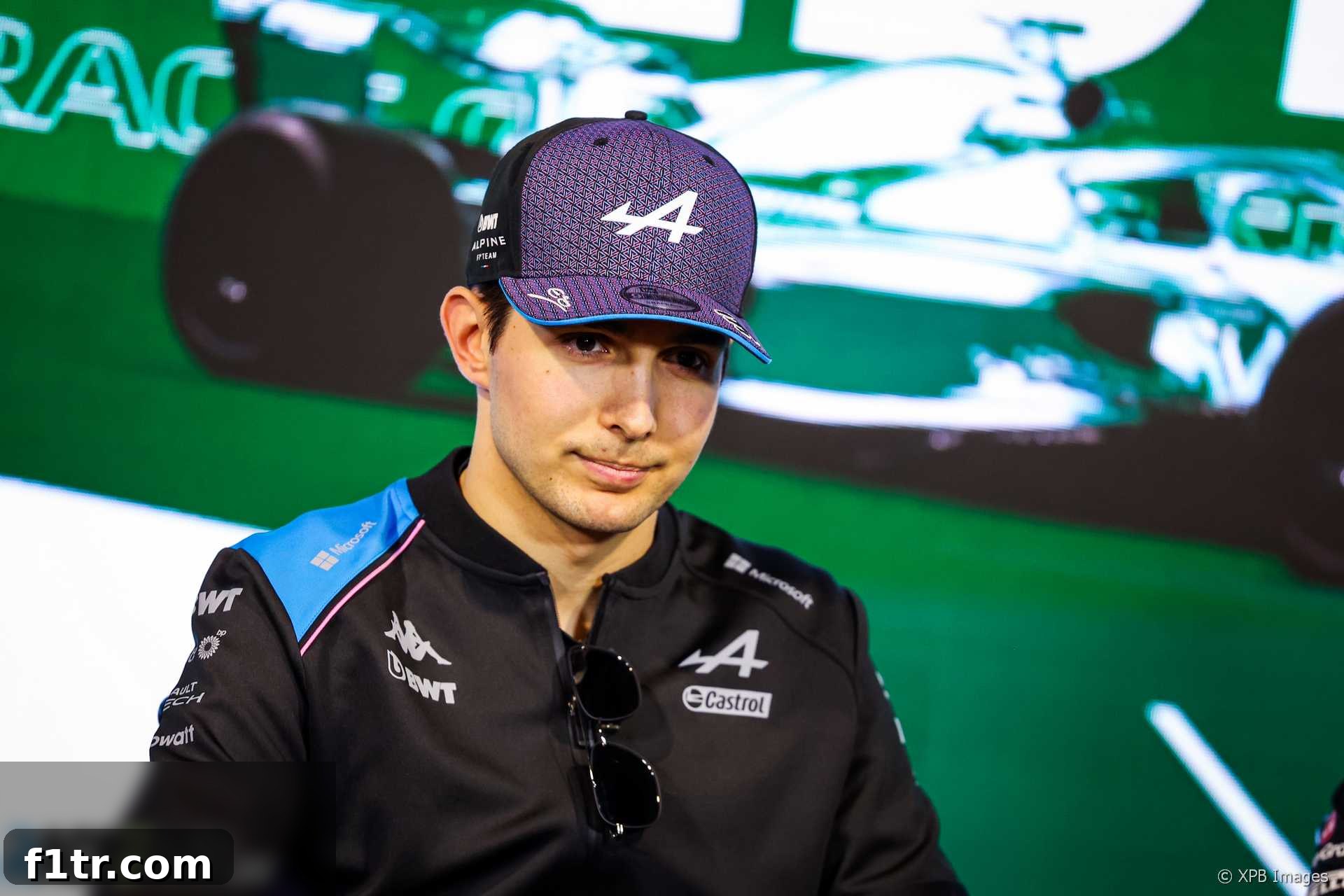
Esteban Ocon’s Bahrain Grand Prix Ordeal: Navigating New Rules and Seeking Redemption in Jeddah
The opening race of the 2023 Formula 1 season in Bahrain proved to be a baptism of fire for Alpine driver Esteban Ocon. What began with a seemingly minor infraction escalated into a cascade of penalties, ultimately leading to his retirement from the race. This challenging start underscored the razor-thin margins and strict adherence to regulations required in the pinnacle of motorsport. Following the tumultuous weekend, Ocon promptly met with the FIA to thoroughly discuss the initial penalty he received for failing to correctly line up his car in its designated starting position on the grid.
The initial penalty, a five-second time penalty, was levied against the French driver for being illegally outside of his grid slot just before the start lights went out. This seemingly small error, a fraction of an inch here or there, can have significant repercussions under Formula 1’s exacting rules. Ocon, ever the professional, was quick to admit his fault, acknowledging his responsibility in the matter. However, he also shed light on the inherent difficulties drivers face from inside the cockpit, particularly concerning visibility of the grid lines.
The Grid Slot Controversy: A Deep Dive into F1’s Precision Rules
Ocon candidly explained the challenge: “Unfortunately, you can’t see very well in these cars. Especially not when you’re on the grid like that. You can see the yellow line as a reference. But that’s up to me to fix that.” His comments highlight a common predicament for F1 drivers, where advanced aerodynamics and protective cockpit designs, while crucial for performance and safety, can sometimes obscure vital visual cues. The low seating position and bulky chassis structures mean that drivers often rely on experience, mirror views, and specific reference points rather than a direct line of sight to the immediate ground around their tyres.
Initially, there was a degree of confusion surrounding the exact nature of his transgression. Ocon had been under the impression that his car had been positioned too far forward on the grid. In light of this, he even pointed out that several of his rivals appeared to have committed similar infractions, suggesting a potential widespread issue or misunderstanding among drivers. However, after reviewing the telemetry and discussing the incident with his team, the Alpine driver came to realise his mistake was different: he had positioned his car too far to the right of his grid slot. This particular error was significant because it related to a new rule that had just come into force for the 2023 season, emphasizing precise lateral positioning within the grid box.
Understanding the New Regulations and Their Impact
The introduction of new rules regarding grid slot alignment for 2023 was aimed at ensuring absolute fairness and consistency across all starting positions. It eliminates any potential for a driver to gain even a marginal advantage by stretching the boundaries of their grid box. For drivers accustomed to previous interpretations, adapting to such precise new stipulations requires meticulous attention to detail and immediate learning, as Ocon discovered first-hand. The subtle difference between being too far forward and too far right, while seemingly minor, can trigger entirely different regulatory responses and penalties.
Meeting the Stewards: Seeking Clarity and Moving Forward
Recognizing the need for absolute clarity, Ocon took the initiative to meet with the FIA stewards. This meeting was crucial for him to fully grasp the specifics of the penalty and understand his obligations under the updated regulations. This proactive approach underscores the commitment of top-tier drivers to fully comprehend and adhere to the rulebook, ensuring they learn from mistakes and avoid future infringements.
“I had the meeting with the FIA, just to understand what exactly happened, and it’s clear now and we move forward,” Ocon confirmed after the discussion. His clarification pinpointed the exact issue: “It was too much to the right, basically. So that’s where it could get confusing, because it was too much to the right and over the line.” This statement highlights the precise nature of modern F1 rules – even a slight deviation beyond the marked boundaries, whether front, back, left, or right, constitutes a breach. The FIA’s clear explanation allowed Ocon to fully internalize the new standard, enabling him to adjust his pre-race procedures for subsequent events.
A Cascade of Penalties: Bahrain’s Disastrous Race Unfolds
The grid penalty, unfortunate as it was, was merely the first in a series of setbacks that would plague Ocon’s Bahrain Grand Prix. What started as a five-second time penalty quickly spiraled into a disastrous sequence of events, effectively derailing his race before it had truly begun.
After incurring front wing damage early in the race, Ocon eventually pitted to serve his initial five-second penalty. However, during this mandatory waiting period, his pit crew inadvertently touched the car before the five seconds had fully elapsed. This seemingly minor timing error, a matter of mere tenths of a second, resulted in a further and more severe punishment: a ten-second stop-and-go penalty from the stewards. Pit stop procedures during penalty service are among the most stringent in F1, designed to prevent any attempt to gain an advantage, even inadvertently. Any premature contact with the car, even by a crew member’s hand, is a direct violation.
The nightmare continued. As if two penalties weren’t enough, Ocon then incurred a third penalty for speeding on his way out of the pit lane after serving the previous one. This five-second time penalty added to the mounting tally, highlighting a complete breakdown in operational precision from both driver and team on a day when nothing seemed to go right. Pit lane speed limits are strictly enforced for safety reasons, protecting both personnel and other cars within the confined pitlane environment. Breaching this limit, even by a small margin, always results in a penalty.
The Cumulative Effect and Race Retirement
In total, Esteban Ocon and the Alpine team had amassed a staggering 20 seconds worth of penalties – five for the grid infringement, ten for the pit stop error, and five for speeding in the pit lane. With his race thoroughly compromised and any chance of a points finish long gone, Alpine made the strategic decision to bring Ocon into the pits and retire the car after 41 laps. It was a race to forget, a stark reminder of how quickly fortunes can turn in Formula 1 due to compounding errors.
Lessons Learned: Alpine’s Self-Assessment and Moving Forward
Reflecting on the calamitous Bahrain weekend, Ocon was remarkably candid and self-critical. “We admit our mistakes,” he stated unequivocally. “In Bahrain, we clearly got it wrong.” He articulated the team’s collective disappointment with a common idiom: “There’s a saying that when it rains, it pours. So that’s what happened to us in Bahrain. Collectively, we are usually very good on operational things like that. And this time, we were not.”
This honest admission from Ocon speaks volumes about the culture within Alpine and the high standards they set for themselves. Formula 1 is not just about car performance; it’s a finely tuned machine where every member, from the driver to the pit crew to the strategists, must operate with flawless precision. The Bahrain incident served as a painful but vital lesson, prompting an immediate internal review of all operational procedures to ensure such a sequence of errors is never repeated. The emphasis on “collectively” highlights the team aspect, acknowledging that responsibility for operational slip-ups lies with the entire unit, not just the individual driver.
Turning the Page: Optimism for Jeddah and Beyond
Despite the crushing disappointment of Bahrain, Ocon and Alpine quickly shifted their focus to the upcoming Saudi Arabian Grand Prix in Jeddah. There was a palpable sense of optimism within the team regarding their potential performance on the faster, flowing street circuit, particularly after showing strong pace there in the previous season.
Ocon contrasted the two venues: “[Bahrain]’s definitely not our best circuit as a whole. Last year was a pretty similar thing. We got P9 in qualifying – but we qualified fifth here [in Jeddah].” This comparison underscores how different track characteristics can dramatically influence car performance and driver comfort. The Bahrain International Circuit, with its rougher asphalt and emphasis on traction out of slow corners, might not have played to the strengths of the Alpine A523. In contrast, the high-speed, technical layout of the Jeddah Corniche Circuit, known for its rapid changes of direction and long straights, could potentially suit Alpine’s aerodynamic package and Ocon’s driving style much better.
Alpine’s Potential and Ocon’s Confidence on Street Circuits
“We’ve been recently very strong out on this track. And it’s a track that I’ve been enjoying racing at,” Ocon added, reinforcing his confidence. Driver preference and comfort with a specific circuit layout can have a significant impact on performance, often unlocking that crucial extra tenth of a second. Street circuits, with their unforgiving walls and high-risk nature, often reward bravery and precision, attributes Ocon is known for. The historical data from Jeddah further fuels this optimism, as Alpine has demonstrated competitive pace there previously, suggesting that the car has an inherent setup advantage on such tracks.
With the Bahrain experience firmly behind them and valuable lessons learned, the team’s aspiration for the Saudi Arabian Grand Prix was clear: “So hopefully we can repeat the same, be competitive and have a good race weekend.” The goal was not just to avoid penalties but to genuinely challenge for strong points, leveraging their known strengths on the Jeddah Corniche Circuit. For Ocon, it was an immediate opportunity for redemption, a chance to put the Bahrain debacle behind him and demonstrate the true pace of both himself and the Alpine challenger.
Esteban Ocon’s Bahrain Grand Prix was a harsh but ultimately instructive reminder of the relentless demands of Formula 1. From grappling with new grid rules and visibility issues to enduring a relentless series of operational penalties, the experience highlighted the extreme precision required from every aspect of an F1 team. His proactive engagement with the FIA and candid self-assessment, coupled with a renewed focus on the upcoming challenge in Jeddah, demonstrate the resilience and determination characteristic of a top-tier driver. As the F1 season progresses, Ocon and Alpine will undoubtedly strive to transform the lessons learned in Bahrain into stronger, more consistent performances, beginning with a hopeful rebound on the streets of Jeddah.