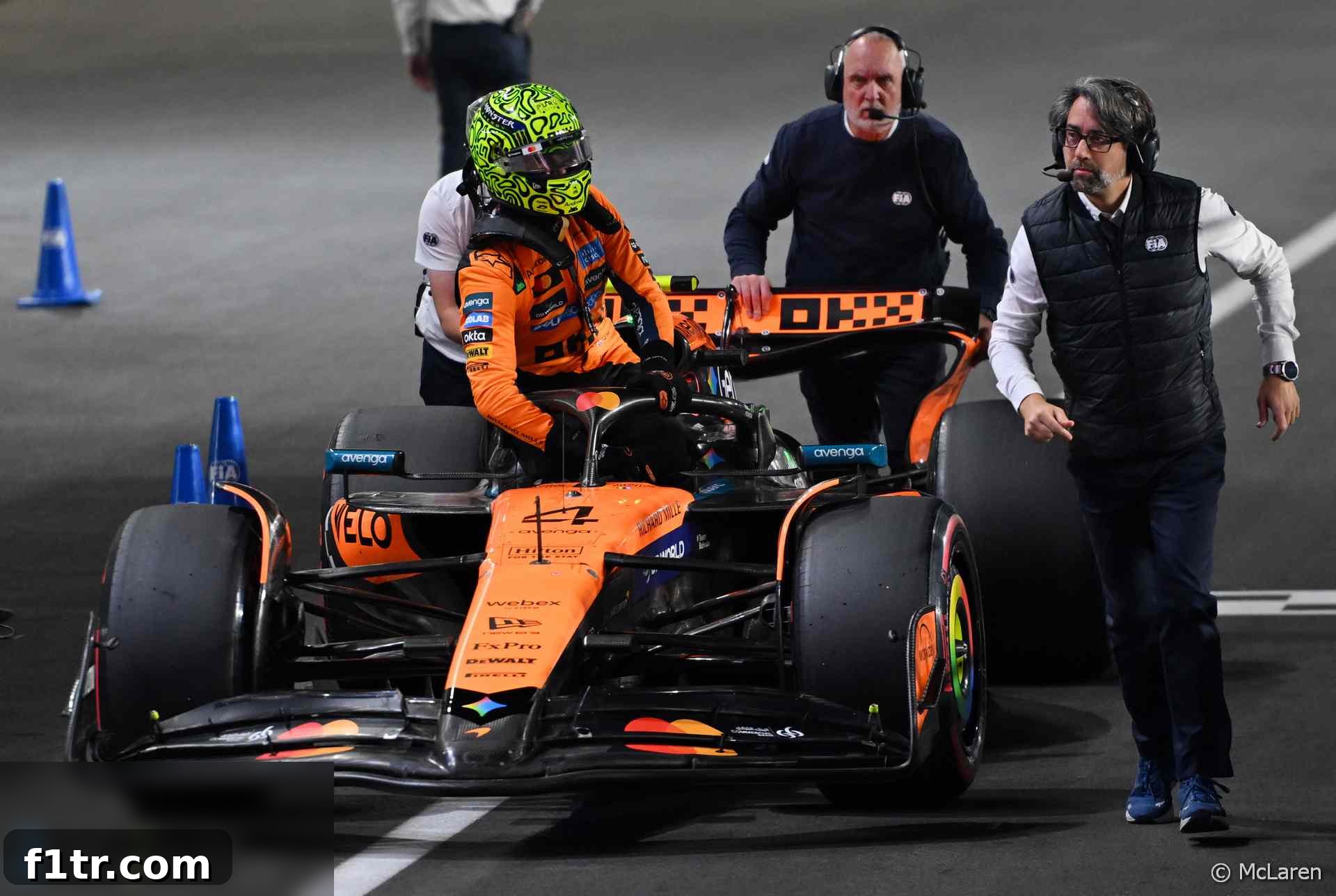
The high-stakes world of Formula 1 qualifying often sees drivers pushing the absolute limits, not just of their cars, but also of strategic track management. A crucial aspect of this is maintaining clean air and adequate space to extract maximum performance. However, recent events have once again brought the contentious issue of impeding a rival, especially a teammate, into sharp focus. Earlier this year in Singapore, Max Verstappen publicly accused Lando Norris of costing him valuable time on his final qualifying lap. Now, a similar shadow of doubt has been cast, asking whether the McLaren driver inadvertently – or perhaps intentionally – hindered his own teammate, Oscar Piastri, during a critical qualifying session.
Advert | Become a Supporter & go ad-free
The incident in question unfolded as Piastri was on his final flying lap, heading into the critical last corner. Ahead of him, Lando Norris had aborted his run following a mistake and was circulating slowly. While Piastri was rapidly closing the gap, the timing and execution of Norris’s return to the pits, or lack thereof, sparked considerable debate among fans and pundits alike. Understanding the intricate dynamics of qualifying requires a closer look at the principles of track spacing and the regulations governing driver conduct.
The Crucial Role of Track Position and Aerodynamics in F1 Qualifying
In Formula 1, drivers meticulously plan their qualifying laps to ensure they have an unobstructed run. A key element of this planning is leaving substantial gaps to cars ahead. The reason is primarily aerodynamic: a car following too closely experiences ‘dirty air’ or turbulent air, which significantly reduces downforce and grip, making it harder to extract optimal performance. This can cost a driver precious tenths of a second, which often means the difference between pole position and several grid places down.
Piastri’s final qualifying lap began with what appeared to be an ample 11-second gap to the closest car ahead, the Racing Bulls of Isack Hadjar. This gap is generally considered sufficient to ensure clean air for a hot lap. However, as Norris slowed considerably after abandoning his lap, Piastri’s carefully managed gap evaporated. By the time Piastri arrived at Turn 16, he found himself just three seconds behind his teammate. This sudden reduction in space naturally raised questions about the impact on Piastri’s performance.
Upon reviewing Piastri’s performance, his final sector time showed only a marginal difference from his previous run: 23.259 seconds compared to 23.257 seconds. Impressively, both these times were faster than anyone else managed in that sector. However, the fine margins of F1 suggest he might have missed an opportunity for further improvement. A deeper dive into his mini-sector times revealed that his speed through the final corner was slightly slower than his previous best. This subtle dip, while not catastrophic, fuels the speculation that the presence of Norris ahead might have had a detrimental effect, however minor.
The Social Media Storm and Norris’s Onboard Footage
The incident gained significant traction on social media, largely due to a clip of Norris’s onboard video that quickly circulated after qualifying. The footage appeared to suggest a calculated timing of his return to the pits. At one point, Norris allowed Hadjar to overtake him. Moments later, his race engineer, Will Joseph, informed him that Piastri was approaching. What happened next intensified the discussion: Norris accelerated and re-passed Hadjar. This sequence of events, viewed in isolation, gave the impression of a driver deliberately manipulating track position relative to his teammate.
However, the full context reveals a more complex scenario. Hadjar, too, was abandoning his lap around the same time and was also receiving information about Piastri’s position on the circuit. Furthermore, Norris was obligated to adhere to the strict delta time regulations enforced between the two Safety Car lines as he returned to the pit lane. The delta time ensures drivers do not drive excessively slowly on in-laps or out-laps, which could be dangerous or create an advantage. Navigating these rules while managing other cars and receiving instructions from the pit wall adds layers of complexity to a driver’s decision-making process.
Advert | Become a RaceFans supporter andgo ad-free
Deciphering the Radio Transcripts: A Play-by-Play Analysis
To gain a clearer understanding of the situation, examining the radio exchanges between Norris and his engineer, Will Joseph, is crucial. Norris had already backed out of his final lap at Turn Two and had slowed down to allow several cars to pass him. The sequence of communications provides a detailed timeline of events:
| Joseph | Turn four Okay. Just be careful of Leclerc, coming out of turn three. |
| Joseph | Turn six Leclerc’s in four. |
| Joseph | Approaching turn seven Leclerc leaving five. |
| Joseph | Russell, on a ‘build’ lap before his final flying run, passes Norris before turn seven Leclerc leaving six Leclerc passes Norris |
| Joseph | Turn seven Then there’s Alonso at six. |
| Joseph | Exit turn seven Alonso’s approaching seven. Alonso passes Norris entering turn eight |
| Joseph | Turn eight Then there’ll be Hadjar at six |
| Joseph | Exit turn 10 Hadjar at seven |
| Joseph | Norris slows considerably approaching turn 12 Hadjar’s in 10. Hadjar goes off at the exit of turn 10 |
| Joseph | Hadjar’s in 11. Hadjar passes Norris, who accelerates |
| Joseph | Then Oscar’s in 10. Norris catches Hadjar at turn 14 and passes him |
| Joseph | Approaching turn 15 Oscar in 12. |
| Joseph | Turn 15 14, we’re box this lap. |
| Joseph | Norris pits And the boards are out. Not sure where to stop, to be honest. |
This transcript reveals Norris’s efforts to manage traffic and adhere to instructions while on a cool-down lap. He slowed to let Hadjar pass him as he approached Turn 12, a critical point in a sequence of three consecutive high-speed corners where space to maneuver is limited. This move suggests an initial attempt to clear the track. However, the plot thickens with Hadjar’s involvement.
Advert | Become a RaceFans supporter andgo ad-free
Hadjar’s Role and the Cascading Effect
As Norris was managing his track position, Hadjar, too, was receiving critical information. His engineer, Pierre Hamelin, warned him that Piastri was rapidly closing in. This led Hadjar to slow down to allow Piastri to pass him after the Turn 12-13-14 sequence. The radio exchanges from Hadjar’s perspective shed further light on the developing situation:
| Hadjar | Hadjar goes off at the exit of turn 10 Sorry. |
| Hamelin | Turn 12 Piastri pushing, eight. |
| Hamelin | Approaching turn 14 Box, box. |
| Hamelin | Exit turn 14 Piastri pushing, five. Norris repasses Hadjar |
| Hamelin | Approaching turn 15 Piastri four… Piastri two, coming now, coming now Piastri passes him |
| Hamelin | Next car Gasly, six, box, box. |
Crucially, after Hadjar had slowed down to make way for Piastri, Norris then repassed Hadjar and continued to push through Turns 15 and 16 on his way into the pits. This particular action by Norris is where the debate intensifies. Was he genuinely attempting to get as close to the delta time as possible, managing his speed for a safe and compliant pit entry? Or did he seize a momentary opportunity to inconvenience his teammate, even subtly, on Piastri’s crucial flying lap? The answer is not straightforward.
Intent vs. Adherence: The Fine Line of F1 Regulations
The FIA’s rules on impeding are clear: drivers must not unnecessarily hinder another competitor, especially one on a flying lap. However, the interpretation of ‘unnecessarily’ often becomes a point of contention. Norris’s actions could be argued from two perspectives. On one hand, he might have been meticulously adhering to the delta time requirements, which can be challenging to manage perfectly while dealing with traffic and adjusting for an aborted lap. Pushing through the final corners could have been an attempt to avoid a delta time penalty himself, which can be severe.
On the other hand, the timing of his acceleration and re-passing Hadjar, just as Piastri was in his critical final sector, appears suspicious to some. In a sport where every millisecond counts, even a slight disturbance of airflow or a psychological distraction can make a difference. The suggestion that a driver might intentionally inconvenience a teammate, especially a leading championship rival, raises ethical questions within the team dynamics.
However, if Norris’s actions were indeed an attempt to impede Piastri, it would have been a significant and perilous gamble. The precedent set by Max Verstappen last year serves as a stark warning. Verstappen received a one-place grid drop for exceeding the delta time and impeding a rival who was not on a flying lap. Had Norris exceeded the delta time while simultaneously impeding a rival who *was* on a flying lap, the penalty would undoubtedly have been far more severe, potentially jeopardizing his own race start and McLaren’s team standings. Such a risk, especially for a teammate, seems disproportionately high for a speculative advantage.
Advert | Become a RaceFans supporter andgo ad-free
Conclusion: An Unresolved Question in the Heat of the Moment
Ultimately, without direct evidence of intent from Lando Norris, it is challenging to definitively conclude whether his actions were a deliberate attempt to impede Oscar Piastri or simply a complex maneuver to adhere to regulations while managing a crowded track. The radio transcripts and onboard footage offer valuable insights, but the subjective nature of “impeding” in the heat of a qualifying session leaves room for interpretation. What is clear is that such incidents underscore the immense pressure on F1 drivers and engineers to navigate not only the competitive landscape but also the intricate web of sporting regulations, where every decision can have significant consequences for individual performance and team harmony. The fine line between strategic track management and infringing on a rival’s flying lap remains one of Formula 1’s most persistent and controversial talking points.
Miss nothing from RaceFans
Get a daily email with all our latest stories – and nothing else. No marketing, no ads. Sign up here:
2025 Qatar Grand Prix
- Norris wins 2025 F1 title and ends Verstappen’s four-year reign as champion
- McLaren “helping Stefano with TV ratings” with Qatar strategy error, jokes Brown
- Alpine are guaranteed to finish last in 2025 – but will set an obscure points record
- Norris take note: The F1 points leader usually loses three-way title fights
- Mercedes grateful for Red Bull’s statement on Antonelli after “disappointing” online abuse
Browse all 2025 Qatar Grand Prix articles