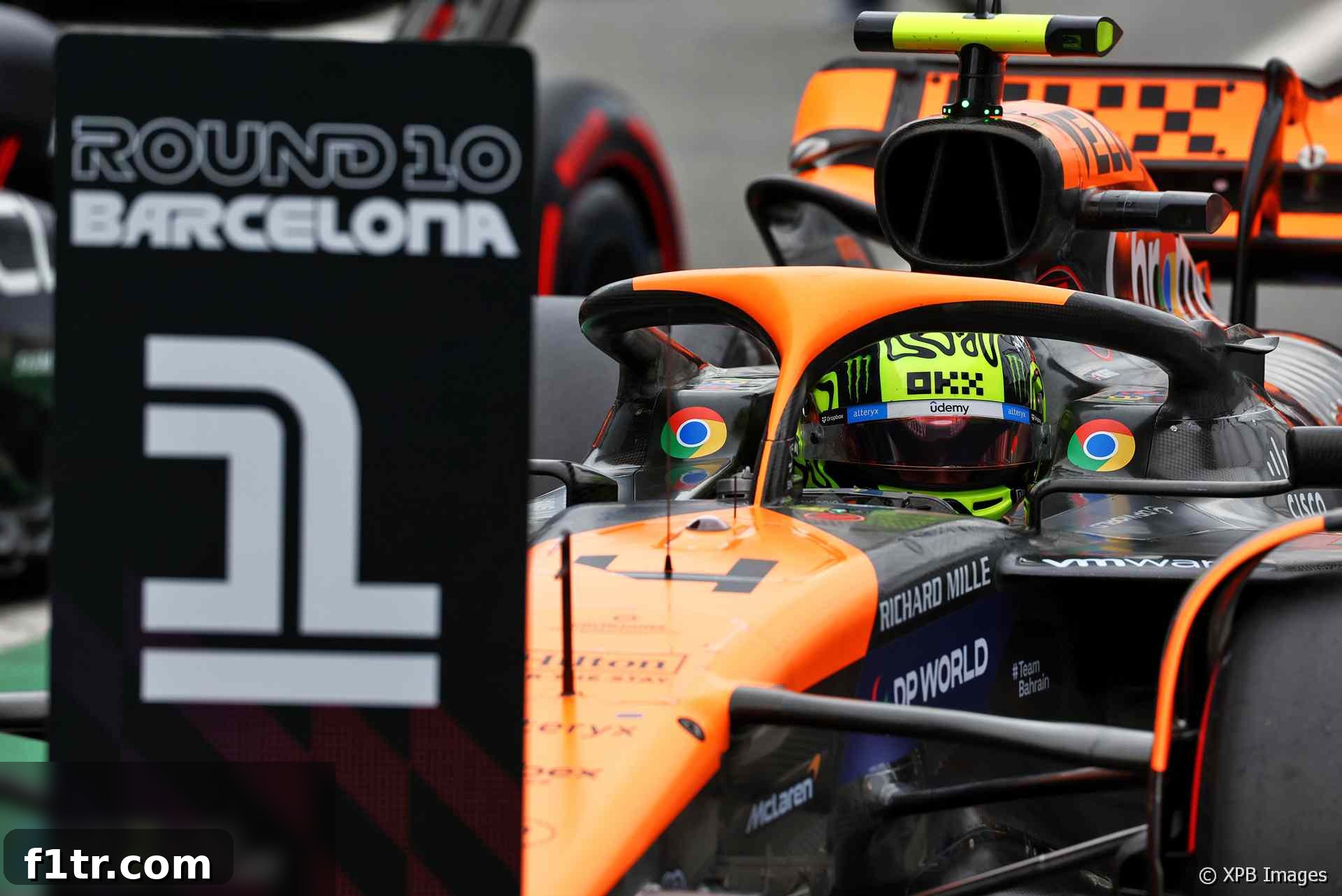
The exhilarating Spanish Grand Prix qualifying session saw Lando Norris seize pole position by an incredibly narrow margin, setting the stage for what promises to be an enthralling race at the Circuit de Catalunya. Had the start/finish line been just 100 metres further down the main straight, Max Verstappen might have claimed pole. But it was Norris, by a mere two-hundredths of a second, who emerged victorious from the Saturday showdown.
The final moments of qualifying painted a vivid picture of the intense rivalry. Norris, with a minuscule lift through the crucial final corner, saw Verstappen, who remained flat out, gaining on him with every metre towards the line. It was a heart-stopping finish that demonstrated the razor-thin performance differences at the front of the grid. Having conquered the 4,657-metre qualifying lap, Norris now faces the daunting task of defending his advantage over the 579-metre sprint from pole position to Turn 1 – the longest on the Formula 1 calendar.
With four different teams occupying the top five grid slots, and the potential for unpredictable weather, this Spanish Grand Prix is poised to be one of the most open and captivating races seen at this circuit in recent memory. The blend of established champions, rising stars, and tactical uncertainties promises a spectacle that F1 fans won’t want to miss.
Weather Forecast: The Unpredictable Element in Barcelona
After three practice sessions bathed in warm, sunny conditions, a significant shift in the weather marked qualifying day. Clouds began to gather over the circuit, leading to a noticeable drop in temperatures. Track temperatures, a critical factor for tyre performance, were approximately 10 degrees Celsius lower than those experienced during Friday’s practice sessions. This change hinted at the challenges awaiting teams and drivers.
Looking ahead to Sunday’s race, conditions are expected to be even cooler, with a strong possibility of rain. Forecasts indicate a high chance of precipitation during Sunday morning in Barcelona, which will undoubtedly impact the F2, F3, and F1 Academy support races. While the rain is anticipated to clear before the Grand Prix’s 3 pm start, there’s a tangible risk of a damp or drying track as the lights go out. Such conditions would introduce an immediate layer of complexity, demanding exceptional adaptability from all competitors.
The cooler track temperatures, irrespective of rain, could prove to be a double-edged sword. On one hand, they might assist drivers in managing tyre degradation, which is projected to be a significant challenge on this circuit known for its high-speed corners. On the other hand, rain would wash away the accumulated rubber, potentially making the track surface more abrasive and punishing on fresh tyres. Drivers will embark on their reconnaissance laps facing potentially vastly different conditions than any they’ve encountered throughout the weekend. Their ability to quickly adjust and extract performance from their machinery in these evolving circumstances will be paramount to their race prospects.
The Critical Start: A Sprint to Turn One
Lando Norris, the pole-sitter, is acutely aware that the 11-second, 579-meter dash to Turn 1 presents a golden opportunity for his closest rivals, Max Verstappen and Lewis Hamilton, to nullify his hard-earned qualifying advantage. The run to the first corner at the Circuit de Catalunya is the longest on the Formula 1 calendar, making the start a critically decisive moment.
“It’s a long run down to Turn 1,” Norris acknowledged after qualifying. “It’s probably one of the places you don’t want to start on pole, but it’s an opportunity for us to go out and try and win a race.” His statement underscores the inherent risk and reward of starting from the front at Barcelona. While pole position offers clear track and optimal race lines, the extended run to Turn 1 allows rivals to leverage slipstream benefits, potentially challenging for the lead even before the first corner.
Despite the inherent slipstreaming opportunity for those behind, championship leader Max Verstappen emphatically stated his preference for starting from pole. “I would always want to start first,” Verstappen asserted. “It’s a bit easier to defend like that.” He highlighted the parity in top speeds among the leading contenders and the absence of DRS for the race start, making the initial getaway purely dependent on driver skill and car launch. This means a strong start from Norris is not just beneficial, but absolutely essential to convert his pole position into an early race lead, setting the tone for the 66-lap Grand Prix.
Race Strategy: The Tire Degradation Challenge
The Circuit de Catalunya is notorious for its demanding characteristics, particularly on tyres. During Friday’s second practice session, long runs revealed significant wear on various compounds, with drivers reporting high degradation rates. This is largely due to the many long, fast corners that subject tyres to sustained lateral loads, making tyre management a crucial aspect of race day performance. Should the track remain dry, Lando Norris believes that the Grand Prix will ultimately be decided by which driver and team can be “kindest” to their rubber.
“I think it’s all about degradation tomorrow and how you look after the tyres,” Norris commented. “It was pretty decent [during practice]. I don’t know if it was as good as Max’s, but I’ll try and make it better tomorrow.” His focus on tyre longevity highlights the strategic battle that will unfold, with teams constantly monitoring wear rates and calculating optimal pit windows.
Pirelli, Formula 1’s official tyre supplier, anticipates that these degradation levels will necessitate a two-stop strategy for most competitors, mirroring the approach taken in the previous season. Last year, Max Verstappen’s winning strategy involved starting on medium tyres, switching to hards, and then fitting softs for the final stint – a testament to the versatility required to manage Barcelona’s demands. Pirelli’s Motorsport Director, Mario Isola, provided further insight into the potential strategies.
“On paper, the quickest strategy does indeed involve the use of two sets of C3 [softs] and one of C2 [mediums],” Isola explained. “We can rule out a one-stop strategy because it’s too slow, but the idea of a four stint, three-stop race is not so far-fetched, being only a handful of seconds slower than a two-stop.” This opens the door for strategic differentiation, with some teams potentially opting for an aggressive three-stop approach if they can find a performance advantage or if track conditions shift significantly. The interplay between tyre compounds, degradation, and the ever-present threat of a safety car will keep strategists on their toes throughout the race.
Overtaking Dynamics: Barcelona’s Persistent Challenge
When the Circuit de Catalunya announced the removal of the unpopular chicane in the final sector, reverting to its faster, more flowing final corners, many in the Formula 1 community harboured hopes for a significant improvement in overtaking opportunities. Barcelona has historically been criticised for producing processional races, and the chicane’s removal was seen as a key step towards enhancing the on-track spectacle.
However, statistical analysis from last year’s race, the first without the chicane, suggests that the change did not dramatically increase passing manoeuvres. A total of 49 on-track overtakes were recorded, only a marginal improvement over the 43 and 44 passes observed in the two preceding years. This indicates that while the faster final sector improved the flow of the lap, it didn’t fundamentally alter the circuit’s inherent challenges for close-quarters racing.
Compounding this issue, many drivers reported difficulties in closely following rivals through the high-speed corners in the previous year. As ground-effect cars continue to mature in their development, they have become increasingly sensitive aerodynamically. This sensitivity means that drivers often lose significant downforce when trailing another car, making it harder to stay within striking distance for an overtake. “Pierre Gasly suggested after last year’s race that ‘The new layout I’m not sure helped that much. I feel like it’s more or less the same.'” His comments reflect a sentiment shared by many, highlighting the persistent challenge of generating genuine overtaking opportunities at this venue.
Another factor that could further limit overtaking is the degree of tyre saving drivers must employ throughout the race. If tyre degradation is as high as anticipated, drivers may be forced to manage their pace more conservatively, reducing their ability to push hard and attack. This conservative approach, coupled with the aerodynamic challenges, could lead to the formation of “DRS trains” – a phenomenon where multiple cars follow each other within DRS activation range but are unable to make a pass due to limited straight-line speed differentials or the inability to close up in corners. Should this occur, the Spanish Grand Prix could once again test the patience of both drivers and fans, despite the circuit’s recent modifications.
Safety Cars: A Rare Interruption
Some tracks on the Formula 1 calendar are inherently prone to incidents and subsequent Safety Car interventions, often due to their tight layouts, unforgiving barriers, or unpredictable weather. Barcelona, however, stands at the opposite end of this spectrum. The Circuit de Catalunya is well-known for being a track where drivers know every inch intimately, having completed countless laps during testing and racing across various categories.
Over the last five Spanish Grands Prix held at this venue, there have been remarkably few Safety Car periods – just two in total. One was triggered by a two-car collision between Lando Norris and Lance Stroll in Turn 2, and the second by Yuki Tsunoda grinding to a halt in the final sector. This low frequency of interruptions is a testament to the circuit’s design, which provides ample run-off areas, and the high skill level of the drivers who rarely make significant mistakes here.
With drivers possessing such a comprehensive understanding of the track, major incidents are uncommon, leading to races that frequently run from lights to flag without any significant neutralisation. The primary risk factor for a Safety Car period typically lies at the very start of the race. The long run to Turn 1, combined with the natural funnel effect through the opening two corners, creates a high-pressure environment where contact is most likely. However, if all 20 cars successfully navigate the first lap without incident, history suggests that the remaining 65 laps are highly likely to proceed under green flag conditions, demanding consistent performance and strategic precision from start to finish.
Driver to Watch: Oscar Piastri’s Redemption Race
While Valtteri Bottas and Sauber might be optimistic about their best chance of scoring points this season, the historical attrition rate at Circuit de Catalunya, which tends to be very low, suggests that their bid for a top-ten finish could prove challenging. Instead, the focus for a potential standout drive should turn towards Oscar Piastri.
Piastri, the second McLaren driver, experienced a frustrating qualifying session. While his teammate Lando Norris was storming to pole position, Piastri’s sole attempt in Q3 was on course for at least a second-row start until a critical error – running wide at the exit of Turn 12 – relegated him to ninth on the grid. This mistake means he starts significantly further back than his car’s inherent pace and McLaren’s current form would suggest, making him an immediate candidate for a charge through the field.
With his teammate vying for victory at the front, Piastri’s race will be about damage limitation and aggressive recovery. He will be looking to clear several cars ahead of him that, on paper, should not be as fast as his McLaren at this circuit. His task is not merely to “save face” by moving up the order; his presence in the top positions and the points he can secure are crucial for McLaren. The constructors’ championship battle is incredibly tight and competitive this year, and every single point will count in their fight against rivals like Red Bull and Ferrari. Piastri’s performance will be under scrutiny, and a strong, composed drive through the mid-pack could be one of the most compelling narratives of the Spanish Grand Prix.
Conclusion: An Unmissable Spanish Grand Prix
The 2024 Spanish Grand Prix is poised to deliver an exhilarating blend of speed, strategy, and potential drama. From the nail-biting pole position battle between Lando Norris and Max Verstappen to the unpredictable weather forecasts, every element seems set to create an unmissable spectacle. The longest run to Turn 1 on the calendar guarantees an intense start, while the challenges of tire degradation and overtaking at Circuit de Catalunya will test drivers and strategists alike. Keep a close eye on Oscar Piastri’s charge through the field, as his recovery could have significant implications for the constructors’ championship. Will Norris hold on for his second career win, or will Verstappen reassert his dominance? Share your predictions and views on the Spanish Grand Prix in the comments below.
2024 Spanish Grand Prix Articles
- Russell ensures Norris has still never kept his lead from pole position
- Williams repeatedly switch floors in search for Sargeant’s missing downforce
- “Why’s he not defending?”: How Russell sank to fourth after stunning start
- What radio calls reveal about Verstappen’s controlled pace and Perez’s struggles
- 2024 Spanish Grand Prix weekend F1 driver ratings
Browse all 2024 Spanish Grand Prix articles