McLaren’s Championship Conundrum: The Looming Shadow of Team Orders for Lando Norris
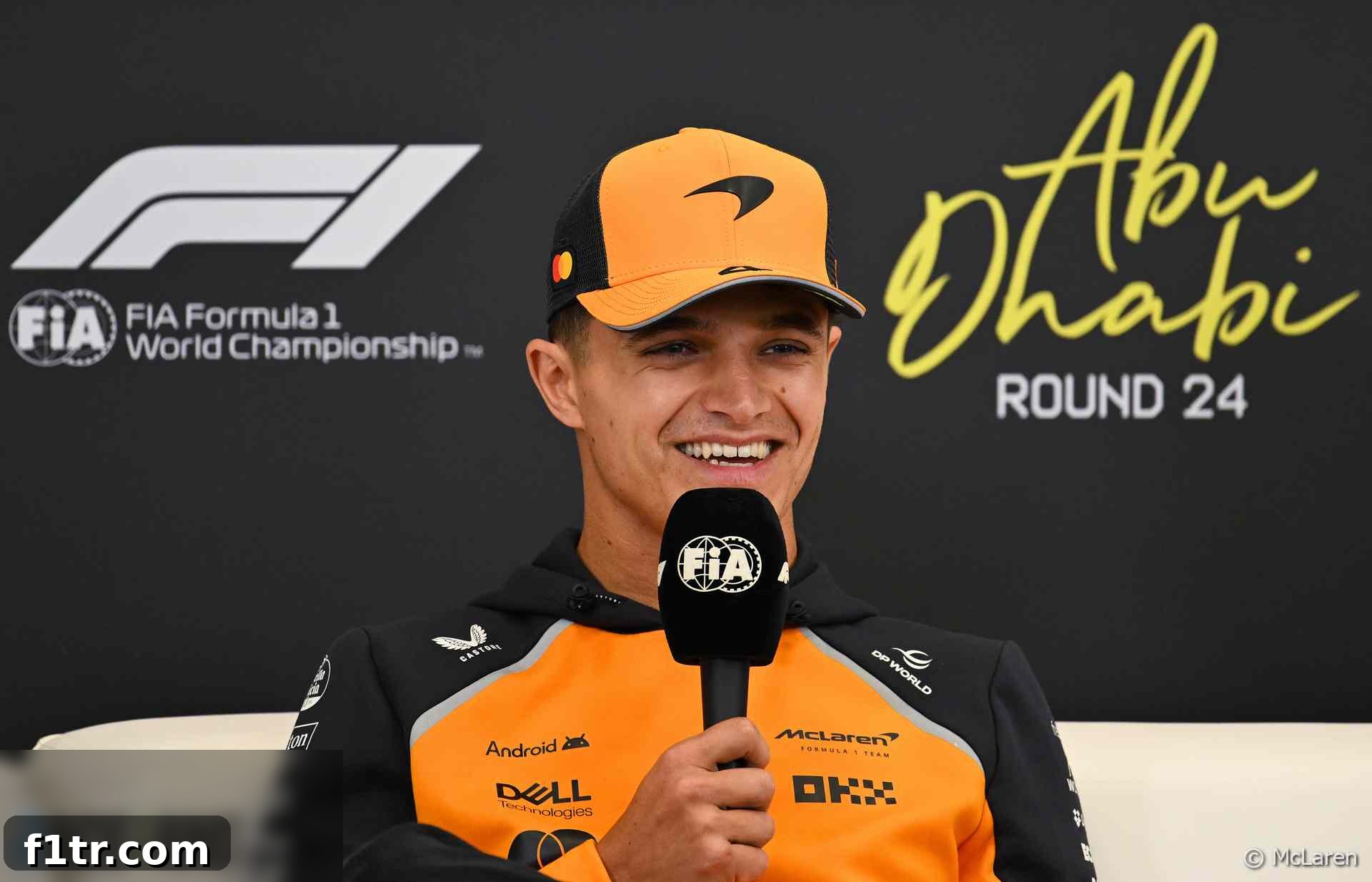
In the electrifying crucible of Formula 1, where every point is meticulously fought for, the climax of a World Championship season often thrusts teams into profound strategic and ethical dilemmas. As the 2025 Formula 1 World Championship hurtles towards its dramatic conclusion, all eyes are fixed on the McLaren camp, particularly on their star driver, Lando Norris. With Norris holding a slender lead in the drivers’ standings, the controversial prospect of team orders – a tactical maneuver as old as the sport itself – hangs heavy in the air. However, according to Norris himself, the Woking-based outfit has yet to broach the delicate subject of imposing such directives to secure his coveted maiden world title.
The championship battle is exquisitely poised, brimming with tension and potential permutations. Lando Norris, enjoying what has been his most competitive season to date, enters the final race with a crucial 12-point advantage over his fierce rival, Red Bull’s Max Verstappen. Adding another layer of complexity, Norris’s highly talented teammate, Oscar Piastri, remains within mathematical striking distance, trailing the championship leader by 16 points. For Norris, the path to glory is clear yet fraught with peril: a finish within the top three positions would decisively guarantee him the championship, rendering Verstappen’s performance largely inconsequential. Yet, the road to such an outcome is rarely straightforward in the unpredictable realm of Formula 1, especially when team dynamics and strategic interventions come into play.
Throughout the current season, McLaren has earned commendation for its unwavering commitment to fostering fair competition between its drivers. Their philosophy has been to allow Norris and Piastri to race unencumbered, believing that genuine competition brings out the best in both individuals and strengthens the team as a whole. This approach has undoubtedly been a cornerstone of their remarkable resurgence, positioning them as genuine championship contenders against the might of Red Bull. Nevertheless, the unparalleled pressure of a season-deciding Grand Prix can compel even the most principled teams to reconsider their established doctrines. McLaren could find itself in an unenviable position, where the only viable strategic avenue to thwart Verstappen’s charge and secure the championship for their team is to issue a direct order to Piastri, instructing him to cede his position to Norris. This hypothetical, yet highly plausible, scenario underscores the intricate and often uncomfortable balance between individual aspirations and the collective pursuit of glory.
When pressed on the sensitive topic, Lando Norris offered a thoughtful and somewhat conflicted perspective. He candidly admitted that while he would certainly be pleased to benefit from such a team decision, he would never be the one to initiate the request. This nuanced stance reveals the internal struggle many drivers face: the inherent desire to win at all costs, contrasted with a strong sense of sporting integrity and an awareness of the potential reputational and relational fallout within the team. His remarks suggest a profound respect for the competitive ethos of Formula 1 and a clear understanding of the broader implications that such a move might entail.
Lando Norris’s Perspective: A Champion’s Dilemma on Team Orders
The discourse surrounding team orders intensifies as the championship reaches its crescendo. “It’s not been discussed,” Norris asserted with a clear tone, directly addressing the swirling rumors and speculation that inevitably precede such a high-stakes event. His statement, delivered with a mix of honesty and perhaps a touch of underlying strategic awareness, provided a crucial insight into his mindset. “Honestly, I would love it, but I don’t think I would ask for it.” This sentiment perfectly encapsulates the modern Formula 1 driver’s intricate position. On one hand, the drivers’ world championship represents the pinnacle of their ambition, and any legitimate means to attain it, including strategic team plays, could be considered. On the other, the profound significance of winning purely on merit, the respect of fellow competitors, and the adoration of the global fanbase often weigh heavily on a driver’s conscience. Norris further elaborated on his thoughts, emphasizing that the ultimate decision regarding such a maneuver would primarily lie with his teammate: “It’s up to Oscar if he would allow it. I don’t think it’s necessarily down to me.” This careful articulation not only demonstrates Norris’s respect for Piastri’s autonomy but also, perhaps subtly, shifts a degree of the moral responsibility away from himself, should such a team order ultimately be implemented.
In a testament to his exemplary sportsmanship and commitment to team harmony, Norris promptly affirmed that he would extend the same courtesy to Oscar Piastri if their positions were reversed. “It’s the same if it’s the other way around: would I be willing to or not? Personally, I think I would, just because I feel like I’m always like that and that’s just how I am.” This reciprocal commitment is a vital ingredient for sustaining a positive and productive team environment, particularly in a sport where intra-team rivalries can often escalate into detrimental conflicts. Norris’s willingness to potentially sacrifice his own individual glory for the broader objective of the team, even when it might not directly benefit his championship aspirations, speaks volumes about his character, his long-term vision within McLaren, and his understanding of the collective effort required for sustained success.
Despite his openness to benefiting from team orders, Norris remains steadfast in his refusal to initiate such a request. “But it’s not really up to me. I’m not going to ask it, I don’t want to ask it because I don’t think it’s necessarily a fair question.” This resolute stance vividly illustrates the ethical complexities that underpin the concept of team orders. To explicitly ask a teammate to yield position can be perceived as an admission of a lack of decisive pace or an attempt to undermine the fundamental sporting values of fair competition. Furthermore, such a request places an immense psychological burden on the driver being asked to comply, potentially impacting their morale and future performance. For Lando Norris, the purity and authenticity of competition appear to hold significant intrinsic value, even if adhering to this principle carries the inherent risk of losing the ultimate prize.
Norris’s pragmatic and philosophical outlook extends beyond the immediate strategic dilemma to encompass the championship outcome itself. “At the same time, if that’s how it ends and Max wins then that’s it: congrats to him and I look forward to next year. It doesn’t change anything, doesn’t change my life, so he will deserve it over us.” This remarkably mature perspective, while possibly a calculated public statement, suggests a profound understanding of the championship journey. It implies an acceptance that titles are earned over an entire season, and if another driver demonstrates superior performance, they are ultimately the rightful recipient. This measured approach could serve as a valuable psychological shield against the intense pressure and emotional turmoil of a title decider, allowing him to concentrate primarily on his driving performance without the added weight of strategic manipulation or the burden of what-ifs.
Oscar Piastri’s Position: A Teammate’s Measured Response to Strategy
Oscar Piastri, the impressive young Australian talent, adopted a more cautious and circumspect approach when confronted with the complex question of team orders. “It’s not something we’ve discussed,” he echoed, mirroring Norris’s initial sentiment, indicating a synchronized team communication strategy or a genuine lack of pre-race discussion on the matter. “So I don’t really have an answer until I know what’s expected of me.” Piastri’s response is both professional and entirely understandable, particularly given his status as a relatively new, yet rapidly ascending, star within the team. As an integral part of McLaren’s long-term vision and future success, his loyalty to the team is paramount. Without explicit and unequivocal directives from the team principal or senior management, it would be strategically imprudent and potentially damaging for him to speculate or commit to a hypothetical scenario that carries such profound implications for his blossoming career and his crucial relationship with Norris.
Piastri’s situation is arguably even more delicate than that of his teammate. As a developing talent, the opportunity to demonstrate his raw speed, racecraft, and ability to compete at the very front of the grid is invaluable. Being asked to step aside, while potentially contributing to a team championship, could subtly undermine his individual standing, create an uncomfortable internal dynamic, or even affect his long-term perception within the sport. His primary focus, quite understandably, remains on extracting the maximum performance from his MCL38 and contributing to McLaren’s overall success through his driving prowess. His statement subtly conveys a willingness to follow team directives, but only once those directives are clearly communicated, justified, and deemed necessary by the team’s hierarchy. This pragmatic ‘wait and see’ approach is a testament to his innate professionalism, his sharp understanding of the intricate hierarchical structure within a Formula 1 racing operation, and his ability to compartmentalize personal ambition from team objectives.
The Ethical Tightrope: Team Orders in Formula 1 History
Team orders are by no means a novel concept in the annals of Formula 1; they represent a recurring ethical battleground that consistently pits the romantic ideals of pure sporting competition against the cold, hard pragmatism of strategic necessity. Historically, various instances have ignited fierce public debate and often led to significant changes in sporting regulations. One of the most infamous examples remains Ferrari’s notorious “Let Michael pass for the championship” instruction to Rubens Barrichello at the 2002 Austrian Grand Prix, a maneuver that sparked widespread condemnation from fans, media, and even governing bodies. This incident, among others, prompted a brief ban on explicit team orders, a ban that was later rescinded. The lifting of the ban tacitly acknowledged the fundamental right of a racing team to formulate and execute its own strategic vision, even if that vision involves influencing driver positions. Nevertheless, the lingering shadow of public disapproval and the potential for reputational damage to both the team and the drivers involved remain powerful deterrents.
For McLaren, a team steeped in a rich heritage of championship triumphs and renowned for its steadfast emphasis on sporting integrity, the decision to impose team orders would undoubtedly be one of the most agonizing and weighty calls in recent memory. The public perception and moral implications of such a move, particularly in a season where they have consistently championed and embodied the spirit of fair racing, would be meticulously weighed. On one hand, securing a drivers’ world championship is the ultimate pinnacle of achievement, a tangible and invaluable reward for years of substantial investment, relentless innovation, and countless hours of dedicated effort. A championship title brings immense prestige, enhances commercial appeal, attracts lucrative sponsorships, and indelibly etches the team’s name into the sport’s illustrious history. On the other hand, a championship attained through the explicit deployment of team orders, particularly if it necessitates the direct sacrifice of one driver’s potential for another, risks leaving a sour taste of unfairness, not only for the passionate fanbase but potentially for the driver who was compelled to yield.
The core of this enduring ethical debate revolves around the fundamental question: Is Formula 1 primarily a team sport, where individual drivers are merely components of a larger machine working towards a collective goal, or is it a gladiatorial contest between individuals, albeit operating within a team structure? Teams universally argue that they invest hundreds of millions of dollars and that drivers are highly compensated employees whose primary mandate is to serve the team’s overarching best interests. Critics, conversely, contend that fans are drawn to F1 to witness unadulterated, unscripted competition, and that strategic interference diminishes the purity and excitement of the spectacle. McLaren’s formidable challenge is to navigate this intricate moral and strategic minefield, making a decision that maximally enhances their chances of championship glory while simultaneously striving to uphold their deeply ingrained values and maintain their esteemed public image.
The “Realistic Scenario”: When and How McLaren Might Intervene
The insightful analysis alluded to in the accompanying figure caption speaks to “the realistic scenario where McLaren could order Piastri to help Norris win the title.” This scenario is almost certainly contingent upon a very specific and unfolding set of circumstances during the frantic pace of the final Grand Prix. Envision a situation where Max Verstappen is performing exceptionally well, perhaps leading the race or locked in a direct battle for the top positions, thereby placing Norris’s championship aspirations in imminent jeopardy. Concurrently, Oscar Piastri might find himself strategically positioned ahead of Lando Norris on track, but critically, not in a position to genuinely challenge for the race victory himself or significantly threaten Verstappen’s championship relevant points haul. In such a high-pressure predicament, with only a handful of laps remaining and the championship potentially slipping from their grasp, McLaren’s strategic command center would face an agonizing and immense imperative to act decisively.
The communication of such an order would be absolutely paramount, requiring utmost clarity, precision, and immediacy: a definitive instruction to Piastri to allow Norris to pass. This is not merely about an arbitrary driver swap; it is a meticulously calculated move designed to optimize the team’s overall championship prospects against an incredibly formidable competitor. For instance, if Piastri is running in second place and Norris in third, while Verstappen leads the race, instructing Piastri to yield to Norris would elevate Norris to second position, potentially securing the exact number of points required to clinch the world title. The precise timing of the call, the exact wording used by the race engineer, and Piastri’s immediate and flawless compliance would be absolutely critical for the success of such a high-stakes maneuver. Any hesitation, delay, or miscommunication could prove catastrophically costly, potentially resulting in the loss of the championship or even incurring penalties from the race stewards.
The burden of making such a monumental decision would weigh heavily on key McLaren personnel, including Team Principal Andrea Stella and CEO Zak Brown. They would be obligated to justify the decision internally to Piastri and his dedicated crew, and externally to a global audience of media and fervent fans. The “realistic scenario” extends far beyond the mere mechanics of a position swap; it encompasses the entire complex ecosystem of justifications, the immediate and long-term consequences, and the delicate emotional management that would inevitably follow. It represents an ultimate moment of truth for McLaren, a profound test of their strategic resolve, their ethical framework, and their collective acumen under the most intense and unforgiving sporting pressure imaginable.
Beyond the Checkered Flag: Long-Term Implications for McLaren’s Future
Regardless of whether McLaren ultimately resorts to team orders or chooses to uphold its policy of fair racing, the outcome of this pivotal championship decider will undoubtedly cast a long shadow, shaping the team’s trajectory and internal dynamics for years to come. Should Lando Norris secure his maiden world title, whether through direct assistance from Piastri or by sheer unadulterated competitive prowess, it would unequivocally validate McLaren’s remarkable resurgence in Formula 1 and emphatically underscore the immense talent they have meticulously nurtured within their driver lineup. It would elevate Norris to an elite, championship-winning status, heralding what could be a new golden era for the venerable Woking-based racing outfit.
However, the manner in which the championship is won could leave distinctly different legacies. A victory achieved through open, uninhibited competition would be universally lauded and celebrated without reservation. Conversely, a championship secured with the overt aid of team orders, while undeniably a title, might carry a subtle asterisk in the minds of some observers, and more importantly, could profoundly impact the internal relationship between Norris and Piastri. While both drivers currently articulate mutual respect and a sincere willingness to support the team’s objectives, such an event has the potential to test even the strongest professional bonds. Maintaining harmony, ensuring that both drivers feel equally valued, and consistently providing equitable support will be paramount for McLaren’s continued success and stability in the seasons that lie ahead.
Should Max Verstappen, the formidable defending champion, emerge victorious despite McLaren’s fervent efforts, Norris’s publicly articulated philosophical acceptance would face its ultimate test. The team would then be compelled to regroup, meticulously analyze any areas where improvements could have been made, and rigorously refocus their collective efforts for the subsequent season. The narrative would inevitably shift from “almost” to “next year,” and the inherent pressure to finally deliver a world championship would only intensify, demanding even greater resolve and performance from every member of the McLaren team.
In essence, the 2025 Formula 1 World Championship decider transcends the scope of a mere racing event; it represents a profound crucible for McLaren Racing. It will rigorously test the resilience of their drivers, the strategic acumen of their leadership, and the very core of their ethical compass. Whether they ultimately cross the finish line with a coveted championship trophy in hand, and critically, how they ultimately achieve that triumph, will undoubtedly constitute a defining moment in their illustrious and storied history, with its reverberations echoing throughout the Formula 1 paddock and beyond for many seasons to come. The entire world of motorsport awaits with bated breath to witness whether McLaren will hold steadfast to its cherished principles of fair play or, under the immense weight of championship pressure, make a pragmatic decision in its relentless pursuit of ultimate glory.