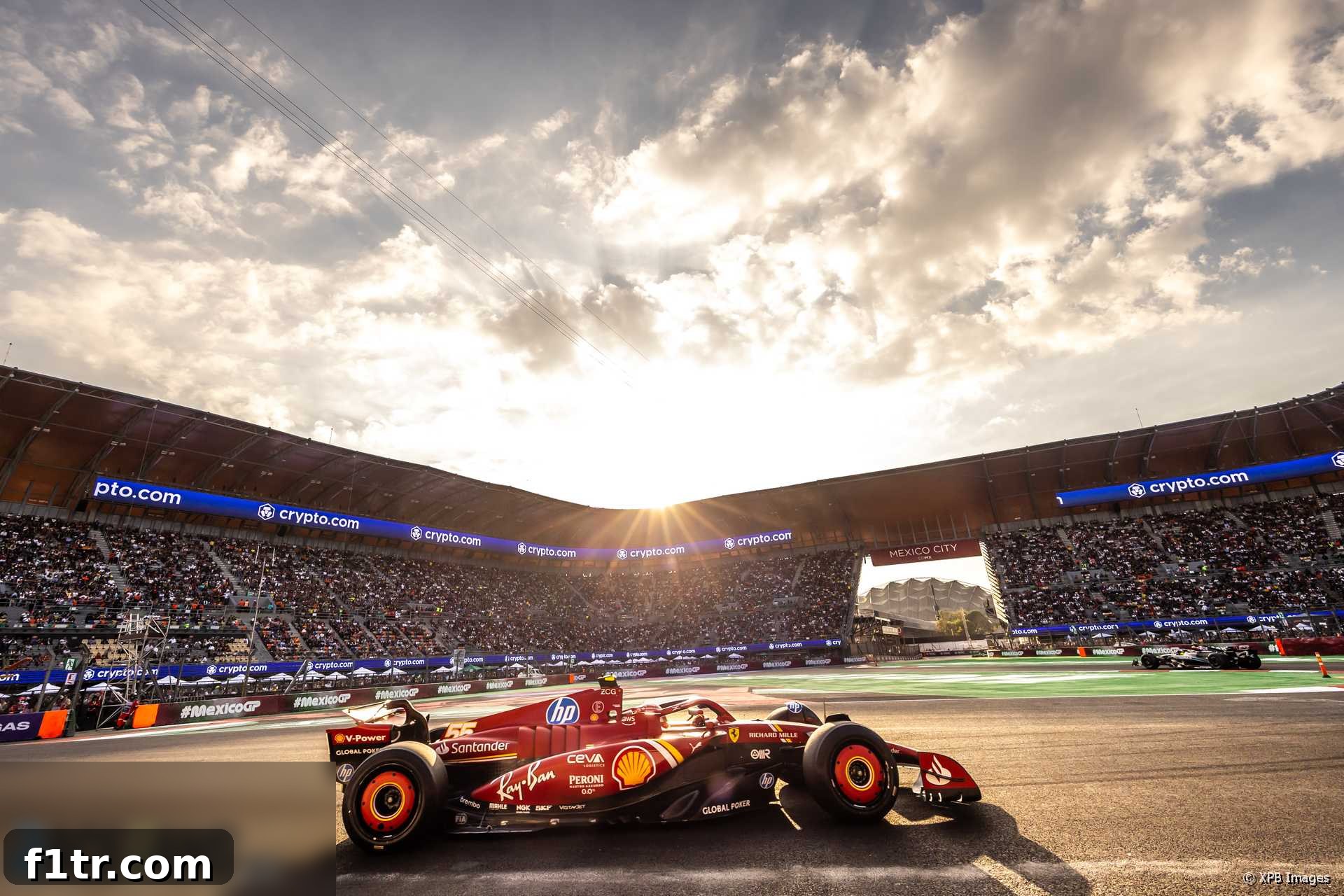
As the Formula 1 season enters its crucial final stages, all eyes turn to the vibrant and challenging Autodromo Hermanos Rodriguez for the Mexican Grand Prix. This weekend promises to be a pivotal event, not just for the drivers vying for championship glory, but also for teams navigating complex tyre strategies and bringing crucial car upgrades. With the thin air of Mexico City presenting unique demands on both machinery and driver skill, every decision, from tyre compound selection to rookie driver performance in practice, could significantly sway the outcome of the race and the increasingly tight title fight.
Following a somewhat uninspiring race last weekend, Formula 1’s official tyre supplier, Pirelli, finds itself under scrutiny. Their attempt to inject more strategic variation into the United States Grand Prix by introducing a significantly harder compound proved largely ineffective. Most teams and drivers opted to avoid the hard tyre, sticking instead to the softer options and meticulously managing their degradation – a scenario that rarely leads to thrilling on-track battles. The question now looms large: will a similar approach by Pirelli in Mexico yield a different, more exciting result?
The Pirelli Tyre Conundrum: Seeking Race Excitement Amidst High Altitude
Pirelli’s intention to create more varied strategies and prevent single-stop races is commendable, but its execution in Austin fell short of expectations. The hard compound was deemed too difficult to switch on and too slow for competitive running, forcing many drivers into a one-stop strategy on medium or soft tyres, prioritizing conservation over aggression. This led to George Russell, among others, expressing his frustration, famously labelling the US Grand Prix a “race to turn one,” highlighting the lack of subsequent on-track action. While his team benefited from a similar situation in Singapore, the sentiment around a processional race remained.
For the Mexican Grand Prix, Pirelli has once again adjusted its compound selection, offering a range that is one step softer across the board compared to Austin. However, the ‘hard’ tyre available this weekend remains a notably robust choice. Unlike the previous two races which featured sprint formats and limited practice, Mexico offers a conventional Grand Prix weekend with three full practice sessions. This provides teams with ample opportunity to gather data, understand the tyre characteristics, and refine their strategies. Whether this extra preparation time will be sufficient to unlock the potential of the harder compounds and encourage more aggressive racing remains a key talking point. The Autodromo Hermanos Rodriguez is notoriously demanding on tyres due to its extremely high altitude, which makes cooling notoriously difficult and often transforms the event into a meticulous exercise in tyre management.
The thin air at over 2,200 meters above sea level significantly reduces aerodynamic downforce, forcing teams to run maximum wing settings just to achieve comparable grip levels to lower-altitude tracks. This also means engines work harder to generate power, leading to higher temperatures for all components, especially tyres. Consequently, overheating and degradation are constant threats, traditionally pushing teams towards conservative strategies. Pirelli’s goal is to counteract this tendency, but the inherent challenges of the circuit suggest that tyre management will likely remain a dominant theme, regardless of the compounds available. A true test of strategic prowess and driver skill lies ahead.
The Championship Crucible: Pressure Mounts on Oscar Piastri
Oscar Piastri’s championship lead, once seemingly robust after his victory following the summer break in August, has been steadily eroded by the relentless charge of Lando Norris and Max Verstappen. Having topped the standings for an impressive 26 weeks, Piastri now finds himself under immense pressure. The gap to Norris has shrunk from 34 points to a mere 14, while Verstappen, who was a distant 104 points behind, is now just 40 points adrift. This dramatic shift in momentum has naturally drawn comparisons to Lewis Hamilton’s agonizing 2007 title defeat, where a seemingly comfortable lead evaporated in the final races. The psychological toll of such a championship battle can be immense, and Piastri needs to demonstrate resilience and exceptional performance to reverse this trend.
To stem the tide, Piastri must quickly regain his winning form. The immediate priority will be to fully understand and optimize his McLaren MCL39 at a circuit where the team has not tasted victory since its return to the calendar in 2015. McLaren’s last win in Mexico dates back to 1989, courtesy of the legendary Ayrton Senna, on an almost entirely different circuit configuration, highlighting the historical challenge this venue presents for the Woking-based outfit. Modern F1 circuits are constantly evolving, with layouts and infrastructure vastly different from their predecessors, making historical performance less directly comparable but still a psychological hurdle. Piastri’s advantage this weekend is that, unlike his two closest championship rivals, he will participate in all three practice sessions. This extra track time could prove invaluable for dialing in the car setup, understanding tyre behavior, and building confidence, potentially giving him the edge he desperately needs.
Gateway to the Grid: The High Stakes of Rookie FP1 Sessions
The Mexican Grand Prix Free Practice 1 session will see a number of regular F1 drivers, including championship contenders Max Verstappen and Lando Norris, sit out as teams fulfill their mandated quota of running inexperienced drivers. This FIA regulation requires teams to allocate a minimum number of free practice sessions to drivers who have participated in no more than two F1 Grand Prix races. It serves as a vital pathway for young talent to gain crucial F1 experience and for teams to evaluate their academy prospects.
However, the stakes are exceptionally high for these rookie drivers, especially those stepping into cars belonging to championship protagonists. Arvid Lindblad will take the wheel of Verstappen’s Red Bull, while local hero Pato O’Ward will replace Norris in the McLaren. Both young drivers will be under immense scrutiny, not just for their pace but, more crucially, for their ability to bring the car back safely. In the midst of a tightening title fight, damaging a chassis could have severe implications for a team’s championship aspirations, potentially impacting parts allocation, budget, and morale. This is a moment for precision and measured performance, not heroics.
The potential for such a scenario is not theoretical; it played out exactly one year ago at this very race. Oliver Bearman, then a practice driver for Ferrari, was involved in a collision with Alexander Albon while driving Charles Leclerc’s car. Such incidents underscore the delicate balance between giving young drivers experience and protecting championship machinery. Alongside Verstappen and Norris, Carlos Sainz Jnr will also step aside for FP1, as will George Russell, Pierre Gasly, and Esteban Ocon, with Lewis Hamilton and Liam Lawson also expected to miss out. This means many established drivers will have less track time to adapt to the unique Mexican conditions, potentially adding another layer of unpredictability to the weekend.
Team Discipline and Development: Alpine and Haas’s Crucial Juncture
Team orders have always been a contentious but essential aspect of Formula 1. Alpine’s recent decision to issue instructions to their drivers regarding the fight for a seemingly insignificant 17th place might have appeared petty to outsiders, but it underscores the team’s unwavering commitment to discipline and protocol. Franco Colapinto, who reportedly disobeyed an instruction, has received a clear message: “The team situation on Sunday has been discussed internally and it is clear that instructions by the team must always be followed no matter what,” he stated in an official team release. This serves as a stark reminder of the hierarchical nature of F1 and the importance of cohesion within a team. Colapinto also faces intense pressure from within the Alpine junior program, as his rival for a potential 2026 seat, Paul Aron, will be in Pierre Gasly’s car during FP1, setting up a fascinating direct comparison between the two aspiring talents.
Meanwhile, Haas, typically not a team associated with late-season development pushes, bucked the trend by introducing significant upgrades for their home race in Austin. This strategic investment paid off handsomely, with Oliver Bearman delivering valuable points in the upgraded VF-25. His performance was particularly impressive given that he only fitted the new parts for sprint race qualifying, having missed the first practice session with them. This success highlights the effectiveness of their development program and the benefits of continuous improvement.
The question of whether this marks the end of teams’ development work for their 2025 cars is pertinent. Laurent Mekies, Red Bull team principal, hinted to Max Verstappen after Singapore that more upgrades were in the pipeline. While nothing new was introduced in Austin, this non-sprint weekend in Mexico provides an ideal opportunity for Red Bull to roll out further enhancements, potentially giving Verstappen an additional boost in his bid for a fifth world title. The delicate balance between focusing on the current season and diverting resources to next year’s car is a constant challenge for all F1 teams, making Haas’s and Red Bull’s decisions particularly insightful.
The Autodromo Hermanos Rodriguez: A Unique F1 Challenge
The Autodromo Hermanos Rodriguez stands out on the Formula 1 calendar primarily due to its extreme altitude. Situated over 2,200 meters above sea level, the circuit presents a unique set of engineering and driving challenges. The thinner air significantly reduces the amount of oxygen available for the engines, leading to a considerable drop in power output. To compensate, teams often run maximum cooling configurations and push their power units to their limits, making reliability a major concern.
Aerodynamically, the thin air means less downforce is generated at any given wing angle. To achieve sufficient grip through the corners, teams are forced to run extremely high-downforce setups, sometimes even beyond what would be used at high-downforce tracks like Monaco. This creates a fascinating paradox where cars appear to have massive wings but still slide around, demanding exceptional car control from the drivers. The cooling of brakes and tyres also becomes critical, as the less dense air is less efficient at dissipating heat. All these factors combine to make the Mexican Grand Prix a grueling test of strategy, engineering, and driver endurance, where meticulous planning and flawless execution are paramount for success.
Join the Conversation: Your Mexican Grand Prix Experience
Are you one of the lucky fans heading to Mexico City for this weekend’s thrilling Grand Prix? We want to hear about your experiences, expectations, and unique insights from the circuit! Share your thoughts and connect with fellow enthusiasts on our dedicated forum:
- Forum: Going to the Mexican Grand Prix at Autodromo Hermanos Rodriguez
Who do you believe will emerge victorious in the 2025 Mexican Grand Prix, and which team holds the advantage this weekend? Have your say and join the discussion below!
Never Miss a Moment: Subscribe to RaceFans Updates
Receive our latest stories directly in your inbox daily – no marketing, no ads. Sign up below:
More from the 2025 Mexican Grand Prix
- F1 fans shocked as ferry company screens “adult film” by mistake
- Russell: Lack of penalties over corner-cutting was ‘especially unfair for Lewis’
- Williams aim to give Albon more “consistent” car after consecutive Q1 exits
- Lawson “not at fault” for marshal incident says FIA following criticism from Mexico’s OMDAI
- Stats: Norris takes F1’s biggest win for two years as Ferrari go win-less for 12 months
Browse all 2025 Mexican Grand Prix articles