Formula 1 is a sport defined by razor-thin margins, where every tenth of a second and every aerodynamic surface can dictate the outcome of a race. In the high-stakes environment of Grand Prix racing, even the slightest contact can have profound consequences, turning a dominant performance into a desperate struggle. Such was the case in a memorable race where Lewis Hamilton, a titan of the sport, endured a significant challenge after a first-lap collision with fierce rival Max Verstappen. Mercedes-AMG Petronas Motorsport, Hamilton’s team, later revealed that the damage sustained in that early encounter cost him a staggering seven seconds over the course of the race distance, a testament to both the precision engineering of F1 cars and the unparalleled skill of the seven-time world champion.
The incident occurred as Hamilton and Verstappen battled intensely during the opening lap, a common occurrence between the two celebrated drivers. Approaching turn two, their cars made contact, an event that, while seemingly minor at high speed, inflicted considerable damage to Hamilton’s W10 challenger. While the immediate focus might have been on the thrilling wheel-to-wheel action, the repercussions were silently unfolding beneath the car’s sculpted bodywork. This often-unseen impact on vehicle performance highlights the intricate relationship between a car’s design, driver control, and the unforgiving nature of top-tier motorsport.
Advert | Become a Supporter & go ad-free
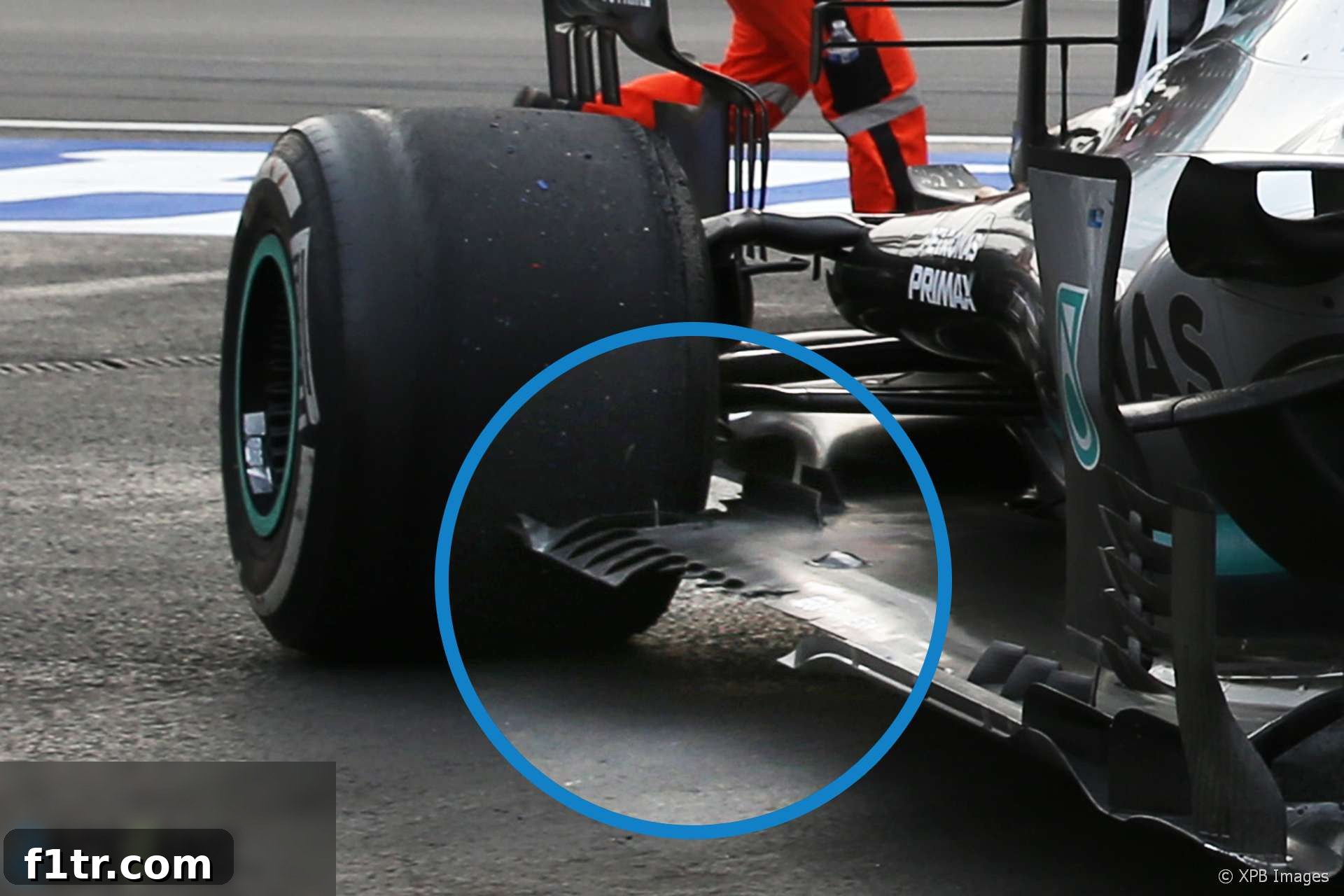
Mercedes’ technical director, James Allison, shed light on the extent of the damage in a detailed team video, offering a rare glimpse into the sophisticated analysis conducted behind the scenes. Allison explained, “When Lewis and Verstappen tangled at the start there was actually a reasonable amount of damage to Lewis’s car in the subsequent collision.” He invited viewers to scrutinize the race footage, where a keen eye might catch “a strip of bodywork flying up past the camera.” This fleeting visual was, in fact, a crucial piece of Hamilton’s car—specifically, a section of the floor that Mercedes refers to as a ‘wouvre panel’—disappearing into the air. This panel, vital for managing airflow beneath the car, suffered significant loss, directly impacting the vehicle’s aerodynamic efficiency.
The ‘wouvre panel’ is an integral component of the car’s floor, designed to meticulously guide airflow around the vehicle and generate essential downforce. Modern Formula 1 cars rely heavily on aerodynamics, with every curve, flap, and panel engineered to extract maximum performance. The floor, in particular, is a masterpiece of aerodynamic design, creating the majority of the car’s downforce through a phenomenon known as ground effect. When a piece of this sophisticated structure is compromised, the delicate balance of airflow is disrupted, leading to a measurable loss in grip and stability.
Beyond the ‘wouvre panel’, the front wing endplate also sustained minor damage. While seemingly small, these two combined issues delivered a significant blow to the car’s overall aerodynamic performance. Allison meticulously quantified the impact: “These two things combined to give Lewis a loss of aerodynamic downforce equivalent to about 0.1 of a second per lap.” In a sport where races are often decided by milliseconds, a tenth of a second per lap is an enormous handicap. For context, over a typical 70-lap Grand Prix, this seemingly minor fraction accumulates to a monumental deficit. “It might not sound a lot but if you remember that the race is 70 laps long, then over the course of that entire race, that’s worth about seven seconds,” Allison emphasized.
This seven-second penalty, incurred purely from the damage, casts Hamilton’s subsequent performance in an even more extraordinary light. To put this into perspective, Hamilton ultimately crossed the finish line less than two seconds ahead of his closest competitor, Sebastian Vettel. This narrow margin of victory underscores just how critical those lost seven seconds were. Had Hamilton not possessed the exceptional skill to mitigate the damage through sheer driving prowess and strategic adaptability, the outcome of the race could have been drastically different. It highlights the fine line between victory and defeat in Formula 1, where every detail, from car setup to driver execution, plays a pivotal role.
During the heat of the battle, Hamilton himself, ever attuned to the nuances of his machine, radioed his team to inquire about potential damage following the contact with Verstappen. Initially, the information relayed back to him was that the contact had been largely “wheel-to-wheel,” suggesting no significant issues that would impede his progress. This initial assessment, though understandable in the chaos of a first lap, meant Hamilton was driving on instinct and feel, pushing a compromised car to its limits without full knowledge of its reduced capabilities. His ability to maintain a blistering pace and execute flawless maneuvers under such circumstances speaks volumes about his racing intelligence and instinct.
Despite carrying this significant aerodynamic burden, Hamilton executed a flawless race. He not only managed to maintain his position but also masterfully navigated the challenges of a damaged car to pass Sebastian Vettel and secure the lead, which he held until the checkered flag. This performance was a true demonstration of his unmatched talent and mental fortitude. Allison aptly summarized the extraordinary effort: “It adds emphasis to the fact this was a very fine, very controlled drive that Lewis put in on Sunday, able to stay ahead of the Ferrari, showing good pace and good consistency despite carrying that damage throughout.” It wasn’t just about raw speed; it was about precision, tire management, adapting braking points, and fine-tuning steering inputs to compensate for the compromised aerodynamics.
The incident also provides valuable insights into the intense pressure faced by F1 teams. While the immediate focus is on the race, engineers in the garage and back at the factory are constantly analyzing telemetry, assessing car health, and strategizing how to overcome unforeseen challenges. For Mercedes, understanding the exact nature and impact of the damage allowed them to support Hamilton with the best possible information, even if it wasn’t immediately apparent to the driver or spectators. This collaboration between driver and team is a cornerstone of success in Formula 1, turning potential disaster into a triumphant victory. Hamilton’s triumph, despite the setback, further cemented his reputation as one of the greatest drivers to grace the sport, capable of extracting maximum performance from any situation.
Advert | Become a RaceFans supporter andgo ad-free
2019 F1 season
- Crying in the Melbourne car park at 2019 grand prix was my career low – Ocon
- McLaren Racing reports reduced £71 million loss in 2019
- Kvyat: Hockenheim podium last year was “my biggest achievement” so far
- How the FIA’s new encrypted fuel flow meter targets Ferrari’s new encrypted fuel flow meter targets Ferrari’s suspected ‘aliasing’ trick
- “He smashed my office door”: 23 must-see moments from ‘Drive to Survive’ season two
Browse all 2019 F1 season articles