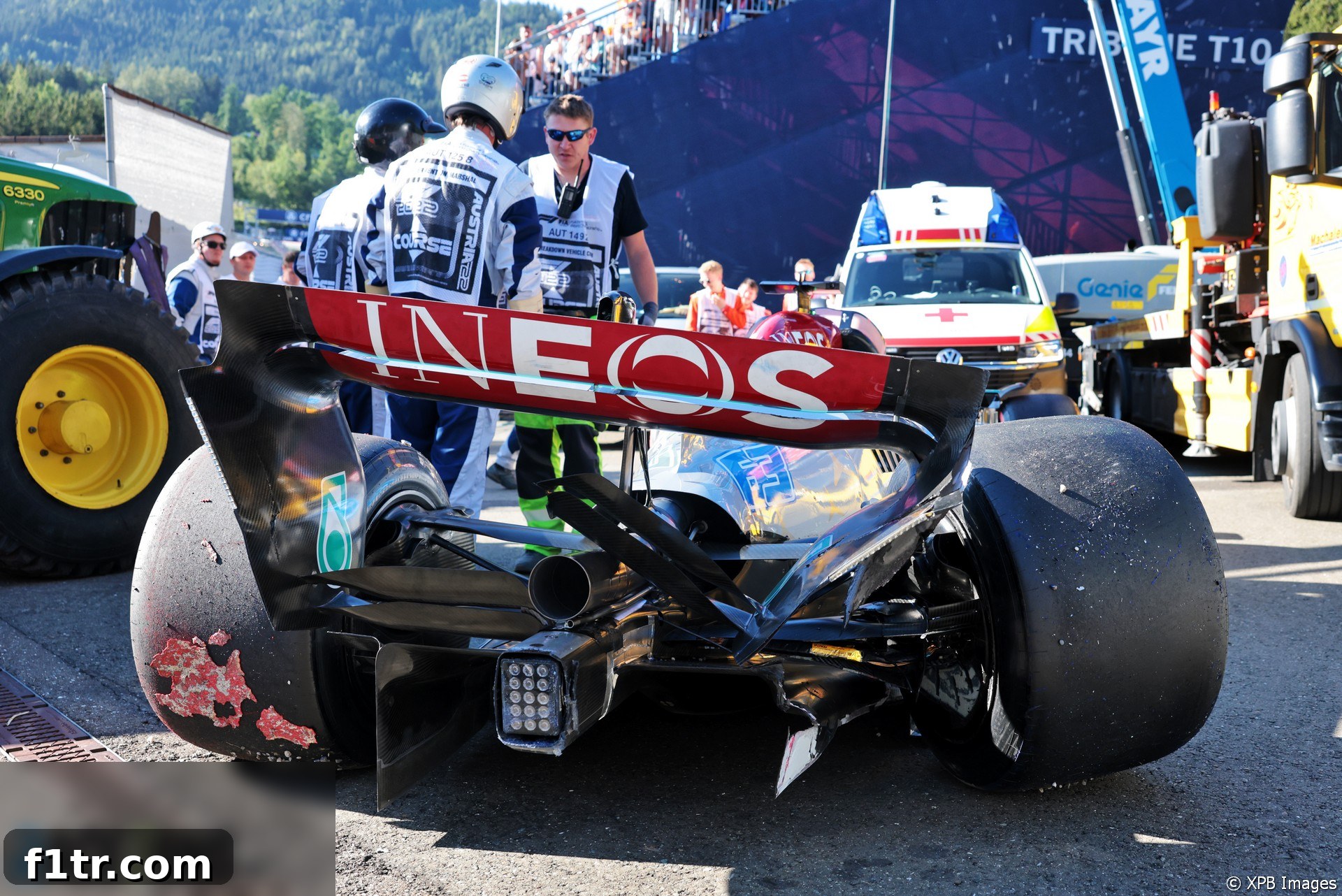
The exhilarating and often unforgiving world of Formula 1 consistently tests the limits of machinery, engineering, and human endurance. At the 2022 Austrian Grand Prix, the Mercedes-AMG Petronas Formula 1 Team found themselves in an unenviable position after both their star drivers, Lewis Hamilton and George Russell, suffered high-speed crashes during the crucial Q3 session of qualifying. This double incident at Spielberg not only set the stage for a dramatic race weekend but also triggered a logistical nightmare for the Silver Arrows, culminating in a critical decision regarding their sole remaining new-specification rear wing. Despite qualifying five places behind his teammate, Lewis Hamilton was ultimately allocated this vital component, a strategic choice that Mercedes technical director Mike Elliott has since meticulously explained, shedding light on the intricate balance of performance, damage assessment, and race strategy under immense pressure.
The Double Crash: High Drama in Austrian Qualifying
The Red Bull Ring, with its challenging high-speed corners and undulating terrain, demands absolute precision and commitment from drivers. During the intense Q3 session of the 2022 Austrian Grand Prix, both Lewis Hamilton and George Russell pushed the limits of their W13 cars, unfortunately beyond the point of no return. Hamilton was the first to hit the barriers, losing control at Turn 7, followed shortly after by Russell, who crashed at Turn 10. These separate but equally impactful incidents left the Mercedes garage facing an immediate and daunting task: repairing two severely damaged cars in a compressed timeframe, with limited resources.
The sight of both Mercedes cars in the barriers sent shockwaves through the paddock and highlighted the brutal reality of Formula 1’s razor-edge competition. For the team, the immediate aftermath was a frantic assessment of the damage and a race against the clock to prepare the cars for the upcoming Sprint race and Sunday’s Grand Prix. The scale of the challenge was immense, turning a routine qualifying session into a monumental test of the team’s engineering prowess and logistical capability.
Unpacking the Damage: A Major Rebuild Under Pressure
Mike Elliott, Mercedes’ technical director, provided a sobering account of the extensive damage sustained by both vehicles. “When you crash two cars it’s always going to make for a very difficult weekend from then onwards,” Elliott stated, underscoring the severity of the situation. Both cars suffered significant damage, including broken floors and rear wings. Additionally, a considerable amount of suspension components were compromised on both W13s. However, Hamilton’s car bore the brunt of the impact, sustaining damage to the front wing and “cosmetic damage to the chassis,” which, while not structural, still necessitated a complete rebuild.
The unique challenge posed by the damaged floors further compounded Mercedes’ problems. With only one complete spare floor available, the team was forced to salvage the best components from the two crashed floors to construct a second usable one. This intricate process of combining parts from damaged units to create a functional component speaks volumes about the team’s resourcefulness and the scarcity of spare parts, especially under the constraints of modern F1 budget caps. The sheer volume of repairs meant that Lewis Hamilton’s car, in particular, required a comprehensive “rebuilding from scratch” operation, a testament to the mechanics’ skill and dedication.
The Crucial Rear Wing Conundrum: A Strategic Masterstroke
One of the most critical decisions Mercedes faced involved the allocation of their rear wings. Both new-specification rear wings, designed for lower downforce and improved straight-line speed, were damaged in the crashes. The team could only salvage and rebuild one of these. The alternative was an older specification rear wing, which provided higher downforce but potentially compromised top-end speed, making overtaking more challenging on a circuit like Spielberg.
The decision ultimately favored Lewis Hamilton for the new-spec, lower-downforce rear wing, despite his lower starting position for the Sprint race compared to George Russell. Mike Elliott explained the rationale: “That we chose to fit to Lewis’s car because he was going to have to come through the field.” Hamilton, starting further back, would need every possible advantage to overtake rivals, and the new-spec wing was deemed more suitable for this purpose, aiding in straight-line speed and minimizing drag. Conversely, George Russell, having qualified five places ahead of Hamilton, was less reliant on a wing optimized purely for overtaking. He was given the older, higher-downforce wing, which, while providing better grip in corners, was “probably not the ideal level of downforce” for the Spielberg circuit, representing a clear performance compromise for Russell.
This calculated strategy highlights the complex interplay between driver starting position, circuit characteristics, and available parts. Mercedes opted to optimize Hamilton’s potential for progression through the field, while acknowledging the compromise imposed on Russell. It was a pragmatic decision born out of necessity, showcasing the strategic thinking required to navigate such unforeseen challenges in Formula 1.
Against the Clock: Hamilton’s Car Reborn in Record Time
The rebuild of Lewis Hamilton’s car was an extraordinary feat of engineering and teamwork. With extensive damage, including the “cosmetic damage to the chassis” that couldn’t be fixed on-site, the entire car had to be stripped down and reassembled. This involved fitting the engine, gearbox, all suspension components, and every other system that bolts onto the chassis.
The Mercedes mechanics, working tirelessly, accomplished this monumental task in an astonishing three-and-a-half hours on Saturday morning, just ahead of the second free practice session (FP2). “The mechanics managed to do that in three-and-a-half hours on Saturday morning which is an amazing achievement and all credit to them for actually getting us back out and into FP2,” Elliott praised. This incredible turnaround underscored the unparalleled dedication and skill of Formula 1 pit crews and engineering teams, who often operate under extreme time pressure with perfection as the only acceptable standard.
Despite this heroic effort, the rushed rebuild had a downstream effect. With Hamilton’s car essentially brand new, the team had very limited time in FP2 to re-dial in the setup. This meant less opportunity for fine-tuning and optimization, adding another layer of compromise to an already challenging weekend. Russell, fortunately, was able to resume running earlier, giving him a slight advantage in terms of track time and setup refinement.
The Precarious Spare Parts Situation: Racing on a Knife Edge
The severity of the double crash and the subsequent repair work left Mercedes in a perilous position concerning spare parts. Mike Elliott revealed the critical shortage: “Having damaged two cars as badly as we did on Friday the drivers [were] now in a position where if we damage them in the sprint race we may well be in a position where we couldn’t race on Sunday.”
This stark reality meant that both Hamilton and Russell had to approach the Sprint race with an amplified level of caution. The risk of another incident, even a minor one, could have effectively ended their Austrian Grand Prix weekend before the main event. This precarious situation forced the drivers to balance the competitive imperative of a sprint race with the critical need to preserve their cars, influencing their driving style and race strategy. Such part shortages are an increasingly prevalent concern in Formula 1, exacerbated by stringent budget caps that limit teams’ ability to stockpile extensive reserves of components. The Austrian Grand Prix served as a vivid reminder of how quickly a team’s resources can be depleted, transforming a championship battle into a logistical survival test.
Mercedes’ Resilience and the Pursuit of Excellence
Despite the immense challenges and compromises faced at the 2022 Austrian Grand Prix, the Mercedes team showcased remarkable resilience and professionalism. From the immediate aftermath of the Q3 crashes to the strategic allocation of parts and the heroic rebuild efforts, every member of the team played a crucial role in ensuring both cars were on the grid for the Sprint and the Grand Prix. The strategic decision to give Hamilton the new-spec rear wing was a testament to the team’s adaptability and commitment to maximizing their drivers’ potential under adverse circumstances.
While the weekend was undoubtedly a test of nerves and resources, it also highlighted the core strengths of the Mercedes-AMG Petronas F1 Team: exceptional engineering talent, unparalleled mechanical skill, and a strategic acumen that allows them to make tough calls when it matters most. These challenges are an inherent part of Formula 1, continually pushing teams to innovate, adapt, and perform at the absolute pinnacle of motorsport. The Austrian Grand Prix stands as a powerful reminder that even in adversity, the pursuit of excellence never ceases.
2022 Austrian Grand Prix
- FIA affirms three sprint races on 2023 Formula 1 calendar
- “Oh, so unlucky!” How Alonso’s cursed Austrian Grand Prix unfolded on his radio
- Ferrari believe their performance deficit to Red Bull is now “negligible”
- Another fan’s experience of harassment last weekend – and why F1 must act
- AlphaTauri “desperately” need upgrades after “disaster” weekend, urges Gasly
Browse all 2022 Austrian Grand Prix articles