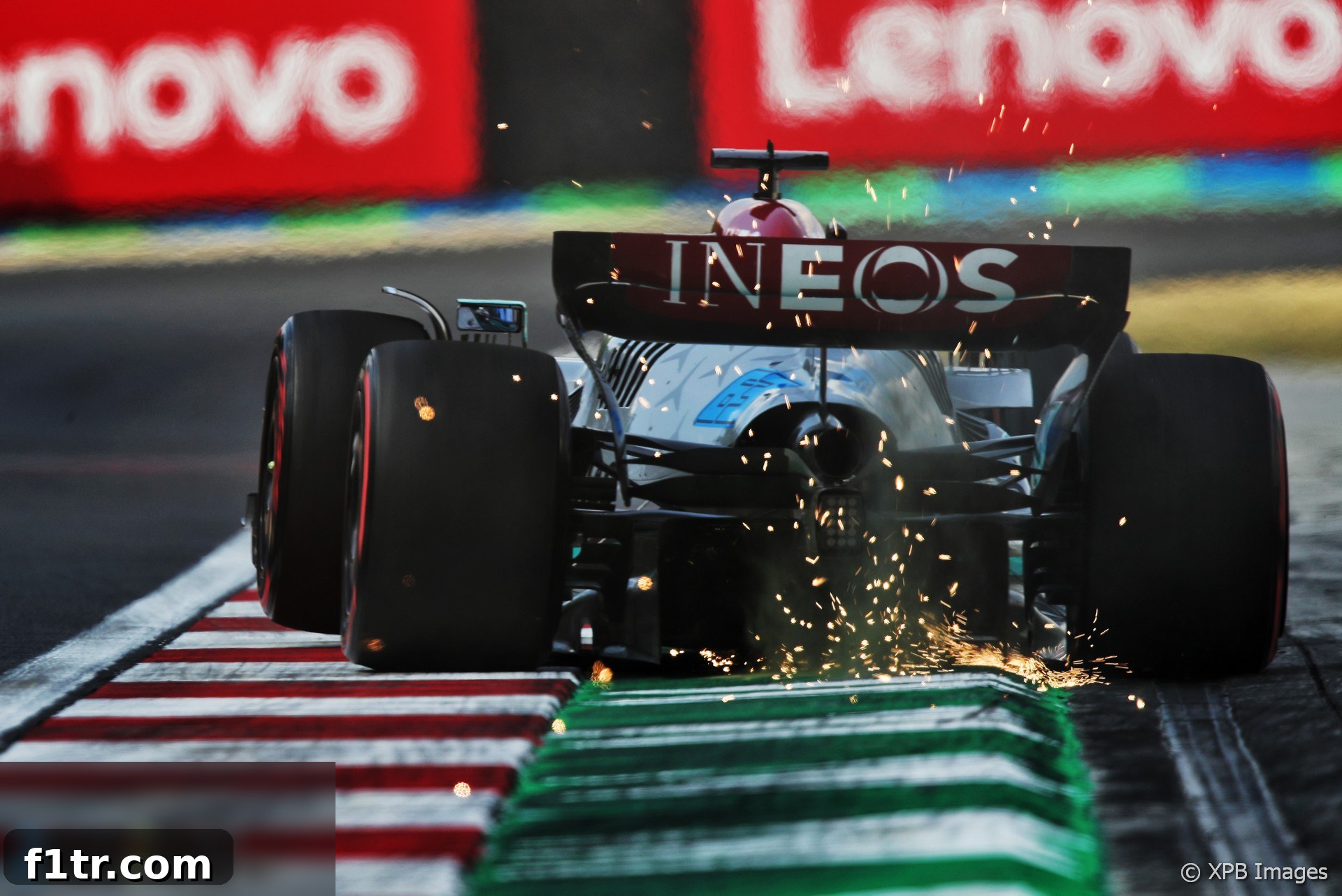
In the high-stakes world of Formula 1, where engineering prowess meets unparalleled speed, driver safety remains a paramount concern. A critical debate has emerged around the phenomenon known as ‘porpoising’, with Mercedes team principal Toto Wolff asserting that the FIA has compelling medical data necessitating immediate action to mitigate its effects. This comes as the sport’s governing body, the FIA, signals its intent to introduce technical adjustments to next year’s cars, specifically aimed at reducing the severe bouncing experienced by drivers, citing unequivocal safety grounds.
Advert | Become a Supporter & go ad-free
Understanding Porpoising: A Return to F1’s Past
The term ‘porpoising’ refers to the rhythmic, high-frequency oscillation of the car’s aerodynamic platform, causing it to violently bounce up and down at high speeds. This phenomenon, largely dormant for decades, made a dramatic return with the introduction of new ground-effect aerodynamic regulations in the 2022 season. These regulations, designed to promote closer racing by shifting aerodynamic reliance from complex top-body elements to underfloor tunnels, inadvertently reintroduced an old problem that plagued F1 cars in the late 1970s and early 1980s.
At its core, porpoising occurs when the airflow under the car’s floor, which generates significant downforce, repeatedly stalls and reattaches. As the car gains speed, the downforce pulls it closer to the ground, increasing the efficiency of the underfloor aerodynamics. However, if the car gets too low, the airflow can separate or ‘stall’, leading to a sudden loss of downforce. This causes the car to rise, re-establishing the airflow and downforce, which then pulls it back down, restarting the cycle. The result is a violent bouncing motion that can be incredibly uncomfortable and, as the FIA argues, dangerous for the drivers.
The FIA’s Stance: Prioritizing Driver Well-being
The FIA’s commitment to driver safety is enshrined in its mandate, and it has consistently intervened to implement measures deemed necessary for the well-being of competitors. In the context of porpoising, the FIA has explicitly stated that the problem “is considered to be a significant safety matter.” This declaration is crucial because it allows the governing body to push through technical changes without requiring a consensus vote from the teams, bypassing the often-contentious political landscape of Formula 1.
Toto Wolff, a vocal proponent of these changes, has revealed that the FIA possesses compelling medical evidence supporting their stance. “The FIA has commissioned medical work on the porpoising. The outcome, the summary of the doctors, is that a frequency of one to two hertz, sustained over a few minutes, can lead to brain damages. We have six to seven hertz over several hours,” Wolff stated emphatically. This stark comparison highlights the potential for long-term health consequences for drivers subjected to such extreme and prolonged vibrations. The continuous jolting and G-forces absorbed by the drivers’ bodies, particularly their spines and heads, raise serious concerns about neurological damage, fatigue, and the ability to maintain full concentration during races, which is critical at speeds exceeding 300 km/h.
Wolff further emphasized the need for pre-emptive action. While acknowledging that porpoising concerns may have temporarily subsided in recent races, he attributes this to the specific characteristics of the tracks visited. “I still fundamentally believe that there is no choice for the FIA and for us to do something because I don’t want to have it back in Spa or in some of the later races where the track is not as smooth as on a conventional race track and we haven’t done anything and people say, ‘well, now it’s too late’,” he explained. His argument underscores that reliance on track-specific conditions for mitigating porpoising is not a sustainable or responsible solution, and that systemic changes are necessary to protect drivers across the diverse F1 calendar.
Advert | Become a RaceFans supporter andgo ad-free
Team Opposition: Performance vs. Regulation
Despite the FIA’s safety declaration, the proposed technical changes have met with significant resistance from some quarters, most notably from Red Bull Racing team principal Christian Horner. Horner last week openly “disputed it is a safety issue” and maintained that the problem could be managed through specific car setup adjustments. “I think that it’s down to a team how it chooses to operate its car,” he argued. “You can remove the porpoising very easily but that’s at the sacrifice of performance.”
Horner’s core argument pivots on the premise that teams have the autonomy and capability to address porpoising within their current technical frameworks, albeit at a cost to outright speed. He believes that the FIA’s intervention oversteps its bounds, implying that it crosses into regulating competitiveness rather than strictly safety. “Therefore it’s not the duty of the FIA to ensure that a team is competitive. Otherwise we’d have had engine [balance of performance rules] over the last 10 years,” he quipped, drawing a parallel to a controversial area of motorsport regulation.
The Red Bull principal also expressed skepticism about the FIA’s motivation for invoking safety, suggesting it might be a strategic maneuver to bypass the usual legislative processes. “I think safety is a very easy card to stand behind because theoretically it’s not then subject to a Commission or World Council vote,” Horner pointed out. He further cautioned against extreme measures, stating, “I think something can be done but I think that it just needs to be sensible. The numbers that have been discussed are just way too extreme compared to the reality of what probably could be done.” This highlights a concern among some teams that the proposed changes might be overly prescriptive or drastically alter the competitive landscape, potentially penalizing teams that have effectively managed porpoising through their own design philosophies.
The underlying tension here is the delicate balance between ensuring a safe competitive environment and preserving the principle of engineering freedom and competitive advantage. Teams like Red Bull, which have arguably managed to control porpoising more effectively than others while delivering championship-winning performance, view mandatory technical directives as potentially undermining their hard-earned advantages.
Advert | Become a RaceFans supporter andgo ad-free
The Path Forward: Navigating Safety, Sport, and Strategy
The FIA’s planned interventions for 2023 include measures such as increasing the floor edge stiffness, raising the floor edges by 25mm, and refining oscillation measurement protocols to ensure cars remain within acceptable bouncing limits. These changes are intended to tackle the root causes of porpoising and bouncing, aiming to create a safer environment for all drivers without drastically altering the core ground effect philosophy of the current regulations.
This ongoing debate underscores the inherent complexities of regulating a sport at the pinnacle of automotive engineering. While the FIA is undoubtedly committed to driver safety, as evidenced by its historical track record of implementing significant safety advancements, teams are equally focused on maximizing performance within the rules. The competitive nature of F1 means that any regulation change, even those driven by safety, will inevitably be viewed through the lens of its impact on the pecking order.
Ultimately, the FIA’s determination, supported by medical evidence and the unequivocal backing of influential figures like Toto Wolff, suggests that significant technical adjustments to address porpoising are indeed on the horizon for the 2023 season. While Christian Horner and other dissenting voices will continue to advocate for a more measured approach, the safety card, when played by the FIA with credible medical data, often trumps other considerations. The resolution of this debate will not only shape the technical landscape of Formula 1 in the coming years but also serve as another testament to the sport’s perennial challenge: balancing groundbreaking innovation with an unyielding commitment to driver well-being.
Related Formula 1 Insights
- How many victory chances did Hamilton have in his first winless F1 season?
- Aston Martin expect rivals will copy novel rear wing by Singapore GP
- Transcript: Why Ferrari told Leclerc ‘the hard is worse than expected’ but still used it
- What made Verstappen’s 10th-to-first win in Hungary a rare achievement
- Gasly pleased FIA is considering “different options” for track limits policing in 2023
Browse all 2022 Hungarian Grand Prix articles